

IRS Notice CP13: Why Is My Balance Zeroed Out?

IRS Notice CP13 is a notice the IRS sends to a taxpayer to inform them that one or more math-related mistakes on their tax return have been corrected — but they neither owe the IRS money, nor does the IRS owe them a refund.
Here is a redacted Notice CP13 that the IRS sent to one of our clients.
Table of Contents
IRS Notice CP13 At a Glance
| Notice Type: | Math Error Notice |
| Generated By: | IRS IMF |
| Preceded By: | Filing of Individual Income Tax Return |
| Recommended Action: | Review Notice for Accuracy |
Free Consultation
Got a CP13 notice? Get a straight answer before you respond.
Talk to a tax expert — free, no obligation. We’ve resolved over $20 million in IRS debt for our clients.
IRS Notice CP13 Explained, Part by Part
Here is a full explanation of the Notice CP13, part by part.
Part 1: Amount Due and Billing Summary
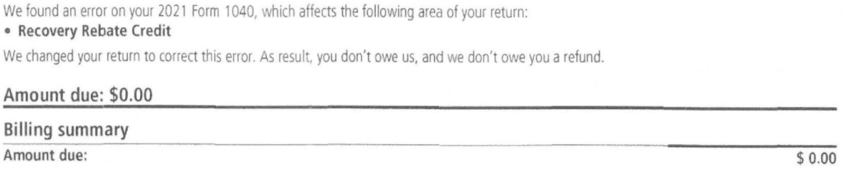
The letter will open with a notice telling you that there was an error with your tax return.
As a result, the corrected return now reflects a balance of $0.00.
You do not owe the IRS anything, and the IRS does not owe you a refund.
It will tell you which part (or parts) of your return were corrected.
In this case, it was the amount of the Recovery Rebate Credit.
Part 2: Why The IRS Changed Your Information

Next, the IRS will tell you why it changed your information.
In this case, it’s relating to the Recovery Rebate Credit.
The IRS will provide a number of reasons for the correction.
In this case, they are:
- The social security number of one or more dependents was missing or incomplete.
- The last name of one or more dependents does not align with IRS records.
- One or more of the listed dependents exceeds the age limit of when one can be claimed as a dependent.
- Your adjusted gross income $75,000. If you’re married and filing jointly, then the gross income is $150,000. If you’re the head of household, the number is $112,500.
- The amount of the recovery rebate credit was computed incorrectly.
Only one or more of these reasons need to be met for the IRS to recalculate your return.
If you believe there is an error, you can contact the IRS and dispute it.
Part 3: What The IRS Needs You To Do Right Now
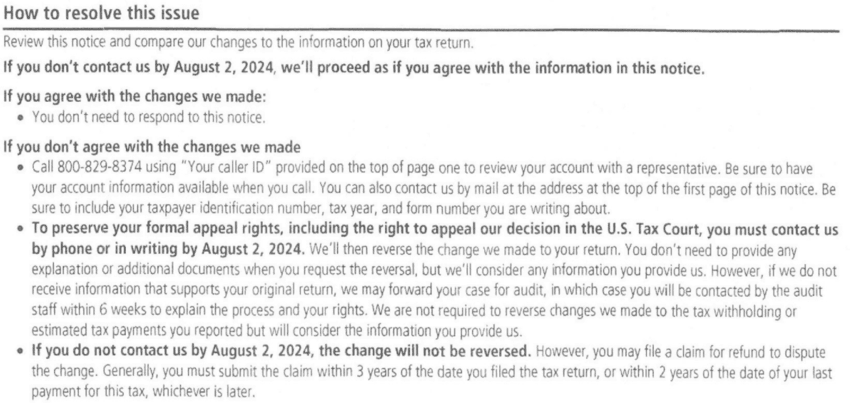
Then, the IRS will tell you how to resolve this issue.
You will have about 60 days from the date of the notice to respond to the notice.
If you have no issues with the notice, then you can keep it for your records and ignore it.
If there is something you don’t agree with the changes the IRS made, then call them at the provided number.
You will need to do so by the due date, either by communicating by phone or mailing them at the provided address.
If you do so within the due date, the reversal will be made to your account.
While you don’t have to provide any additional documents, the IRS will consider anything you do provide.
If you choose not to provide any information, the IRS can and will forward your case for audit.
If the deadline passes, then the changes will not be reversed.
However, you may file a claim for a refund to dispute the change as long as it’s within 3 years of the date of the filed tax return or 2 years from the date of your last payment.
The IRS will honor whatever comes later.
Part 4: Your Tax Calculations

Then the IRS will give you a breakdown of your tax calculations.
It will pull from specific lines on your tax return and compare your calculations to the IRS calculations.
Specifically, it will pull from the adjusted gross income and taxable income to calculate your total tax.
Part 5: Payments and Credits

Then, the IRS will provide a breakdown of your payments and credits.
Any payments made or credits to your account will be totaled and applied to your account as a deduction from the total tax that you owe.
Part 6: Taxpayer Rights and Sources for Assistance

Lastly, the IRS will provide you with some resources for additional help and assistance.
It will provide you with descriptions of the Taxpayer Rights and Sources for Assistance, breaking down the services they provide.
There’s a list of the taxpayer bill of rights online, free for anyone to access.
It’s important to review them so you know what your fundamental rights are.
The IRS also provides a Taxpayer Advocate Service (TAS) to protect taxpayer rights.
It operates independently, but it works to help you in your communication with the IRS.
There’s also a sub-section for low-income taxpayers or English learners, providing more resources you’re fully in your rights to use.
What You Should Do If You Receive a CP13
Below are steps for you to take after you receive a CP13 Notice from the IRS.
Step 1: Confirm Everything Is Correct
The first thing you should do is to ensure the IRS’s corrections are correct.
The IRS is telling you that there was an error, and you have a zero balance.
Is this correct?
Do you actually meet one of your qualifications?
Look at your CP13 Notice closely.
If everything looks right, then you can put your mind at ease.
However, if there is an error, contact the IRS as soon as you can.
Step 2: Dispute the Charges if the IRS is Wrong
If there is an indisputable error in your CP13 Notice, contact the IRS as soon as possible.
The best way to do so is through the provided phone number.
You will have about 60 days to say something, or else the IRS will refuse to make additional changes.
If you call the IRS, then provide any additional information to dispute the changes.
If you don’t have any additional information to provide, prepare for the IRS to send your account for an audit.
Make sure you dispute the charges within the time frame.
The process likely won’t be easy, which is why we provide this service for our clients.
Step 3: If Everything Is Correct, Say Nothing
If everything is correct, then you can ignore the notice and proceed as normal.
No further action is required from you.

“Choice Tax Relief was outstanding in helping us prepare our taxes. Their team was incredibly responsive — quick to return calls and emails — and consistently offered thoughtful, strategic suggestions that made the process smooth and stress-free.”
Get Help Now
Got a CP13 notice? Get a straight answer before you respond.
Talk to a tax expert — free, no obligation. We’ve resolved over $20 million in IRS debt for our clients.


Author:

Logan Allec, CPA, Founder and Owner
Logan Allec has been serving taxpayers as a CPA for over 14 years. After leaving his role at a "Big 4" firm, he started Choice Tax Relief to help everyday Americans who have found themselves behind on their taxes. He also educates thousands of people daily about tax relief on his YouTube channel. In addition to his CPA license, Logan also has a Master's Degree in Taxation from the University of Southern California (USC). He lives with his wife and children in the Los Angeles area. Learn more about Logan here.