

IRS Notice CP71H Explained: What It Is and What To Do

IRS Notice CP71H is the Annual Reminder of the Shared Responsibility Payment (SRP) that the IRS sends to taxpayers with unpaid SRP amounts.
The SRP is the “Obamacare penalty” imposed on taxpayers who lacked minimum essential healthcare coverage for one or more tax years between 2014 and 2018.
Notice CP71H is tax-year-specific, so you may receive multiple CP71H notices if you owe the IRS the SRP for multiple tax years.
The IRS sends this notice because it is legally required to under Internal Revenue Code Section 7524, which states:
“Not less often than annually, the Secretary shall send a written notice to each taxpayer who has a tax delinquent account of the amount of the tax delinquency as of the date of the notice.”
Here is a Notice CP71H that the IRS sent to one of our clients.
Table of Contents
IRS Notice CP71H At a Glance
| Letter Type: | Annual Reminder to Individual |
| Generated By: | IRS Service Center |
| Recommended Action: | Pay Balance or Enter Into Resolution With ACS or Revenue Officer |
Free Consultation
Got a CP71H notice? Don’t wait for the IRS’s next move.
Talk to a tax expert — free, no obligation. We’ve resolved over $20 million in IRS debt for our clients.
IRS Notice CP71H Explained, Part by Part
Here is a full explanation of the Notice CP71H, part by part.
Part 1: Amount Due and Billing Summary
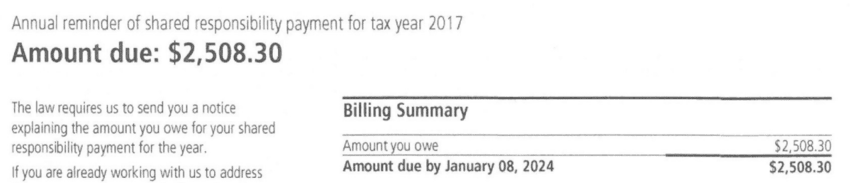
On the first page of the Notice CP71H, the IRS tells you how much SRP they believe you owe for the year to which this particular notice pertains.
There will also be a billing summary, breaking down how much you owe and giving you a due date for the payment.
The IRS cannot charge the typical late payment penalties on the SRP, so you won’t see a line for penalties here.
Part 2: Payment Coupon
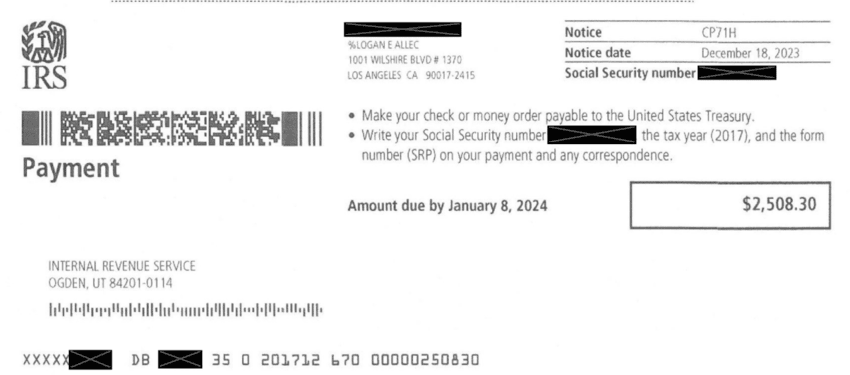
Next, in your CP71H Notice, the IRS provides you with a payment coupon if you want to and are able to pay off your SRP for this particular tax year in a single lump sum.
It’s important to note that if you can only pay off some years and not others, and remember each year has its own CP71H form, it may be wise to pay off some tax years before others.
The IRS isn’t going to tell you this — instead, they will push for everything to be paid off by their specific deadlines.
Part 3: What the IRS Wants You to Do Now
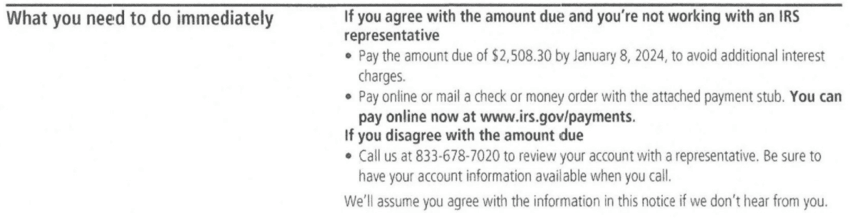
Then, the IRS will tell you to immediately pay off your balance.
They’ll then direct you back to the payment coupon or their website if you prefer digital payments.
Obviously, if you qualify for a hardship or some other beneficial tax relief program, you would not necessarily have to pay off your entire balance in full.
Part 4: What You Need to Know

The IRS will then give you the reason it sent you the CP71H Notice — because the IRS believes you still owe an SRP for the tax year of the notice, since you did not have minimum essential healthcare for that year.
Interestingly, the IRS cannot take the collection activities against you for the SRP that it could typically take against you for a normal tax liability; that is, the IRS cannot perform the following things against you for an SRP:
- filing a Notice of Federal Tax Lien against you
- levy you
- assess the failure-to-pay penalty against you
That said, the IRS may still charge interest on your outstanding SRP balance.
Part 5: Payment Options


Then, the IRS once again urges you to pay them, providing you with information about how to do so.
It also provides you with several options you can explore if you can’t pay your balance in full by the deadline.
These tax relief options include:
- Installment Agreement: Also known as a “pay over time.” An installment agreement allows you to pay your tax debt off over time through an agreement with the IRS. Even though the IRS wants to be paid as quickly as possible, long-term options are available to be negotiated.
- Offer in Compromise: An offer in compromise allows you to settle your tax debt for less than you owe in a lump sum paid within five or 24 months through an agreement with the IRS. It’s not always guaranteed, but it’s an effective option if you need to buy a bit of time.
- Currently Not Collectible (CNC) Status: Also known as a “temporarily delay collection.” The CNC status, also known as the IRS hardship program, is an agreement with the IRS that protects you from government actions regarding forced collection activities, such as a wage garnishment, bank levy, or Social Security levy against you.
Part 6: If The IRS Doesn’t Hear From You

The IRS will continue to send you notices until the payment is collected or the SRP assessment drops off due to the IRS’s 10-year collections statute of limitations.
Part 7: Additional Information
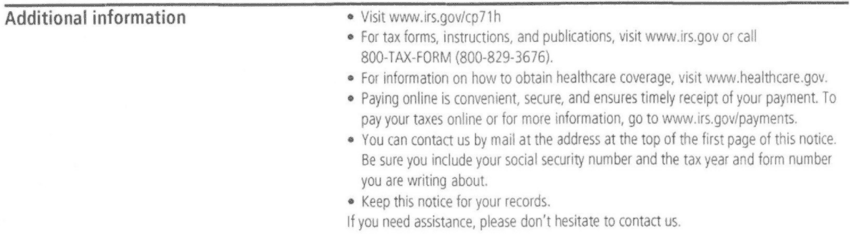
Finally, at the end of the CP71H Notice, the IRS provides some additional information, such as:
- The official IRS webpage for the CP71H Notice
- Where you can obtain tax forms and other IRS documents
- Where you can obtain healthcare coverage
- Where and how you can give payments to the IRS
- How to contact the IRS
What to Do If You Received Notice CP71H From the IRS
Below are the steps to take if you receive a CP71H Notice.
1. Ensure You Actually Owe The IRS
Sometimes, the IRS makes mistakes.
Ensure that you are actually deserving of the notice.
If you have already sent the payment, or do not believe you owe the SRP for the year of the CP71H notice, but still received a CP71H, contact the IRS.
2. Pay Off Your Balance
As obvious as it seems, if you are within your means to do so, pay off your balance.
It’s the fastest and easiest way to get the IRS off your back.
3. Negotiate With The IRS
If you cannot pay off your debt, then consider entering into one of the aforementioned agreements.
It’s the best way to protect yourself and your assets while still showing the IRS that you care and are aware of their notices.
Your options include:
- Entering into an installment agreement with the IRS to pay off your debt or a portion of it over time.
- Convince the IRS that you can’t pay them anything right now, since it would cause significant financial hardship, and get your account placed into the currently not collectible (CNC) status
- Submit an offer in compromise to the IRS to settle your tax debt for less than you owe
If you’d like more information about any of these tax relief options, be sure to check out our article explaining what tax relief is or watch the video below to learn about the IRS forgiveness program.

“Choice Tax Relief was outstanding in helping us prepare our taxes. Their team was incredibly responsive — quick to return calls and emails — and consistently offered thoughtful, strategic suggestions that made the process smooth and stress-free.”
Get Help Now
Got a CP71H notice? Don’t wait for the IRS’s next move.
Talk to a tax expert — free, no obligation. We’ve resolved over $20 million in IRS debt for our clients.


Author:

Logan Allec, CPA, Founder and Owner
Logan Allec has been serving taxpayers as a CPA for over 14 years. After leaving his role at a "Big 4" firm, he started Choice Tax Relief to help everyday Americans who have found themselves behind on their taxes. He also educates thousands of people daily about tax relief on his YouTube channel. In addition to his CPA license, Logan also has a Master's Degree in Taxation from the University of Southern California (USC). He lives with his wife and children in the Los Angeles area. Learn more about Logan here.