

IRS Notice CP79: What It Is and How to Claim Your Credits Again

If you claimed the Child Tax Credit or the Earned Income Tax Credit and the IRS took it back, Notice CP79 is the letter that explains what that decision means for every tax return you file from here on.
The notice is a single page, and the first thing it tells you is that you don’t need to do anything right now.
That sentence is true in a narrow sense and badly misleading in every other sense.
Here is a redacted CP79 notice that one of our clients received (PDF).
Important: A CP79 is not a ban. The notice mentions a two-year ban and a ten-year ban, but those paragraphs describe what could happen if the IRS audits you again in the future — they are not describing anything that has already happened to you. If the IRS had actually banned you, you would have received Notice CP79A or Notice CP79B instead.
Key Takeaways
- What it is: Notice CP79 tells you the IRS denied or reduced one or more credits — the Earned Income Credit, Child Tax Credit, Additional Child Tax Credit, Credit for Other Dependents, or American Opportunity Tax Credit — after examining the tax year shown on the notice.
- It is not a ban: A CP79 by itself only means that from now on you must attach Form 8862 to any return on which you claim those credits again.
- Where the bans actually live: The two-year and ten-year bans described on the notice are warnings about a future audit, and when the IRS imposes one it uses a different notice, CP79A or CP79B.
- When Form 8862 applies: The form is required only when the credit was disallowed through an examination, not when it was corrected as a math or clerical error.
- The cost of skipping it: If you leave Form 8862 off a later return, the IRS can strip the credit out summarily under its math error authority without ever opening an audit.
- If the IRS got it wrong: Audit reconsideration lets you reopen the closed examination and submit the documentation the IRS never saw.
Table of Contents
What Is IRS Notice CP79?
Notice CP79 is the letter the IRS sends after it examines a return and disallows one or more of the family and education tax credits you claimed on it.
The notice does two things at once.
It confirms which credits were denied or reduced for the year the IRS looked at, and it puts a condition on your future returns.
That condition is Form 8862, Information to Claim Certain Credits After Disallowance.
From the moment a CP79 is issued, the IRS will not allow you to claim the listed credits again until you file that form and show that you now meet the rules.
The credits that can trigger a CP79 are:
- Earned Income Tax Credit (EIC or EITC)
- Child Tax Credit (CTC)
- Additional Child Tax Credit (ACTC), the refundable portion of the CTC
- Credit for Other Dependents (ODC)
- American Opportunity Tax Credit (AOTC), the partially refundable education credit
The notice one of our clients received lists two of those groupings: the CTC, ACTC, or ODC on one line, and the Earned Income Tax Credit on another.
Behind the notice, the IRS sets what it internally calls a recertification indicator on your account, and that indicator is what causes the credits to be blocked until Form 8862 arrives.
The rule comes from the tax code itself rather than from IRS policy.
Internal Revenue Code section 32(k)(2) says that a taxpayer denied the Earned Income Credit through the deficiency procedures gets no credit in any later year “unless the taxpayer provides such information as the Secretary may require to demonstrate eligibility for such credit.”
Treasury Regulation section 1.32-3 names Form 8862 as that information and confirms the requirement is triggered only when the credit is “assessed as a deficiency (other than as a mathematical or clerical error under section 6213(b)(1)).”
The Protecting Americans from Tax Hikes Act of 2015 extended the same machinery to the child and education credits, which now live in Internal Revenue Code sections 24(g) and 25A(b)(4).
On the procedural side, the IRS handles this work under IRM 4.19.14, Refundable Credits Strategy, with the recertification and ban rules at IRM 4.19.14.7.
Free Consultation
Got a CP79 notice? Get a straight answer before you respond.
Talk to a tax expert — free, no obligation. We’ve resolved over $20 million in IRS debt for our clients.
IRS Notice CP79 at a Glance
| Notice name | Notice CP79, “We denied or reduced one or more of the credits claimed on your tax return” |
| What it means | The IRS examined the tax year shown and disallowed or reduced one or more family or education tax credits |
| Credits involved | EIC, CTC, ACTC, ODC, and the American Opportunity Tax Credit |
| Action required now | None on this notice by itself, unless you disagree with the disallowance |
| Action required later | Form 8862 must be attached to the next return on which you claim the credits |
| Is it a ban? | No — bans arrive on Notice CP79A (two years) or Notice CP79B (ten years) |
| Legal authority | IRC § 32(k)(2), § 24(g), and § 25A(b)(4); Treas. Reg. § 1.32-3 |
| Related notices | CP75 and CP75A (the examination), CP79A and CP79B (bans), CP74 (successful recertification) |
CP79 vs. CP79A vs. CP79B
The single most common panic reaction to a CP79 comes from the paragraph near the bottom that mentions a two-year ban and a ten-year ban.
Read that paragraph again slowly, because it is written in the conditional.
It says that if the IRS audits a future return and denies the credits again, it could impose a ban.
The IRS uses three different notice numbers precisely so that the difference is visible on the page, and the number printed in the upper-right corner of your notice tells you which situation you are actually in.
| Notice | What the IRS Determined | What It Means for Your Credits |
|---|---|---|
| CP79 | The credits were denied or reduced, with no finding of reckless disregard or fraud | You may claim them again on any future return, but you must attach Form 8862 |
| CP79A | A final determination that the claim was due to reckless or intentional disregard of the rules | You cannot claim the credits for two tax years, and Form 8862 is required on the first return after the ban ends |
| CP79B | A final determination that the claim was due to fraud | You cannot claim the credits for ten tax years, and Form 8862 is required on the first return after the ban ends |
A plain CP79 means the IRS disagreed with your claim but did not conclude that you were reckless or dishonest about it.
A CP79A means the IRS made a final determination that the claim came from reckless or intentional disregard of the rules, which under Internal Revenue Code section 32(k)(1)(B)(ii) triggers a disallowance period of two tax years.
A CP79B means the IRS made a final determination of fraud, which under section 32(k)(1)(B)(i) triggers ten tax years.
The distinction matters enormously, because a CP79 costs you one extra form and a CP79A or CP79B costs you thousands of dollars in credits you cannot claim at all.
Why Did I Get IRS Notice CP79?
A CP79 always follows an examination of the year listed on the notice, so something in that year’s return did not hold up.
The reasons we see most often are:
- The IRS could not verify that a child you listed met the relationship, age, or residency tests for the credit
- Two people claimed the same child, and the IRS applied the tiebreaker rules against you
- A Social Security number or ITIN for you, your spouse, or a dependent was missing, invalid, or not issued by the due date of the return
- Your reported income or filing status did not support the credit at the amount you claimed
- You never responded to the earlier audit letter, so the IRS closed the examination by disallowing the credit by default
That last reason deserves its own sentence, because it is the one most people do not realize applies to them.
A credit examination normally opens with Notice CP75 or CP75A asking you to send documents proving the child lived with you and is related to you.
If that letter went to an old address, or arrived while you were moving, or simply got lost in a stack of mail, the IRS never hears back and disallows the credit without ever seeing your evidence.
The CP79 is then the first letter you actually read, which is why so many people receiving one are certain they qualified.
A Walkthrough of IRS Notice CP79
Below is a section-by-section walkthrough of the redacted CP79 our client received, so you can find the same information on your own copy.
Part 1: The Notice Header

The block in the upper-right corner is the fastest way to confirm what you are holding.
It shows the notice number, the tax year the IRS examined, the notice date, the last digits of the Social Security number on the account, and a phone number.
On this notice the number is CP79, the tax year is 2022, and the notice date is October 30, 2023.
Notice that the tax year and the notice date are almost a year and a half apart, which is normal for credit examinations and is a good reminder that the year under review is often not the year you just filed.
The phone number printed here is 800-829-0922, which reaches the IRS collection and account line rather than the examiner who made the decision.
Part 2: Who the Notice Was Sent To

The taxpayer’s name has been blacked out in the copy shown here, but the address underneath it has not.
This notice was addressed in care of Logan Allec at the Choice Tax Relief office, which is why the firm’s address appears in the mailing window instead of the client’s.
The marking “CAF 9H” in the header block is the giveaway: this is a representative’s copy, generated because the client had a power of attorney on file with the IRS.
If you have a representative on file, both of you should receive a copy, and if only one of you did it is worth checking that the Form 2848 on file is still current.
Part 3: The Headline

The headline is deliberately broad: “We denied or reduced one or more of the credits claimed on your tax return.”
Denied and reduced are very different outcomes, and the headline will not tell you which one happened to you.
The amount actually changed on your account appears on a separate notice, usually a CP21 or CP22 adjustment notice or a balance-due notice, not on the CP79.
Part 4: Which Credits the IRS Denied
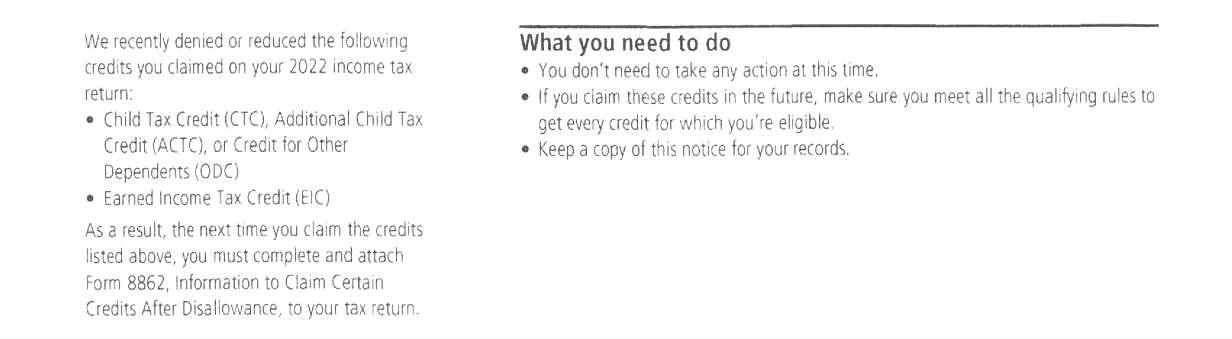
The left column lists the credits that were denied or reduced and states the consequence in a single sentence: the next time you claim them, you must complete and attach Form 8862.
The right column is the part that causes the trouble.
“You don’t need to take any action at this time” is accurate only if you agree with the IRS that you were not entitled to the credits.
If you believe you did qualify, the CP79 is your notice that a decision has already been made against you, and doing nothing lets that decision stand.
Part 5: Claiming the Credits on Future Returns
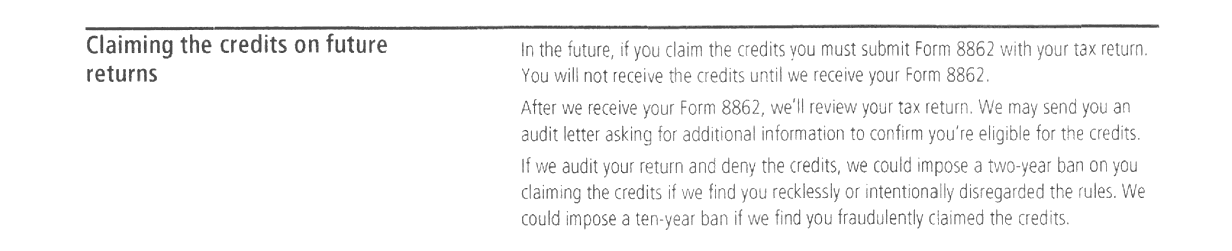
This section spells out the mechanics and quietly contains the most useful sentence on the page.
“You will not receive the credits until we receive your Form 8862” means the form is a precondition, not a formality you can send in later.
The section also warns that after the IRS receives the form it may send an audit letter asking for more information, which is the IRS telling you in advance that a post-CP79 return gets a closer look than an ordinary one.
The final paragraph is where the two-year and ten-year bans are described, in the conditional, as consequences of a future audit.
Part 6: Additional Information

The last section points you to irs.gov/cp79 and to three publications.
One of those references has not been valid for years.
Tip: The notice suggests reading Publication 972, Child Tax Credit. The IRS made Publication 972 obsolete after tax year 2020, and the page it used to live on now says exactly that. Child Tax Credit guidance moved into the Instructions for Schedule 8812 (Form 1040), which is where you should look instead. The other two publications the notice lists — Publication 596 for the Earned Income Credit and Publication 970 for education benefits — are both still current.
What Form 8862 Actually Asks You
Form 8862 is short, and its length is misleading, because a wrong answer on it is a statement made under penalty of perjury on your tax return.
The current version is the December 2025 revision, and it is organized into four parts.
- Part I asks every filer for the tax year and a checkbox for each credit being claimed
- Part II covers the Earned Income Credit, with one section for claims involving a qualifying child and a separate section for childless claims
- Part III covers the Child Tax Credit, Additional Child Tax Credit, and Credit for Other Dependents, focusing on residency and dependency
- Part IV covers the American Opportunity Tax Credit, including whether the student was enrolled at least half time and whether the four-year limit has been used up
You complete only the parts that correspond to the credits you are claiming.
The questions track the exact tests the IRS decided you failed, which is why the form is worth filling out with your documentation in front of you rather than from memory.
When You Do Not Need to File Form 8862
The requirement is narrower than the notice makes it sound, and there are four situations where Form 8862 is not required.
- The credit was reduced or removed as a math or clerical error rather than through an examination, which is the exception written into Treasury Regulation section 1.32-3(b)
- You already filed Form 8862 after a previous disallowance, the credit was allowed, and it has not been disallowed again since
- You are claiming the Earned Income Credit with no qualifying child, and the only reason the credit was disallowed before was that a child you listed was not in fact your qualifying child
- You are inside a two-year or ten-year ban period, in which case the credit is not available to you at all and the form does not unlock it
The third exception is the one worth reading twice.
If your CP79 was issued because a child did not qualify, you can still claim the childless version of the Earned Income Credit without Form 8862, provided you meet the other requirements in Publication 596.
Still have questions? Talk to a tax expert — free.
How to Respond to IRS Notice CP79
Even though the notice says no action is required, there are five things worth doing while the notice is in front of you.
- Confirm the notice number in the upper-right corner is CP79 and not CP79A or CP79B, because that single letter determines whether you are facing a form requirement or a multi-year ban.
- Pull the return for the tax year listed and work out why the credit was denied, since the CP79 itself never tells you the reason.
- Order your account transcript and wage and income transcript for that year at irs.gov/account, which will show the examination adjustment and any balance the disallowance created.
- Gather the proof you would need to show the child lived with you and is related to you, including school records, medical records, lease or utility documents, and letters from a childcare provider or clergy member.
- Decide whether you are accepting the disallowance or challenging it, and calendar the deadline for whichever path you choose.
If you are accepting it, file Form 8862 with the next return on which you claim the credits and keep a copy of the CP79 with your records.
If you are challenging it, move quickly, because the practical value of a challenge shrinks as the refund statute of limitations runs.
What Happens If You Skip Form 8862
Leaving Form 8862 off a later return does not start an argument with the IRS.
It ends one before it begins.
Treasury Regulation section 1.32-3(d) provides that when a taxpayer subject to the recertification requirement fails to attach the form, the IRS can deny the credit as a mathematical or clerical error under Internal Revenue Code section 6213(g)(2)(K).
Math error authority is a shortcut that lets the IRS assess the tax without issuing a notice of deficiency first, which means no Tax Court petition and no audit.
You would still be able to request abatement within 60 days of the math error notice, but you would have to catch the notice and act on it.
The simpler outcome is that the credit is stripped out of your refund and you find out weeks later when a smaller deposit arrives than you were expecting.
Can You Challenge the Disallowance?
Yes, and the route is audit reconsideration.
Audit reconsideration is the process for asking the IRS to reopen an examination it has already closed, and it is described in Publication 3598 and administered under IRM 4.13.1.
You use it when you have documentation the IRS never saw, which is exactly the position of a taxpayer whose CP75 letter never reached them.
To request it, you send a written request to the office that issued the adjustment, along with copies of the records that establish the child’s relationship, age, and residency for the year in question.
Form 886-H-EIC is the IRS’s own checklist of acceptable documents, and building your package around it is the single most effective thing you can do to get a reconsideration granted.
There is also a less well-known route out of a ban.
The instructions to Form 8862 state that a taxpayer who wants to contest a two-year or ten-year ban may file the form during the ban period and mail the return rather than e-filing it.
The point of mailing it is procedural: the paper return forces the IRS to work the claim through the deficiency process, which produces a statutory notice of deficiency you can petition to the United States Tax Court.
That is a genuine appeal to a judge rather than a request that the IRS reconsider its own decision.
What Happens After You File Form 8862
Once the IRS receives an acceptable Form 8862, it releases the recertification indicator and processes the credit.
Two timing rules are worth knowing before you count on the money.
The IRS cannot issue any refund on a return claiming the Earned Income Credit or the Additional Child Tax Credit before mid-February, and that hold applies to your entire refund rather than just the credit portion.
On top of that, a return carrying a Form 8862 may be routed for additional review, which can add weeks even when everything is in order.
If the credit is allowed and you had been through an Earned Income Credit recertification, the IRS closes the loop with Notice CP74 confirming that you have successfully recertified and that you will not need Form 8862 again unless the credit is disallowed a second time.
Getting Help With a CP79 Notice
A CP79 usually means the IRS made a decision about your family without ever hearing your side of it.
If you believe you were entitled to the credits, the proof is often already sitting in your school records, your lease, and your child’s medical file.
Our licensed tax professionals can pull your IRS transcripts for the examined year, work out exactly which test the IRS says you failed, and handle either the Form 8862 filing or the audit reconsideration package that gets your credits back.
Call 866-8000-TAX or schedule a free consultation to talk it through with someone who has done this before.

“I was initially skeptical reaching-out to any company that provided back-tax relief assistance, but Choice Tax gave me confidence in their abilities from the first call we had. They were very empathetic to my personal reasons of being behind.”
IRS Notice CP79 FAQs
Is Notice CP79 an audit?
No, the CP79 is the letter that closes out an examination rather than the letter that opens one. A credit examination normally begins with Notice CP75 or CP75A asking you to send documents proving a child’s relationship, age, and residency. The CP79 tells you how that examination came out, which is why many people who receive one never realized they were under examination at all.
Does Notice CP79 mean I am banned from claiming the Child Tax Credit?
No. A plain CP79 imposes no ban whatsoever — it only requires Form 8862 the next time you claim the credit. Bans are issued on separate notices: CP79A for a two-year ban and CP79B for a ten-year ban. Check the notice number printed in the upper-right corner of your letter, because that single letter is the difference between one extra form and years of lost credits.
Do I have to file Form 8862 every year from now on?
No, only until the credit is allowed once. After you file Form 8862 and the IRS allows the credit without reducing or denying it, you do not need to file the form again unless the credit is disallowed a second time through another examination.
How long will Form 8862 delay my refund?
Federal law prevents the IRS from releasing any refund on a return claiming the Earned Income Credit or the Additional Child Tax Credit before mid-February, and that hold applies to your entire refund rather than just the credit. On top of that, the CP79 itself warns that the IRS may send an audit letter after it receives your Form 8862, so it is reasonable to plan for several additional weeks.
The notice says to read Publication 972, but I cannot find it. Where did it go?
Publication 972 was discontinued after tax year 2020, and the IRS now marks it obsolete. Child Tax Credit rules moved into the Instructions for Schedule 8812 (Form 1040). The CP79 notice template was simply never updated to reflect the change, so this is a dead reference rather than something you are failing to find.
Can I still get the credits for the year the IRS denied?
Possibly, through audit reconsideration. If you have documentation showing you qualified, you can ask the IRS to reopen the closed examination, and if it agrees, the credit is restored for that year. Move promptly, because the refund statute of limitations can leave you in a position where a reconsideration reduces what you owe but no longer produces a refund.
Get Help Now
Got a CP79 notice? Get a straight answer before you respond.
Talk to a tax expert — free, no obligation. We’ve resolved over $20 million in IRS debt for our clients.


Author:

Logan Allec, CPA, Founder and Owner
Logan Allec has been serving taxpayers as a CPA for over 14 years. After leaving his role at a "Big 4" firm, he started Choice Tax Relief to help everyday Americans who have found themselves behind on their taxes. He also educates thousands of people daily about tax relief on his YouTube channel. In addition to his CPA license, Logan also has a Master's Degree in Taxation from the University of Southern California (USC). He lives with his wife and children in the Los Angeles area. Learn more about Logan here.