

IRS Letter 3164-B: What It Is and What to Do Before the IRS Contacts Third Parties

IRS Letter 3164-B is the notice a revenue officer sends before contacting other people about the taxes you owe, such as your bank, your employer, your employees, or your neighbors.
It is not a bill, and it does not ask you to sign or send anything back.
What it does is start a clock.
Federal law says the IRS cannot contact anyone else about collecting your tax debt until 45 days after it sends you this notice, and the letter prints the exact date the contacts can start and the date they have to stop.
That waiting period is the best chance you will get to deal with the revenue officer directly, before your bank or your employer hears from the IRS.
Here is a redacted Letter 3164-B that one of our clients received (PDF).
Important: The letter in this article is the copy the IRS mailed to Choice Tax Relief as the client’s authorized representative, which is why it says POA Copy at the top. We blacked out the client’s name, address, and taxpayer identification number, along with the revenue officer’s name, employee ID number, phone and fax numbers, and signature.
Key Takeaways
- Letter 3164-B tells you that the IRS revenue officer collecting your balance intends to contact other people about you, such as your bank, your employer, or your neighbors.
- No one can be contacted until the 46th day after the letter date, and the contacts have to stop within one year, on dates the letter spells out.
- The IRS treats a levy sent to your bank or your employer as a third-party contact, so this letter is also part of the groundwork for a levy.
- The IRS may tell the people it contacts only what it needs to get its information, but the contact itself still tells them the IRS is interested in you.
- You can ask for a list of everyone the IRS contacted, by phone, in writing, or in person, and the IRS has to give it to you.
- The most reliable way to limit the contacts is to give the revenue officer what it needs, and propose a way to resolve the balance, before the window opens.
Table of Contents
Where Letter 3164-B Fits Among IRS Third-Party Contact Notices
Letter 3164-B is the balance due version of the IRS’s third-party contact letter, and it is one of several versions the IRS sends depending on why it wants to contact other people about you.
The table below shows how Letter 3164-B compares to the others, so you can confirm which notice you received and what it means.
| Notice | What It Is | When the IRS Sends It |
|---|---|---|
| Letter 3164-A | The third-party contact notice for a trust fund recovery penalty investigation. | When a revenue officer is investigating whether you are personally responsible for a business’s unpaid payroll taxes and intends to contact others about it. |
| Letter 3164-B | The third-party contact notice for a balance due investigation. | When a revenue officer is collecting tax that has already been assessed against you and intends to contact others, such as your bank or employer. |
| Letter 3164-P | The third-party contact notice for an investigation of the penalties for promoting abusive tax shelters or aiding and abetting an understatement of tax. | When the IRS is investigating one of those penalties and intends to contact others about it. |
| Letter 3164-W | The third-party contact notice for a transferee investigation. | When a revenue officer is looking at whether you can be made to pay someone else’s tax because you received their assets, and intends to contact others about it. |
| Letter 3164-X | The third-party contact notice for a delinquent return investigation. | When a revenue officer is pursuing tax returns you have not filed and intends to contact others about it. |
| Notice LT40 | The Advisory Notice to Taxpayer of Need to Contact Third Parties, a collection notice that also includes a billing summary of what you owe. | When the IRS intends to contact third parties, such as your bank or employer, about collecting a balance you owe. |
| Other Letter 3164 versions | The IRS uses more than twenty versions of Letter 3164 in all, including versions its examiners send during audits. | When an IRS examiner or other employee intends to contact third parties about your return or account. |
Free Consultation
Got IRS Letter 3164-B? Get a straight answer before you respond.
Talk to a tax expert — free, no obligation. We’ve resolved over $20 million in IRS debt for our clients.
What Is IRS Letter 3164-B?
Letter 3164-B is the third-party contact notice the IRS uses in balance due cases, meaning cases where it is trying to collect a tax that has already been assessed.
It comes from a revenue officer, an IRS employee who works collection cases in person instead of from a call center.
The law behind it is Internal Revenue Code section 7602(c), which bars the IRS from contacting anyone other than you about the determination or collection of your taxes unless it has warned you first.
Since August 2019, that warning has to go out at least 45 days before the contacts begin, and it has to name a period of no more than one year in which the contacts will happen.
The IRS is not supposed to send it as a formality, either, because the statute only allows the notice when the IRS actually intends to contact other people during that period.
Put simply, a Letter 3164-B means the revenue officer on your case has decided to look for information somewhere other than you.
IRS Letter 3164-B at a Glance
| Question | Answer |
|---|---|
| What is it? | Advance notice that the IRS revenue officer collecting your balance intends to contact third parties about you. |
| Who sends it? | A revenue officer in IRS field collection, named in the Person to Contact block. |
| Who might be contacted? | The letter’s examples are a neighbor, a bank, an employer, or employees, but anyone likely to have information about your income, accounts, or assets can be contacted. |
| When can contacts start? | On the 46th day after the letter date. The letter prints the exact date. |
| How long can they go on? | No more than one year from the start date, unless the IRS sends you a new notice. |
| Do you have to reply? | The letter itself asks for no reply, but the collection case behind it needs your attention. |
| Your right | A list of the third parties the IRS contacted, which you can request at any time by phone, in writing, or in person. |
| Version | Letter 3164-B (Rev. 5-2023), Catalog Number 73227V. |
Why the IRS Sent You Letter 3164-B
A revenue officer sends Letter 3164-B when they plan to get or confirm information about you from someone else.
In a balance due case, that information is usually about what you earn, where you bank, and what you own, because those are the facts an officer needs to decide how the debt gets paid.
The letter gives the reason in its second paragraph: the IRS talks to other people when it needs information you have not been able to provide, or when it wants to verify information it has already received.
That second reason matters, because it means you can get this letter even if you have been cooperating.
An officer who already has your financial statement may still want to confirm your wages with your employer or your balances with your bank.
There is a bigger reason, too.
The IRS counts a levy sent to your bank or your employer as a contact with a third party, so a revenue officer who may need to levy has to have this notice in place first.
You may also have received a Letter 725-B from the same revenue officer, which schedules a meeting and lists the records to bring.
IRS Letter 3164-B Explained, Part by Part
Here is the Letter 3164-B one of our clients received, part by part, with what each section means for you.
The letter is dated March 3, 2025, and it covers four years of individual income tax.
Part 1: The Letter Header

The top of the letter tells you who sent it and when.
This one came from the revenue officer’s office in Canton, Ohio.
The words POA Copy at the very top mean it is the copy the IRS sent to the taxpayer’s authorized representative, which in this case was our firm.
The date in the upper right, March 3, 2025, is the most important date on the page, because the 45-day waiting period counts from it.
Under the date are the last four digits of the taxpayer identification number the letter is about, which we blacked out.
If you filed jointly, expect one letter for each spouse, because the IRS sends each spouse a separate notice.
Part 2: Who the Letter Went To and Who Sent It

The left side is the taxpayer’s name and mailing address.
The right side is the Person to Contact block, which names the revenue officer assigned to the case and gives an employee ID number, a direct phone number, a fax number, and office hours.
Keep the officer’s name and ID number handy, because the letter asks you to include both if you write in.
This client’s letter lists hours of 7:00 a.m. to 3:45 a.m., which is clearly meant to be 3:45 p.m.
A letter with a named officer and a direct phone line is a sign that your case has been assigned to the field rather than handled by phone.
Part 3: The IRS Is Collecting, and It Normally Deals With You

The first paragraph says the IRS is attempting to collect taxes you owe and that you should already know about it from earlier contacts.
That tells you this is a collection case, not an audit.
The second paragraph explains that the IRS normally deals with you or your authorized representative directly.
It then gives the two reasons it talks to other people: to get information you have not been able to provide, and to verify information it has received.
Talking to your representative does not count as a third-party contact, so an officer working with your tax professional is not what this letter is warning you about.
Part 4: The Notice That the IRS Will Contact Other People

This is the sentence that makes the letter a third-party contact notice, and the IRS printed it in bold.
The examples it gives are a neighbor, a bank, an employer, or employees.
They are examples, not a limit, so the officer can contact anyone likely to have information about your income, accounts, or assets.
The paragraph ends by saying the IRS generally tells those people only limited information, such as your name.
Limited is not the same as invisible, though, because an IRS employee asking about you tells the other person, at the very least, that the IRS is interested in you.
Part 5: The Contact Window

This paragraph does three things.
First, it says the law prohibits the IRS from disclosing more information than it needs to get or verify what it is after.
Second, it sets the window, and on this letter the contacts could begin on April 18, 2025, which is 46 days after the letter date, and had to end one year later, on April 18, 2026.
The 46 is not a typo.
The IRS reads the law as requiring 45 full days to pass, and its own manual tells revenue officers they may not contact a third party until the 46th day after the letter date.
Third, it tells you that you have the right to request a list of the people the IRS contacted, and that you can ask by telephone, in writing, or during a personal interview.
Count the days on your own letter so you know exactly how long you have before the window opens.
Part 6: Faxing Your Request and Your Rights as a Taxpayer
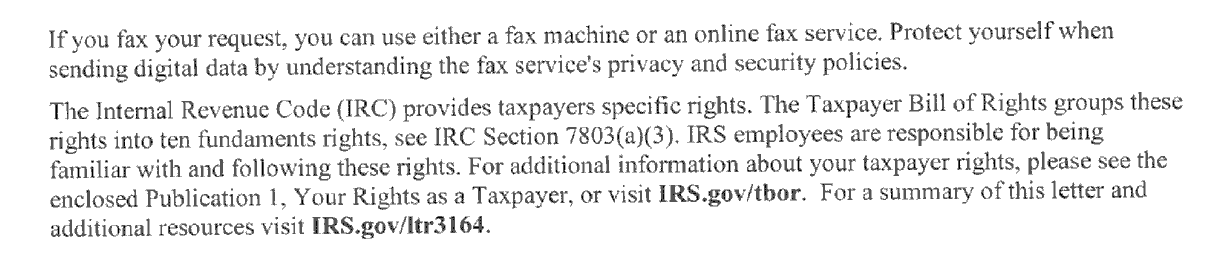
The next two paragraphs are standard language.
One says you can fax your request using a fax machine or an online fax service, and warns you to understand an online service’s privacy and security policies before you send anything through it.
The other points you to the Taxpayer Bill of Rights and to Publication 1, Your Rights as a Taxpayer, which comes enclosed with the letter.
Publication 1 has a history here.
Before August 2019, the IRS generally treated Publication 1 by itself as enough warning that it might contact third parties.
In February 2019, a federal appeals court ruled in J.B. v. United States that a general publication like that was not reasonable advance notice, because it gave the taxpayer no real chance to hand over the information first.
That July, the Taxpayer First Act rewrote the rule to require the specific, dated notice you are now holding, and the IRS’s manual now says Publication 1 no longer satisfies the requirement.
The paragraph also sends you to IRS.gov/ltr3164, the IRS’s own short page about this letter.
Part 7: Questions and Requests for the List

The last paragraph tells you to direct questions, and any request for the list of people contacted, to the revenue officer named at the top.
If you write, include the officer’s name and employee ID number.
Under the Internal Revenue Manual, the IRS mails the list on Letter 3173 within 14 calendar days of a valid request.
A valid request includes your name, address, taxpayer identification number, and the tax periods involved, and each spouse has to ask separately, because the IRS does not accept a joint request.
The list only covers contacts already made, so you can ask again later, but the IRS will not process a new request made within 90 days of your last one.
The list can also leave out people who told the IRS they fear reprisal.
Part 8: The Signature and the Enclosure
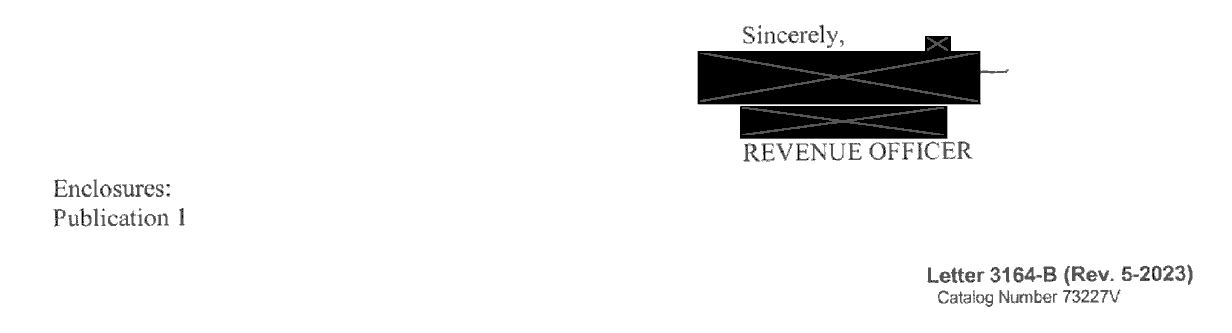
The letter is signed by the revenue officer, and the only enclosure is Publication 1.
The footer identifies it as Letter 3164-B (Rev. 5-2023), Catalog Number 73227V.
Part 9: The Tax Periods

The second page lists the tax periods the notice covers.
This client’s letter covers Form 1040 individual income tax for the years ending December 31, 2017, 2018, 2019, and 2021.
Check that these years match the balances you know about, because the notice applies to the periods it lists.
If a year you owe for is missing, or a year you do not owe for is on the list, ask the revenue officer why.
Why Letter 3164-B Matters Before a Levy
Most of the IRS’s collection tools work through someone else.
A bank levy goes to your bank, a wage levy goes to your employer, and a levy on money your customers owe you goes to your customers.
The IRS’s own rules generally treat levies and summonses issued to anyone other than you as third-party contacts, so none of them can go out until the window on your letter opens.
That makes Letter 3164-B part of the paperwork for enforced collection, even if the officer never calls a single neighbor.
A levy has its own notice rules on top of this one, including a final notice of intent to levy that gives you the right to a collection due process hearing, which a revenue officer usually sends as Letter 1058.
If you have already received that final notice, the opening of the contact window is one of the last things standing between your balance and a levy on your bank account or your paycheck.
Summonses work the same way, with one difference in collection cases that most people never hear about.
Normally, when the IRS summons records about you from someone else, the law requires it to notify you so you can ask a court to quash the summons.
That requirement does not apply to a summons issued to help collect a tax that has already been assessed against you, so a revenue officer can summon your bank’s records in a balance due case without sending you a separate notice.
In that situation, the Letter 3164-B in your hands may be the only advance warning you get.
What the IRS Can and Cannot Tell the People It Contacts
The IRS can disclose only what it needs to get the information it is looking for.
That limit comes from Internal Revenue Code section 6103(k)(6), which allows these disclosures only to the extent necessary to obtain information that is not otherwise reasonably available.
For an ordinary request for information, that usually means your name and enough to identify you, not the details of your tax problem.
A levy is different, because the levy form itself tells your bank or employer how much the IRS is collecting.
Either way, the contact reveals that the IRS is involved with you.
The J.B. court pointed to exactly that concern, noting the legislative history’s recognition that third-party contacts can have a chilling effect on a taxpayer’s business.
The people the IRS contacts are also told that their names will go on a list that may be sent to you.
When the IRS Can Skip the 45-Day Notice
The 45-day notice is the rule, but section 7602(c)(3) lists situations where the IRS does not have to give it.
- Contacts you authorize: for example, asking the officer to call your bookkeeper. The IRS documents that consent on Form 12180, and it will not accept a blanket authorization.
- Jeopardy: cases where the IRS determines for good cause that notice would jeopardize collection of the tax.
- Reprisal: contacts where notice may lead to reprisal against any person, which the IRS decides one contact at a time.
- Criminal investigations: any pending criminal investigation.
Some contacts are not third-party contacts in the first place.
Searching public records or commercial databases without speaking to anyone, getting public information from a government office, talking to your authorized representative, and computer matching programs like the Federal Payment Levy Program all fall outside the rule.
In March 2024, the IRS also proposed regulations that would cut the 45 days to as few as 10 in certain collection cases, such as when a year or less remains on the collection statute and the taxpayer cannot be reached or refuses to pay.
You cannot stop the contacts by refusing to authorize them, so the practical way to keep the list short is to make the officer’s questions unnecessary.
Still have questions? Talk to a tax expert — free.
What to Do After You Receive Letter 3164-B
- Find your three dates. The letter date, the date contacts can begin, and the date they must end. The start date is your real deadline.
- Contact the revenue officer before the window opens. Call the number in the Person to Contact block, or have your representative call. The surest way to keep the IRS from asking other people about you is to give the officer what it needs yourself.
- Get your financial information together. In a balance due case that usually means a collection information statement, Form 433-A for individuals or Form 433-B for businesses, along with bank statements, pay stubs, and proof of your monthly expenses.
- File any missing returns. A revenue officer generally will not approve a payment plan or any other resolution while required returns are still unfiled.
- Propose a way to resolve the balance. Depending on your finances, that may be an installment agreement, currently not collectible status, or an offer in compromise.
- Ask for the list of contacts. You are entitled to it, it tells you who the IRS has already talked to, and each spouse should ask separately.
- Keep a record of everything. Note the date of every call with the officer, and keep copies of what you send, along with fax confirmations or certified mail receipts.
Tip: If you hire a representative, get their Form 2848 power of attorney on file with the IRS before the window opens. The revenue officer can then work through your representative, and conversations with your representative are not third-party contacts.
What Happens If You Ignore Letter 3164-B
Nothing happens on the day the letter arrives.
On the 46th day, the revenue officer can start contacting your bank, your employer, and anyone else likely to have information about you.
If those contacts turn up accounts or wages and you have already received your final notice of intent to levy, the next thing your bank or employer gets from the IRS can be a levy.
A revenue officer who cannot get your cooperation also has other tools, including filing a notice of federal tax lien and summoning records.
And when the one-year window runs out on an open case, the officer can send another Letter 3164-B to start a new one.
Getting Help With IRS Letter 3164-B
A Letter 3164-B means your case is with a revenue officer who is ready to look beyond you for answers.
The 45 days before the contact window opens are your chance to change that.
Our licensed tax professionals can contact the revenue officer for you, pull your IRS transcripts, put together the financial information the officer will ask for, and propose the resolution that fits your finances.
If a revenue officer is working your case, we know how to deal with it the smart way.
Call 866-8000-TAX or schedule a free consultation and we will look at your letter with you.

“My deepest appreciation to Andrea and Kylie from Choice Tax Relief for helping me with my Tax debt that had accrued since 2013. The amount that I owed was in the six figures. There was no way I could pay it on my own going through the IRS without any help.”
IRS Letter 3164-B FAQs
What is IRS Letter 3164-B?
Letter 3164-B is the advance notice an IRS revenue officer sends before contacting third parties, such as your bank, employer, employees, or neighbors, about collecting a tax balance you owe. Federal law requires the notice at least 45 days before the contacts begin, and the letter names a contact period of no more than one year.
Does Letter 3164-B mean I am being audited?
No. Letter 3164-B is used in balance due cases, which are collection cases about tax that has already been assessed. The IRS has other versions of Letter 3164 for audits and for other kinds of investigations.
When can the IRS start contacting third parties after Letter 3164-B?
On the 46th day after the date of the letter. The letter prints the exact start date and an end date, which can be no more than one year after the start. To keep contacting third parties after that, the IRS has to send you a new notice.
Who will the IRS contact after sending Letter 3164-B?
The letter’s examples are a neighbor, a bank, an employer, or employees, but the revenue officer can contact anyone likely to have information about your income, accounts, or assets. Levies and summonses sent to banks, employers, and other third parties also count as third-party contacts.
Will the IRS tell my employer or my neighbors how much I owe?
For an ordinary request for information, the IRS can disclose only what it needs to get that information, which is usually little more than your name. A levy is different, because the levy form tells your bank or employer the amount being collected. Either way, the contact itself lets the other person know the IRS is involved.
Can I stop the IRS from contacting third parties?
You cannot block the contacts by refusing to authorize them. What you can do is make them unnecessary by giving the revenue officer the information it needs and proposing a way to resolve the balance before the contact window opens.
How do I get a list of who the IRS contacted?
Ask the revenue officer named on your letter, by phone, in writing, or in person, and include your name, address, taxpayer identification number, and the tax periods. The IRS mails the list on Letter 3173, and each spouse has to request it separately.
Is Letter 3164-B the same as Notice LT40?
They serve the same purpose, because both give you advance notice that the IRS intends to contact third parties about a balance you owe. Letter 3164-B comes from a revenue officer, while Notice LT40 is a collection notice that also includes a billing summary of what you owe.
Get Help Now
Got IRS Letter 3164-B? Get a straight answer before you respond.
Talk to a tax expert — free, no obligation. We’ve resolved over $20 million in IRS debt for our clients.


Author:

Logan Allec, CPA, Founder and Owner
Logan Allec has been serving taxpayers as a CPA for over 14 years. After leaving his role at a "Big 4" firm, he started Choice Tax Relief to help everyday Americans who have found themselves behind on their taxes. He also educates thousands of people daily about tax relief on his YouTube channel. In addition to his CPA license, Logan also has a Master's Degree in Taxation from the University of Southern California (USC). He lives with his wife and children in the Los Angeles area. Learn more about Logan here.