

IRS Notice CP23: Why Did The IRS Recalculate My Return?

IRS Notice CP23 tells you that the IRS changed your tax return because the estimated tax payments you claimed do not match the payments on its records, and that the change left you with a balance due.
In this article I will walk you through a real CP23 that one of our clients received, part by part, and show you how to test the IRS’s numbers before you pay.
On that notice the IRS agreed with every dollar of income and tax our client reported and still sent a bill for $2,734.05.
A CP23 is a notice about payments, and the job is to find out whose record of those payments is right.
Here is a redacted CP23 notice that one of our clients received (PDF).
I also recorded a video about a penalty that shows up on CP23 notices.
Key Takeaways
- A CP23 means the IRS changed your return to match its record of your estimated tax payments, and the change left a balance due.
- On our client’s CP23, dated June 3, 2024, the IRS accepted the income and total tax on the return and billed $2,734.05 because of the payments side alone.
- Internal Revenue Code section 6201(a)(3) lets the IRS assess an overstated estimated tax credit like a math error, and it says the 60-day abatement rule for math errors does not apply.
- If you made a payment the IRS did not count, prove it and have the IRS apply it to the right year instead of paying twice.
- If the IRS is right, paying by the date on the notice avoids additional penalty and interest, and the failure-to-pay penalty can sometimes be removed.
Table of Contents
What Is IRS Notice CP23?
The IRS describes the CP23 on its own page about the notice this way: “We corrected your return because we found a difference between the amount of estimated tax payments on your tax return and the amount we posted to your account.”
The sentence that follows is what separates a CP23 from its sister notices: “You have a balance due because of these changes.”
The Internal Revenue Manual, the IRS’s own procedures manual, files the CP23 under the name “Estimated Tax Credits Discrepancy.”
The IRS’s page says the notice “may also cover other changes we made while processing your return,” so read yours for changes beyond the payment lines.
A CP23 is not the plain balance due bill, the CP14, which the Internal Revenue Manual labels “Balance Due, No Math Error.”
And it is not quite a math error notice like the CP11, a difference that matters when you want to dispute it and that I cover below.
Free Consultation
Got a CP23 notice? Get a straight answer before you respond.
Talk to a tax expert — free, no obligation. We’ve resolved over $20 million in IRS debt for our clients.
IRS Notice CP23 at a Glance
| Detail | What It Means |
|---|---|
| Notice type | CP23: the IRS changed your return to match its record of estimated tax payments, and you owe a balance |
| Our client’s notice | Dated June 3, 2024, tax year 2023, Form 1040 |
| Amount due | $2,734.05 by June 24, 2024 |
| What changed | Payments only; income and total tax are the same in both columns |
| Legal basis | Internal Revenue Code section 6201(a)(3) |
| Penalty shown | Failure to pay, 0.50% a month, $31.68 |
| Interest shown | 8.0% a year, $33.37 |
| If you agree | Pay by the date on the notice or set up a payment plan |
| If you disagree | Call the number on the notice or write, with proof of the payment |
Why Did the IRS Send You a CP23 Notice?
Line 26 of Form 1040 is where you report your estimated tax payments for the year and any amount applied from the prior year’s return.
When the IRS processes the return, it compares that claim with the payments and credits posted to your account for the same year.
If the two do not match, the IRS changes the return to match its own record and sends one of three notices: a CP23 for a balance due, a CP24 for a credit or a CP25 for an even balance.
The legal authority is Internal Revenue Code section 6201(a)(3), which covers a return that overstates “the amount paid as estimated income tax.”
It says the overstated amount “may be assessed by the Secretary in the same manner as in the case of a mathematical or clerical error appearing upon the return.”
In plain terms, the IRS can assess the difference without sending a notice of deficiency first.
The first thing I want to know is what caused the mismatch, and the IRS’s own answer is: “The most common cause is an incorrect entry on the estimated tax line of the tax return.”
A Part-by-Part Walkthrough of IRS Notice CP23
Here is our client’s notice, one part at a time, with the real figures.
Part 1: The Opening Statement, Amount Due and Billing Summary
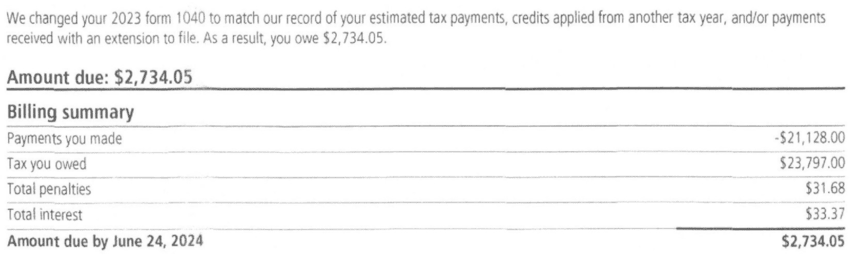
The notice is dated June 3, 2024 and covers tax year 2023 and Form 1040.
It opens: “We changed your 2023 form 1040 to match our record of your estimated tax payments, credits applied from another tax year, and/or payments received with an extension to file.”
The next sentence is the bill: “As a result, you owe $2,734.05.”
The billing summary shows how the IRS got there:
- Payments you made: -$21,128.00
- Tax you owed: $23,797.00
- Total penalties: $31.68
- Total interest: $33.37
- Amount due by June 24, 2024: $2,734.05
The arithmetic reconciles: $23,797.00 of tax minus $21,128.00 of payments is $2,669.00, and $2,669.00 plus $31.68 plus $33.37 is $2,734.05.
June 24, 2024 is 21 days after the notice date, which matches section 6601(e)(3) of the Code: an amount paid within 21 calendar days of a notice and demand (10 business days for amounts of $100,000 or more) bears no further interest after the notice date.
Part 2: How to Resolve This Issue

Under the heading “How to resolve this issue,” the first instruction is: “Review this notice and compare our changes to the information on your tax return.”
I would add your bank records to that comparison, because the question on a CP23 is whether a payment exists, and the return cannot answer that.
The notice continues: “If you agree with the changes we made: Pay the amount due of $2,734.05 by June 24, 2024 to avoid additional penalty and interest charges”.
Part 3: Options If You Can’t Pay in Full
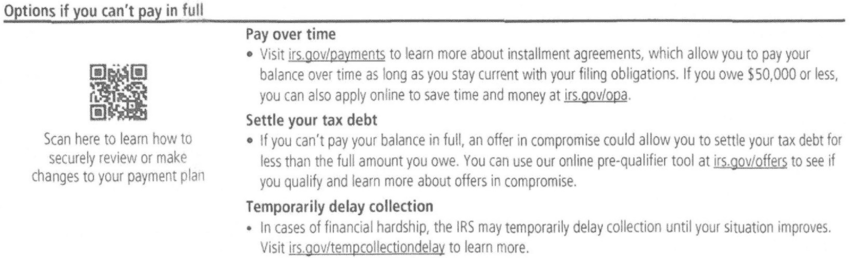
This part starts with a QR code captioned “Scan here to learn how to securely review or make changes to your payment plan” and then lists three options.
The first is “Pay over time,” which covers an installment agreement and adds: “If you owe $50,000 or less, you can also apply online to save time and money at irs.gov/opa.”
As of October 2026, the IRS’s payment plan page lists a $29 setup fee for a long-term plan with direct debit set up online, $69 online without direct debit, and none for a short-term plan of 180 days or less.
The second is “Settle your tax debt,” the notice’s heading for an offer in compromise, which carries a $205 application fee unless you meet the IRS’s low-income certification.
The third is “Temporarily delay collection,” which the IRS also calls currently not collectible status, and its page on the subject says penalties and interest keep accruing until the balance is paid.
All three options assume the balance is correct, so settle that question first.
Part 4: If You Disagree With the Changes

The heading is “If you disagree with the changes we made:” and the instruction is to call 800-829-8374, using the caller ID printed at the top of page one, “to review your account with a representative.”
Writing is the other route: “You can also contact us by mail at the address at the top of the first page of this notice.”
If you write, the notice says to “include your taxpayer identification number, tax year, and form number you are writing about.”
We keep a page on the IRS line at 800-829-8374, and my advice is to call whichever number is printed on your own notice.
The paragraph does not say the IRS will reverse the change if you ask, for a reason I explain in the dispute section below.
Part 5: Your Tax Calculations

This table has two columns, “Your calculations” and “IRS calculations,” and on our client’s notice they are identical:
- Adjusted gross income, Form 1040 line 11: $198,263.00 in both columns
- Taxable income, Form 1040 line 15: $161,248.00 in both columns
- Total tax, Form 1040 line 24: $23,797.00 in both columns
The IRS accepted our client’s income and tax exactly as reported.
If the two columns differ on your notice, the IRS changed more than your payments, and that change deserves its own review.
Part 6: Your Payments and Credits

This is the table that explains the bill, and it has only an “IRS calculations” column:
- Income tax withheld, Form 1040 line 25d: $20,028.00
- Estimated tax payments, Form 1040 line 26: $100.00
- Other credits, Form 1040 line 32: $0.00
- Other payments received: $1,000.00
- Total payments and credits: $21,128.00
The four rows add up to $21,128.00, the same payments figure as in the billing summary.
Line 26 is the one that matters, because the IRS had only $100.00 of estimated tax payments on record for 2023.
The table does not show what our client entered on line 26, so have your filed return open to that line when you read your own notice.
The $1,000.00 of “Other payments received” is the only row without a Form 1040 line next to it.
Part 7: Payments Credited to Your Account for 2023

Under the heading “Payments credited to your account for 2023,” the notice says: “Your payments, including credits received from another tax year, are shown below.”
On our client’s notice the table has one row, a $100.00 item described as “Payment” with a date received of 7/7/2023.
Hold this table next to your bank statements, because any payment you can prove that is missing from it is the one to chase.
Part 8: Penalties
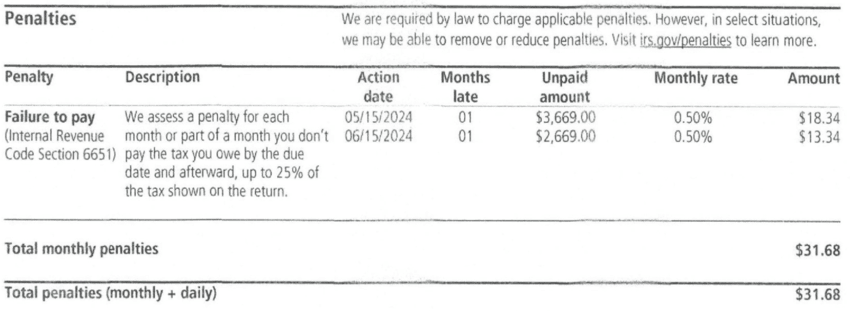
The only penalty on our client’s notice is failure to pay under Internal Revenue Code section 6651.
The notice explains it this way: “We assess a penalty for each month or part of a month you don’t pay the tax you owe by the due date and afterward, up to 25% of the tax shown on the return.”
There are two rows:
- Action date 05/15/2024, months late 01, unpaid amount $3,669.00, monthly rate 0.50%, amount $18.34
- Action date 06/15/2024, months late 01, unpaid amount $2,669.00, monthly rate 0.50%, amount $13.34
The math checks: 0.5% of $3,669.00 is $18.345 and 0.5% of $2,669.00 is $13.345, which the notice shows as $18.34 and $13.34, for total penalties of $31.68.
The starting figure reconciles too, because $23,797.00 of tax minus $20,028.00 of withholding and $100.00 of estimated payments is $3,669.00.
The unpaid amount falls by exactly $1,000.00 between the rows, which matches the $1,000.00 of “Other payments received” in Part 6.
This is the penalty I would ask the IRS to remove through penalty abatement, and I cover the grounds below.
Part 9: Interest
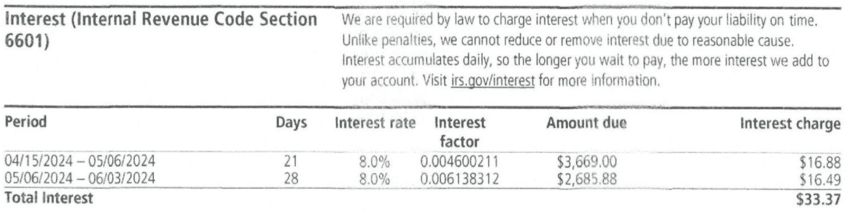
The interest part cites Internal Revenue Code section 6601 and warns: “Unlike penalties, we cannot reduce or remove interest due to reasonable cause.”
The table has two rows:
- 04/15/2024 to 05/06/2024, 21 days, 8.0%, interest factor 0.004600211, amount due $3,669.00, interest charge $16.88
- 05/06/2024 to 06/03/2024, 28 days, 8.0%, interest factor 0.006138312, amount due $2,685.88, interest charge $16.49
Check the multiplication: $3,669.00 times 0.004600211 is $16.88 and $2,685.88 times 0.006138312 is $16.49, for total interest of $33.37.
The second row tells you when the $1,000.00 arrived, because $3,669.00 plus $16.88 of interest minus $1,000.00 is $2,685.88, so the payment posted on May 6, 2024.
The factors are 8% a year compounded daily: divide 8% by the 366 days in 2024, compound it for 21 days, and you get 0.004600211.
The 8.0% was the IRS underpayment rate for April through June 2024, and IRS interest rates are set every quarter.
For the quarter beginning October 1, 2026, the IRS set the underpayment rate at 7%.
Part 10: IRS Help
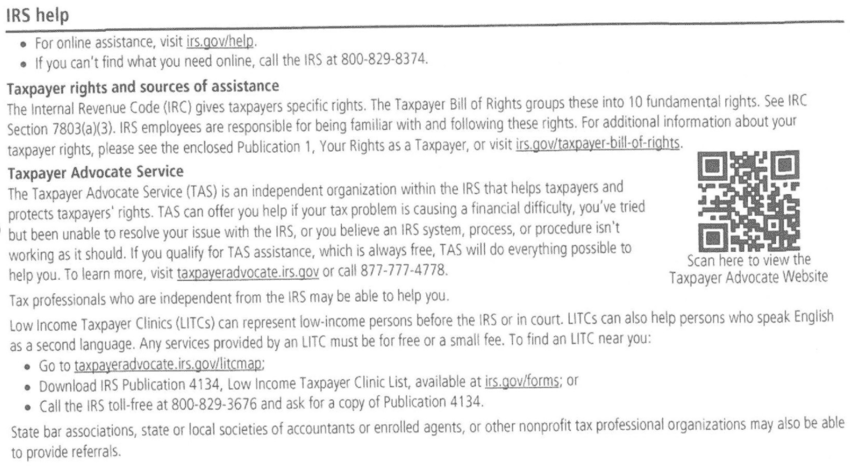
This part points you to irs.gov/help and then says: “If you can’t find what you need online, call the IRS at 800-829-8374.”
Next is a paragraph on the Taxpayer Bill of Rights, which in the IRS’s own wording includes the right “to have the IRS apply all tax payments properly.”
Then comes the Taxpayer Advocate Service, with the phone number 877-777-4778, which describes itself as an independent organization within the IRS and does not charge for its help.
The last paragraph covers Low Income Taxpayer Clinics, which are independent from the IRS and, according to the Taxpayer Advocate Service, help qualifying taxpayers for free or for a small fee.
Part 11: The Payment Coupon
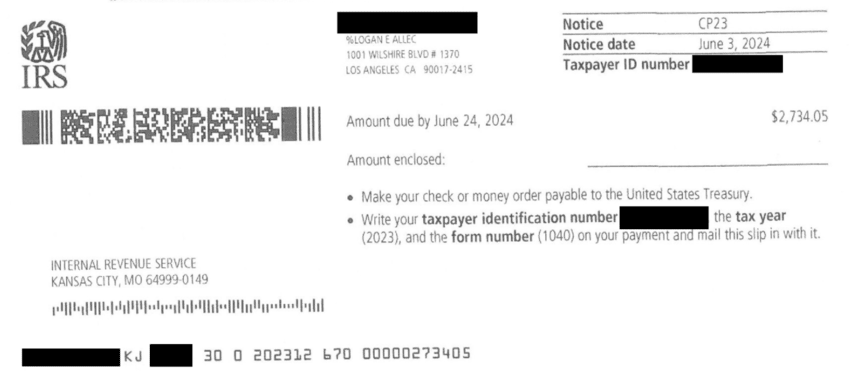
The last part is the coupon, addressed to the Internal Revenue Service in Kansas City, MO 64999-0149, which repeats “Amount due by June 24, 2024: $2,734.05”.
The instructions read: “Make your check or money order payable to the United States Treasury.”
They continue: “Write your taxpayer identification number, the tax year (2023), and the form number (1040) on your payment and mail this slip in with it.”
I tell clients to follow that second instruction to the letter and to keep a copy of the check.
Under our client’s blacked-out name it shows “%LOGAN E ALLEC” and what was then our Los Angeles office address, because we hold a power of attorney for this client and the notice came to our office.
The scan line at the bottom includes 202312, which matches the tax period ending December 2023, and 00000273405, which is $2,734.05 without the decimal point.
Where a Missing Estimated Tax Payment Can End Up
If you made a payment and it is not on the notice, these are the places I check, each one documented in the IRS’s own materials:
- A different tax year: a payment made through IRS Direct Pay is made for a specific tax year, and the fourth estimated payment for a year is due on January 15 of the following year, so I check that one first.
- Your spouse’s account: the Internal Revenue Manual has a procedure for “spousal payments” that sit on the spouse’s own account until they are moved to the joint account.
- A prior-year credit that shrank: the IRS has separate notices for reducing the overpayment you asked to apply forward (CP10) or not applying it as you asked (CP45).
- An extension payment: the Form 4868 instructions put it on Schedule 3, line 10, a different line from estimated payments.
- A payment your bank did not honor: the IRS charges a separate penalty for a dishonored payment, so confirm that the payment cleared.
When a payment is on the wrong year or account, the IRS moves it with what the Internal Revenue Manual calls a credit transfer, and the notice it sends after applying a payment to your account is the CP62.
When a payment cannot be found on your account, the IRS’s tool is a payment tracer, which the manual defines as “the process used to locate a missing or misapplied payment.”
How to Check What the IRS Actually Has
Your IRS Online Account shows up to five years of payment history, including estimated tax payments.
The account transcript for the year goes further, because the IRS says it shows “payment types” and “changes made after you filed your original return.”
Then gather your own proof: bank statements, canceled checks front and back, and the confirmation numbers from IRS Direct Pay or EFTPS.
For every payment, compare four things: the date, the amount, the Social Security number it was made under and the tax year it was applied to.
I also pull the transcripts for the years before and after, and for a spouse’s account when the return is joint, because those are the other places a payment can post.
Tip: Download your account transcripts before you call the IRS, so that you and the representative are reading the same list of postings.
CP23 vs. CP24 vs. CP25
The CP23 has two sister notices that start from the same mismatch and end in a different place.
| Notice | Result of the Change | What the IRS Tells You to Do |
|---|---|---|
| CP23 | A balance due | Pay by the date on the notice or arrange to pay over time, and contact the IRS if you disagree |
| CP24 | A possible credit or overpayment | No response is required if you agree |
| CP25 | No refund and no additional amount due | No response is required if you agree |
I read a CP24 as carefully as a CP23, because the IRS’s page lists an incorrect payment applied to your account as one cause and says you will need to return any refund you receive by mistake.
Can You Dispute a CP23?
Yes, and the notice tells you how: call the number on it or write to the address at the top of the first page.
What you cannot do is make the IRS undo the change simply by objecting, and that is where a CP23 parts ways with a true math error notice.
With a math error notice, section 6213(b)(2) of the Code gives you 60 days after the notice is sent to request abatement, and on receiving the request “the Secretary shall abate the assessment.”
Section 6201(a)(3) removes that right for overstated estimated tax payments by saying section 6213(b)(2) “shall not apply with regard to any assessment under this paragraph.”
A CP23 by itself does not open the door to Tax Court either, because section 6213(b)(1) gives “no right to file a petition with the Tax Court” based on a math error notice and section 6201(a)(3) puts an overstated estimated tax credit on the same assessment track.
So the dispute is about facts, and you win it with proof of payment: the canceled check, the bank statement line, or the Direct Pay or EFTPS confirmation.
If the payment was misapplied, the fix is moving the payment, not paying twice, and the IRS’s page says that when it fixes a misapplied payment the late payment penalty and interest “will adjust automatically.”
Important: If your CP23 also changed your income, deductions or credits, that part may be a true math error change, and the 60-day abatement right is worth protecting by responding inside 60 days.
On timing, the IRS’s page says to contact the IRS “by the date indicated” on the notice and the Taxpayer Advocate Service’s CP23 page says within 60 days from the notice date, and I would not wait for either.
Penalty relief is a separate request, and the IRS’s First Time Abate relief covers the failure-to-pay penalty when you filed the same type of return on time for the prior three years and have a clean penalty record for those years.
The IRS says an automatic version of that relief starts with 2025 returns, and that for earlier years you still have to ask by phone, by letter or on Form 843.
Reasonable cause is the other route, and the IRS says mistakes, oversights and lack of funds by itself generally do not qualify.
Interest cannot be removed for reasonable cause, as the notice itself says.
Still have questions? Talk to a tax expert — free.
How to Respond to IRS Notice CP23
Step 1: Compare the Notice With Your Return
Put line 26 of your filed Form 1040 next to the estimated tax payments the IRS shows in the payments and credits table.
If the income and tax columns match, as they do on our client’s notice, the only open question is payments.
Step 2: Gather Proof and Check the IRS’s Records
List every estimated payment, extension payment and prior-year credit you counted on the return, and find the bank record or confirmation for each one.
Then look for each payment in your IRS Online Account or on the account transcript, first on the year you intended and then on the neighboring years and your spouse’s account.
Step 3: Pay or Dispute Before the Date on the Notice
If the return overstated your payments, pay the amount due by the date printed on the notice or apply for a payment plan, and correct your own copy of the return.
If you can prove a payment the IRS did not count, call the number on the notice or write to the address at the top of the first page, and send copies of your proof.
Step 4: Ask for Penalty Relief and Keep Records
Whether you pay or dispute, ask whether the failure-to-pay penalty qualifies for First Time Abate or reasonable cause relief.
Keep a copy of everything you send and a note of every call, with the date and the name or ID number of the person you spoke to.
What Happens If You Ignore IRS Notice CP23
I tell clients that the balance on a CP23 grows while it sits, because the failure-to-pay penalty keeps adding 0.5% of the unpaid tax for each month or part of a month and interest keeps accumulating daily.
The IRS then sends reminders: its page for the CP501 calls that notice a reminder that you owe a balance, and its page for the CP503 says the IRS may file a Notice of Federal Tax Lien.
After those comes the CP504, which the IRS’s page describes as a notice of intent to levy and which says the IRS can take your state income tax refund.
The IRS says that if you do not pay within 10 days after a notice of intent to levy, the failure-to-pay penalty becomes 1% per month.
The IRS can also apply your future refunds to the balance, and section 6502 of the Code generally gives it 10 years from assessment to collect.
If you did make the payment, ignoring the notice leaves the IRS’s record wrong and the collection notices coming on a balance you do not owe.
Tip: If you cannot pay in full, apply for a payment plan anyway, because the IRS says an approved plan on a return filed on time cuts the failure-to-pay penalty to 0.25% a month.
Get Help With IRS Notice CP23
At Choice Tax Relief, the first thing we do with a CP23 is pull the account transcripts for the year on the notice and the years around it, and match every posting to your payment records.
If a payment is sitting in the wrong place, we call the IRS on your behalf under a power of attorney (Form 2848), ask for it to be moved and request abatement of the failure-to-pay penalty where the facts support it.
If the balance is real and you cannot pay it at once, we negotiate an installment agreement, an offer in compromise or currently not collectible status, depending on what your finances support.
Call us at 866-8000-TAX or book a free consultation and we will tell you where your account stands.

“Very professional and super easy to communicate with! It was easy from start to finish. We gathered all documents together and Logan and his team pretty much took care of the rest. We highly recommend them to anyone!”
Frequently Asked Questions About IRS Notice CP23
Why did I get a CP23 if I never made estimated tax payments?
The IRS says the most common cause is an incorrect entry on the estimated tax line of the return. Look at line 26 of the Form 1040 you filed and see whether an amount was entered there by mistake.
How long do I have to respond to a CP23?
The notice prints a pay-by date, which on our client’s notice was 21 days after the notice date. For disagreements, the IRS’s page says to contact the IRS by the date indicated on the notice, and the Taxpayer Advocate Service’s page says within 60 days from the notice date.
Is a CP23 the same as a math error notice?
Not quite. Internal Revenue Code section 6201(a)(3) lets the IRS assess an overstated estimated tax credit in the same manner as a math error, but it says the 60-day abatement rule in section 6213(b)(2) does not apply. You need proof of the payment to get the change undone.
What if I made the payment and the IRS did not count it?
Gather proof, such as the canceled check or the electronic payment confirmation, and call or write the IRS using the contact information on the notice. The payment may be on a different tax year or on a spouse’s account, and the IRS can move it.
Can the penalty and interest on a CP23 be removed?
The failure-to-pay penalty can be removed if you qualify for First Time Abate or can show reasonable cause. Interest cannot be removed for reasonable cause, as the notice itself says.
Do I need to file an amended return after a CP23?
Not for the change the IRS already made. The IRS says to correct the copy of the return you kept for your records and not to send it in.
Get Help Now
Got a CP23 notice? Get a straight answer before you respond.
Talk to a tax expert — free, no obligation. We’ve resolved over $20 million in IRS debt for our clients.


Author:

Logan Allec, CPA, Founder and Owner
Logan Allec has been serving taxpayers as a CPA for over 14 years. After leaving his role at a "Big 4" firm, he started Choice Tax Relief to help everyday Americans who have found themselves behind on their taxes. He also educates thousands of people daily about tax relief on his YouTube channel. In addition to his CPA license, Logan also has a Master's Degree in Taxation from the University of Southern California (USC). He lives with his wife and children in the Los Angeles area. Learn more about Logan here.