

Unfiled Tax Returns: Why They’re a Problem and What to Do About Them

If you have unfiled tax returns, you probably know that you have a problem.
How big a problem?
Well, the problem could be as small as missing out on some refunds to which you’re entitled to having an IRS revenue officer show up at your door to being charged with a federal crime under Section 7201 or Section 7203 of the tax code.
Table of Contents
5 Reasons Why Unfiled Tax Returns Are a Problem
If you’re reading this article, you’re likely aware that having unfiled tax returns is a problem.
1. Prison Time
Not everybody who gets behind on filing their taxes goes to federal prison, but some do.
This is because Internal Revenue Code Section 7203 states that anyone who willfully fails to file a required tax return is guilty of a misdemeanor, punishable by a fine of up to $25,000 as well as up to one year in prison.
And Section 7201 is even worse, stating that anyone who willfully attempts to evade or defeat a tax — and intentionally not filing a required tax return could certainly be part of such a scheme — is guilty of a felony, punishable by a fine of up to $100,000 as well as up to five years in prison.
Of course, “willfulness” is the key to a criminal finding here, and you can learn more about what this means in our article, “Can You Go to Jail For Not Filing Taxes?”
2. The IRS Taking Matters Into Their Own Hands
A second consequence of having unfiled tax returns is that the IRS may take matters into their own hands and file a substitute for return (“SFR” for short) for your unfiled years.
An SFR is essentially a calculation performed by an IRS computer system that calculates your tax liability based on the following assumptions:
- Your filing status is single (if the IRS believes you to be unmarried) or married filing separately (if the IRS believes you to be married)
- You have no dependents
- You qualify for no tax credits
- You earned all the income reported on your wage and income transcript for the year with no deductions against the income reported
- You take the standard deduction
Naturally, this calculation will often result in a grossly overstated tax liability.
But in the eyes of the IRS, this doesn’t matter — it can still assess a tax liability (with penalties and interest) against you based on this IRS-prepared SFR and then proceed to take forced collections activity against you.
3. Penalties and Interest
If you’re a W-2 employee who had a decent amount of taxes taken out of your paycheck every pay period for the years you haven’t filed tax returns for, you may not be looking at too great a tax bill, even considering penalties and interest.
However, if you are a 1099 worker who has unfiled tax returns — watch out!
The IRS may prepare a substitute for return (SFR) for you based only on your 1099 income without any expenses and assess tax accordingly.
If this happens to you, be prepared for a massive tax bill from the IRS.
For example, the account transcript excerpt shown below is from one of our clients who was a 1099 truck driver and had several years of unfiled tax returns.
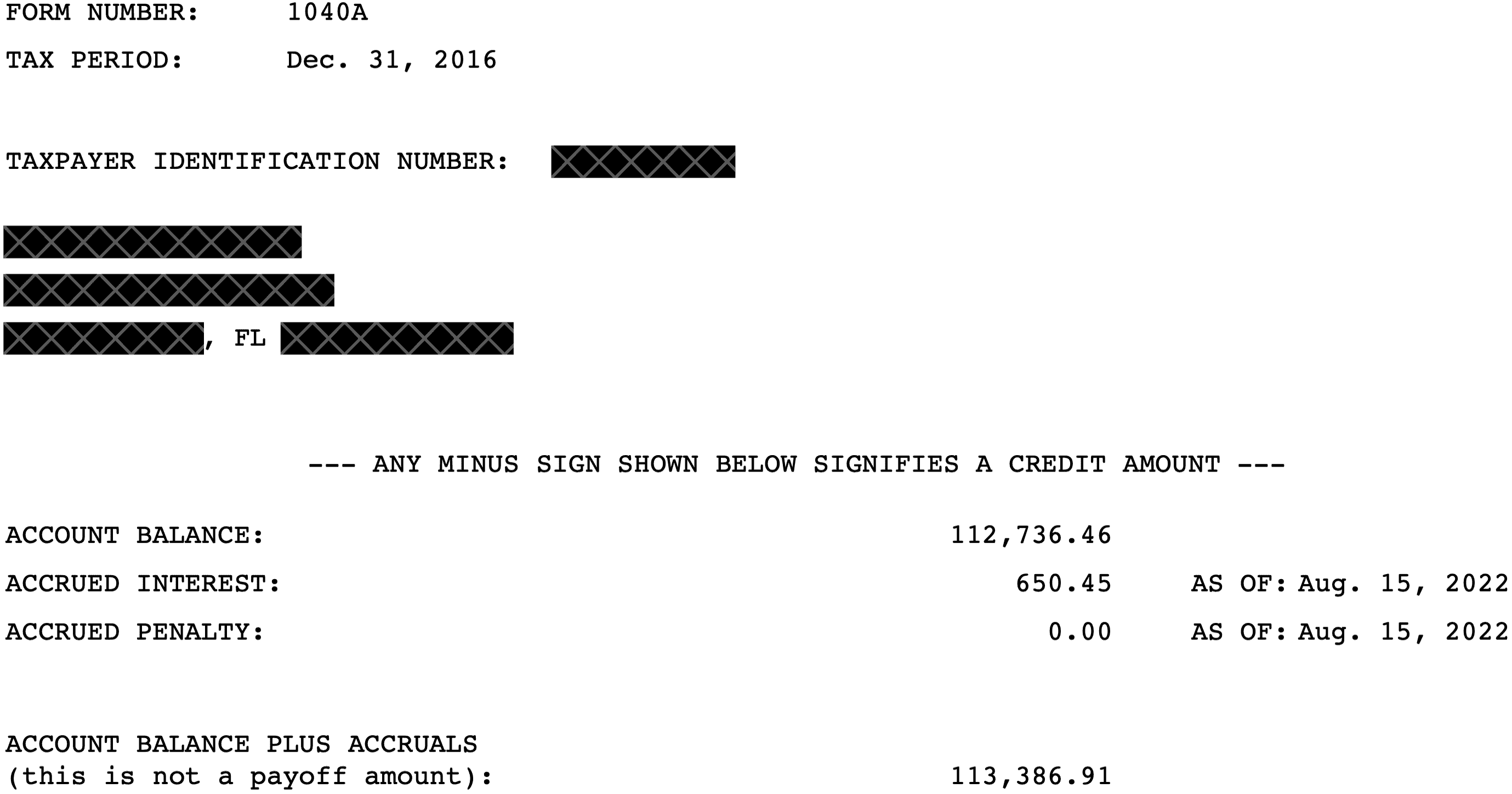
This excerpt is just for one year — tax year 2016.
The IRS assessed over $113,000 in taxes, penalties, and interest based on this individual’s single Form 1099.
(Note that the “accrued interest” and “accrued penalty” amounts in the image above represent only the accrued but not assessed penalties and interest; the already-assessed penalties and interest were over $30,000 for this particular year.)
This taxpayer had other tax years with similar situations when he came to us.
Shortly thereafter, a revenue officer was assigned to his case because his balance was over $250,000.
However, once we filed his returns, we got his balance for this year down to less than $10,000!
So we took what was a huge problem due to his unfiled tax returns and made it a much smaller problem simply by filing his tax returns.
4. Loss of Refund
Now, you may be thinking, “Well, I don’t have to worry about penalties and interest — I’m a W-2 employee who usually gets a refund.”
If that’s the case, you risk a different problem — losing thousands of dollars in refunds that the IRS would have paid you if you had simply filed your returns timely.
Now, all is not lost if you’ve only gotten behind a few years — but once you hit the three-year mark, you may be out of luck for a refund.
That’s because Internal Revenue Code Section 6511 establishes a three-year statute of limitations for refund claims — applied to unfiled tax returns, this means that the only way you can get a refund for a return you failed to file timely is if you file it within three years of the return’s due date or extended due date (if you filed a timely extension for the return).
5. Sense of Guilt
In addition to the concrete reasons listed above, getting behind on your tax return filing obligations can also bring with it a sense of guilt that you are doing something wrong.
And if that’s how you feel, your conscience is correct — you are out of compliance with our tax system, and you should do everything you can to get back in compliance ASAP.
Free Consultation
Behind on filing your tax returns? Let’s get you caught up.
Talk to a tax expert — free, no obligation. We prepare years of unfiled tax returns and have resolved over $20 million in IRS debt for our clients.
What To Do If You Have Unfiled Tax Returns, Step By Step
If you have unfiled tax returns, you need to get back into compliance ASAP.
Step #1: Determine which years you haven’t filed a return for.
The first step is to identify the population of tax returns that you haven’t filed.
This isn’t to say that you will necessarily file all of these returns, but you do need to identify which returns you haven’t filed.
Most people find out which years they haven’t filed in one of the three following ways:
Option 1: Call the IRS.
It may take a while — not to mention multiple attempts — to get through to the IRS these days, but you can try calling 1-800-829-1040 to try to speak to someone at the IRS who can tell you which tax returns you haven’t filed.
Option 2: Check your account transcripts.
Another option to verify your missing returns is to check your account transcripts, year by year.
You can obtain your yearly account transcripts online or by mail; more information about retrieving transcripts is available here on the IRS website.
Option 3: Hire a professional to do a full compliance check for you.
If you don’t want to spend the time trying to figure this all out, consider hiring a professional like our staff at Choice Tax Relief to obtain a compliance check for you.
Part of this service includes determining which tax years you haven’t filed returns for.
Step #2: Of the unfiled years, determine which years you should file returns for.
Now that you’ve verified the population of returns you haven’t filed, you need to determine which years you should file for — that is, the returns that it is in your best interest, based on your risk tolerance, to file.
Option #1: File all delinquent returns.
Now, the safest option is to simply file all the returns that you haven’t filed to an extent you have a filing requirement for them.
This is because if you don’t file a return for a given year, the IRS’s assessment statute of limitations never starts running, and it can theoretically come back at any time in the future to do a substitute for return (SFR) for that year and assesses you the tax liability, penalties, and interest, etc.
Imagine if the IRS came back after 30 years to SFR an old tax year — charging you 30 years of interest (in addition to penalties and the underlying tax liability).
Now, in practice, the IRS typically doesn’t create an SFR for years older than five years ago, which leads us to your next option: only file the last six years of tax returns.
Option #2: Only file the last six years of returns to the extent required.
Some time back, the IRS issued Policy Statement 5-133, which states that “normally” the IRS will not enforce “delinquency procedures” for “more than six years…without prior managerial approval.”
This means that current IRS procedure is to consider a taxpayer in compliance with their tax return filings insofar as they have filed the last six years of tax returns (to the extent required) — even if they have other delinquent years of returns older than six years.
The majority of the clients for which we prepare back tax returns for here at Choice Tax Relief opt for this route, knowing, of course, that the IRS could come back at any time in the future and SFR them for the years older than six years that they have not filed.
Step #3: Determine if you need to prioritize any of your returns.
In general, you should simply prepare your delinquent returns in chronological order.
There are a number of reasons for this, including properly calculating amounts that could carry forward from one year to the next, such as capital losses or passive activity losses.
That said, if you’re under a time crunch for a given year, you may need to prioritize preparing or filing that year.
What kind of a “time crunch” could result in this situation?
The first one that comes to mind is an imminent refund statute expiration — if the three-year anniversary of the due date of one of the tax returns you’re filing is coming up very soon, and you believe you will be owed a refund for that year, it would be best to prioritize filing that return on or before the three-year anniversary.
Another consideration when it comes to the order in which you prioritize — or at least file — your tax returns is that you may want to file your “refund” returns first so as to secure those refunds before filing your “balance due” returns.
Obviously, if you have other balance dues that exceed your potential refunds for your refundable years, this consideration is neither here nor there.
Step #4: Gather your documents for the years you intend to file.
Obviously, you need some basis to file your tax return.
At a minimum, you should pull your IRS wage and income transcripts for the years you intend to file.
Ensuring that you report all of the income that the IRS believes you earned during the year — per the tax form information reported on your wage and income transcripts — will also ensure that you are not the recipient of a dreaded CP2000 Notice from the IRS.
Of course, there may be information relevant to your tax returns that are not found on your wage and income transcripts; such information includes:
- Dependents’ names, dates of birth, and Social Security numbers
- Itemized deduction information such as medical and dental expenses, charitable donations, and gambling losses
- Business expenses
- Rental property expenses
- Information pertaining to the purchase or sale of real estate
- Childcare expenses paid
The more information you can gather for a tax year about information like this, the more you could potentially save in taxes, penalties, and interest.
Step #5: Prepare your tax returns.
Congratulations, you’ve now identified which years of returns you want to file and gathered the documents and other information you need to prepare these returns.
Now you actually have to prepare the returns themselves.
From what I understand, most retail tax software products, such as TurboTax, will prepare up to the last three to four years of taxes in them, so you can easily do your last three to four years of tax years using products like these.
But what if you have older years to follow?
In this case, you have three choices:
Option #1: Download the forms from irs.gov and prepare the returns manually.
The IRS keeps downloadable forms on its website for previous tax years that you can download and utilize.
Of course, preparing your tax returns using these PDFs is a painstaking process since you will have to fill out each box manually, doing every calculation yourself.
Unfortunately, unless you have an extremely simple return — say, just one Form W-2 or something like this — utilizing this method can result in errors; check out the journey of the individual featured in my YouTube video below if you don’t believe me.
Option #2: Hire a tax professional.
Most professional tax software goes back a decade or more, so naturally another option you have to get the older years prepared is to hire a tax professional, such as the good folks here at Choice Tax Relief.
Step #6a: E-file e-file-eligible returns, if you’d like.
Once you’ve prepared your tax returns, you need to file them.
The IRS lets taxpayers electronically file the last three years of tax returns, but the number of years (up to three) that you actually can e-file will be determined on your tax software’s restrictions.
Note that while e-filing returns is obviously more convenient, it will cause any balances due to be assessed very quickly and likely earlier than your paper-filed returns, if any, are processed — making it impossible to get into a resolution on this quickly-assessed debt until your other returns are, in fact, processed.
On the other hand, if you’re owed a refund for a refundable year within the past three tax years and believe you will get it (i.e., there are no other balances due or possible offsets that would intercept your refund), you would likely want to e-file that year before filing your balance-due tax years.
Step #6b: Sign and mail your paper-filed returns.
As for years beyond the three-year e-file window, or years within the window that you simply choose to paper file, you will need to:
- Print these returns, single-sided.
- Sign and date these returns on the appropriate lines on the return. (Your spouse must sign as well for any year in which you and your spouse are filing jointly.)
- Mail these returns to the appropriate filing address as found in the current Form 1040 instructions.
Step #7: Monitor your IRS account for successful return processing.
Now, once you’ve actually filed all your returns, you should give yourself a pat on the back — that wasn’t easy, but you did it!
That said, the process isn’t *entirely* over yet; you still need to make sure that the IRS actually processes your returns, issues you any refunds, and assesses any balances due.
You can do this by checking your account transcripts on a regular basis as well as by being sure to check your mail for any IRS notices pertaining to your recent return filings.
Step #8: Pay off or enter into a resolution for any balances due.
OK, at this point, you’ve received any refunds you are entitled to — and you are on the hook for any balances due assessed by the IRS.
If you have ample funds to pay off what you owe, you may as well do so, unless you want to pay your debt back in installments.
But if you truly cannot pay what you owe, you may qualify for a tax relief program — you can learn more about these in our article, “What Is Tax Relief?”
Optional: Watch the video below for more guidance.
Confused by all these steps?
The good news is I have a full-length YouTube video telling you exactly how to file your back tax returns, avoid penalties, and get your life back on track — just sit back and watch the video below!
Common Questions About Unfiled Taxes
How long can the IRS come after you for unfiled taxes?
The IRS can come after you for unfiled taxes as long as it wants.
This is because the IRS’s time limit to “come after you for unfiled taxes” — that is, the IRS’s statute of limitations on assessment — never starts running until you actually file your tax return.
This means that, theoretically, the IRS can make its own assessment of tax against you for an unfiled year via the substitute for return process whenever it wants to in the future.
That said, once the IRS has made an assessment against you for unfiled returns via the SFR process, its standard 10-year statute of limitations on collections goes into effect.
How far back can the IRS go for unfiled taxes?
The IRS can go back as far as it wants to for unfiled taxes, but it typically doesn’t go back beyond six years.
This is because IRS Policy Statement 5-133 states as follows:
“Normally, application of the above criteria will result in enforcement of delinquency procedures for not more than six (6) years. Enforcement beyond such period will not be undertaken without prior managerial approval. Also, if delinquency procedures are not to be enforced for the full six year period of delinquency, prior managerial approval must be secured.”
Of course, the six-year rule is not absolute; for one thing, the IRS says in its own policy statement above that it can go back beyond the six-year standard compliance period if managerial approval is secured.
Additionally, keep in mind that the IRS’s six-year rule for unfiled taxes is merely an IRS procedure at the current time and that the IRS can “change its mind” on this point at any time in the future.
Learn more about how far back the IRS can go for unfiled taxes in this article.
Can you go to jail for unfiled taxes?
Yes, you can go to jail for unfiled taxes, but not everyone with unfiled taxes goes to jail.
Internal Revenue Code Section 7203 establishes that willfully failing to file a required return is a misdemeanor punishable by a fine of up to $25,000 or imprisonment of up to one year (or both).
That said, actual prosecutions of individuals who simply failed to file their tax returns — even willfully — are relatively rare.
This isn’t to say that it can’t happen to you, but for most Americans with unfiled taxes, their main concern should be the significant penalties and interest that result from failing to file your required income tax returns.
How can I fix my unfiled taxes?
You can fix your unfiled taxes by filing them.
You can do this yourself with a tax software program such as TurboTax, by downloading PDF tax return forms at irs.gov, or by hiring a team of professional tax preparers such as the team we have at Choice Tax Relief.

“A special thank-you to Nathan and Luke for their help and professionalism throughout the entire process. They assisted me in getting four tax years filed, working directly with the necessary entities on my behalf.”
Get Help Now
Behind on filing your tax returns? Let’s get you caught up.
Talk to a tax expert — free, no obligation. We prepare years of unfiled tax returns and have resolved over $20 million in IRS debt for our clients.


Author:

Logan Allec, CPA, Founder and Owner
Logan Allec has been serving taxpayers as a CPA for over 14 years. After leaving his role at a "Big 4" firm, he started Choice Tax Relief to help everyday Americans who have found themselves behind on their taxes. He also educates thousands of people daily about tax relief on his YouTube channel. In addition to his CPA license, Logan also has a Master's Degree in Taxation from the University of Southern California (USC). He lives with his wife and children in the Los Angeles area. Learn more about Logan here.