

IRS Form 13711: How to Appeal a Rejected Offer in Compromise

IRS Form 13711, Request for Appeal of Offer in Compromise, is the form you file when the IRS rejects your offer in compromise (OIC) and you want the IRS Independent Office of Appeals to take a second look.
Offers get rejected all the time, including offers where it seems clear to us that the taxpayer qualifies. Usually the rejection comes down to math: the IRS calculated that you can pay more than you offered, and we think the IRS got the math wrong.
We’ve had clients in exactly this situation. In one case we believed the client had a strong offer, the IRS rejected it, we appealed on Form 13711, and we eventually brought a $90,000 tax bill down to just over $2,000.
If the IRS denies your offer, a well-prepared Form 13711 gives you another shot at acceptance, or at least gets the IRS back to the negotiating table.
Here is the redacted Form 13711 we filed for one of our clients. We’ll walk through it part by part below, then cover what happens after you file and how to give your appeal the best chance.
Key Takeaways
- Form 13711 is an appeal, not a new offer. You use it after the IRS rejects your offer in compromise. A returned offer can’t be appealed.
- You have 30 days from the date on the rejection letter. The IRS says a late appeal won’t be accepted, so this deadline is the whole ballgame.
- Mail it to the office that sent the rejection letter, not to Appeals. That office forwards your case.
- The form is mostly a table of disagreed items. For each number you dispute, you give a short reason and point to the documents that prove it.
- Filing on time keeps you protected. While a timely appeal is pending, the IRS can’t levy your wages or bank accounts over the tax covered by the offer.
- Appeals’ decision is final. If Appeals sustains the rejection, no court can review it, so the appeal is your real last word on this offer.
Table of Contents
IRS Form 13711 At a Glance
| Question | Answer |
|---|---|
| What is it? | The IRS form for asking the Independent Office of Appeals to review a rejected offer in compromise. |
| When do you use it? | After you receive a letter rejecting your offer. Not for offers the IRS returned as unprocessable, and not for offers you withdrew. |
| What’s the deadline? | 30 days from the date on your rejection letter. The IRS won’t accept an appeal filed after that. |
| Where does it go? | To the IRS office that sent you the rejection letter, at the address on that letter. |
| Do you have to use the form? | No. A signed letter with the same information works too. The form just keeps you from leaving anything out. |
| What happens next? | Appeals assigns an appeals officer, who mails you Letter 5576 to schedule a conference, usually by phone. |
Free Consultation
Got IRS Form 13711? Get a straight answer before you respond.
Talk to a tax expert — free, no obligation. We’ve resolved over $20 million in IRS debt for our clients.
Rejected vs. Returned: Make Sure You Can Appeal
Before you fill anything out, read your letter carefully. The IRS does two different things with offers it doesn’t accept, and only one of them can be appealed.
| Rejected offer | Returned offer | |
|---|---|---|
| What it means | The IRS investigated your offer and decided it isn’t enough, usually because it calculated that you can pay more. | The IRS didn’t fully consider your offer. Common reasons: you weren’t current on filings or estimated payments, you missed a deadline for information, or a new balance showed up. |
| Can you appeal? | Yes, within 30 days, on Form 13711 or by letter. | No. The IRS says you can ask for a reconsideration by calling the number on the return letter within 30 days (IRS OIC FAQs). |
| Your deposit | The payments you sent with the offer aren’t refunded. They’re applied to your balance. | Same. Offer payments aren’t refundable. |
IRS Form 13711 Explained, Part by Part
Here is a full explanation of Form 13711, part by part, using the completed form we filed for a client. The current version of the form is dated December 2017.
Part 1: Taxpayer’s Information
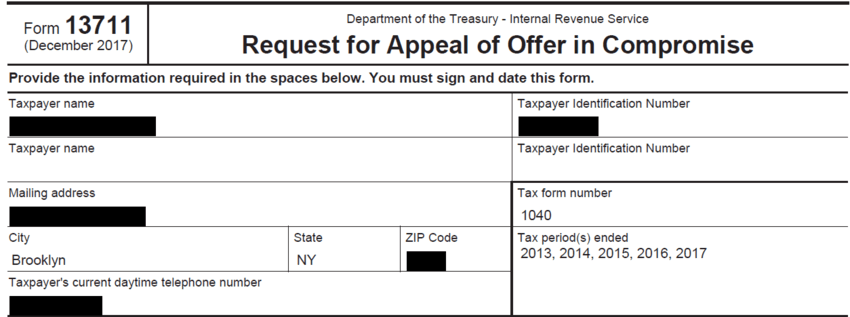
At the top of the form you’ll find the form number and title, then your information: name, daytime phone number, mailing address and taxpayer identification number.
In the box on the right, you list the tax form your balance comes from (Form 1040 for most people) and the tax periods covered by the offer. Copy these straight from your rejection letter so they match the IRS’s records.
Part 2: Authorized Representative’s Information

If a CPA, enrolled agent or tax attorney is handling the appeal, this is where their name, address and phone number go. The IRS wants a Form 2848, Power of Attorney, attached if it doesn’t already have one on file.
If you’re handling the appeal yourself, skip this part.
Part 3: Instructions on How to Appeal

This section matters more than it looks. It tells you exactly how the IRS wants your disagreement presented.
The IRS rejection letter came with an Income and Expense Table and an Asset and Equity Table. Those tables are how the IRS arrived at your “reasonable collection potential,” the amount it thinks it can collect from you. Your appeal is a line-by-line argument with those tables.
In the left column, name the item you dispute, using the same wording the IRS used in its tables. In the right column, state briefly why the IRS is wrong, with the specific number you say is correct and the documents that back it up.
The form also says you can dispute statements in the rejection letter that aren’t in the tables, as long as you can support your position.
Part 4: Primary Disagreed Item
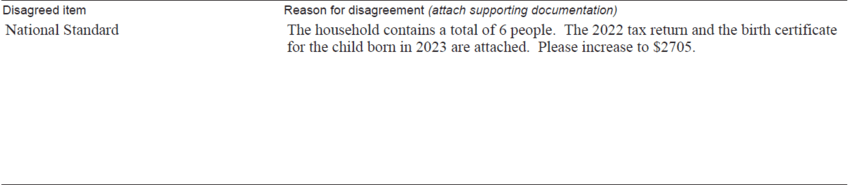
The front of the form has room for your main point of disagreement, with more space on the back.
On our client’s form, we led with the IRS’s National Standards allowance. The IRS had used the wrong household size: it hadn’t counted a child who had recently been born. One more dependent changes the allowable amounts for food, clothing and other living expenses, and that alone moved the numbers in our client’s favor.
That was far from the only problem with the offer specialist’s calculation, but you lead with your strongest, cleanest point.
Part 5: Taxpayer’s Certification

You, and your spouse if the offer is joint, sign here under penalties of perjury. You’re certifying that everything in the appeal is true, correct and complete to the best of your knowledge.
Don’t skip this. An unsigned appeal is an incomplete appeal, and you don’t want to find that out after the 30 days have run.
Part 6: Representative’s Certification

Your representative signs and dates here too, and checks one of two boxes: either they have personal knowledge that the facts in the appeal are true, or they prepared the appeal from information you gave them and don’t have personal knowledge of the facts.
Either box is fine. It just tells the appeals officer whose knowledge the statements rest on.
Part 7: Additional Disagreed Items
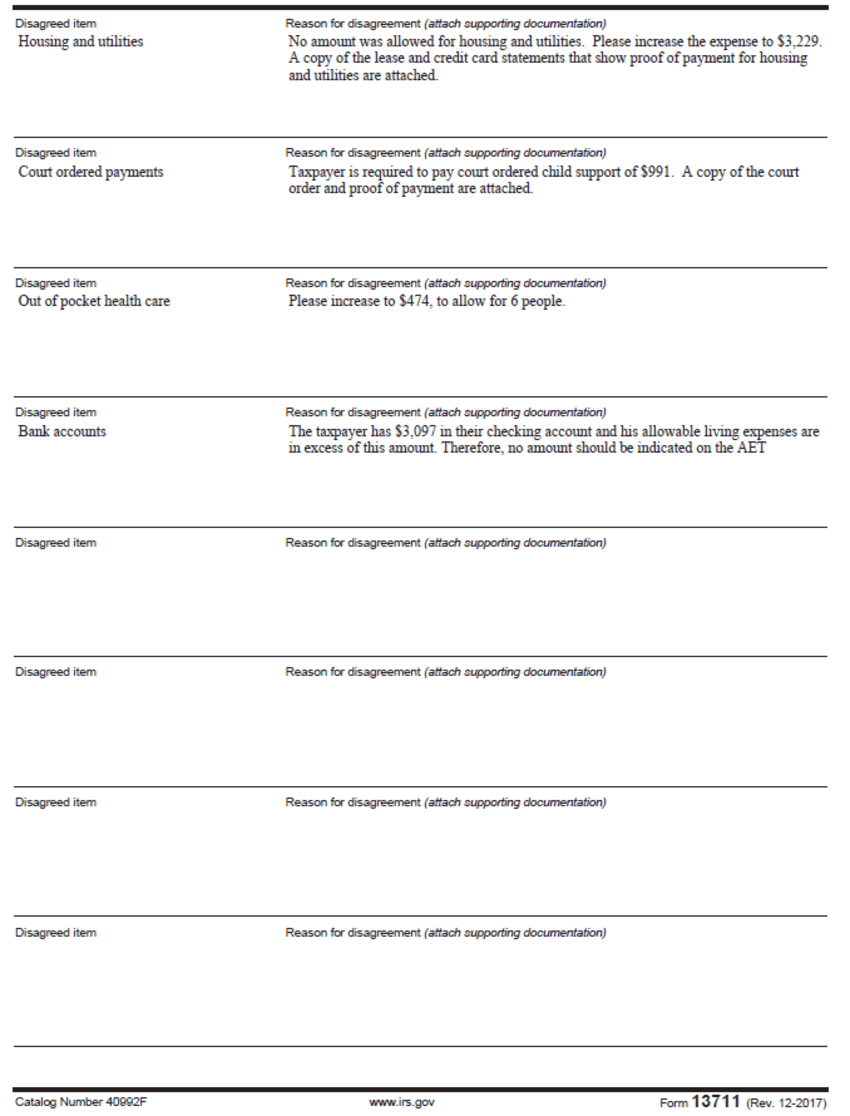
The back of the form gives you room for the rest of your disagreed items. On our client’s appeal, we listed several, all tied to the expense tables in the rejection letter:
- Housing: the IRS allowed $0. That’s not a typo. The IRS allowed nothing for housing even though we had provided a lease and credit card statements showing significant housing costs. We pointed to those documents and showed our own calculation of the client’s actual housing expense.
- Court-ordered child support. The IRS left it out of the client’s expenses entirely. We cited the amount, the court order and the payment history.
- Out-of-pocket health care. Because the IRS had missed the newborn, it also used the wrong number of people for the out-of-pocket health care allowance. We asked that the allowance be raised to $474 a month to account for the extra dependent.
- The Asset and Equity Table. The IRS counted the balance in the client’s checking account as an asset it could collect, even though the client’s allowable living expenses for the month were well above that balance. Money you need for next month’s rent and groceries isn’t equity the IRS gets to count.
Notice the pattern. Every item names a specific number, says what the IRS did with it, says what the number should be, and points to proof.
Still have questions? Talk to a tax expert — free.
What Happens After You File Form 13711
Your appeal goes to the office that rejected the offer, which checks that it’s timely and forwards your file to the Independent Office of Appeals. From there:
- An appeals officer is assigned and mails you Letter 5576. That letter confirms Appeals has your case and schedules a conference, usually a phone call. Under IRM 8.23.3, the officer should send it within 30 days of receiving your file, but files can wait in line for months before that happens. On one of our cases, five months passed between Appeals receiving the case and the letter going out.
- You get two 14-day windows. From the date on Letter 5576, you have 14 days to ask for the administrative file on your disputed items and 14 days to ask for a different conference time or format. The letter also sets a date for any additional information.
- The conference happens. It’s informal. You or your representative walk the appeals officer through each disagreed item and the documents behind it. Appeals works from the financial information already in your file and, if it’s less than 12 months old, generally won’t make you start your financial disclosure over.
- Appeals decides. It can tell the IRS to accept your offer, it can calculate a different reasonable collection potential and give you 14 days to raise your offer to match, or it can sustain the rejection.
Collection Is Paused While You Appeal
Filing on time does more than keep your offer alive. Under Internal Revenue Code section 6331(k), the IRS can’t levy your wages, bank accounts or other property for the tax covered by the offer while the offer is pending, for 30 days after a rejection, and, if you appeal within those 30 days, for as long as the appeal is pending.
The trade-off is that the IRS’s 10-year clock to collect stops running during that same time. So an appeal buys you protection, but it doesn’t run out the IRS’s time.
How to Appeal a Rejected Offer in Compromise
Here’s how we approach an OIC appeal, step by step.
Step 1: Figure Out Why the Offer Was Rejected
Read the rejection letter and its tables slowly. Most rejections say the IRS believes you can pay more than you offered, and the tables show exactly where that conclusion came from: an expense the IRS cut, an asset it valued too high, income it counted that you no longer have.
Sometimes the problem is simpler, like a missing document the offer specialist never received. Either way, you can’t argue with a number until you know which number is the problem.
Step 2: Rebuild Your Financial Picture Around the Disputed Items
Go back through your income, expenses, assets and debts with the IRS’s tables next to you. For every item you plan to dispute, gather the proof: pay stubs, bank statements, a lease, medical bills, a court order, an appraisal. If your circumstances have changed since you filed the offer, document the change too.
Step 3: Complete Form 13711
List each disagreed item in the IRS’s own words, give your number, and name the documents that support it. Keep it short and specific. The appeals officer is going to compare your claims with your evidence, and a clear table beats three pages of narrative.
You can also appeal by letter instead of using the form. The IRS says the letter has to include your name, address, taxpayer identification number and daytime phone, a statement that you want to appeal to the Independent Office of Appeals, a copy of the rejection letter, the tax periods involved, the items you disagree with and why, the facts and any law that support you, and your signature under penalties of perjury (IRS, Appeal your rejected offer in compromise).
Step 4: Send It Within 30 Days
Mail the appeal to the office that sent the rejection letter, at the address on that letter, so that it arrives within 30 days of the letter’s date. We send appeals by certified mail with a return receipt and keep a complete copy of the package.
Step 5: Prepare for the Conference
Appeals can take months to reach your case, so use the time. Organize your documents by disagreed item, and think about where the appeals officer might land. Appeals often doesn’t accept the original offer as filed. It calculates its own number and invites you to amend your offer up to it, and you’ll have 14 days to decide. Know in advance what amount you could live with.
Step 6: Decide Whether to Get Help
An OIC appeal is won or lost on reasonable collection potential math: allowable expenses, asset equity and future income. A CPA, enrolled agent or tax attorney who works these cases every day knows which arguments move the number and which ones appeals officers have heard a thousand times. That’s what we do, and it’s where the $90,000-to-$2,000 result above came from.
If you’d like us to look at your rejection letter before the 30 days run out, book a free consultation or call us at 866-8000-TAX.
IRS Form 13711: Frequently Asked Questions
What is IRS Form 13711?
Form 13711, Request for Appeal of Offer in Compromise, is the form you use to ask the IRS Independent Office of Appeals to review an offer in compromise the IRS rejected. It lists the items in the IRS’s rejection you disagree with and why.
How long do I have to appeal a rejected offer in compromise?
30 days from the date on the rejection letter. The IRS says appeals filed after that won’t be accepted.
Where do I send Form 13711?
To the IRS office that sent you the rejection letter, at the address shown on the letter. That office forwards your case to Appeals.
Can I appeal an offer in compromise the IRS returned?
No. Only rejected offers can be appealed. If the IRS returned your offer and you think that was a mistake, the IRS says to call the number on the return letter within 30 days and ask for a reconsideration.
Can the IRS levy me while my offer in compromise appeal is pending?
No. Federal law bars levies while an offer is pending, for 30 days after a rejection, and during an appeal filed within those 30 days. The IRS’s 10-year collection clock is paused during that time too.
What happens after I file Form 13711?
An appeals officer is assigned to your case and mails you Letter 5576, which schedules a conference, usually by phone. After the conference, Appeals can accept your offer, ask you to raise it to a number it calculates, or sustain the rejection. Its decision isn’t reviewable by a court.
Do I need a tax professional to file Form 13711?
No, but the appeal turns on the IRS’s reasonable collection potential calculation, and a representative who works these cases regularly can challenge allowable expenses, asset values and income assumptions more effectively. Your representative signs the form too and must have a Form 2848 on file.

“Their team of experts saved me a staggering $23,000 in taxes owed to the IRS. From the initial consultation to the final resolution, they demonstrated exceptional professionalism, knowledge, and dedication.”
Get Help Now
Got IRS Form 13711? Get a straight answer before you respond.
Talk to a tax expert — free, no obligation. We’ve resolved over $20 million in IRS debt for our clients.


Author:

Logan Allec, CPA, Founder and Owner
Logan Allec has been serving taxpayers as a CPA for over 14 years. After leaving his role at a "Big 4" firm, he started Choice Tax Relief to help everyday Americans who have found themselves behind on their taxes. He also educates thousands of people daily about tax relief on his YouTube channel. In addition to his CPA license, Logan also has a Master's Degree in Taxation from the University of Southern California (USC). He lives with his wife and children in the Los Angeles area. Learn more about Logan here.