

IRS Letter 5576: What It Is and How to Respond

If IRS Letter 5576 just showed up in your mailbox, it means two things.
First, the IRS rejected the offer in compromise you submitted.
Second — and this is the good news — your appeal of that rejection made it to the IRS Independent Office of Appeals, and an appeals officer has scheduled a conference to hear you out.
In other words, Letter 5576 is the official start of round two in your fight for your offer in compromise.
Here is a redacted Letter 5576 that one of our clients received.
In this article, I’ll walk you through the current Letter 5576 part by part and explain exactly what to do before your conference date arrives.
Key Takeaways
- IRS Letter 5576 is the acknowledgement and conference letter the IRS Independent Office of Appeals sends after you appeal a rejected offer in compromise.
- Your offer was already rejected before this letter arrived — typically because the IRS calculated that you can pay more than you offered.
- The conference is usually by telephone, but you can request a video conference, an in-person meeting, or correspondence by mail or secure messaging instead.
- Two 14-day windows run from the letter date — one to request access to the administrative file in your case and one to ask for a different conference time or format.
- The letter also sets a deadline to submit any additional information you want the appeals officer to consider.
- If you skip the conference and don’t respond, Appeals decides your offer on the information it already has — and if it sustains the rejection, that decision is not reviewable by any court.
Table of Contents
IRS Letter 5576 At a Glance
| Question | Answer |
|---|---|
| What is it? | Confirmation that the Independent Office of Appeals received your appeal of a rejected offer in compromise — with a conference date and time |
| Is it bad news? | No — it means your appeal is moving forward and you’ll get to make your case to an appeals officer |
| Who sends it? | The IRS Independent Office of Appeals — not the collection unit that rejected your offer |
| What are the deadlines? | 14 days to request the administrative file or a different conference arrangement, plus a stated deadline for additional information |
| What’s at stake? | Whether your offer in compromise gets accepted after all — Appeals’ decision is not reviewable by any court |
Free Consultation
Got IRS Letter 5576? Get a straight answer before you respond.
Talk to a tax expert — free, no obligation. We’ve resolved over $20 million in IRS debt for our clients.
How You End Up With a Letter 5576
Letter 5576 only arrives after a specific sequence of events.
- You submitted an offer in compromise: you filed Form 656 along with a financial disclosure on Form 433-A (OIC) or Form 433-B (OIC), asking the IRS to settle your tax debt for less than you owe.
- The IRS rejected it: the IRS sent you a rejection letter — most commonly because its calculation of your “reasonable collection potential” came out higher than your offer amount.
- You appealed within 30 days: you filed Form 13711, Request for Appeal of Offer in Compromise — or a written protest — within 30 days of the date on the rejection letter.
- Appeals took the case: the Independent Office of Appeals received your case, assigned it to an appeals officer, and that officer mailed you Letter 5576.
The IRS’s own procedures — Internal Revenue Manual (IRM) 8.23.3, Evaluation of Offers in Compromise — say the appeals officer assigned to your case should send this letter within 30 days of receiving your file.
The Collection-side procedures for rejecting an offer and routing a timely appeal to Appeals are spelled out in IRM 5.8.7, Return, Terminate, Withdraw, and Reject Processing.
On our sample letter, the taxpayer’s case was received by Appeals on January 27, 2026, and the letter itself is dated June 22, 2026 — so be prepared for some quiet months between filing your appeal and hearing from your appeals officer.
Letter 5576 vs. Letter 6459C
Letter 5576 is one of several letters you may see over the life of an offer in compromise, and it’s easy to confuse them.
Here’s how Letter 5576 compares to Letter 6459C, the monitoring letter the IRS sends after an offer is accepted.
| Letter 5576 | Letter 6459C | |
|---|---|---|
| Where you are in the OIC process | Your offer was rejected and you appealed — Appeals has your case | Your offer was accepted and you’re in the payment and compliance phase |
| Who sends it | IRS Independent Office of Appeals | IRS Monitoring Offer in Compromise (MOIC) unit |
| What it’s telling you | Your appeal was received and a conference is scheduled | The IRS is monitoring your offer payments and tax compliance |
| Deadlines involved | 14 days to request the file or change the conference; a set date for additional information | Varies — typically tied to your offer payment terms |
| What’s at stake | Whether your offer gets accepted after all | Whether your accepted offer stays in good standing |
IRS Letter 5576 Explained, Part by Part
Here is a full explanation of the Letter 5576, part by part, based on our client’s recent Letter 5576.
Part 1: The Letterhead and Case Information
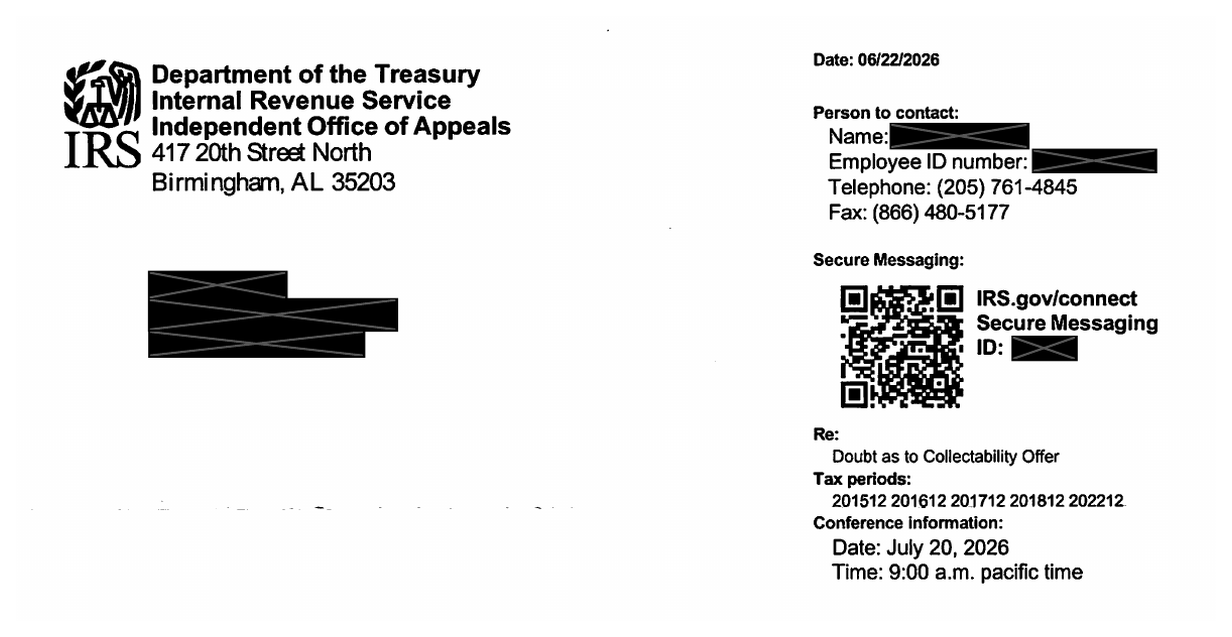
The first thing to notice is who this letter is from: the Independent Office of Appeals, not the IRS collection unit that rejected your offer.
That distinction matters, because Appeals is set up to be independent of the IRS office that made the original decision in your case.
The right-hand column packs in the details you’ll actually use:
- Date: the letter date — your 14-day windows run from this date, which on our sample is June 22, 2026.
- Person to contact: the name, employee ID, telephone number, and fax number of your assigned appeals officer.
- Secure Messaging: a QR code and ID for IRS Secure Messaging at IRS.gov/connect, which lets you and your representative communicate with the appeals officer online.
- Re: the type of case — our sample says “Doubt as to Collectability Offer,” meaning the offer was based on the taxpayer’s inability to pay the full liability.
- Tax periods: the periods covered by the offer in YYYYMM format — “201512,” for example, is the tax year ending December 2015.
- Conference information: the scheduled date and time of your appeals conference — July 20, 2026, at 9:00 a.m. Pacific time on our sample.
Part 2: The Headline and the Rejection Recap
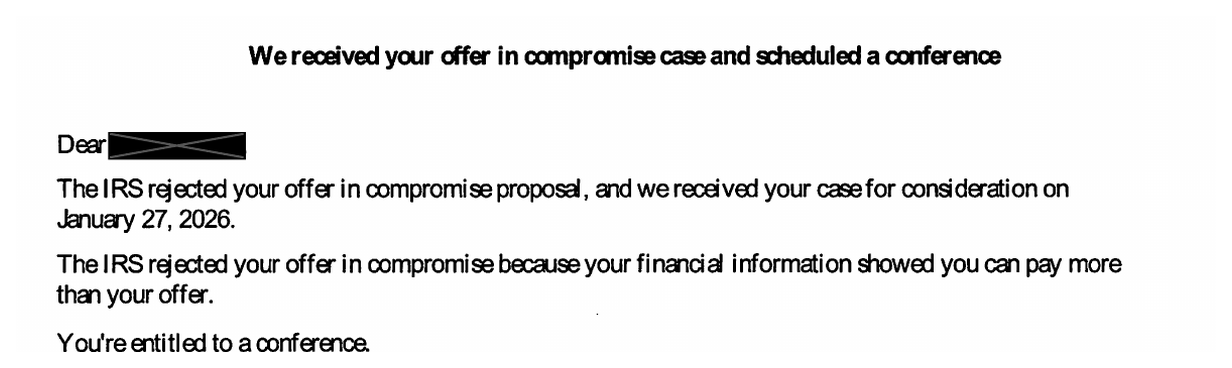
The headline says it plainly: “We received your offer in compromise case and scheduled a conference.”
On our sample, the IRS states that it rejected the offer and received the case for consideration on January 27, 2026.
It also restates the rejection reason: the taxpayer’s financial information showed they can pay more than their offer.
That one sentence is the entire battlefield of your appeal.
The IRS computed a “reasonable collection potential” — its estimate of what it could collect from your assets and future income — and that number came out higher than your offer.
Your appeal is your chance to show the appeals officer why that calculation overstates what you can actually pay.
Finally, the letter confirms the single most important sentence in it: “You’re entitled to a conference.”
Part 3: Your Conference, Your Options, and Your Deadlines
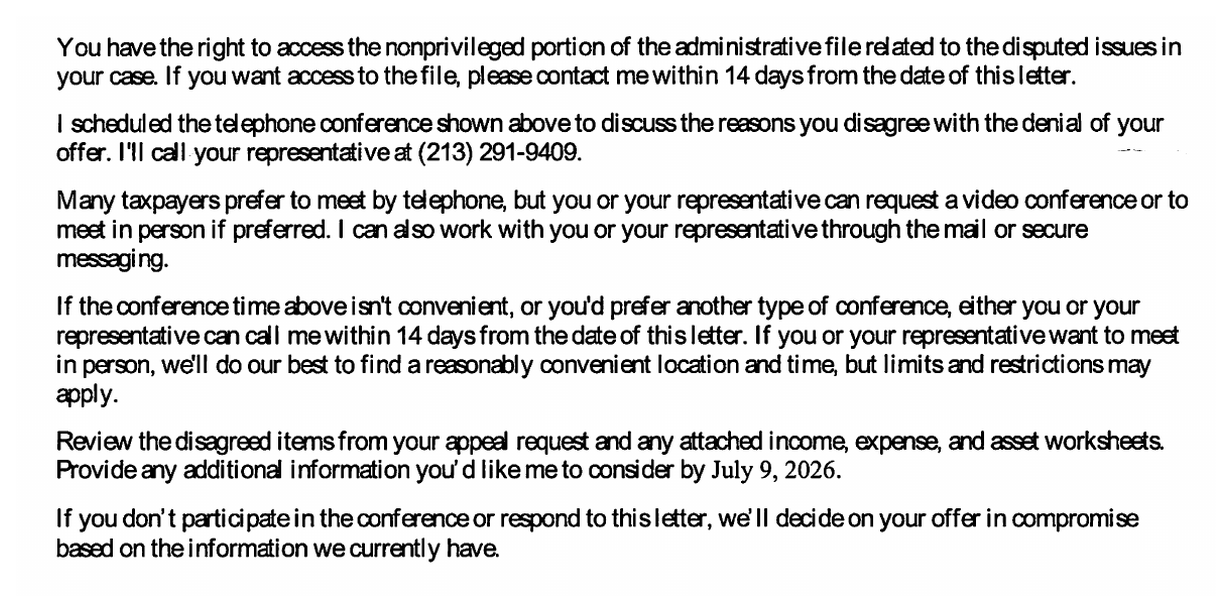
This section is where your to-do list lives.
- Administrative file access: you have the right to see the nonprivileged portion of the administrative file on your disputed issues — but you must contact the appeals officer within 14 days of the letter date to request it.
- The telephone conference: the appeals officer scheduled the call shown on page 1 and will dial you — or, as on our sample, your representative — at the number listed.
- Other formats: you or your representative can request a video conference or an in-person meeting instead, and the appeals officer can also work your case through the mail or secure messaging.
- Rescheduling: if the conference time doesn’t work, you have 14 days from the letter date to call and arrange a different time or type of conference.
- Additional information: the letter tells you to review the disagreed items from your appeal along with the income, expense, and asset worksheets — and to provide anything new by a stated deadline, which is July 9, 2026 on our sample.
The section closes with a warning worth taking seriously: if you don’t participate in the conference or respond to the letter, Appeals will decide your offer based on the information it already has.
Part 4: The Appeals Process
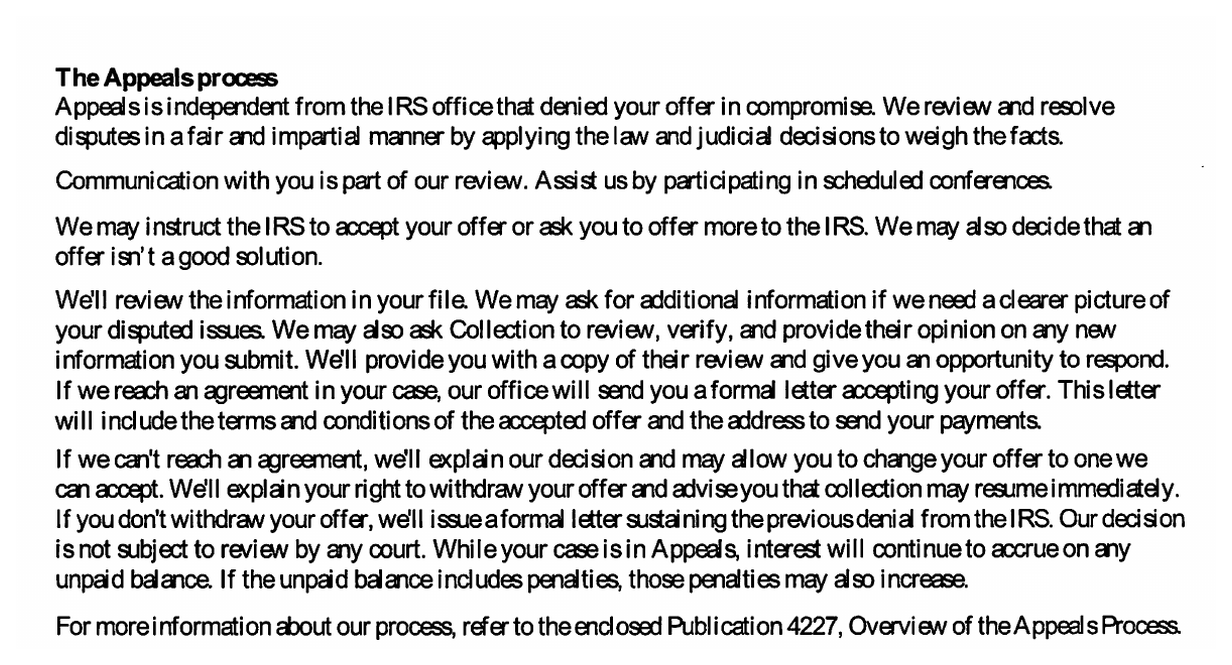
Page 2 of the letter explains how the Independent Office of Appeals will handle your case, and it’s worth reading closely.
Appeals starts by emphasizing its independence from the IRS office that denied your offer, and says it resolves disputes “in a fair and impartial manner by applying the law and judicial decisions to weigh the facts.”
It then lays out what can happen:
- Appeals can instruct the IRS to accept your offer — the outcome you’re hoping for.
- Appeals can ask you to offer more — often the practical result when the numbers land somewhere in the middle.
- Appeals can decide an offer isn’t a good solution at all — sustaining the rejection.
The letter also explains that if you submit new information, Appeals may ask Collection to review and verify it and provide an opinion — and you’ll get a copy of that review and a chance to respond.
Under IRM 8.23.3, the appeals officer generally works from the financial analysis already in your file and isn’t supposed to go hunting for additional assets beyond what Collection documented, or revise asset values upward, unless information you provide supports it.
If you reach an agreement, Appeals will send a formal acceptance letter with the terms and conditions of your accepted offer.
If you can’t reach an agreement, Appeals will explain its decision, may allow you to amend your offer to an acceptable amount, and will advise you of your right to withdraw the offer.
Two sentences in this section deserve special attention.
First: “Our decision is not subject to review by any court” — unlike many IRS disputes, a sustained OIC rejection in a non-CDP case is the end of the administrative road.
Second: while your case sits in Appeals, interest keeps accruing on your unpaid balance, and penalties may continue to grow too.
Part 5: Taxpayer Rights and Sources for Assistance
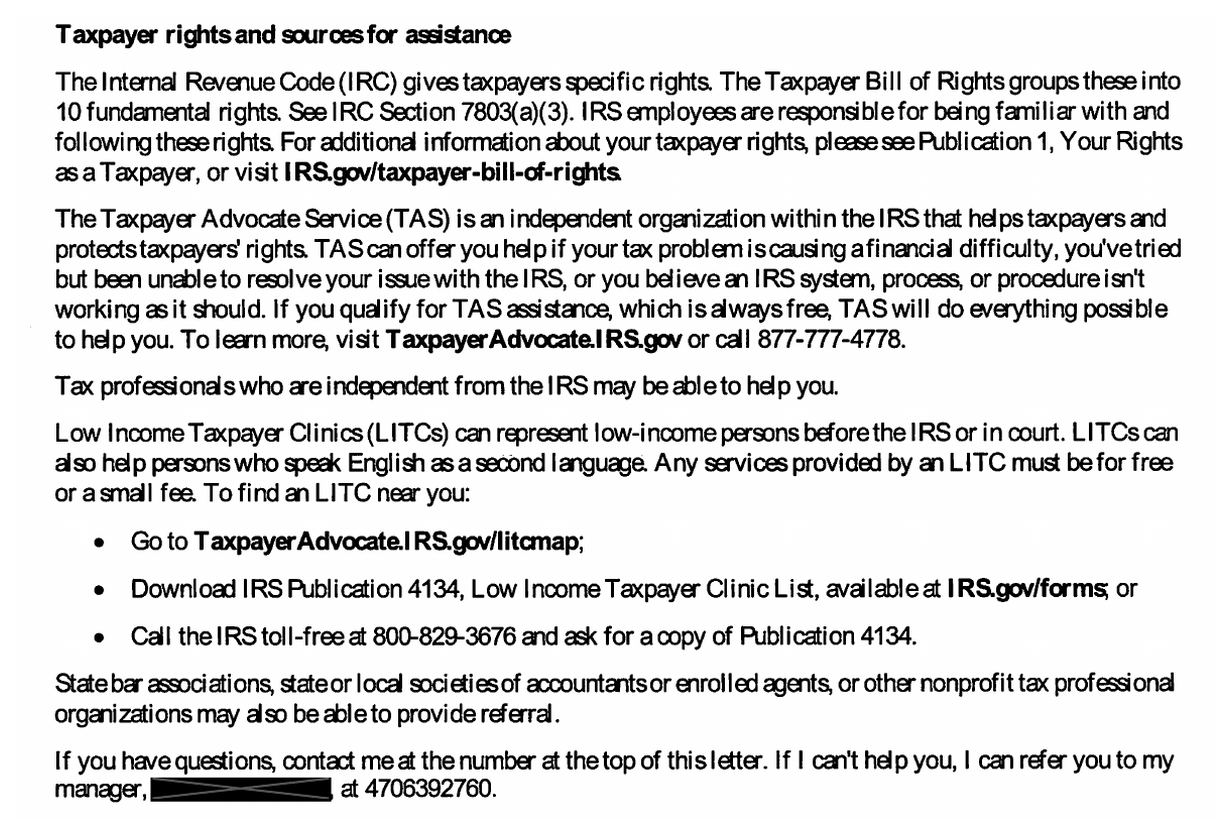
This is the letter’s standard rights section, but a few items are genuinely useful.
- Taxpayer Bill of Rights: the letter points you to the 10 fundamental rights grouped under IRC Section 7803(a)(3), detailed in Publication 1 and at IRS.gov/taxpayer-bill-of-rights.
- Taxpayer Advocate Service (TAS): an independent organization within the IRS that can help if your tax problem is causing financial difficulty — reachable at TaxpayerAdvocate.IRS.gov or 877-777-4778.
- Low Income Taxpayer Clinics (LITCs): free or low-cost representation for qualifying taxpayers.
- The manager escalation path: the letter names the appeals officer’s manager and gives a direct phone number in case the officer can’t resolve your question.
Part 6: Secure Messaging, Faxing, and the Signature Block
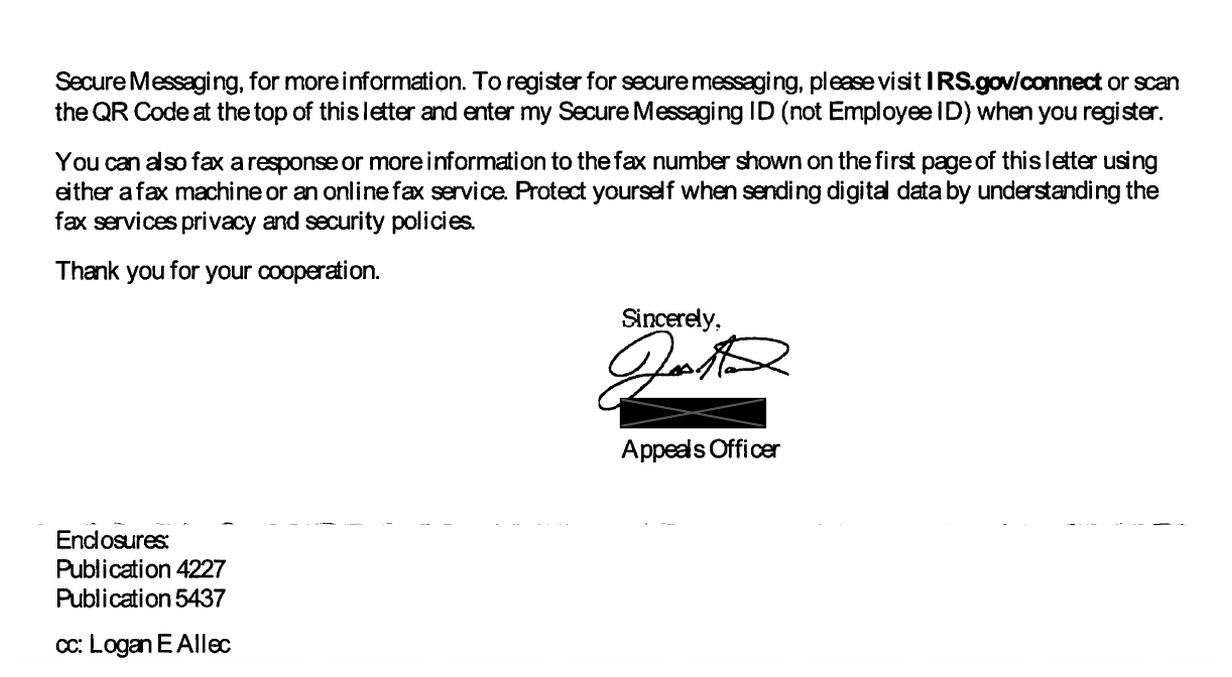
The final page covers the mechanics of communicating with your appeals officer.
- Secure messaging: register at IRS.gov/connect using the Secure Messaging ID from page 1 — not the employee ID — to exchange messages and documents online.
- Fax: you can fax a response or additional information to the fax number on page 1.
- Enclosures: our sample came with Publication 4227 (an overview of the Appeals process) and Publication 5437 (a guide to Appeals secure messaging).
- The cc line: if you have an authorized representative, they get a copy — which is exactly why our firm received this sample letter.
When Does the IRS Send Letter 5576?
The IRS sends Letter 5576 after your appeal of a rejected offer in compromise lands on an appeals officer’s desk.
Under IRM 8.23.3, the appeals officer should make initial contact by issuing this letter within 30 days of receiving the case.
Keep in mind, though, that “receiving the case” can happen months after you filed your appeal — cases wait in queue before being assigned.
On our sample, roughly five months passed between Appeals receiving the case in January and the letter going out in June.
So if you appealed a rejected offer and haven’t heard anything, a long silence followed by a Letter 5576 is the normal rhythm — not a sign your appeal was lost.
Still have questions? Talk to a tax expert — free.
What Should You Do After Receiving Letter 5576?
Here’s the game plan, step by step.
Step 1: Calendar Every Date in the Letter
That means the conference date and time, the 14-day window to request the administrative file or a different conference arrangement, and the stated deadline for submitting additional information.
Miss the information deadline and the appeals officer may decide your case on the file as it stands.
Step 2: Decide Whether To Request the Administrative File
You have the right to see the nonprivileged portion of the file on your disputed issues, and it shows you exactly how the IRS built the numbers that sank your offer.
If you want it, contact the appeals officer within 14 days of the letter date.
Step 3: Rebuild the Financial Picture Around the Disputed Items
Pull out the income, expense, and asset worksheets from the rejection and your appeal, and gather proof — pay stubs, bank statements, appraisals, medical bills, anything that supports your side of each disagreed number.
One helpful rule from IRM 8.23.3: if the financial statement in your file is less than 12 months old, the appeals officer generally shouldn’t make you start your financial disclosure over from scratch.
Step 4: Submit Your Additional Information by the Deadline
You can mail it, fax it to the number on page 1, or upload it through IRS Secure Messaging once you’ve registered at IRS.gov/connect.
Remember that anything new you submit may be routed to Collection for verification, so make it accurate and well documented.
Step 5: Show Up — Prepared — or Have Your Representative Show Up for You
The conference is informal, but it’s still a negotiation over what you can actually pay.
A licensed representative who speaks the language of reasonable collection potential can argue allowable expenses, asset valuations, and future income assumptions in a way that moves the number.
If you’d like that kind of help with your OIC appeal, book a free consultation with our team or call us at 866-8000-TAX.
How Your OIC Appeal Can End
There are really only four ways out of the process Letter 5576 kicks off.
- Your offer is accepted: Appeals instructs the IRS to accept your original offer and sends a formal acceptance letter with the terms — at which point you’re on your way to a Letter 6459C world of making your payments and staying compliant.
- You amend your offer upward: if Appeals calculates a reasonable collection potential meaningfully different from Collection’s figure, it may give you 14 days to amend your offer to match — often the realistic win.
- You withdraw your offer: the letter advises you of this right, but understand that collection activity may resume immediately after withdrawal.
- The rejection is sustained: Appeals issues a formal letter sustaining the denial, and that decision is not subject to review by any court.
Even a sustained rejection isn’t necessarily the end of the story — you can submit a new offer later if your financial circumstances genuinely support one.
What Happens If You Ignore Letter 5576?
Ignoring Letter 5576 is one of the more expensive mistakes you can make in the OIC process.
If you skip the conference and don’t respond, the appeals officer decides your offer on the information already in the file — the same information that got your offer rejected in the first place.
The likely result is a formal letter sustaining the rejection, with no court review available.
Once the rejection is final, IRS collection resumes — meaning the balance-due notice stream, from reminders like CP503 up to the levy-warning CP504, and eventually enforced collection such as liens and levies.
And remember: interest has been accruing on your unpaid balance the entire time your case sat in Appeals.
You went to the trouble of filing Form 13711 and waiting months for this conference — don’t leave the last, most important step on the table.
IRS Letter 5576: Frequently Asked Questions
What is IRS Letter 5576?
Letter 5576 is the acknowledgement and conference letter the IRS Independent Office of Appeals sends after you appeal a rejected offer in compromise. It confirms Appeals received your case, restates why your offer was rejected, and schedules a conference with your assigned appeals officer.
Does Letter 5576 mean my offer in compromise was rejected?
Yes — the rejection already happened before this letter. But Letter 5576 means your appeal of that rejection was received and is being heard, so your offer is still very much alive.
Do I have to do the appeals conference by phone?
No — telephone is the default, but you or your representative can request a video conference or an in-person meeting, or work the case through the mail or IRS Secure Messaging. Contact the appeals officer within 14 days of the letter date to make other arrangements.
Can Appeals actually accept my rejected offer?
Yes — Appeals can instruct the IRS to accept your offer as submitted. And even when it won’t go that far, it may invite you to amend your offer to a number it calculates it can accept.
What happens if Appeals sustains the rejection of my offer?
Appeals issues a formal letter sustaining the denial, and in a non-CDP case that decision is not reviewable by any court. IRS collection can then resume — though you remain free to submit a new offer in compromise later if your finances support one.
Should I hire a tax professional for an offer in compromise appeal?
You’re not required to, but an OIC appeal is won or lost on reasonable collection potential math — allowable expenses, asset equity, and future income — and an experienced representative can challenge those numbers far more effectively. That’s exactly what we do at Choice Tax Relief.

“After carrying a tax burden for more than 10 years, we honestly thought there was no realistic solution. Our tax debt had grown to over $120,000 and had become a constant source of stress and worry. The team at Choice Tax Relief completely changed that. In a matter of days, they were able to reduce our tax liability to less than $15,000.”
Get Help Now
Got IRS Letter 5576? Get a straight answer before you respond.
Talk to a tax expert — free, no obligation. We’ve resolved over $20 million in IRS debt for our clients.


Author:

Logan Allec, CPA, Founder and Owner
Logan Allec has been serving taxpayers as a CPA for over 14 years. After leaving his role at a "Big 4" firm, he started Choice Tax Relief to help everyday Americans who have found themselves behind on their taxes. He also educates thousands of people daily about tax relief on his YouTube channel. In addition to his CPA license, Logan also has a Master's Degree in Taxation from the University of Southern California (USC). He lives with his wife and children in the Los Angeles area. Learn more about Logan here.