

IRS Letter 143C: What It Is and How to Respond

If you just pulled IRS Letter 143C out of your mailbox, take a breath.
This letter is not an audit, and it is not a bill.
The IRS is telling you one specific thing: the tax return you filed lacks a valid original signature, and until you fix that, the IRS will not treat your return as filed.
In this article, I’ll walk you through a real Letter 143C my firm received for a client, section by section, and show you exactly how to respond before the 30-day deadline.
You can view the full letter here: redacted IRS Letter 143C that one of our clients received (PDF).
Important: The redacted letter in this article is a CAF copy — the version the IRS mails to a taxpayer’s authorized representative — which is why it’s addressed in care of Choice Tax Relief.
Key Takeaways
- Letter 143C means the IRS has your tax return but can’t process it because the return is missing a valid original signature.
- Photocopied, stamped, or scanned signatures don’t count — the IRS wants your original ink signature on the “Sign Here” line of your return.
- Do not sign the letter itself. Sign the return, and if you filed jointly, both spouses must sign.
- You generally have 30 days from the date on the letter to mail your signed return back to the address at the top of the letter.
- An unsigned return is not a valid return in the eyes of the IRS and the courts, so refunds stay frozen and the statute of limitations never starts running.
- If you owe tax for the year in question, don’t sit on this letter — failure-to-file penalties can keep growing until the IRS has a validly signed return on file.
Table of Contents
What Is IRS Letter 143C?
IRS Letter 143C is a correspondence letter the IRS sends when it has received a tax return — or a request to adjust a tax account — but the paperwork is missing something it needs, most commonly a valid original signature.
On the redacted letter in this article, the problem is spelled out in the very first sentence: “Your tax return lacks a valid original signature.”
Federal law is strict on this point.
- IRC §6061 requires that a tax return be signed in accordance with the forms and regulations the IRS prescribes.
- IRC §6065 requires that a return contain a declaration that it is made under penalties of perjury — which is exactly what the signature block on your Form 1040 says.
The United States Tax Court, in the landmark case Beard v.
Commissioner, held that a document only counts as a valid tax return if, among other things, it is executed under penalties of perjury — in other words, signed.
So an unsigned return sitting in an IRS service center is, legally speaking, not a return at all.
The Internal Revenue Manual tells IRS employees to use Letter 143C to request the missing signature and any other missing information from the taxpayer.
You can see this guidance in IRM 21.5.1, which covers general account adjustments and directs employees to Letter 143C when a case can’t move forward without more information, including no-reply procedures for taxpayers who ignore it.
Free Consultation
Got IRS Letter 143C? Get a straight answer before you respond.
Talk to a tax expert — free, no obligation. We’ve resolved over $20 million in IRS debt for our clients.
Letter 143C vs. Form 3531: What’s the Difference?
The IRS actually has two different ways of chasing a missing signature, and it helps to know which one you’re holding.
| Letter 143C | Form 3531 | |
|---|---|---|
| What it is | A correspondence letter about your return or account | A “Request for Signature or Missing Information” form packet |
| Where your return is | The IRS typically keeps your return while it corresponds with you | Your original return is usually mailed back to you with the form on top |
| Who sends it | IRS accounts and adjustments functions working your account | IRS submission processing centers rejecting the return up front (see IRM 3.11.3) |
| What you do | Sign your return with an original signature and mail it to the address on the letter within 30 days | Sign the returned original return and mail the entire packet back |
| What they have in common | Both mean your return is not yet a valid, processable return — and both reject photocopied signatures | |
Why Did You Get Letter 143C?
In practice, a missing-signature letter almost always traces back to one of a few scenarios.
- You simply forgot to sign a paper return before dropping it in the mail — by far the most common cause.
- You sent a photocopy or printout of a signed return, so the signature on file is a reproduction rather than an original.
- You filed a joint return and only one spouse signed, when the IRS requires both signatures on a joint Form 1040.
- You signed in the wrong place, such as on a cover letter or attachment instead of the “Sign Here” line.
- Someone signed on your behalf — a preparer or representative — without the required authorization attached.
Whatever the cause, the fix is the same: get a valid original signature in front of the IRS.
Breaking Down Letter 143C Section by Section
Let’s walk through the actual letter, using the redacted letter my firm received.
Part 1: The Letter Header
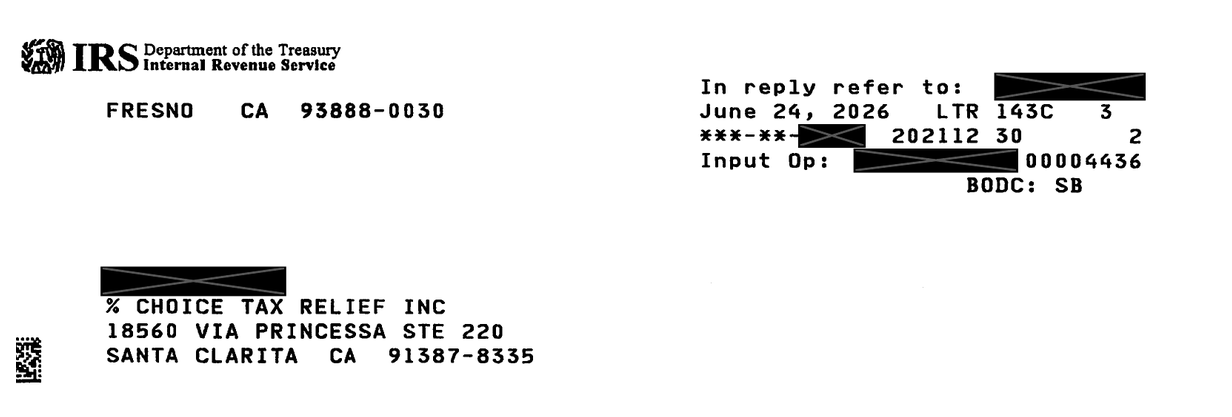
The top of the letter tells you who’s writing and why.
- Sender: this client’s notice came from the IRS campus in Fresno, CA 93888.
- Letter date: June 24, 2026 — your 30-day response clock runs from this date.
- Letter number: “LTR 143C” appears in the upper right, which is how you know exactly which letter you’re holding.
- BODC code: the “BODC: SB” notation means the account sits in the IRS’s Small Business/Self-Employed operating division.
Because this is a CAF copy, the recipient block shows the client’s name (redacted) in care of Choice Tax Relief’s office.
When a taxpayer has an authorized representative on file with the IRS’s Centralized Authorization File, the IRS mails the representative a copy of most notices and letters.
Part 2: The Tax Year and Form at Issue

Next, the letter identifies exactly which return has the signature problem.
- Taxpayer identification number: masked except the last digits.
- Tax period: Dec. 31, 2021 — meaning the client’s 2021 Form 1040.
- Form: 1040.
Notice the timeline here: the letter is dated June 2026, but it concerns a 2021 return.
That’s a common pattern in our practice — taxpayers catching up on several years of unfiled returns file older paper returns, and a missing signature on any one of them can stall the whole catch-up plan.
Part 3: The Problem — and Exactly How to Fix It
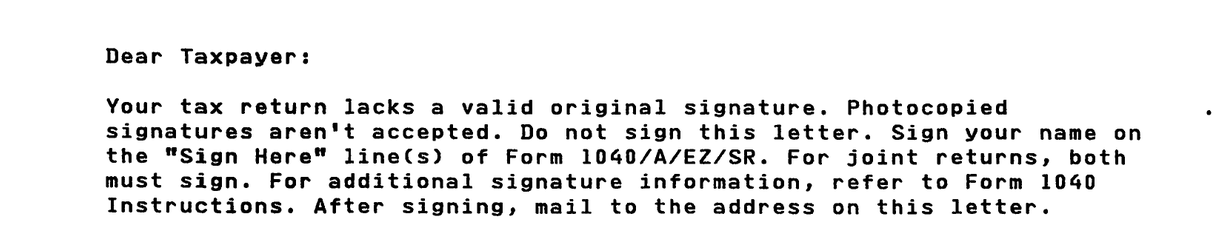
This paragraph is the heart of Letter 143C, and it packs in every rule you need to know.
- “Your tax return lacks a valid original signature” — the IRS has your return but won’t process it.
- “Photocopied signatures aren’t accepted” — you need to sign in ink, not send a copy of a signature.
- “Do not sign this letter” — signing the letter itself does nothing; the signature has to be on the return.
- “Sign your name on the ‘Sign Here’ line(s) of Form 1040/A/EZ/SR” — that’s the signature block on page two of your Form 1040.
- “For joint returns, both must sign” — one spouse’s signature isn’t enough on a married-filing-jointly return.
- “After signing, mail to the address on this letter” — send it back to the address at the top of the letter, not your usual filing address.
If the IRS didn’t enclose your return with the letter, sign a complete copy of the return you filed and mail that.
Part 4: The 30-Day Deadline

The IRS asks for your response within 30 days of the date of the letter and even encloses a return envelope.
On this client’s notice, that means a letter dated June 24, 2026 called for a response by roughly July 24, 2026.
If you have questions, the letter lists 800-829-0922 as the number to call.
Part 5: How to Respond in Writing
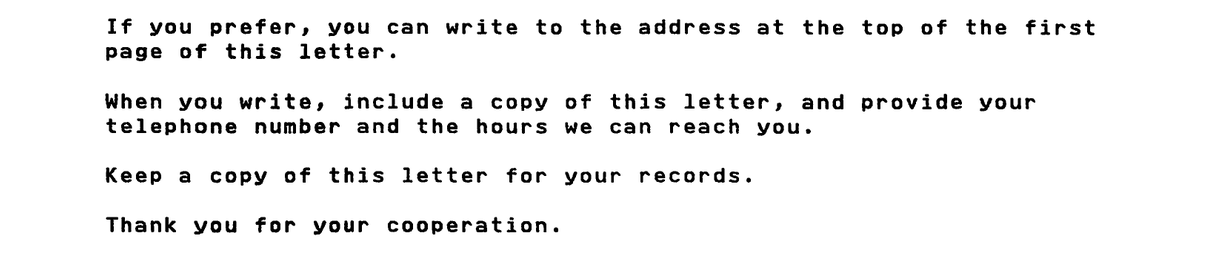
The letter closes with standard correspondence housekeeping.
- Write to the address at the top of page one if you prefer responding by mail.
- Include a copy of the letter with anything you send, so the IRS can match your response to your file.
- Provide your phone number and the best hours to reach you.
- Keep a copy of the letter — and, I’d add, a copy of everything you mail back.
Part 6: Page Two — Signature Block
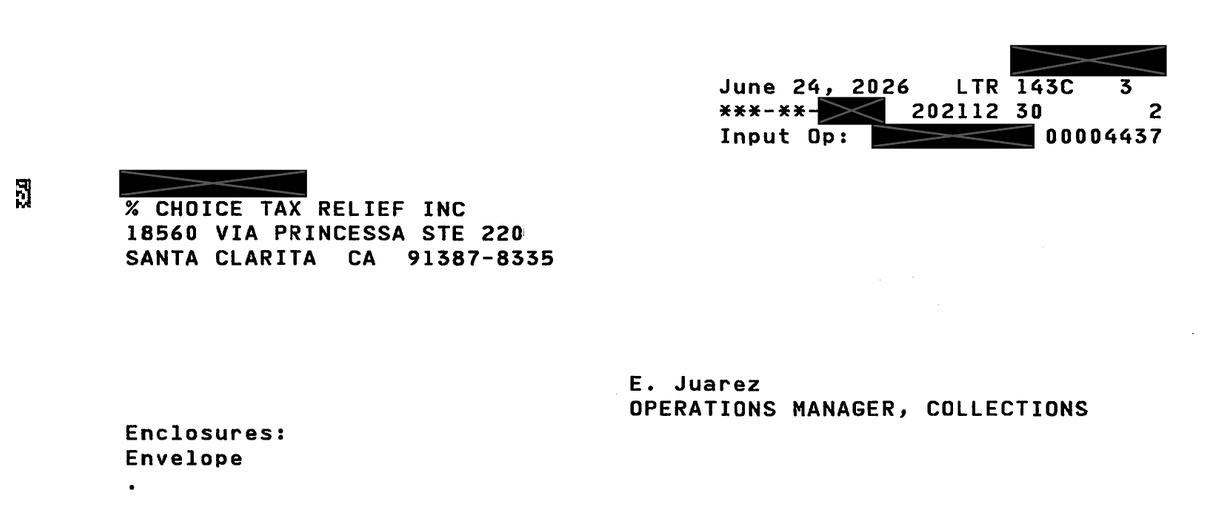
Page two repeats the header information and closes with the IRS employee’s signature block.
On this client’s notice, the letter is signed by an operations manager in Collections, and the enclosures line confirms the IRS included a reply envelope.
A Collections signature block is worth noticing — it’s consistent with a back-year return filed as part of resolving an outstanding account, which is exactly the situation many Letter 143C recipients are in.
Why a Missing Signature Is a Bigger Deal Than It Sounds
It’s tempting to treat Letter 143C as bureaucratic busywork.
But until the IRS has a validly signed return from you, you’re exposed in several ways.
- Your refund stays frozen. The IRS won’t release a refund on a return it can’t legally process.
- The refund clock keeps ticking. The deadline to claim a refund — generally three years from the return’s due date — doesn’t pause while your unsigned return sits in limbo, so on an older return a long delay can cost you the refund entirely.
- The statute of limitations never starts. The three-year window the IRS has to audit and assess tax only starts when a valid return is filed, so an unsigned return leaves that window open indefinitely.
- Penalties can keep growing. If you owe tax for the year, the failure-to-file penalty — up to 25% of the unpaid tax — is calculated based on when a valid return is finally filed.
If penalties have already piled up on your account, read about your options on our penalty abatement page — first-time abatement or reasonable cause relief may apply.
Still have questions? Talk to a tax expert — free.
What to Do When You Receive Letter 143C
Step 1: Read the letter and identify the return.
Confirm which tax year and form the IRS is asking about — on this client’s notice, the 2021 Form 1040.
Step 2: Sign the return — not the letter — in ink.
Sign on the “Sign Here” line of the Form 1040, with an original signature, exactly as the letter instructs.
If your original return wasn’t enclosed, print or copy the complete return you filed and sign that.
Step 3: Get both spouses’ signatures on a joint return.
A married-filing-jointly return needs both signatures before the IRS will treat it as valid.
Step 4: Mail it back within 30 days — with proof.
Send the signed return to the address at the top of the letter, include a copy of the letter, and use certified mail with return receipt so you can prove when you responded.
Step 5: Keep copies and follow up.
Keep a copy of everything, then watch your IRS online account or Where’s My Refund to confirm the return finally posts.
If nothing has changed after several weeks, call the number on the letter — 800-829-0922 on this client’s notice — with the letter in front of you.
What Happens If You Ignore Letter 143C?
Nothing good.
If you never supply a valid signature, the IRS is left holding a document that legally isn’t a return.
- Your return can be treated as unfiled, which means for that year you’re a non-filer in the IRS’s eyes.
- Any refund on the return will never be paid, and once the refund statute expires, the money is gone for good.
- If you owe, the balance keeps growing — failure-to-file penalties, failure-to-pay penalties, and interest continue to accrue.
- The IRS’s collection machinery can eventually engage, from unfiled-return notices like CP518 up to a substitute-for-return assessment the IRS prepares without your deductions and credits.
Thirty minutes with a pen and a certified-mail slip beats every one of those outcomes.
If Letter 143C is just one piece of a bigger back-tax problem — unfiled years, a growing balance, or IRS collection letters — my firm helps people with exactly that.
Book a free tax relief consultation and we’ll figure out your next move together.

“I highly recommend Choice Tax Relief. Tim & Luke were Amazing and Professional in getting my taxes done & turned in for multiple years. I will be using them for all my tax filings now and in the future. Stellar company and staff!”
Frequently Asked Questions
Is IRS Letter 143C an audit?
No — Letter 143C is processing correspondence, not an examination. The IRS isn’t questioning your income or deductions; it simply can’t treat your return as valid until it has your original signature.
Can I send a photocopy of my signed return?
No. The letter says photocopied signatures aren’t accepted. You can send a copy of the return itself, but the signature on it must be freshly signed in ink — an original signature on whatever paper you mail in.
We filed a joint return — do both spouses have to sign?
Yes. The letter is explicit that on a joint return, both spouses must sign the “Sign Here” lines. If one spouse is unavailable, the Form 1040 instructions cover limited alternatives such as signing under a valid power of attorney.
Will Letter 143C delay my refund?
Yes. The IRS won’t release a refund on a return it considers invalid, so your refund is on hold until your signed return is received and processed. And because the deadline to claim a refund keeps running, an old-year return left unsigned for too long can lose its refund permanently.
What if I already mailed a signed return?
Your response and the letter may simply have crossed in the mail. If you responded recently, give the IRS a few weeks and monitor your online account. If you responded long ago, call the number on the letter with your proof of mailing handy, and be prepared to send a newly signed return anyway.
What if I miss the 30-day deadline?
Respond anyway — late is far better than never. The 30-day window is the IRS’s requested timeframe, not a statute of limitations on fixing the problem. But the longer the return sits unsigned, the longer refunds stay frozen and the more penalties can accrue if you owe, so move quickly.
Get Help Now
Got IRS Letter 143C? Get a straight answer before you respond.
Talk to a tax expert — free, no obligation. We’ve resolved over $20 million in IRS debt for our clients.


Author:

Logan Allec, CPA, Founder and Owner
Logan Allec has been serving taxpayers as a CPA for over 14 years. After leaving his role at a "Big 4" firm, he started Choice Tax Relief to help everyday Americans who have found themselves behind on their taxes. He also educates thousands of people daily about tax relief on his YouTube channel. In addition to his CPA license, Logan also has a Master's Degree in Taxation from the University of Southern California (USC). He lives with his wife and children in the Los Angeles area. Learn more about Logan here.