

IRS Phone Numbers: The Full List Plus the Numbers the IRS Calls From

The IRS does not have one phone number.
It has dozens, and the one that gets published everywhere, 800-829-1040, is often the slowest way to reach the person who actually has your file.
This page is a working directory of IRS phone numbers, organized by what you are actually trying to do.
It also has something you will not find on IRS.gov: a running log of the phone numbers the IRS has called us from.
We are a tax relief firm, so IRS employees call us on our clients’ behalf all the time.
Every time an IRS employee calls from a number that is not in any public directory, we log it here with the screenshot.
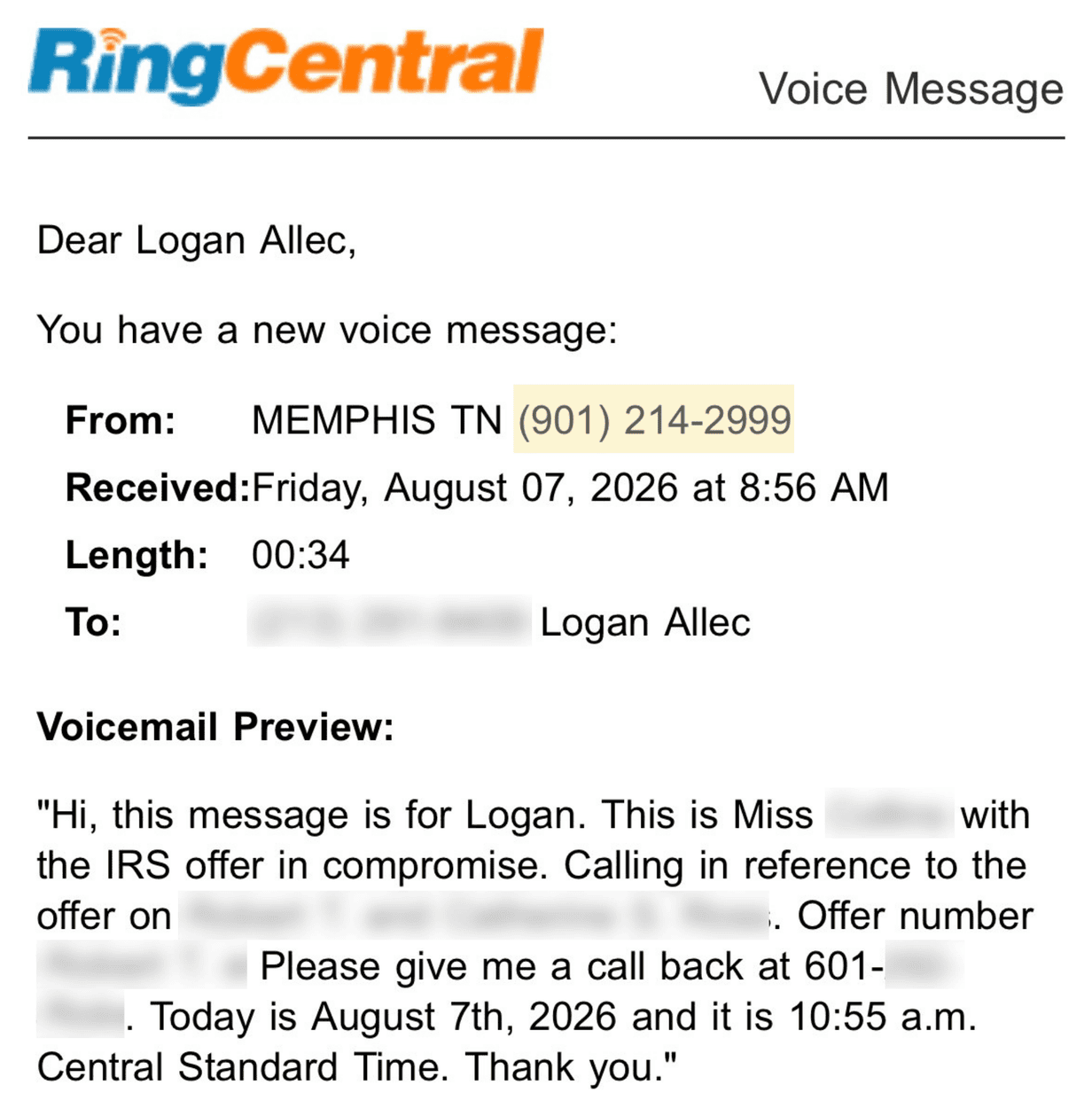
That voicemail came in on the morning of August 7, 2026, from an offer examiner in the IRS Centralized Offer in Compromise unit, about a pending offer we filed for a client.
Nothing about that number appears anywhere on IRS.gov.
The IRS will never call to demand immediate payment by gift card, prepaid debit card, or wire transfer, and it will never ask for a credit or debit card number over the phone.
If a caller does either of those things, it is a scam, and you can report it to the Treasury Inspector General for Tax Administration at 800-366-4484.
Key Takeaways
- The main IRS line for individuals is 800-829-1040, open 7 a.m. to 7 p.m. local time, Monday through Friday.
- Wait times average about 8 minutes during filing season and about 15 minutes the rest of the year, and they are shortest Wednesday through Friday.
- The IRS does call taxpayers, and for some cases the Internal Revenue Manual requires an employee to attempt a phone call before the IRS can act against you.
- The IRS publishes no list of the numbers its employees call from, which is why a real IRS call is so hard to verify.
- A legitimate IRS voicemail is often vague by law, because IRC Section 6103 bars the employee from leaving your tax information on a recording.
- The number that shows on your caller ID is frequently not the number you are told to call back, and the Internal Revenue Manual explains exactly why.
Table of Contents
The IRS Phone Numbers Most People Need
If you only want one number, this is the table to read.
| What You Need | Phone Number | Hours |
|---|---|---|
| Individual tax questions and account help | 800-829-1040 | 7 a.m. to 7 p.m. local time, Mon-Fri |
| Business tax questions and EIN assignment | 800-829-4933 | 7 a.m. to 7 p.m. local time, Mon-Fri |
| Refund status (automated) | 800-829-1954 | Automated, available anytime |
| Amended return status | 866-464-2050 | Automated |
| Transcript by mail (automated) | 800-908-9946 | Automated |
| Schedule an in-person appointment | 844-545-5640 | 7 a.m. to 7 p.m. local time, Mon-Fri |
| Taxpayer Advocate Service intake | 877-777-4778 | Mon-Fri |
| Report an IRS impersonation call | 800-366-4484 | Mon-Fri |
The IRS help lines are open Monday through Friday only.
Residents of Alaska and Hawaii should follow Pacific time, and phone lines in Puerto Rico are open from 8 a.m. to 8 p.m. local time.
During periods of high call volume the IRS may offer you a callback instead of holding, and you should take it.
The IRS says wait times average 8 minutes from January through April and 15 minutes from May through December, that Mondays and Tuesdays are the worst days, and that Wednesday through Friday are the shortest.
Free Consultation
Not sure what to do next? Get a straight answer from a tax pro.
Talk to a tax expert — free, no obligation. We’ve resolved over $20 million in IRS debt for our clients.
IRS Phone Numbers for Individuals
These are the general-purpose lines for personal tax matters.
| Purpose | Phone Number | Hours |
|---|---|---|
| Individual tax help (English and Spanish) | 800-829-1040 | 7 a.m. to 7 p.m. local time |
| Interpretation services, all other languages | 833-553-9895 | 7 a.m. to 7 p.m. local time |
| Order tax forms and publications | 800-829-3676 | Mon-Fri |
| VITA free tax preparation site locator | 800-906-9887 | Seasonal |
| Tax Counseling for the Elderly and AARP Tax-Aide | 888-227-7669 | Seasonal |
| Federally declared disaster and combat zone hotline | 866-562-5227 | Mon-Fri |
| Schedule a Taxpayer Assistance Center appointment | 844-545-5640 | 7 a.m. to 7 p.m. local time |
Every Taxpayer Assistance Center is appointment-only, so you cannot walk in without calling 844-545-5640 first.
IRS Phone Numbers for Refunds and Transcripts
Most refund and transcript questions are answered faster by an automated line or your online account than by a live representative.
| Purpose | Phone Number | Notes |
|---|---|---|
| Automated refund hotline | 800-829-1954 | Current-year refunds; same data as Where’s My Refund |
| Amended return status | 866-464-2050 | Form 1040-X; allow up to 3 weeks to appear |
| Transcript by mail | 800-908-9946 | Automated; mailed to your address of record |
| Refund trace, married filing jointly | 800-829-1040 | Requires Form 3911 |
If you filed a joint return and need a refund trace, you cannot use the automated system and must call 800-829-1040 and file Form 3911.
IRS Phone Numbers for Businesses and Specialty Taxes
Business accounts route through a different call center than individual accounts, and calling the individual line about a business issue usually means a transfer or a second call.
| Purpose | Phone Number | Hours |
|---|---|---|
| Business and Specialty Tax Line | 800-829-4933 | 7 a.m. to 7 p.m. local time |
| EIN for international applicants (not toll free) | 267-941-1099 | 6 a.m. to 11 p.m. Eastern |
| Excise taxes | 866-699-4096 | 8 a.m. to 6 p.m. Eastern |
| Estate and gift taxes (Forms 706 and 709) | 866-699-4083 | 10 a.m. to 2 p.m. Eastern |
| Tax Exempt and Government Entities | 877-829-5500 | 8 a.m. to 5 p.m. local time |
| e-Help Desk (e-file, EFTPS, e-Services) | 866-255-0654 | 6:30 a.m. to 6 p.m. Central |
| EFTPS customer service | 800-555-4477 | 24 hours |
| FBAR and Bank Secrecy Act help line | 866-270-0733 | Mon-Fri |
| Information return reporting (1099 series) | 866-455-7438 | Mon-Fri |
The estate and gift tax line has the narrowest window of any IRS number at four hours a day, so plan around it.
IRS Phone Numbers for Collections, Payment Plans, and Liens
These are the numbers that matter if you owe money, and they are the ones our clients need most.
| Purpose | Phone Number |
|---|---|
| Automated Collection System, individual | 800-829-7650 |
| Automated Collection System, business | 800-829-3903 |
| Set up or revise an individual payment plan | 800-829-1040 |
| Business payment plans | 800-829-4933 |
| Lien questions, self-employed individuals | 800-829-8374 |
| Lien questions, other individuals and businesses | 800-829-0922 |
| Centralized Lien Operation (payoff and release) | 800-913-6050 |
| Centralized Insolvency Operation (bankruptcy) | 800-973-0424 |
| CP2000 and Automated Underreporter notices | 800-829-8310 |
| Automated Substitute for Return unit | 866-681-4271 |
If you received a balance-due notice, the fastest number is almost always the one printed on the notice itself rather than any number in this table.
That is because the notice number routes you to the unit that generated it, and the general line does not.
Phone Numbers Printed on IRS Notices
These are the numbers we see most often on the notices our clients bring us. Each one has its own page covering which notices print it, what the call is for, and what to have ready before you dial.
| Number | Where you’ll see it |
|---|---|
| 833-678-7020 | Balance-due notices such as the CP14, CP503, CP504 and CP523 |
| 833-282-7220 | Automated Collection System letters such as the LT11, LT16 and LT40 |
| 844-875-3420 | Notice CP40, when your account goes to a private collection agency |
| 800-829-8310 | CP2000 notices, which propose more tax when your return doesn’t match what employers, banks and other payers reported |
| 855-800-8106 (fax) and 800-829-8374 | Notice CP59, when the IRS has no record of your tax return |
| 855-279-2109 (fax) | Notice CP63, when the IRS is holding your refund until you file missing returns |
If the IRS has sent your account to a private collection agency, the agency will reach out to you directly. Our guide to IRS collection agencies covers all three: CBE Group, Coast Professional and ConServe.
IRS Phone Numbers for Offer in Compromise and Passport Cases
The IRS runs its offer in compromise program out of two centralized sites, and which one has your case depends on where you live.
| Unit | Phone Number | States Served |
|---|---|---|
| Memphis COIC unit | 844-398-5025 | AZ, CA, CO, HI, ID, KY, MS, NM, NV, OK, OR, TN, TX, UT, WA |
| Brookhaven COIC unit | 844-805-4980 | AK, AL, AR, CT, DC, DE, FL, GA, IA, IL, IN, KS, LA, MA, MD, ME, MI, MN, MO, MT, NC, ND, NE, NH, NJ, NY, OH, PA, PR, RI, SC, SD, VA, VT, WI, WV, WY, and foreign addresses |
| Passport certification unit | 855-519-4965 | All states |
| Passport certification, international callers (not toll free) | 267-941-1004 | Overseas |
| Innocent spouse and injured spouse relief | 855-851-2009 | All states |
| Status of an appeal request | 855-865-3401 | All states |
Worth knowing: those two COIC numbers are the only offer in compromise phone numbers the IRS publishes anywhere, and neither one reaches the offer examiner assigned to your case.
We come back to why that matters below.
If you leave a message on the appeals status line at 855-865-3401, the IRS says it will research your case and return your call within 48 hours.
That is an IRS employee calling you back from a number you have never seen, which is exactly the situation this page exists to document.
Taxpayer Advocate Service Phone Numbers
The Taxpayer Advocate Service is an independent organization inside the IRS that helps taxpayers whose problems are causing financial hardship or who have tried and failed to resolve an issue through normal channels.
| Purpose | Contact |
|---|---|
| National intake line | 877-777-4778 |
| TTY/TDD | 800-829-4059 |
| Fax for Form 911 | 855-828-2723 |
| Local office directory | taxpayeradvocate.irs.gov/contact-us |
Every state has at least one local Taxpayer Advocate office with its own direct number, and the local number is usually far more productive than the national intake line.
IRS Phone Numbers for Identity Theft and IP PINs
| Purpose | Phone Number | Hours |
|---|---|---|
| Identity Protection Specialized Unit | 800-908-4490 | 7 a.m. to 7 p.m. local time |
| IP PIN reissue, international (not toll free) | 267-941-1000 | 6 a.m. to 11 p.m. Eastern |
| Verify a notice or letter you received | 800-829-1040 | 7 a.m. to 7 p.m. local time |
| Report an IRS impersonation call (TIGTA) | 800-366-4484 | Mon-Fri |
| Report abusive tax schemes and promoters | 866-775-7474 | Mon-Fri |
The Identity Protection Specialized Unit cannot give you refund status or general account information, so do not call 800-908-4490 for anything other than identity verification.
IRS Phone Numbers for Tax Professionals
If you hold a valid Form 2848 or Form 8821 for a client, you should not be calling the public lines at all.
| Purpose | Phone Number | Hours |
|---|---|---|
| Practitioner Priority Service | 866-860-4259 | 7 a.m. to 7 p.m. local time |
| e-Services and e-Help Desk | 866-255-0654 | 6:30 a.m. to 6 p.m. Central |
| PTIN sign up and renewal | 877-613-7846 | Mon-Fri |
| Office of Professional Responsibility | 202-317-6897 | Mon-Fri |
| CAF Unit Ogden (fax only) | 855-214-7522 | States west of the Mississippi plus WI |
| CAF Unit Memphis (fax only) | 855-214-7519 | States east of the Mississippi plus AR and LA |
| CAF Unit Philadelphia (fax only) | 855-772-3156 | International authorizations |
The CAF units have no public phone number at all, only fax numbers, which is why practitioners with an authorization problem go through the Practitioner Priority Service instead.
International and Accessibility Phone Numbers
| Purpose | Phone Number | Hours |
|---|---|---|
| International Taxpayer Service Call Center (not toll free) | 267-941-1000 | 6 a.m. to 11 p.m. Eastern |
| Callers in Guam, the Bahamas, the U.S. Virgin Islands, and Puerto Rico | 800-829-1040 | Mon-Fri |
| TTY/TDD for deaf and hard of hearing callers | 800-829-4059 | 7 a.m. to 7 p.m. local time |
| IRS Accessibility Helpline | 833-690-0598 | Mon-Fri |
| Braille, large print, and accessible formats | 800-829-3676 | Mon-Fri |
The Accessibility Helpline at 833-690-0598 handles alternative media and accessibility services only, and it has no access to taxpayer accounts.
Phone Numbers the IRS Has Actually Called Us From
Here is a problem no directory solves.
The IRS publishes numbers you can call in, and it publishes nothing at all about the numbers its employees call out from.
We checked, and the IRS page built specifically to answer the question of whether a contact is really the IRS lists no outbound caller ID numbers whatsoever.
So when an unfamiliar number calls you and the person says they are with the IRS, there is no official list to check it against.
This section is our attempt to build one from the ground up, using calls we can personally verify.
Because we represent taxpayers, IRS employees call our office about real cases with real case numbers, and we can confirm the call was genuine from the case file.
Every entry below is a call we received, logged with the date, the unit, and a screenshot.
| Number | IRS Unit | Caller ID Location | Date We Received It |
|---|---|---|---|
| 901-214-2999 | Centralized Offer in Compromise (COIC) | Memphis, TN | August 7, 2026 |
901-214-2999 (Memphis, TN) — Centralized Offer in Compromise
On the morning of Friday, August 7, 2026, our office received a voicemail from 901-214-2999, displayed on caller ID as MEMPHIS TN.
The caller identified herself by name as being with the IRS offer in compromise unit.
She was calling about a specific pending offer, which she identified by both taxpayer names and by offer number, and both matched an open case in our files.
That case detail is what makes this data point verifiable rather than anecdotal, and it is why we are comfortable attributing this number to the IRS.
| Detail | What We Observed |
|---|---|
| Number that called | 901-214-2999 |
| Caller ID location | MEMPHIS TN |
| Date and time received | Friday, August 7, 2026 at 8:56 a.m. Pacific |
| Time stated in the message | 10:55 a.m. Central |
| Length | 34 seconds |
| IRS unit | Centralized Offer in Compromise (COIC) |
| Employee role | Offer examiner |
| Reason for the call | A pending offer in compromise, identified by offer number |
| Callback number given | A 601 area code number, different from the number that called |
Memphis is one of only two Centralized Offer in Compromise sites in the country, per Internal Revenue Manual 5.8.3.1.6, which defines COIC as the units “located in Brookhaven and Memphis campus.”
So a Memphis number calling about an offer in compromise is exactly where an offer examiner would sit.
Note what this number is not.
It is not 844-398-5025, the published Memphis COIC number, and it is not any other number the IRS prints on a form or a web page.
If you had tried to verify this call against a public directory, you would have found nothing.
Third-party caller ID databases are not a substitute for this.
We looked 901-214-2999 up on four of the big “who called me” sites and got four different answers, including one that labels it the Taxpayer Advocate Service, one that rates it low risk, and one that rates it 100% very high fraud risk.
None of those labels comes from a verified IRS source, and the one calling it Taxpayer Advocate Service appears to trace back to a single commenter in 2017 who guessed.
Why the Number That Calls You Is Not the Number You Call Back
The most interesting detail in that voicemail is the one that looks like a red flag.
The call came from a 901 Memphis number, but the callback number the examiner gave was in area code 601, which is central and southern Mississippi, roughly two hundred miles from Memphis.
To most people that mismatch reads as a scam, and it is a reasonable instinct.
But the IRS documents the exact mechanism that produces it.
Internal Revenue Manual 2.28.1.2.2.1.1 describes a service that “Allows the user to mask the mobile phone number when sending the caller’s caller-ID data on an outbound call from a BYOD device,” and then states plainly that “The IRS masked Caller-ID data is sent as if the user was calling from within the IRS office.”
In other words, the number on your caller ID can be an office-level number rather than the number of the person actually dialing.
The same section says the employee can press *82 to unmask, which sends the caller ID of their desk phone instead.
Separately, Internal Revenue Manual 2.28.1.2.1.2.3 states that “The DID number assigned to each person, is dictated by the assigned Post of Duty,” and that an employee who relocates gets a number from the new location’s pool.
Put those two rules together and a single IRS employee can easily be associated with more than one phone number, only one of which will ever show up on your phone.
A caller ID number that does not match the callback number is not by itself evidence of a scam, and it is not by itself evidence of a legitimate call either.
The only reliable move is to hang up and call back on a number you obtained yourself, from your own IRS correspondence or from the directory above.
Does the IRS Actually Call Taxpayers?
Yes, and the popular advice that “the IRS never calls, they only send letters” is wrong in a way that can cost you money.
What is true is that the IRS almost always writes first.
The IRS scam guidance says it plainly: “We don’t call without notifying you by mail.”
After that first letter, phone calls are routine, and here is who places them:
- Revenue agents contact you by mail first, then may call to discuss an audit or confirm an appointment.
- Revenue officers either mail Letter 725-B or call you to set up a meeting.
- Revenue officers working employment tax cases actually call before mailing a balance due notice, and send Letter 5857 with a scheduled call time.
- Offer examiners and offer specialists call to request additional information needed to investigate an offer in compromise.
- Taxpayer Advocate Service case advocates contact you by phone or letter once your case is assigned.
- Criminal Investigation special agents may call unannounced, though they do not work civil tax cases.
- Private collection agencies working IRS accounts call, but only after both the IRS and the agency have mailed you a letter.
The IRS also uses automated phone messages that direct you to IRS.gov without sharing any account details.
If You Have a Pending Offer in Compromise, Missing the Call Can Cost You the Offer
This is the part that turns a phone directory into something that actually matters.
For offers in compromise, the Internal Revenue Manual does not merely permit a phone call, it requires one before the IRS takes certain adverse actions.
- Internal Revenue Manual 5.8.4.6(4) states that when returns are unfiled, “the taxpayer/representative must be contacted by telephone to discuss.”
- Internal Revenue Manual 5.8.4.6(12) requires two phone attempts, with the second on the next business day.
- Internal Revenue Manual 5.8.7.2.2.1 requires one telephone attempt to secure missing returns before the offer is returned.
- Internal Revenue Manual 5.8.7.2.2.2 requires one telephone attempt to request missing estimated tax payments.
- Internal Revenue Manual 5.8.7.2.2.4 requires one phone attempt to secure missing information, and gives you five business days to respond after a voicemail.
Read that last one again.
If an offer examiner calls, leaves a voicemail, and you do not call back within five business days, the IRS can move to return your offer.
The advice to ignore unknown numbers because “the IRS never calls” is, for a taxpayer with a pending offer, advice to lose the offer.
A pending or accepted offer in compromise is one of the categories the IRS excludes from private debt collection entirely.
So if you have a live offer and you get a collection-sounding call, it is far more likely to be your assigned offer examiner than a collection agency.
Why a Real IRS Voicemail Can Sound Suspicious
Taxpayers regularly tell us a message “sounded fake” because the caller would not say what the call was about.
That is usually the law working correctly.
IRC Section 6103 protects your tax return information, and the Internal Revenue Manual carries that protection into voicemail.
Internal Revenue Manual 13.1.6.7 tells Taxpayer Advocate Service employees that “no tax information protected by IRC 6103 may be left on an answering device or voice mail” without your prior consent, and limits what they can say to their last name, their badge number, the fact that they work for TAS, a reference to the date of your inquiry, and a callback number.
Internal Revenue Manual 5.8.1.5.1 goes further for offer in compromise employees, instructing that when someone other than the taxpayer answers, employees “should not identify themselves as IRS employees or state the reason for the attempted contact.”
So a legitimate IRS voicemail can consist of a first name, a number, and nothing else.
The message we logged above was detailed because it reached an authorized representative on a case with a Form 2848 on file, which is precisely the situation where disclosure is permitted.
How To Tell a Real IRS Call From a Scam
The behaviors below are the reliable signals, not the caller ID.
A real IRS employee will:
- Give you their name, title, and ten-digit Smart ID badge number when you ask.
- Reference correspondence the IRS already mailed you.
- Let you hang up and call back through official channels.
- Direct any payment to the United States Treasury, never to an individual or a third party.
A scammer will:
- Demand immediate payment by gift card, prepaid debit card, cryptocurrency, or wire transfer.
- Ask for a credit or debit card number over the phone.
- Threaten to send police, immigration officers, or have you arrested.
- Refuse to let you question or appeal the amount owed.
- Call out of the blue about a refund you never claimed.
The IRS also states that it does not leave urgent or threatening messages.
Still have questions? Talk to a tax expert — free.
What To Do If You Miss a Call From the IRS
- Write down the number that called, the date, the time, and anything the message said.
- Check your mail, including anything from the last ninety days, since the IRS almost always writes before it calls.
- Find the phone number printed on that correspondence, because it routes to the unit that actually has your case.
- If you have no correspondence, call the appropriate number from the directory above rather than the number that called you.
- Ask the employee for their name, title, and ten-digit badge number, and write those down too.
- If you have a pending offer in compromise, an audit, or an assigned revenue officer, treat the callback as urgent rather than optional.
- If anything about the call matched the scam list above, report it to TIGTA at 800-366-4484.
If you are represented, forward the message to your representative before calling back, because the IRS can discuss the case with them and they will recognize immediately whether the call fits an open matter.
Getting Help With a Call From the IRS
A call from the IRS is not the problem by itself, but it is almost always a signal that something on your account is already moving.
An offer examiner calling about missing information, a revenue officer calling to schedule, and an automated collection message are three very different situations, and they carry three very different deadlines.
Our licensed tax professionals can pull your IRS transcripts, confirm which unit actually has your file, tell you what the call was really about, and handle the callback for you so nothing is said that hurts your position.
If the IRS is already calling you, we know how to deal with it the smart way.
Call 866-8000-TAX or schedule a free consultation and we will tell you who called and what it means for your case.

“Working with Luke at Choice Tax service has been a fantastic experience. His commitment to clear communication is what truly sets him apart. I was always impressed by his responsiveness to my questions, and I love that he provided consistent, proactive updates.”
IRS Phone Number FAQs
What is the main IRS phone number?
The main IRS phone number for individuals is 800-829-1040, open Monday through Friday from 7 a.m. to 7 p.m. local time. Businesses use 800-829-4933 during the same hours. If you received an IRS notice, the number printed on the notice will usually get you to the right unit faster than either of these.
How do I talk to a real person at the IRS?
Call 800-829-1040 during business hours and work through the menu to an account-specific option rather than an automated one, since automated selections end the call without a transfer. Wait times average about 8 minutes during filing season and about 15 minutes the rest of the year, and the IRS says Wednesday through Friday are shortest and Mondays and Tuesdays are worst. If the system offers you a callback, take it, because you keep your place in line without holding.
Does the IRS call taxpayers, or does it only send letters?
The IRS does call taxpayers. Its own guidance says it will not call without first notifying you by mail, but once that letter has gone out, calls from revenue officers, revenue agents, offer examiners, and Taxpayer Advocate Service case advocates are routine. In some situations the Internal Revenue Manual actually requires an IRS employee to attempt a phone call before the IRS may take action against you.
What phone number does the IRS call from?
There is no published answer, and that is the core problem. The IRS page dedicated to helping you verify whether a contact is really the IRS lists no outbound caller ID numbers at all. IRS employees can also appear on your caller ID as an office-level number rather than their own line, because Internal Revenue Manual 2.28.1.2.2.1.1 lets an employee mask their number so the call displays as if it came from inside the IRS office.
Is 901-214-2999 really the IRS?
In our first-hand experience, yes. On August 7, 2026 our office received a voicemail from that number, displayed as MEMPHIS TN, left by an offer examiner with the IRS Centralized Offer in Compromise unit who referenced a real pending offer by taxpayer name and offer number that matched an open case in our files. Memphis is one of only two Centralized Offer in Compromise sites in the country. That said, a number appearing on our caller ID once does not mean every call from it is genuine, since caller ID can be spoofed, so verify any specific call using the steps on this page rather than relying on the number alone.
What is the IRS phone number for an offer in compromise?
The IRS publishes two, both tied to where you live: 844-398-5025 for the Memphis COIC unit and 844-805-4980 for the Brookhaven COIC unit. Neither one reaches the offer examiner assigned to your case. Once an offer is assigned, the only direct number you have is the one printed on your own IRS correspondence or given to you by the examiner.
Why did the IRS leave a voicemail that did not say anything?
Because the law usually forbids saying more. IRC Section 6103 protects your return information, and the Internal Revenue Manual bars employees from leaving protected tax information on a recording without your consent. Internal Revenue Manual 5.8.1.5.1 goes further for offer in compromise employees, telling them not to identify themselves as IRS employees or state why they called when someone other than the taxpayer picks up. A vague message is often the strongest sign that the caller was following the rules.
How do I report a fake IRS phone call?
Report IRS impersonation calls to the Treasury Inspector General for Tax Administration at 800-366-4484 or through the impersonation scam reporting form at tigta.gov. You can also email [email protected] with “IRS Phone Scam” in the subject line and include the caller’s number. Never give a caller a credit card number, a gift card code, or a wire transfer, because the IRS never asks for payment that way.
Get Help Now
Not sure what to do next? Get a straight answer from a tax pro.
Talk to a tax expert — free, no obligation. We’ve resolved over $20 million in IRS debt for our clients.


Author:

Logan Allec, CPA, Founder and Owner
Logan Allec has been serving taxpayers as a CPA for over 14 years. After leaving his role at a "Big 4" firm, he started Choice Tax Relief to help everyday Americans who have found themselves behind on their taxes. He also educates thousands of people daily about tax relief on his YouTube channel. In addition to his CPA license, Logan also has a Master's Degree in Taxation from the University of Southern California (USC). He lives with his wife and children in the Los Angeles area. Learn more about Logan here.