

IRS Notice CP11: What To Do If Your Miscalculated Your Tax Return

IRS Notice CP11 is the notice the IRS sends to a taxpayer to inform them that the IRS has discovered a math error on the taxpayer’s tax return resulting in a balance due of five dollars or more.
If you receive this notice, it means that the IRS has found an error based on one or more of the following items on your tax return:
- Incorrect Deductions
- Incorrect Dependant Listings
- Incorrect Income Reporting
- Mathematical Errors
If your return indicated a refund due to you, you will have to wait until the IRS completes its review before you receive your refund.
Here is a redacted Notice CP11 that the IRS sent to one of our clients.
Table of Contents
IRS Notice CP11 At a Glance
| Notice Type: | Math Error |
| Generated By: | IRS Tax Return Processing |
| Preceded By: | Tax Return Filing |
| Followed By: | Assessment |
| Recommended Action: | Review Return For Accuracy |
Free Consultation
Got a CP11 notice? Get a straight answer before you respond.
Talk to a tax expert — free, no obligation. We’ve resolved over $20 million in IRS debt for our clients.
IRS Notice CP11 Explained, Part by Part
Here is a full explanation of the Notice CP11, part by part.
Part 1: Amount Due and Billing Summary
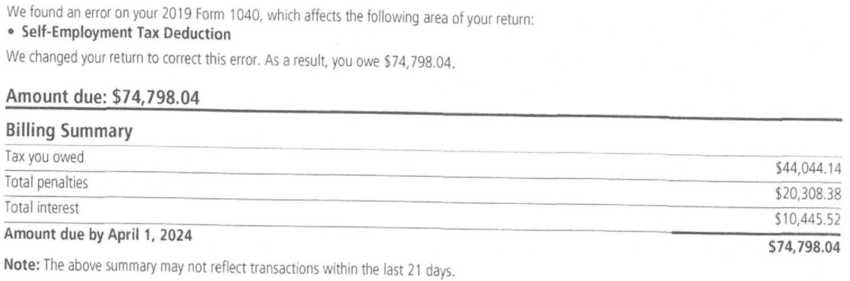
First, the IRS will give you a billing summary, highlighting your amount due.
It will have the original tax you owe, then penalties, and interest payments.
You will have about 21 days to pay off the new balance.
In this case, the error was found with a tax deduction.
There will be other reasons related to the previously mentioned list at the beginning of the article.
Part 2: Why The IRS Changed Your Information

Then the IRS will tell you why it changed your information.
In this case, the taxpayer either did not calculate the self-employment deduction accurately or did not include Schedule SE to their return when they filed it.
Part 3: How To Resolve The Issue With The IRS

Next, the IRS will tell you how to resolve this issue, with a warning that if you don’t contact them within 30 days of the notice date, the IRS will assume you will agree with the changes they made to your tax return and they will proceed accordingly.
Obviously, if you agree with the changes the IRS made, the IRS wants you to pay off what you owe immediately, and they provide you the link where you can do that online.
If you pay directly from a bank account, there will be no service fee, as opposed to a credit or debit card, which has a small fee.
They also provide you with a list of other payment options, such as a check or money order.
Part 4: Options If You Cannot Pay In Full
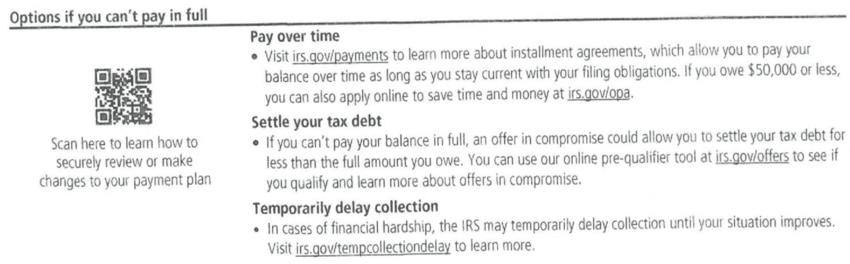
Then, the IRS will give you options if you cannot pay in full.
You can opt to pay with installment agreements, allowing you to pay your balance over time with your current filing obligations.
If you need, you can settle your tax debt with an Offer In Compromise (OIC).
We’ll expand on an OIC later, but it will allow you to settle your debt for less than you owe.
Last, you can offer a temporary delay in collection to halt any IRS action for a predetermined period of time.
Part 5: If You Don’t Agree With The Changes The IRS Made

If you disagree with the changes the IRS made to your return, it will provide a number you can call.
You will have to talk to a tax representative with your account information to dispute issues with the IRS.
We provide this service for our client since it’s incredibly long and difficult to come to a resolution.
Part 6: Tax Calculations

Then, the IRS will provide its calculations, showing how it differs from yours.
There will be a line for gross income adjustments and taxable income.
Here, you can see the differences in calculations.
If you have any disagreements to make, this section is the best place to highlight differences.
Part 7: Payments and Credits

Then, the IRS will give you a chart of your payments and credits.
This includes any income tax you’ve withheld or payments made on the tax balance already.
Here, it will use the information to decrease your tax balance based on previously made deposits.
Part 8: Penalty Fees
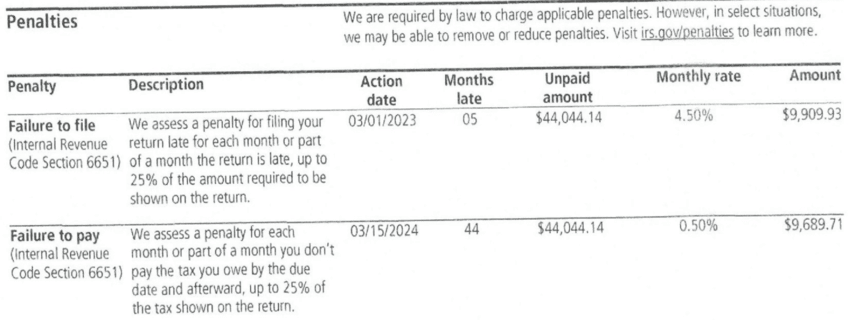
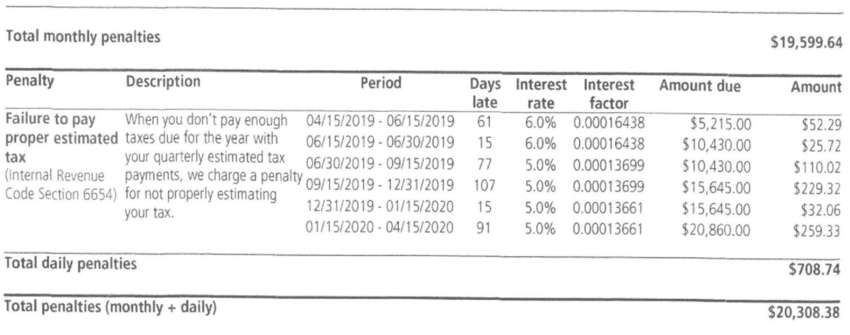
The IRS is obligated to charge you penalties if you haven’t paid your balance.
There is a failure-to-file penalty that has a 5.0% monthly rate, but it is reduced to 4.5% in months it runs concurrently with the failure-to-pay penalty, which has a 0.5% monthly rate.
There is also the failure to pay proper estimated tax penalty, which is essentially an interest charge imposed on taxpayers who fail to make estimated payments during the year.
It will finish with the sum of all the penalties at the bottom of the daily chart.
Part 9: Interest
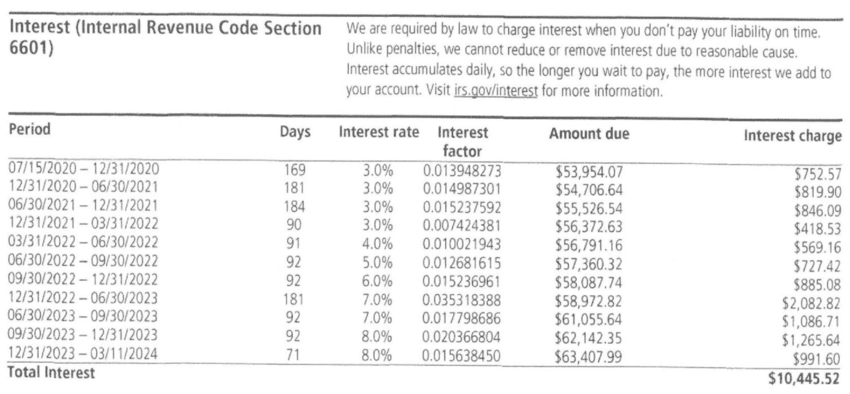
After the penalties are added, the IRS will then charge you interest on your unpaid balance.
It is calculated based on the interest rate, days late, interest factor, and amount due.
The total interest is added to the original balance and other penalties to sum to the total balance due.
Read this article to learn more about how IRS interest rates are calculated by quarter.
Part 10: IRS Help
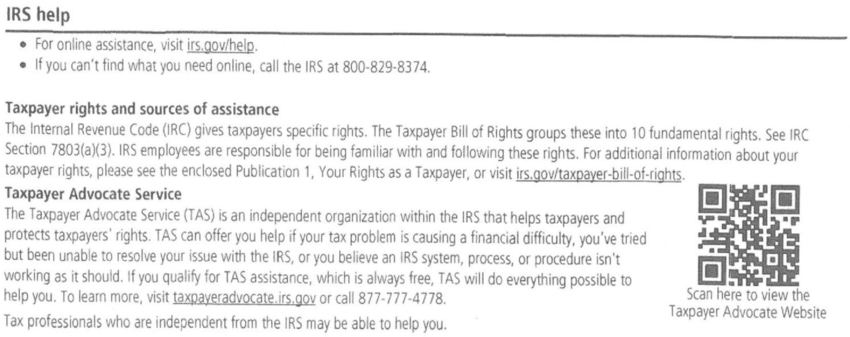
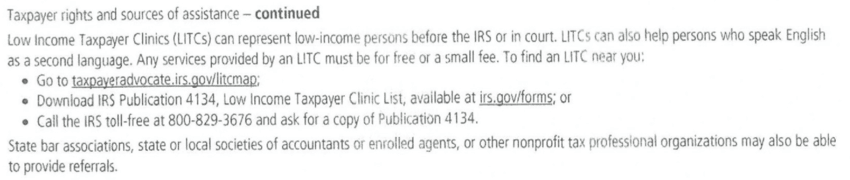
The IRS provides other ways to help taxpayers.
There are rights under the Internal Revenue Code.
They provide a link to help people understand their rights.
We’ve linked that here.
There is also a taxpayer advocate service, an independent organization within the IRS to help protect taxpayer rights.
Additionally, there are Low Income Taxpayer Clinics (LITCs) to represent low-income people in court.
Additionally, you can go to a third party, like a tax relief firm, for assistance.
Part 11: Payment Coupon
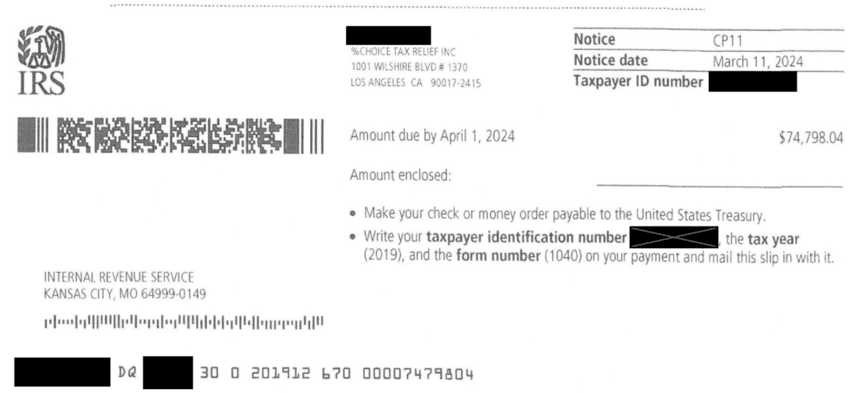
Lastly, if you want to pay off your balance in full, the IRS provides you with a payment coupon.
You use it alongside a check or money order.
Do not forget to make the check or money order payable to the United States Treasury.
You also need to include your TIN, form number, and tax year on the payment.
Then, mail the slip to the provided IRS address.
You will have about 20 days to pay off your balance.
What You Should Do If You Receive a CP11
Below are steps for you to take after you receive a CP161 Notice from the IRS.
Step 1: Confirm You Actually Owe The IRS
The IRS makes mistakes.
This should not be a surprise.
However, that means that the first step you should take is to ensure you actually made an error that they need to correct.
The IRS is claiming you calculated your return incorrectly.
Is that true?
Did you, or is it an error on their part?
The IRS is saying you have penalty fees you owe them.
Is that true?
Do you have an outstanding balance collecting interest or other penalties?
Read and reread your CP11 Notice closely.
Check and check again to fully make sure their claims are 100% accurate.
Step 1a: Dispute the Charges if the IRS is Wrong
If you found a concrete error in your CP11 Notice, contact the IRS at their provided phone number.
You’ll need to do so within 30 days of the notice date; otherwise, your notice will be cemented in their system.
Unfortunately, it likely won’t be a one-and-done phone call.
You’ll have to prepare to defend yourself against multiple representatives and talk to many people over and over again.
Despite its difficulty, you have a right to do so and shouldn’t be deterred from it.
Since it’s so long and arduous, we at Choice Tax Relief provide the service for our clients.
Step 2: If You Can Pay In Full, Do So
You will have 20 days from the date of the notice to pay off your balance.
This will halt the interest penalties and other fees being held against your account.
If you need to dispute some of the charges with the IRS, do so sooner rather than later.
Obviously, you should pay off your balance.
It’s the quickest and easiest way to protect yourself and your account from the IRS and its exorbitant penalties.
Step 3: Seek Penalty Abatement From the IRS
As mentioned previously, you should seek penalty abatement.
Penalty abatement for you to possibly get charges reduced or waived completely by appealing to the IRS.
It’s always worth it to try, even if the solution isn’t guaranteed.
Choice Tax Relief will always attempt to seek some penalty abatement for our clients.
Step 4: Seek Tax Relief
If you’ve done everything possible to plead your case with the IRS and still can’t afford your balance, consider seeking tax relief.
Sometimes, the better option is known as an offer in compromise (OIC).
It’s an agreement between the IRS and the taxpayer, allowing you to settle your debt with the IRS for less than what’s originally owed.
If the OIC isn’t a feasible option, there are others.
Some options, like installment payments and temporary hardship placements (called currently not collectible status), help taxpayers find some relief as they work to pay off all their balances.
Installment payments allow taxpayers to pay off their balance in monthly payments.
Temporary hardship placements are put in place to help taxpayers halt IRS collections for a set period of time in order to regain monetary stability.
It will not get rid of the debt, but it provides time to save up and begin paying it off.

“Choice Tax Relief was outstanding in helping us prepare our taxes. Their team was incredibly responsive — quick to return calls and emails — and consistently offered thoughtful, strategic suggestions that made the process smooth and stress-free.”
Get Help Now
Got a CP11 notice? Get a straight answer before you respond.
Talk to a tax expert — free, no obligation. We’ve resolved over $20 million in IRS debt for our clients.


Author:

Logan Allec, CPA, Founder and Owner
Logan Allec has been serving taxpayers as a CPA for over 14 years. After leaving his role at a "Big 4" firm, he started Choice Tax Relief to help everyday Americans who have found themselves behind on their taxes. He also educates thousands of people daily about tax relief on his YouTube channel. In addition to his CPA license, Logan also has a Master's Degree in Taxation from the University of Southern California (USC). He lives with his wife and children in the Los Angeles area. Learn more about Logan here.