

IRS Notice CP128: Why Is The IRS Using My Overpayment?

IRS Notice CP128 is the notice the IRS sends to your business to notify it that it has applied the overpayment shown on your business’ tax return to an outstanding balance for another period.
Remember, if a taxpayer owes money to the IRS, any form of overpayments or refunds will automatically be applied to the balance until it is paid off in full.
Here is a redacted Notice CP128 that the IRS sent to one of our business clients.
Table of Contents
IRS Notice CP128 At a Glance
| Notice Type: | Refund Application to Balance Due For Business |
| Generated By: | IRS BMF |
| Preceded By: | Filing of Business Tax Return Showing Refund Due |
| Recommended Action: | Pay Off or Enter Into Resolution for Remaining Balance |
Free Consultation
Got a CP128 notice? Get a straight answer before you respond.
Talk to a tax expert — free, no obligation. We’ve resolved over $20 million in IRS debt for our clients.
IRS Notice CP128 Explained, Part by Part
Here is a full explanation of the Notice CP128, part by part.
Part 1: Notice And Billing Summary
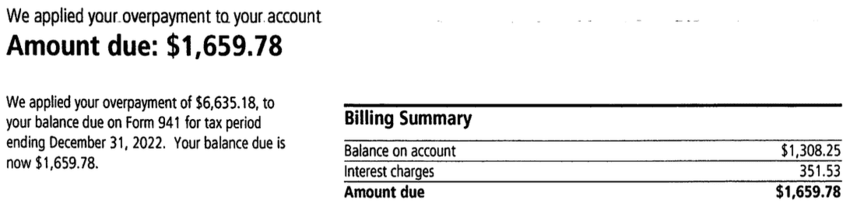
First, the IRS will open its letter by telling you that it applied your overpayment to your account.
Even though it used your overpayment, you still owe the IRS money.
The notice will also tell you which form and tax period the IRS is taking the overpayment from.
For the remaining balance, the notice will provide a billing summary breakdown.
This will include the balance on your account and any additional interest charges, with the total amount due listed at the bottom.
Part 2: What The IRS Needs You To Do Immediately


Next, the IRS will tell you what they want you to do as soon as possible.
The obvious thing is that the IRS wants its money.
It will tell you to make a payment for the remaining balance to avoid incurring more interest penalties or other applicable penalties.
It will provide you with several payment options, including electronic or mail.
If you cannot pay off the full balance, then the IRS urges you to pay as much as you can, and then call and negotiate the remaining balance.
If you believe there was an error, then the IRS provides a phone number to call and dispute the charges.
Part 3: Payment Coupon
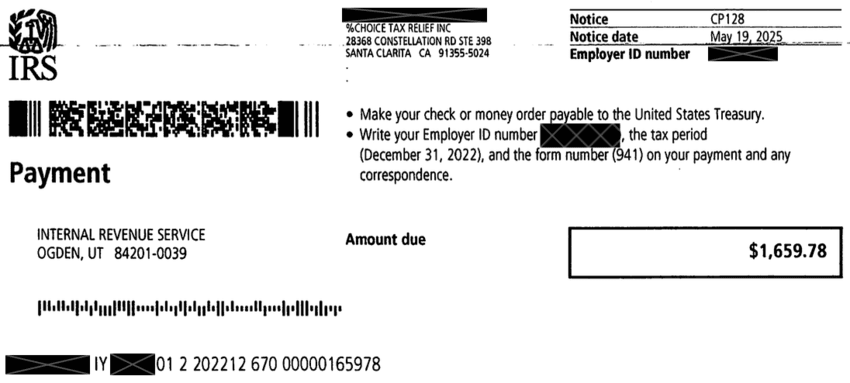
Then, if you choose to pay off your balance with a check or money order, the IRS provides a payment coupon for you to send in.
If you choose this method of payment, then you need to remember to write your EIN, the tax period the notice is for, and the form number on your payment.
The check or money order should be sent with this coupon.
Don’t forget to make it payable to the United States Treasury.
Part 4: Payments Credited To Your Account For The Ending Tax Period

Then, the IRS will provide you with a table of all the deposits, credits, and overpayments previously applied to your account.
It will have the date the payment was received alongside the amount.
All these payments are applied to the tax period you have an outstanding balance.
If there are any payments that are incorrect or missing, then you should call the provided number as soon as possible.
Part 5: Interest Charges
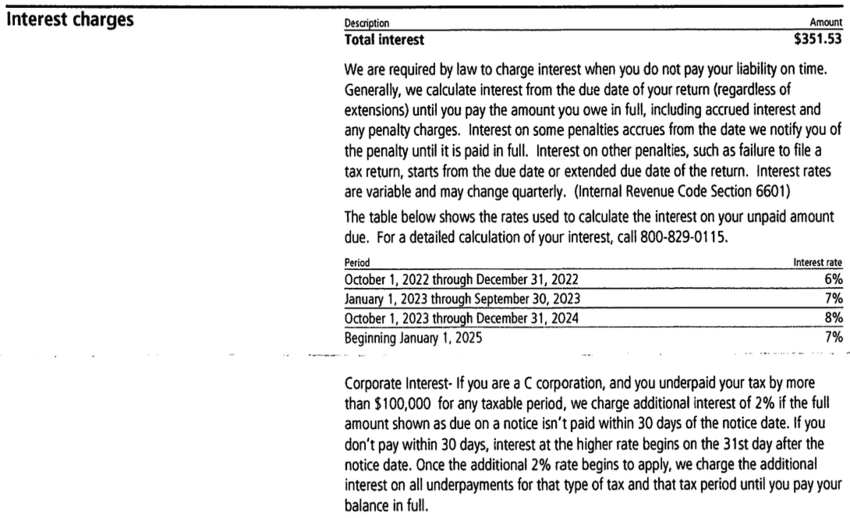
Next, the notice will give you a table of your interest fees.
It will open with the total interest owed, followed by an explanation of why you are being charged interest. Legally, the IRS is required to charge interest on any outstanding balances.
Then, it’ll break down the periods and corresponding interest rates.
Each period has a slightly different interest rate, so it’s important to make sure you know what your rate is.
If you are a C-Corp and have underpaid by $100,000 or more, then your interest will be increased by 2% if you haven’t paid the full balance within 30 days.
Once the 2% penalty is applied, there will be additional interest on all underpayments until the balance is paid in full.
Part 6: Additional Information

Lastly, the IRS will give you some additional information for your notice.
They will link to the IRS webpage for this specific notice.
We linked that for you here.
If you have questions related to tax forms, instructions, or publications, the IRS provides a phone number or other website for you to find more information.
If you wish to correspond with the IRS through mail, be sure to include your EID, tax year, and form number for whatever you are writing about.
What You Should Do If You Receive a CP128
Below are steps for you to take after you receive a CP128 Notice from the IRS.
Step 1: Confirm You Actually Owe The IRS
The obvious first step is to make sure you actually owe the IRS money.
When working with overpayments and payments over multiple periods, it’s easy for the IRS to make mistakes.
It’s up to you to check and keep your personal records up to date so you can correct any errors.
The IRS is claiming you still have a balance outstanding.
Is this true?
Do you actually have an outstanding balance, or did they forget to apply other credits?
Always keep a close eye on your notices.
Check and double-check your notices to make sure that if an error, you can catch and correct it.
Step 1a: Dispute the Notice if the IRS is Wrong
If you believe that the IRS made a mistake, then provide an explanation as soon as possible.
You should contact them quickly to prevent any more interest or other penalty fees from piling up.
The IRS has provided both a phone number and a mailing address to contact it.
If you choose to mail the IRS, you should sign and date the form with your EIN, tax period, and form number.
It’s important that all these things are included so the IRS knows what you’re talking about.
While it won’t be an easy process, phone calls can be highly effective.
It’s important to realize that a single phone call will not resolve the process.
You need to prepare to tell your story multiple times.
We provide this service to our clients since we know time is often more valuable than money.
Step 2: If You Can Pay Off In Full, Do So
If you can pay off your balance in full, then do so.
It’s the easiest and most effective way to halt any more penalties from building up and to get the IRS completely off your back.
While it may sound obvious, it’s the most straightforward and easiest path to take.
Step 3: Seek Penalty Abatement From the IRS
If you need to, consider seeking penalty abatement.
Penalty abatement will allow you to appeal the IRS charges.
It holds the possibility of reducing or even completely removing the outstanding balance on your account.
It’s not a guarantee, but it’s always worth a shot.
Choice Tax Relief will always attempt to seek some penalty abatement for our clients.
Step 4: Seek Tax Relief
Tax relief is always an option for taxpayers after they have tried all other options.
The easiest option is an Installment Agreement.
It allows taxpayers to pay with installment payments over a predetermined period of time.
It breaks the debt into more manageable parts, helping the taxpayer out.
Another solution is known as a temporary hardship placement (called currently not collectible status).
A temporary hardship placement allows taxpayers to prepare to pay off their debt by halting any IRS activity.
While it doesn’t make the debt go away completely, it helps give you some time to get back on your feet.
Lastly, the best offer is known as an offer in compromise (OIC).
While it doesn’t work for everyone, it’s effective.
It will allow the taxpayer to settle their debt with the IRS for less than they owe already.

“I did a lot of research and spoke to multiple companies that help with tax resolution. I’m glad I chose Choice Tax Relief. They are very knowledgeable and professional.”
Get Help Now
Got a CP128 notice? Get a straight answer before you respond.
Talk to a tax expert — free, no obligation. We’ve resolved over $20 million in IRS debt for our clients.


Author:

Logan Allec, CPA, Founder and Owner
Logan Allec has been serving taxpayers as a CPA for over 14 years. After leaving his role at a "Big 4" firm, he started Choice Tax Relief to help everyday Americans who have found themselves behind on their taxes. He also educates thousands of people daily about tax relief on his YouTube channel. In addition to his CPA license, Logan also has a Master's Degree in Taxation from the University of Southern California (USC). He lives with his wife and children in the Los Angeles area. Learn more about Logan here.