

IRS Notice CP259: What To Do When You Haven’t Filed Your Tax Return

IRS Notice CP259 is the notice the IRS sends to a taxpayer to inform a business that it is failed to file its required tax returns.
Examples of tax returns that a business could fail to file include:
- Form 1120: U.S. Corporation Income Tax Return
- Form 1120-S: U.S. Income Tax Return for an S Corporation
- Form 940: Employer’s Annual Federal Unemployment (FUTA) Tax Return
- Form 941: Employer’s Quarterly Federal Tax Return
The CP259 is period-specific, so your business will receive one for each period the IRS deems delinquent.
Here is a redacted Notice CP259 that the IRS sent to one of our clients.
Table of Contents
IRS Notice CP259 At a Glance
| Notice Type: | Return Delinquency |
| Generated By: | IRS BMF |
| Preceded By: | Non-Filing of Business Tax Return |
| Followed By: | IRS SFR Filing |
| Recommended Action: | File Required Tax Return |
Free Consultation
Got a CP259 notice? Let’s get your tax returns caught up.
Talk to a tax expert — free, no obligation. We prepare years of unfiled tax returns and have resolved over $20 million in IRS debt for our clients.
IRS Notice CP259 Explained, Part by Part
Here is a full explanation of the Notice CP259, part by part.
Part 1: Why The IRS Is Sending You The Notice

First, the IRS will tell you which form your business failed to file.
In this case, it’s the Form 941 — the employer’s quarterly federal tax return.
However, the notice can be generated due to a failure to file any business tax return.
Part 2: What the IRS Says You Need to Do Immediately
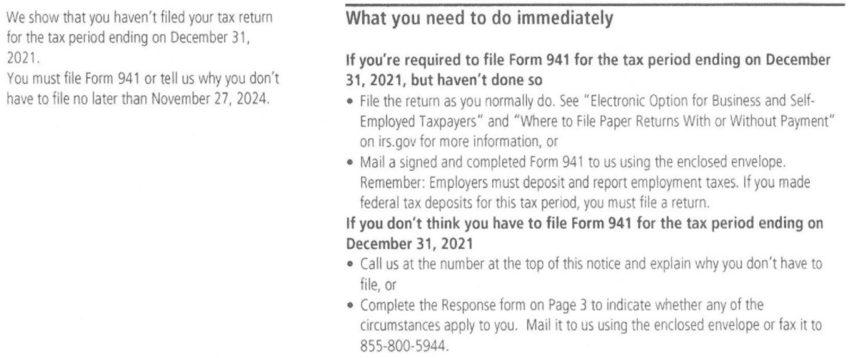
Next, the IRS will tell you what you need to do immediately.
The most obvious thing they want you to do is file the missing tax return.
You will have about 30 days from the date of the notice to file your return before the IRS charges you even more penalties and interest than it already has.
If you think there was an error, you should contact the IRS as soon as possible.
You can dispute the notice with the form at the end of the letter or call them at their provided number.
Part 3: If The IRS Doesn’t Hear From You

Then, the IRS will tell you what will happen if they don’t hear from you.
If you do not call and dispute the notice or file the return specified in the notice, the IRS may file a substitute for return (SFR) and assess your tax liability based on this filing.
Part 4: Additional Information

Then, the IRS will provide additional information to accompany the notice.
There will be a website link for more information that the IRS deems important.
We linked that here.
The IRS website is also a valuable resource for information on other tax forms, instructions, and publications.
You can also call them at their provided number.
Part 5: Response Form
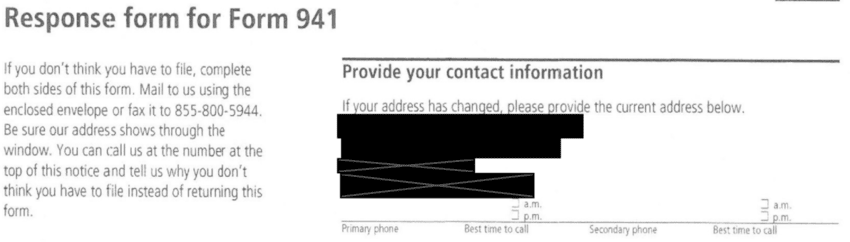
If you don’t think you need to file the return for the period specified in the notice, then the IRS provides a response form for you to fill out with information showing that you do not have to file.
If you would rather call the IRS, you can do so at the provided number instead of filling out and returning the form.
Part 6: Indication of Reasons Not To File A Tax Return
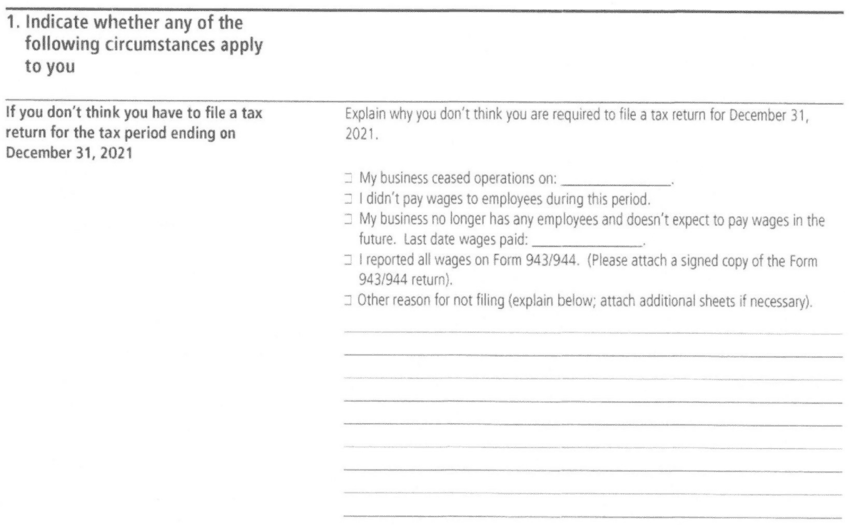
The first part of the form is an indication of why you don’t need to file a form.
These are the following reasons provided for the Form 941 (your reasons may be different if you received a Notice CP259 for a different return):
- Your business ceased operations. Make sure to provide the date when operations ceased.
- You didn’t pay wages to your employees during this tax period.
- Your business doesn’t have any employees, and you do not expect to pay wages in the future. Make sure to provide the date when you last paid wages.
- You reported all wages on a Form 943/944. If this is the case, you need to provide a signed copy of the Form 943/944 return.
If there is another reason for the lack of filling, then use the provided space to explain.
Do not forget to attach any necessary paperwork to the form.
Part 7: If You Have A Credit Or Made A Payment/Deposit

The IRS requires you to have a tax return in order for your business to be eligible for a refund.
The filing must be done within three years of the tax return’s due date, OR within two years from the date the tax was paid on the return.
If you want to carry your credit forward, you must file a tax return.
Part 8: Signature and Mailing The Form

The last section of the form is your signature.
It validates your entire form.
If any information is falsified, there are penalties for perjury.
The form should be completed to the best of your knowledge with all appropriate attachments.
What You Should Do If You Receive a CP259
Below are steps for you to take after you receive a CP259 Notice from the IRS.
Step 1: Follow Up If You Think There Was A Mistake
If you believe there is an issue with the form, then fill out the provided response form.
You can also call them if that is preferred over mailing/faxing them the form.
Just be sure that any action you take is done within 30 days of the date of the notice.
There are different response forms to fill out, depending on which form is missing.
However, the process should be mostly the same or highly similar.
Step 2: File Your Missing Tax Return
If you have no issues with the form, then file your tax return as soon as you can.
You only have 30 days from the date of the notice to take action.
It’s best to do it right away so you do not have to pay any penalty or interest fees.

“A special thank-you to Nathan and Luke for their help and professionalism throughout the entire process. They assisted me in getting four tax years filed, working directly with the necessary entities on my behalf.”
Get Help Now
Got a CP259 notice? Let’s get your tax returns caught up.
Talk to a tax expert — free, no obligation. We prepare years of unfiled tax returns and have resolved over $20 million in IRS debt for our clients.


Author:

Logan Allec, CPA, Founder and Owner
Logan Allec has been serving taxpayers as a CPA for over 14 years. After leaving his role at a "Big 4" firm, he started Choice Tax Relief to help everyday Americans who have found themselves behind on their taxes. He also educates thousands of people daily about tax relief on his YouTube channel. In addition to his CPA license, Logan also has a Master's Degree in Taxation from the University of Southern California (USC). He lives with his wife and children in the Los Angeles area. Learn more about Logan here.