

IRS Notice CP508C: What To Do If Your Passport Is In Jeopardy

IRS Notice CP508C is the IRS’s official notification that it has “certified” your tax debt to the U.S. Department of State as seriously delinquent.
In plain English: your tax debt is now standing between you and your passport.
Once this certification is in place, the State Department will not issue you a new passport and will not renew your existing or expired passport until the IRS reverses — or “decertifies” — the certification.
And if you currently hold a valid passport, the State Department could go so far as to revoke it or limit it to return travel to the United States, although outright revocation is less common.
Once the IRS has certified your tax debt to the State Department, it is required under Internal Revenue Code Section 7345(d) to “contemporaneously” notify you of the certification, and the CP508C Notice you are holding in your hand meets this requirement.
That said, there is hope.
Paying your balance in full is the fastest way out, but it is not the only way — entering into a resolution such as an installment agreement or an offer in compromise will also get your debt decertified so your passport is freed up.
We will walk through all of your options later in this article.
Here is a redacted IRS Notice CP508C that the IRS sent to one of our clients — a taxpayer who, as you can see, had nearly $1 million of tax debt certified to the State Department.
Key Takeaways
- IRS Notice CP508C means the IRS has certified your tax debt to the State Department as “seriously delinquent” under Internal Revenue Code Section 7345.
- While the certification is in place, the State Department will deny your passport application or renewal — and it may revoke or limit a passport you already have.
- “Seriously delinquent” generally means you owe more than $66,000 (the 2026 threshold, adjusted annually for inflation) and the IRS has filed a lien or issued a levy for the debt.
- The amount on your CP508C is only the portion of your debt that was certified — your total balance with the IRS may actually be higher.
- To get decertified, you generally must pay in full or get into a resolution with the IRS such as an installment agreement or offer in compromise; the IRS then has 30 days to notify the State Department.
- If you believe the certification is wrong, you can petition the U.S. Tax Court or a U.S. district court — no administrative appeal is required first.
Table of Contents
The CP508 Series of IRS Notices
The CP508C is the certification half of the IRS’s passport program, and it is one of only two notices the IRS sends about a seriously delinquent tax debt.
The table below shows how the CP508C compares to its counterpart so you can confirm which notice you are holding and what it means for your passport.
| Notice | What It Is | When the IRS Sends It |
|---|---|---|
| CP508C | Notice that the IRS has certified your unpaid balance to the U.S. Department of State as a seriously delinquent tax debt. | After your assessed balance passes the annual threshold and the IRS has either filed a notice of federal tax lien with your appeal rights exhausted or issued a levy. |
| CP508R | Notice that the IRS has reversed that certification and told the U.S. Department of State your debt is no longer seriously delinquent. | After you pay or resolve the debt — or after the IRS determines the certification was erroneous. |
Free Consultation
Got a CP508C notice? Don’t wait for the IRS’s next move.
Talk to a tax expert — free, no obligation. We’ve resolved over $20 million in IRS debt for our clients.
IRS Notice CP508C At a Glance
| Question | Answer |
|---|---|
| What is it? | Notice that the IRS has certified your seriously delinquent tax debt to the U.S. Department of State |
| Who gets it? | Taxpayers who owe more than the annual threshold ($66,000 in 2026) with a tax lien filed or levy issued |
| Is it bad news? | Yes — your passport application or renewal will be denied, and your current passport could be revoked |
| Is there a deadline? | The notice gives a pay-by date about 30 days out; interest is computed to that date |
| What should you do? | Verify the debt, then pay in full or enter into a resolution (installment agreement, offer in compromise, etc.) |
| What comes after? | Once resolved, the IRS reverses the certification and sends you Notice CP508R |
IRS Notice CP508C Explained, Part by Part
The IRS refreshed the layout of this notice, so if you have seen an older CP508C, the current version — five pages, including a payment stub — will look a little different.
Here is a full explanation of the current IRS Notice CP508C, part by part, using the actual (redacted) notice our client received.
Part 1: Notice Header

The header tells you exactly what you are dealing with.
In the top-right box you will find the notice type (CP508C), the notice date — which starts the clock on the pay-by date inside — your partially masked taxpayer ID number, and the phone number for the IRS’s passport unit: 855-519-4965 (or +1-267-941-1004 if you are calling from outside the United States, which, given that this notice is all about your passport, is a real possibility for many recipients).
Note the return address as well: this notice comes from the IRS’s dedicated passport certification unit — “Attn: Passport” — at P.O. Box 8208, Philadelphia, PA 19101-8208.
Part 2: The Certification and Your Amount Due

The big bold words at the top say it plainly: “The U.S. Department of State has been notified of your seriously delinquent federal tax debt certification.”
Directly below is your amount due — in our client’s case, a staggering $954,470.52.
The IRS then spells out the consequences:
- The State Department will deny your passport application or renewal
- If you currently have a valid passport, it may revoke it or limit your ability to travel outside the United States
Part 3: What You Need to Know
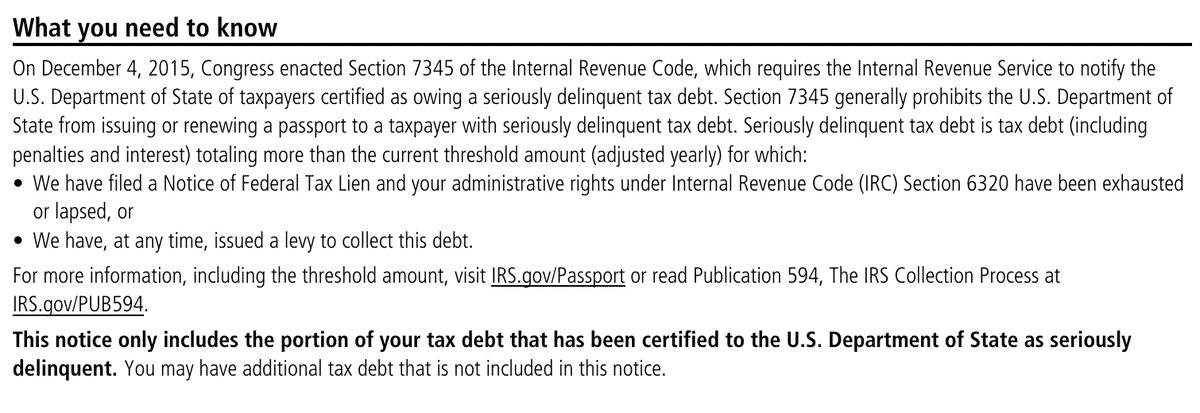
Next, the IRS gives you the legal backstory in its “What you need to know” section:
- Its statutory authority. On December 4, 2015, Congress enacted Internal Revenue Code Section 7345 as part of the Fixing America’s Surface Transportation (FAST) Act, requiring the IRS to notify the State Department of taxpayers certified as owing seriously delinquent tax debt.
- The definition of seriously delinquent tax debt. This is tax debt — including penalties and interest — totaling more than the current threshold (adjusted yearly for inflation; $66,000 for 2026) for which the IRS has either filed a Notice of Federal Tax Lien (and your administrative rights under IRC Section 6320 have been exhausted or lapsed) or issued a levy.
- Its effect. Section 7345 generally prohibits the State Department from issuing or renewing a passport for a taxpayer with seriously delinquent tax debt.
The notice also points you to IRS.gov/Passport for more information, including the current threshold amount, and to Publication 594 for an overview of the IRS collection process.
Part 4: What You Need to Do
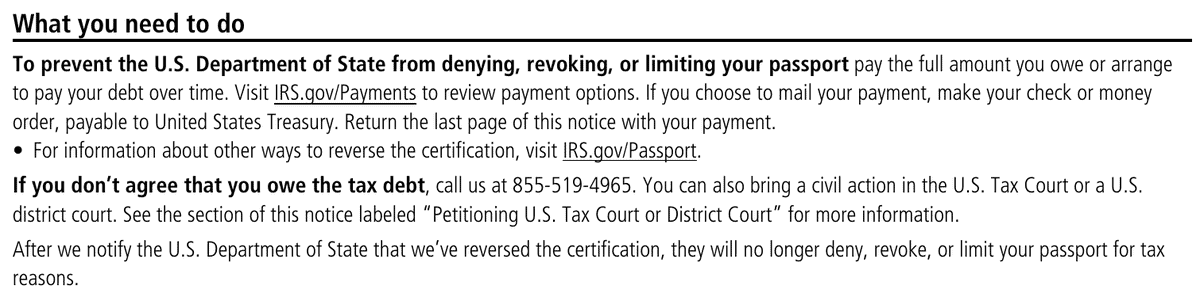
Then the IRS tells you what to do about it, and the instructions boil down to three scenarios:
- To prevent the State Department from denying, revoking, or limiting your passport — pay the full amount you owe or make arrangements to pay over time (the notice points you to IRS.gov/Payments to review payment options). If you mail a payment, your check or money order should be payable to “United States Treasury,” and you should return the last page of the notice with it.
- If you don’t agree that you owe the tax debt — call the IRS at 855-519-4965. You can also bring a civil action in the U.S. Tax Court or a U.S. district court (more on that in Part 7 below).
- After the debt is resolved — once the IRS notifies the State Department that the certification has been reversed, the State Department will no longer deny, revoke, or limit your passport for tax reasons.
Part 5: Billing Summary
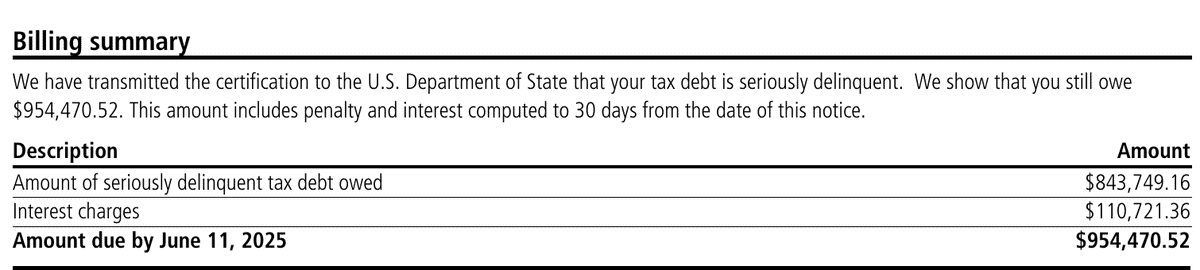
Page 2 of the notice opens with your billing summary — the certified debt in two lines plus a total:
- Amount of seriously delinquent tax debt owed: $843,749.16 for our client
- Interest charges: $110,721.36
- Amount due: $954,470.52, due by June 11, 2025 — 30 days after the notice date
Note the wording here: the amount “includes penalty and interest computed to 30 days from the date of this notice.”
So if you pay later than the pay-by date, the payoff figure will have grown; if you pay earlier, it will be slightly less.
Part 6: Billing Details
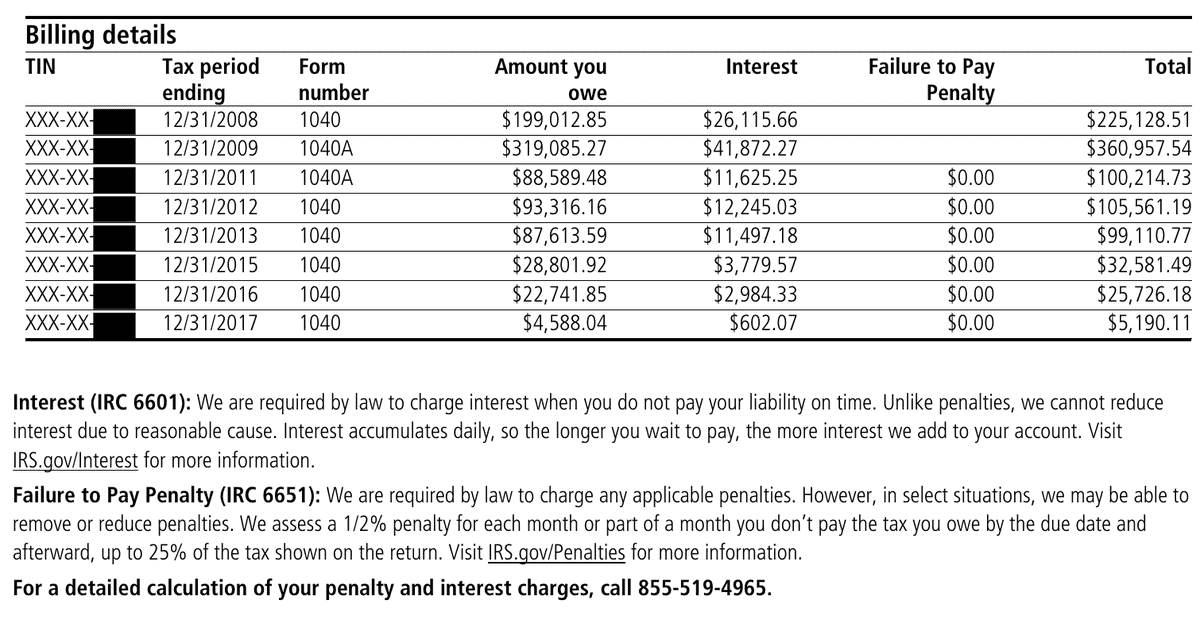
The billing details table breaks your certified debt down year by year.
For each tax period, you will see the form filed, the amount you owe, accrued interest, and any failure to pay penalty.
Our client’s certified debt spanned eight separate tax years — 2008 through 2017 — with the single largest year (2009) accounting for over $360,000 of the total.
This is a fairly common profile for CP508C recipients: seriously delinquent tax debt usually builds up over many years, not one bad season.
Below the table, the IRS explains the two charges that keep your balance growing:
- Interest (IRC Section 6601): The IRS is required by law to charge interest when you don’t pay on time, it accrues daily, and — unlike penalties — the IRS cannot reduce it for reasonable cause.
- Failure to pay penalty (IRC Section 6651): A 1/2% penalty for each month or part of a month the tax goes unpaid, up to a maximum of 25% of the tax. Unlike interest, penalties can potentially be removed or reduced in select situations — which is exactly what penalty abatement is for.
Part 7: Petitioning the U.S. Tax Court or District Court
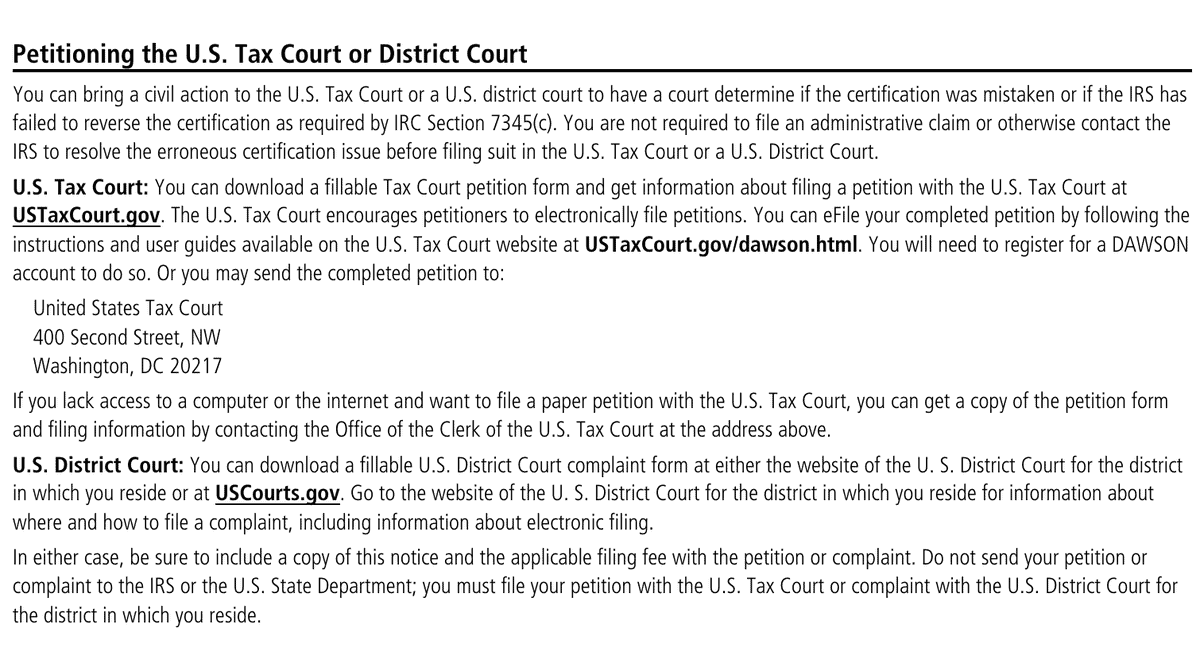
This section — given far more prominence on the current version of the notice than on older versions — explains your judicial remedy.
If you believe the certification is erroneous, or that the IRS failed to reverse a certification when it was required to under IRC Section 7345(c), you can bring a civil action in the U.S. Tax Court or a U.S. district court.
Two points here are worth underlining:
- You are not required to go through the IRS first. The notice states outright that you don’t need to file an administrative claim or otherwise contact the IRS before filing suit over an erroneous certification.
- You can file electronically with the Tax Court. The Tax Court encourages electronic petitions through its DAWSON system at USTaxCourt.gov — or you can mail a completed petition to the United States Tax Court at 400 Second Street, NW, Washington, DC 20217. For district court, you would file a complaint with the district court for the district where you reside (see USCourts.gov).
In either case, include a copy of your notice and the applicable filing fee — and do not send your petition or complaint to the IRS or the State Department, a mistake that would cost you precious time.
Part 8: Where to Find More Information and Your Taxpayer Rights
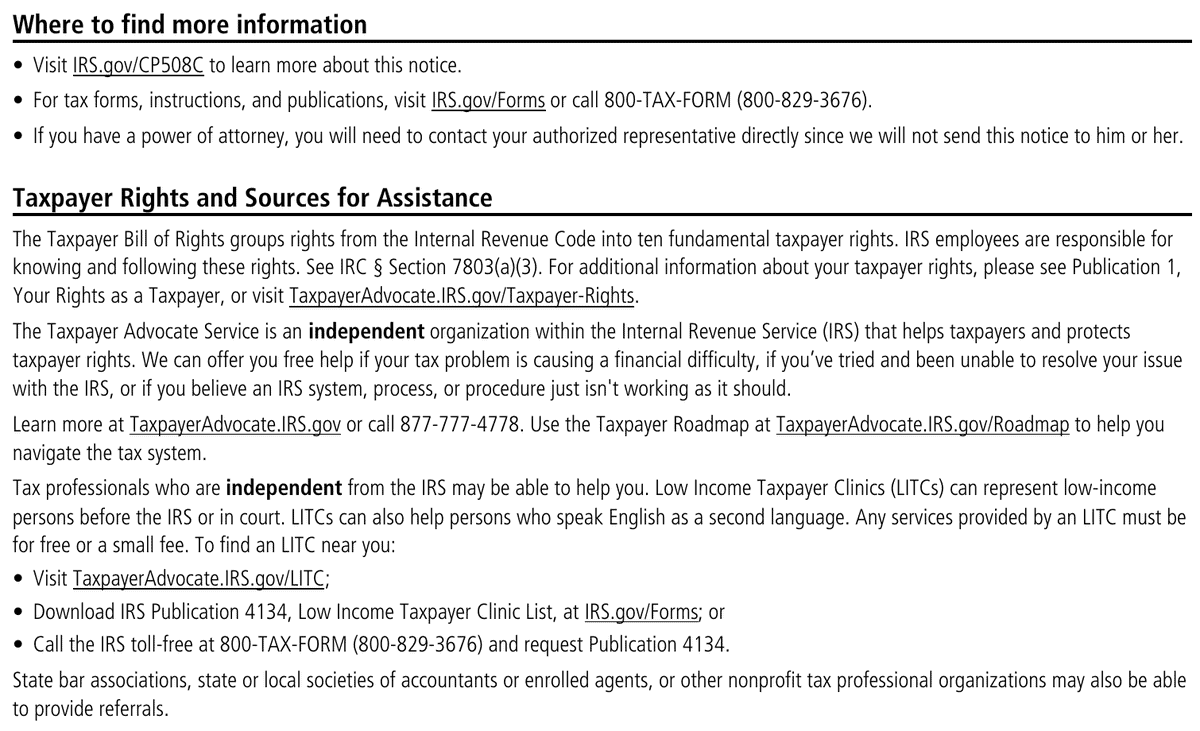
The back half of page 3 covers resources:
- IRS.gov/CP508C for more about the notice itself
- The reminder we mentioned earlier that the IRS will not send this notice to your power of attorney
- A rundown of the Taxpayer Bill of Rights
It also describes two sources of free or low-cost help:
- The Taxpayer Advocate Service (877-777-4778), an independent organization within the IRS that helps taxpayers whose tax problems are causing financial difficulty
- Low Income Taxpayer Clinics, which can represent qualifying taxpayers before the IRS or in court for free or a small fee
Part 9: Payment Stub
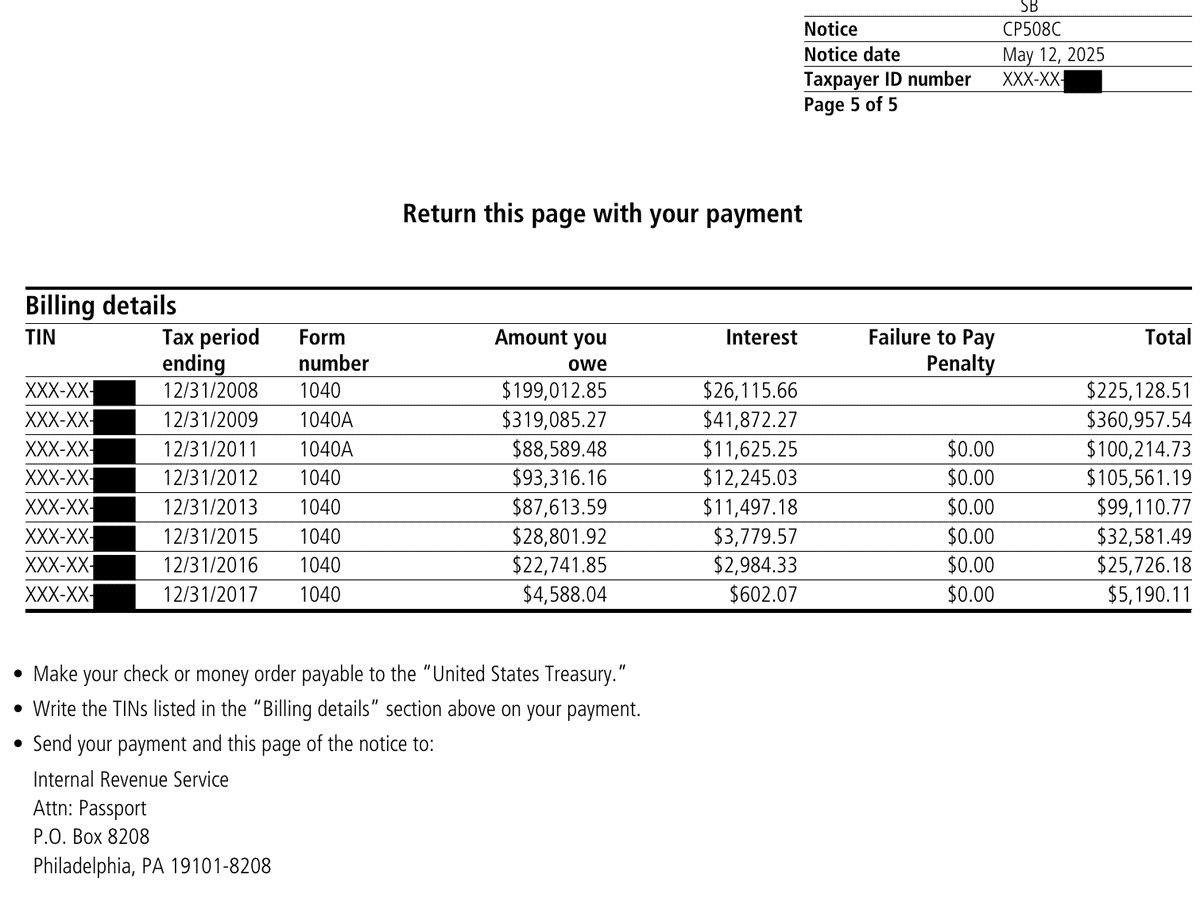
The final page of the notice — “Return this page with your payment” — is your payment stub, and it repeats the year-by-year billing details for your records.
If you are paying by mail, make your check or money order payable to “United States Treasury,” write the TIN(s) listed in the billing details on your payment, and send it with this page to the IRS’s passport unit in Philadelphia at the address shown.
Older versions of the CP508C did not include a payment coupon at all, so this dedicated stub is a welcome, if small, improvement.
That said, mailing a check is not your only option — IRS.gov/Payments offers direct pay from your bank account, which gets credited faster.
Why Does the IRS Send Notice CP508C?
The IRS sends Notice CP508C because it is statutorily required to do so.
Under IRC Section 7345(d), when the IRS certifies a taxpayer’s seriously delinquent tax debt to the State Department, it must “contemporaneously” notify the taxpayer of that certification.
So by the time this notice reaches your mailbox, the certification has already been transmitted — the CP508C is not a warning that certification might happen; it is confirmation that it has happened.
CP508C vs. CP508R: Certification and Decertification
The CP508C has a mirror image: IRS Notice CP508R, which the IRS sends when it reverses the certification.
Here is how they compare:
| CP508C | CP508R | |
|---|---|---|
| What it means | Your tax debt has been certified to the State Department as seriously delinquent | The certification has been reversed (decertified) |
| Passport impact | Applications and renewals denied; possible revocation | The State Department can issue or renew your passport again |
| What triggers it | Debt over the annual threshold plus a filed lien or issued levy | Full payment, a resolution like an installment agreement or offer in compromise, or an erroneous certification being corrected |
| Timing | Sent when the IRS transmits the certification | The IRS must notify the State Department within 30 days of the debt being resolved |
Owe the IRS? Talk to a tax expert — free.
What You Should Do If You Receive a CP508C
Below are the steps we recommend you take after you receive IRS Notice CP508C.
Step 1: Confirm You Actually Owe the IRS
The obvious first step is to make sure you actually owe what the notice says you owe.
The IRS makes mistakes — assessments based on returns it filed for you (called substitutes for return), misapplied payments, and identity theft issues all happen.
Pull your IRS Online Account at irs.gov/account or have a tax professional pull your account transcripts and verify every certified year against the billing details table on your notice.
Also confirm the certification itself is proper.
Certain debts should never be certified — for example, debt you are paying under a current installment agreement, debt in an accepted offer in compromise, debt suspended because of an innocent spouse claim, or debt in a pending collection due process hearing.
If any of these apply to you, the certification may be erroneous.
Step 2: If the Certification Is Wrong, Dispute It
If you find an error — you already paid, the debt isn’t yours, or your debt falls into one of the excluded categories — call the IRS passport unit at 855-519-4965 and get the certification reversed.
If you have already paid the tax debt in full, send proof of that payment to the address on your notice.
And remember from Part 7 above: if the certification is erroneous, you can take the IRS straight to the U.S. Tax Court or a U.S. district court without first going through an administrative process.
When your passport — and with it, potentially your livelihood — is on the line, you have every right to move quickly.
Step 3: If You Can Pay in Full, Do So
Full payment is the fastest, cleanest way to get decertified.
Once your debt is fully satisfied, the IRS must reverse your certification and notify the State Department within 30 days.
If you have imminent international travel plans, it can move even faster — see the expedited decertification discussion below.
Step 4: If You Can’t Pay in Full, Get Into a Resolution
Most people who receive a CP508C — our nearly-million-dollar client included — cannot simply write a check.
The good news is that full payment is not required to get your passport back.
Your tax debt stops being “seriously delinquent” once it is being resolved, including through:
- An installment agreement. A monthly payment plan with the IRS (you can apply at irs.gov/opa). Once your agreement is approved, your debt is no longer seriously delinquent — even though you haven’t paid it off yet. You will then receive monthly payment reminders, and you will want to avoid defaulting on the agreement.
- An offer in compromise. An offer in compromise lets you settle your tax debt for less than you owe based on your ability to pay. An accepted offer — and even a pending offer, while it’s being considered — takes your debt out of seriously delinquent status.
- Other relief. Requesting innocent spouse relief or a timely collection due process hearing also suspends certification, and debts in bankruptcy, debts of identity theft victims, debts in currently not collectible (hardship) status, debts in a federally declared disaster area, and debts owed by taxpayers in a combat zone are excluded from certification as well.
Along the way, it is also worth pursuing penalty abatement — asking the IRS to remove or reduce penalties for reasonable cause or under its first-time abatement policy.
It won’t touch the interest, but on large balances like the one on this notice, removing failure-to-pay penalties can meaningfully shrink the mountain.
Step 5: If You Have Imminent Travel Plans, Ask for Expedited Decertification
If you have resolved your debt and need your passport for travel within about 45 days, tell the IRS.
It can expedite the decertification — shortening the normal 30-day State Department notification to roughly 9 to 16 days — if you provide proof of your travel plans (such as an itinerary) and a copy of the State Department’s denial letter if your application was denied.
IRS Notice CP508C: Frequently Asked Questions
What is IRS Notice CP508C?
IRS Notice CP508C is the IRS’s notification that it has certified your tax debt to the U.S. Department of State as seriously delinquent under Internal Revenue Code Section 7345. While the certification is in place, the State Department will not issue or renew your passport and may revoke your current one.
How much tax debt triggers a CP508C?
Seriously delinquent tax debt is tax debt, including penalties and interest, totaling more than an annually adjusted threshold — $66,000 for 2026 — for which the IRS has filed a Notice of Federal Tax Lien (with lien rights exhausted or lapsed) or issued a levy.
Will my current passport be revoked because of the CP508C?
Not necessarily. The certain consequence is that the State Department will deny new passport applications and renewals. Revocation of a currently valid passport is possible but less common; the State Department may also limit an existing passport to return travel to the United States.
Do I have to pay in full to get my passport back?
No. Your debt stops being seriously delinquent once you enter into a resolution such as an installment agreement or offer in compromise, or when other exclusions apply (like innocent spouse relief or a timely collection due process hearing). The IRS then reverses the certification and notifies the State Department within 30 days.
What if I have a trip coming up soon?
If your travel is within about 45 days and your debt has been resolved, the IRS can expedite decertification — cutting the State Department notification from 30 days down to roughly 9 to 16 days. You’ll need to provide proof of travel and, if applicable, the State Department’s denial letter.
Can I fight the certification in court?
Yes. If you believe the certification is erroneous or that the IRS failed to reverse it when required, you can petition the U.S. Tax Court (electronically through DAWSON at USTaxCourt.gov) or file a complaint in a U.S. district court — and you are not required to file an administrative claim with the IRS first.

“I owed almost $200,000 of IRS debt and she was able to negotiate an installment agreement that reduced it down to $48,600 over 10 years. I almost couldn’t believe it. Can’t recommend this company enough.”
Get Help Now
Got a CP508C notice? Don’t wait for the IRS’s next move.
Talk to a tax expert — free, no obligation. We’ve resolved over $20 million in IRS debt for our clients.


Author:

Logan Allec, CPA, Founder and Owner
Logan Allec has been serving taxpayers as a CPA for over 14 years. After leaving his role at a "Big 4" firm, he started Choice Tax Relief to help everyday Americans who have found themselves behind on their taxes. He also educates thousands of people daily about tax relief on his YouTube channel. In addition to his CPA license, Logan also has a Master's Degree in Taxation from the University of Southern California (USC). He lives with his wife and children in the Los Angeles area. Learn more about Logan here.