

IRS Notice LT17: How to Deal With This Urgent Notice From the IRS

IRS Notice LT17 is the “Please Take Action on Your Balance Due” notice that the IRS sends you when you owe taxes.
Despite the triangled exclamation point and the capitalized and bolded warning “URGENT NOTICE — You need to act immediately”, the LT17 is a fairly generic notice that simply:
- informs you of what you owe the IRS
- what the IRS can do to you if you don’t pay or resolve your balance
- your payment options
Now, even though the LT17 is fairly generic — simply telling you what the IRS can do to you rather than making any specific threat against you — it does signal to the taxpayer that they are now on the IRS’s radar.
We are seeing taxpayers with balances due for which they had previously been receiving mere annual reminder notices in the CP71 series now receiving the LT17 with the IRS taking forced collection activity shortly thereafter if the issue is not dealt with.
Essentially, Notice LT17 is a warning from the IRS that enforcement action will follow so long as the balance remains unpaid.
Here is a redacted Notice LT17 that the IRS sent to one of our clients.
Table of Contents
IRS Notice LT17 At a Glance
| Notice Type: | Urgent Notice |
| Generated By: | IRS ACS Support |
| Preceded By: | At Least One Other LT or CP Notice |
| Followed By: | Adverse Consequences |
| Recommended Action: | File Delinquent Returns and Pay Off Balance Due or Enter Into Resolution |
Free Consultation
Got an LT17 notice? Don’t wait for the IRS’s next move.
Talk to a tax expert — free, no obligation. We’ve resolved over $20 million in IRS debt for our clients.
IRS Notice LT17 Explained, Part by Part
Here is a full explanation of the Notice LT17, part by part.
Part 1: Notice and What The IRS Needs You To Do Immediately
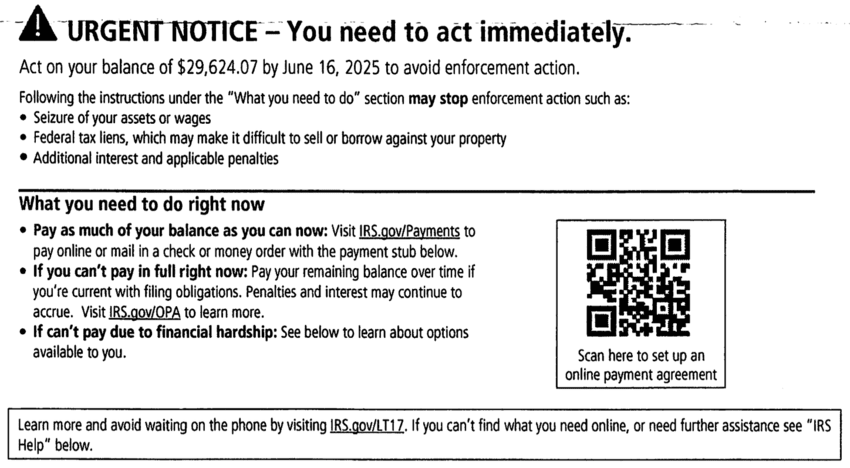
The IRS opens this notice with an exclamation point and big, bold letters — you can’t miss the fact that this is an “URGENT NOTICE” requiring immediate action.
Immediately below the lede, the notice provides additional information:
- Your current balance with the IRS (in our client’s case, $29,624.07)
- The deadline the IRS is giving you to avoid enforcement action (in our client’s case, June 16, 2025)
Confused about what exactly “enforcement action” is?
That’s OK — the IRS then gives you examples of actions they can take against you if you don’t deal with your tax debt, including:
- seizing your assets or wages
- filing a notice of federal tax lien against you
- charging additional interest and penalties
Then, the IRS tells you “what you need to do right now.”
Obviously, the government wants you to “pay as much of your balance as you can now,” and that’s the first thing the notices tells you to do.
Now, the IRS realizes that you may not have the ability to pay off your balance in full immediately, so it lets you know about a couple other options:
- setting up an installment agreement to pay off your debt over time
- being placed into the IRS hardship program
Finally, in the box at the bottom of this section, the IRS provides you with a link to the official IRS webpage for the LT17 notice.
Part 2: IRS-Provided Help

Next, the IRS provides you with a phone number you can call; note that the 800-829-7650 phone number provide in the notice our client received is a phone number for the IRS’s Automated Collection System (ACS), not the general IRS line.
Part 3: Billing Summary
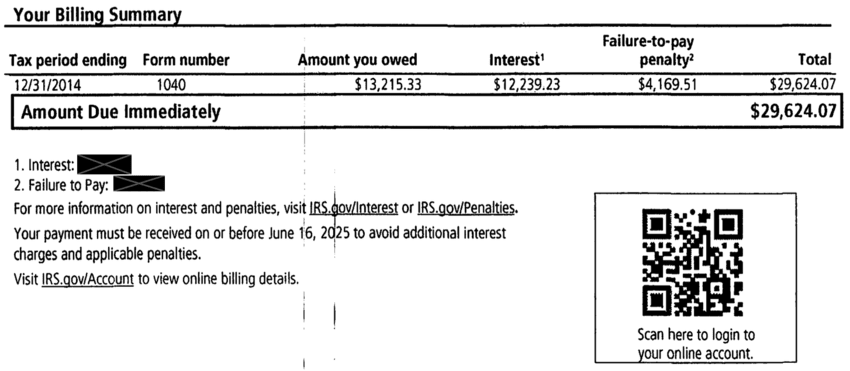
Next, the IRS will provide you with your billing summary.
It will provide you with the tax period ending, form number, amount owed, interest penalties, failure to pay penalties, and the total owed.
You will be able to scan the provided QR code to log into your online account to view your billing details online.
You will have about 30 days from the date of the notice to pay off your outstanding balance before additional interest and penalties accrue from that indicated in this billing summary.
Part 4: If You Can’t Pay Due to Financial Hardship
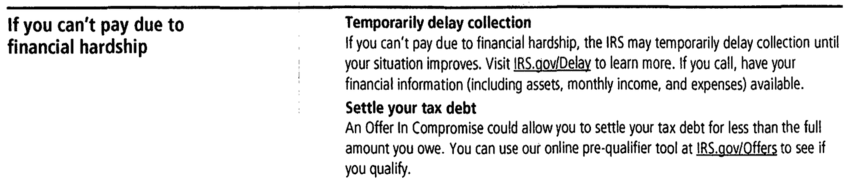
In this section of the Notice LT17, the IRS provides you with two options for what you can do if you can’t pay the IRS what you owe due to financial hardship.
These two options are a temporary collection delay or an offer in compromise.
A temporary delay in collection will halt any IRS action against you for a predetermined length of time.
Your assets and such will be protected until your financial situation improves.
Though the process doesn’t get rid of your tax debt, it provides a cushion of time for you to save up.
The other option is an Offer In Compromise (OIC).
This is an agreement with the IRS to settle your tax debt for less than you owe.
It’s on a qualification basis, though.
There are alternative options if you don’t qualify, and we’ll discuss those later.
Part 5: Taxpayer Rights and Sources for Assistance
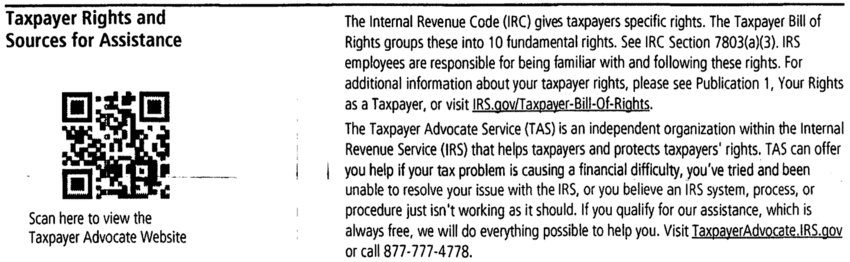
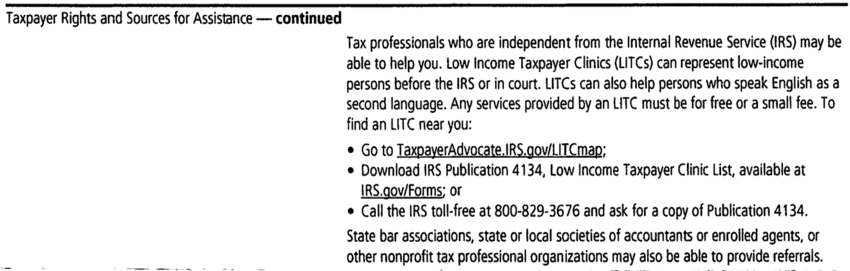
Next, the IRS will provide you with a way to access your taxpayer rights.
They link their website to the Taxpayer Bill of Rights, which gives an explanation of your rights as a taxpayer when dealing with the IRS.
They cannot do anything that violates those rights, so it’s important to be educated and up to date on them.
Then, the IRS will provide some sources of assistance.
This will include the Taxpayer Advocate Service (TAS), an independent service from the IRS to help resolve tax problems and protect your rights.
There are also Low Income Taxpayer Clinics (LITCs) to help represent low-income persons before the IRS or in court, if the situation calls for it.
If you want to take advantage of these services, they provide a phone number or a form you can fill out and turn in.
Part 6: Payment Coupon
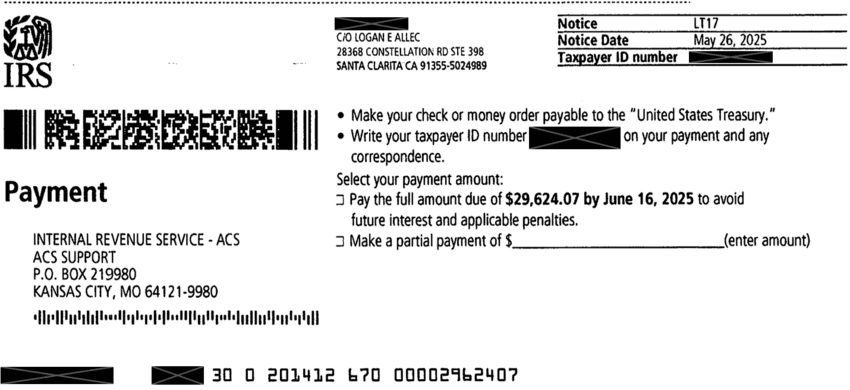
Finally, they provide you with a payment coupon.
It’s a form you can fill out to pay off your full or partial balance.
When filling it out, check the box corresponding to the payment you wish to proceed with.
You must also be sure to include your TIN on any mail you send, including this payment.
The check or money order must also be payable to the United States Treasury.
When you’re done filling everything out, it should then be mailed to the provided IRS address.
What You Should Do If You Receive an LT17
Below are steps for you to take after you receive an LT17 Notice from the IRS.
Step 1: Confirm You Actually Owe The IRS
The obvious first step is to make sure you actually owe the IRS.
It’s easy to panic when it appears that you owe an impossible amount of money to the IRS.
However, it makes mistakes, and it’s up to you to make sure the claims are correct.
The IRS is claiming you haven’t paid your taxes.
Is that true?
Did you pay, but they either didn’t receive your process your payment or receive it?
Always look and check your LT17 Notices.
Check and verify the legitimacy of the IRS’s claims and make sure they’re accurate.
Step 1a: Dispute the Charges if the IRS is Wrong
If you found an irrefutable error in your LT17 Notice, then contact the IRS at the provided phone number as soon as possible.
The sooner the better, especially since you only have 30 days from the date of your balance to pay off your debt.
Unfortunately, the IRS isn’t known for speed.
The likelihood of having a one-and-done phone call is quite low.
Instead, you’ll likely have to make multiple phone calls over and over to get everything sorted.
The process is long and difficult, so we do this on behalf of our clients.
We want to protect your rights and ensure you save money in the long run.
Step 2: If You Can Pay In Full, Do So
If you can pay in full, do so.
It’s the fastest and easiest way to stop the IRS from taking any action against you.
You will have about 30 days from the date of the notice to pay everything off.
While it may sound obvious, it is the most straightforward path and solution to your outstanding balance.
Step 3: Seek Penalty Abatement From the IRS
If you cannot afford your balance, consider seeking penalty abatement.
Penalty abatement allows you to possibly reduce or remove your balance by appealing to the IRS.
It’s highly effective if you qualify.
Not everyone qualifies, so it’s not a guaranteed solution, but it never hurts to check.
Choice Tax Relief will always attempt to seek some penalty abatement for our clients.
Step 4: Seek Tax Relief
If you’ve done everything possible to plead your case with the IRS and still can’t afford your balance, consider seeking tax relief.
The timeline won’t be the clearest, but it will help you as you think through your balance.
We’ve already talked about the temporary delay in collection you can appeal for.
We’ve also discussed an offer in compromise (OIC), which allows you to settle tax debt for less than you owe.
However, an OIC isn’t a feasible option for everyone; the IRS provides other alternatives.
Things like the previously mentioned installment payments are highly effective, alongside temporary hardship placements (called currently not collectible status).
A “not collectible status” will stop the IRS from taking action against you, temporarily.
During this time, you can save and prepare to pay off your balance.
This does not stop the debt completely; it merely puts a pause on it.
Installment payments are where the IRS sets up some sort of payment plan to allow to alleviate the tax burden on your business.

“Working with Luke at Choice Tax Relief has been a fantastic experience. His commitment to clear communication is what truly sets him apart. I was always impressed by his responsiveness to my questions, and his consistent, proactive updates.”
Get Help Now
Got an LT17 notice? Don’t wait for the IRS’s next move.
Talk to a tax expert — free, no obligation. We’ve resolved over $20 million in IRS debt for our clients.


Author:

Logan Allec, CPA, Founder and Owner
Logan Allec has been serving taxpayers as a CPA for over 14 years. After leaving his role at a "Big 4" firm, he started Choice Tax Relief to help everyday Americans who have found themselves behind on their taxes. He also educates thousands of people daily about tax relief on his YouTube channel. In addition to his CPA license, Logan also has a Master's Degree in Taxation from the University of Southern California (USC). He lives with his wife and children in the Los Angeles area. Learn more about Logan here.