

IRS Letter 484C: Why Did The IRS Reject My Installment Agreement?

IRS Letter 484C tells you the IRS could not set up the installment agreement you asked for as you proposed it and needs something more from you first.
On the letter one of our clients received, that something was either a higher monthly payment or a financial statement.
In this article I will walk you through that real letter, part by part.
It names $63.00 as the minimum monthly payment the IRS can accept and gives our client 30 days to answer.
It is not a formal rejection, and that distinction controls what the IRS can do next and what rights you have.
Here is a redacted Letter 484C that one of our clients received (PDF).
Key Takeaways
- Letter 484C means the IRS could not set up your installment agreement as proposed, and on our client’s letter the reason was a monthly payment too low to pay the balance in full.
- It is not a formal rejection, because the letter says the request “may be rejected” if the IRS does not get what it asked for within 30 days.
- You can agree to the minimum payment on Form 433-D, which was $63.00 on our client’s letter, or send Form 433-F or Form 433-B and ask for a partial payment installment agreement.
- Federal law bars levies while a request is pending, for 30 days after a rejection and during a timely appeal, but I would confirm that the IRS has recorded your request as pending.
- A rejection can be appealed within 30 days through the Collection Appeals Program, and penalties and interest keep adding up the whole time.
Table of Contents
What Is IRS Letter 484C?
Letter 484C is a plain, typed IRS correspondence letter, not one of the designed CP notices.
It is a reply, and our client’s copy opens with “Thank you for your correspondence dated Sep. 04, 2024, concerning the above tax periods.”
The sentence that defines it comes next: “We couldn’t process your installment agreement request.”
The IRS gives its reason in the same paragraph: “The monthly payment amount you proposed was insufficient to create a full pay installment agreement, based on your current balance.”
A full pay installment agreement is a monthly plan that pays the entire balance, with penalties and interest, before the IRS’s time to collect runs out.
The letter is not a bill for a new amount, a notice of intent to levy, or the formal rejection that starts an appeal deadline.
Under the Treasury regulation, a request “has not been rejected until the IRS notifies the taxpayer or the taxpayer’s representative of the rejection, the reason(s) for rejection, and the right to an appeal.”
We cover how IRS payment plans work in general in a separate guide.
Free Consultation
Got IRS Letter 484C? Don’t wait for the IRS’s next move.
Talk to a tax expert — free, no obligation. We’ve resolved over $20 million in IRS debt for our clients.
IRS Letter 484C at a Glance
| Detail | What It Means |
|---|---|
| Letter type | A typed IRS letter answering an installment agreement request |
| Reason on our client’s letter | The proposed monthly payment was too low for a full pay installment agreement |
| Minimum payment on our client’s letter | $63.00 a month |
| Deadline to respond | 30 days from the date of the letter |
| If you can pay the minimum | Return a revised payment proposal on Form 433-D |
| If you can’t pay the minimum | Send Form 433-F, or Form 433-B for a business, with Form 433-D |
| Is it a rejection? | No, the letter says the request “may be rejected” if you do not respond |
| Appeal rights | They start with a formal rejection, which you have 30 days to appeal |
Why Did the IRS Send You Letter 484C?
You asked to pay monthly, and the IRS ran the numbers on the amount you offered.
Section 6159 of the Internal Revenue Code authorizes installment agreements that will help the IRS collect a tax debt in full or in part.
The IRS’s Topic 202 on tax payment options says your proposed payment must pay the tax liability in full by the Collection Statute Expiration Date.
That date is generally 10 years from the date the tax was assessed, and the same page says a proposal that will not pay the entire balance by then requires a Collection Information Statement.
The regulation under section 6159 covers what happens next: when a request lacks what the IRS needs to evaluate it, “the IRS will request the taxpayer to provide the needed additional information.”
If you do not send it within a reasonable time, the regulation says “the IRS may reject the proposed installment agreement.”
Our client’s Letter 484C reads as that request, with the time to answer set at 30 days.
A Part-by-Part Walkthrough of IRS Letter 484C
Here is our client’s letter in the order it reads, with what I would check in each part.
Part 1: The Opening and the Minimum Payment
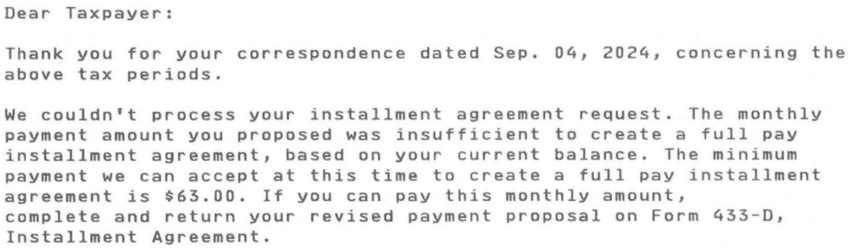
The letter begins “Dear Taxpayer:” and thanks our client for their correspondence dated Sep. 04, 2024.
Our redacted copy does not show the letter date, the tax periods or the balance, so I will not guess at them.
After saying it could not process the request, the IRS gives the number: “The minimum payment we can accept at this time to create a full pay installment agreement is $63.00.”
The words “at this time” and “based on your current balance” tell you the figure is a snapshot of a balance that keeps changing.
If you can pay it, the letter says to “complete and return your revised payment proposal on Form 433-D, Installment Agreement.”
Part 2: If You Can’t Pay That Amount
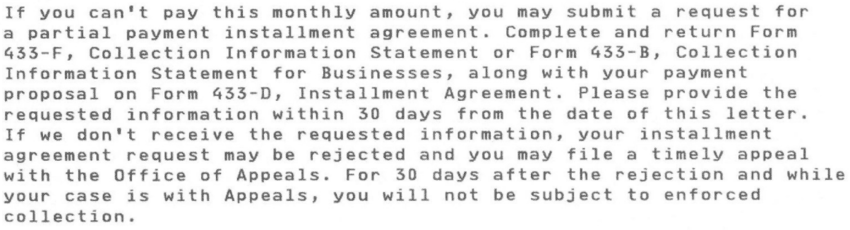
The next paragraph begins, “If you can’t pay this monthly amount, you may submit a request for a partial payment installment agreement.”
That request takes Form 433-F, Collection Information Statement, or Form 433-B for a business, along with the payment proposal on Form 433-D.
Then the deadline: “Please provide the requested information within 30 days from the date of this letter.”
The sentence after it is the one I want you to read twice: “If we don’t receive the requested information, your installment agreement request may be rejected and you may file a timely appeal with the Office of Appeals.”
The words “may be rejected” look ahead, which tells me the request was still open when the letter was written.
The paragraph ends with a promise that tracks section 6331(k) of the Internal Revenue Code: “For 30 days after the rejection and while your case is with Appeals, you will not be subject to enforced collection.”
Tip: The 30 days run from the date printed on the letter, not from the day you opened it.
Part 3: Penalties
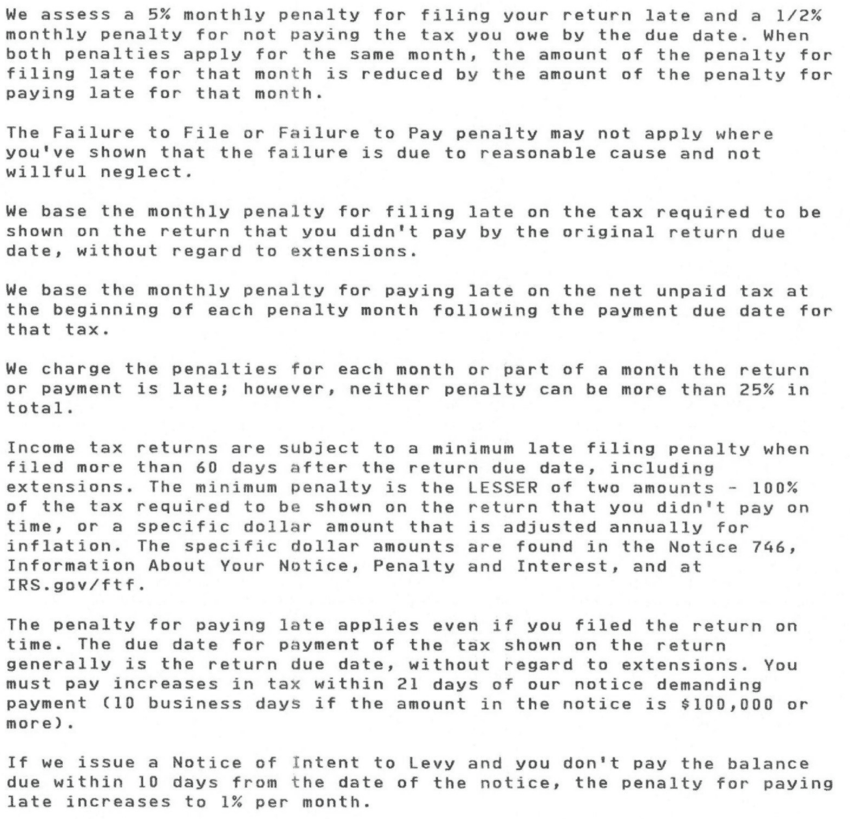

This part explains the late filing and late payment penalties, and it gives no penalty amounts for our client.
It starts with the rates: “We assess a 5% monthly penalty for filing your return late and a 1/2% monthly penalty for not paying the tax you owe by the due date.”
When both apply in the same month, the late filing penalty is reduced by the late payment penalty, so the month costs 4.5% plus 0.5%, or 5% in total.
The letter caps each penalty at 25%, so the late filing penalty stops growing after five months, while the late payment penalty, at 1/2% a month, would take 50 months to reach its cap.
The minimum late filing penalty for a return more than 60 days late is the lesser of 100% of the unpaid tax or a dollar amount the letter leaves out, which the IRS failure to file penalty page lists as $525 for returns due after December 31, 2025.
The late payment rate falls only once a plan is approved: “For individuals who filed on time, the penalty decreases to 1/4% per month while an approved installment agreement with the IRS is in effect for payment of that tax.”
The letter also gives the ground for a penalty abatement request, a showing that the failure was “due to reasonable cause and not willful neglect.”
Part 4: Interest and Payments in the Meantime
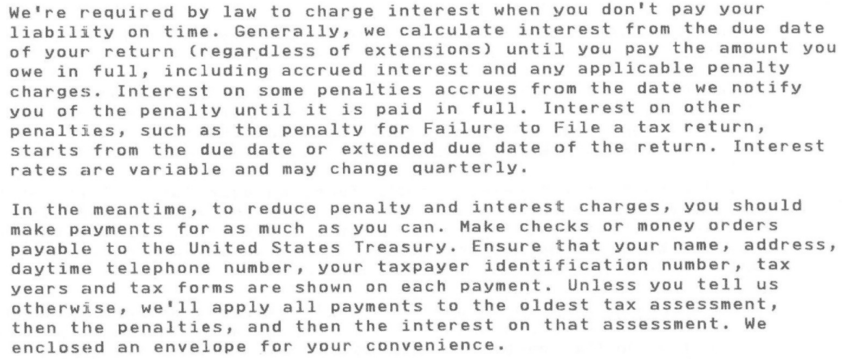
The letter says interest generally runs “from the due date of your return (regardless of extensions) until you pay the amount you owe in full,” so an extension of time to file does not stop IRS interest.
Rates “are variable and may change quarterly” in the letter’s words, and the IRS’s quarterly interest rate page shows 7% a year for individual underpayments in the quarter that began October 1, 2026.
The next paragraph is advice from the IRS: “In the meantime, to reduce penalty and interest charges, you should make payments for as much as you can.”
I agree, because the letter bases the late payment penalty “on the net unpaid tax at the beginning of each penalty month” after the due date, so every payment shrinks next month’s penalty base.
The IRS also says how it will apply the money: “Unless you tell us otherwise, we’ll apply all payments to the oldest tax assessment, then the penalties, and then the interest on that assessment.”
Part 5: Federal Income Tax Is a Pay-As-You-Go Tax
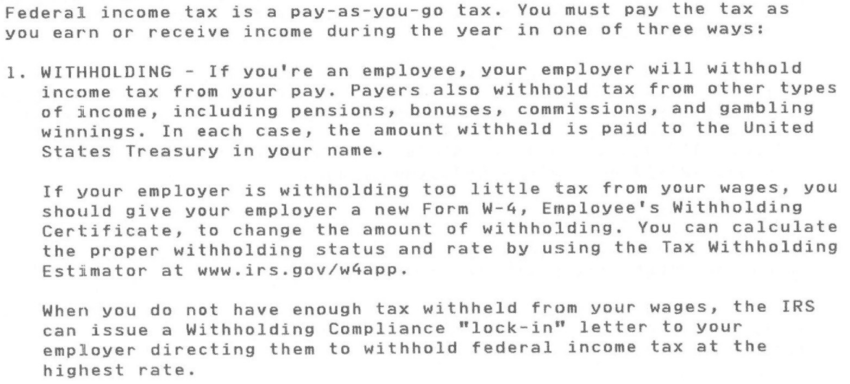
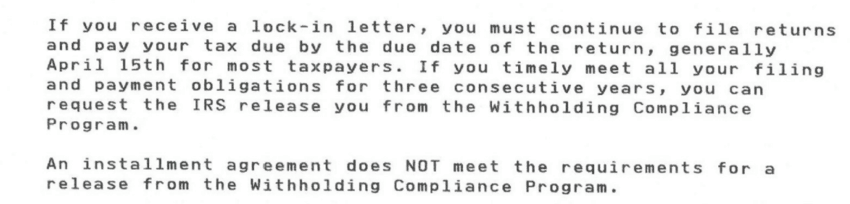
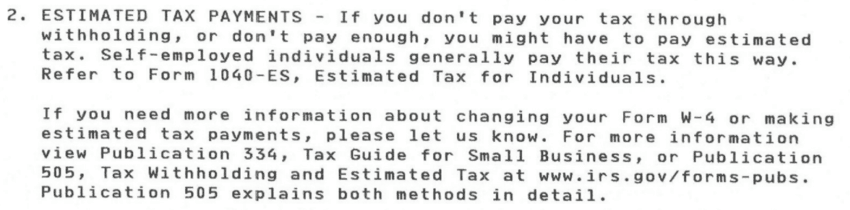
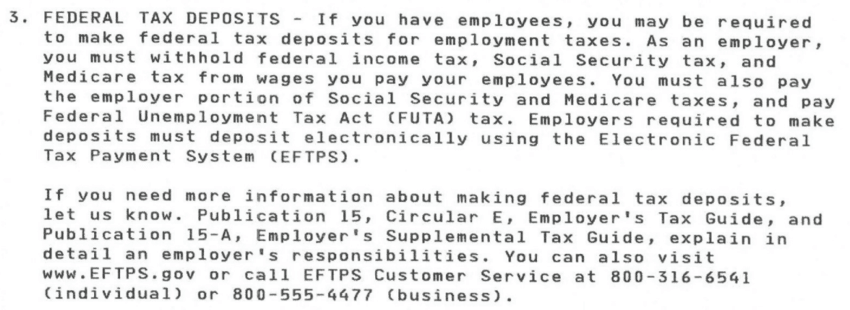
This section runs across four images, and I read it as the IRS telling our client how to keep a future agreement from failing.
It opens with “Federal income tax is a pay-as-you-go tax” and lists three ways to pay during the year: withholding, estimated tax payments and federal tax deposits.
Employees are told to give their employer a new Form W-4 if too little is withheld, and warned that the IRS can send the employer a lock-in letter directing it to withhold at the highest rate.
The letter says you can ask for release from a lock-in after three consecutive years of timely filing and paying, and adds, “An installment agreement does NOT meet the requirements for a release from the Withholding Compliance Program.”
Taxpayers who do not pay enough through withholding are pointed to estimated tax and Form 1040-ES, and employers to federal tax deposits.
All of this belongs in a payment plan letter because Form 433-D requires you to file every federal return and pay every new tax bill on time, and section 6159 lets the IRS terminate an agreement over an unpaid new tax bill, which is what a CP523 notice announces.
Part 6: Additional Information
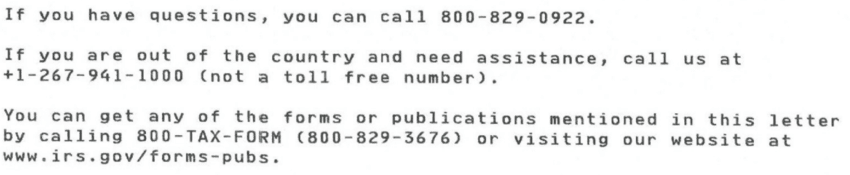
The contact section is short: “If you have questions, you can call 800-829-0922.”
It gives +1-267-941-1000 for taxpayers outside the country, which is not a toll free number, and 800-TAX-FORM (800-829-3676) or www.irs.gov/forms-pubs for forms.
I would call with the letter in front of you, and when we call for a client we do it under a power of attorney on Form 2848.
Part 7: Further Contact
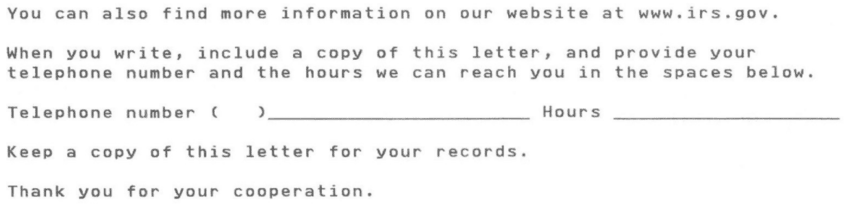
The letter then gives an instruction for written replies: “When you write, include a copy of this letter, and provide your telephone number and the hours we can reach you in the spaces below.”
I would fill in both blanks, so the IRS can match your forms to this request and reach you with a question.
The last instruction is “Keep a copy of this letter for your records.”
Part 8: Where to Send Forms and Payments
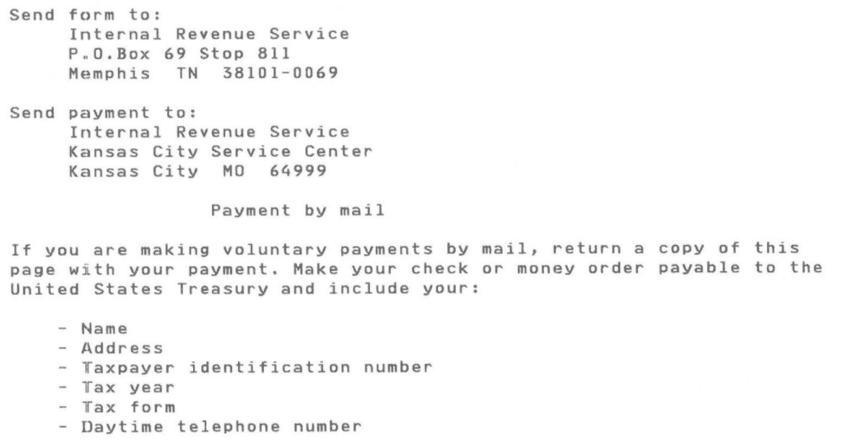
The final image gives two different addresses.
- Send form to: Internal Revenue Service, P.O.Box 69 Stop 811, Memphis TN 38101-0069
- Send payment to: Internal Revenue Service, Kansas City Service Center, Kansas City MO 64999
The section headed “Payment by mail” says, “If you are making voluntary payments by mail, return a copy of this page with your payment.”
These are the addresses on our client’s letter, so use the ones printed on yours.
Important: On our client’s letter the forms go to Memphis and the payments go to Kansas City, so do not put a check in the envelope with your forms.
Not Processed Is Not the Same as Rejected
For a letter like our client’s, the honest answer to the question in this post’s title is that the IRS has not rejected anything yet.
The regulation says a proposed installment agreement “becomes pending when it is accepted for processing” and stays pending until the IRS accepts it, notifies you that it has been rejected, or you withdraw it.
While a request is pending, section 6331(k) bars the IRS from levying to collect the tax the agreement would cover, unless you waive the protection in writing, the IRS determines the request was submitted solely to delay collection, or collection is in jeopardy.
It does not stop the IRS from applying your refunds to the debt or filing a Notice of Federal Tax Lien.
The 10-year collection statute of limitations also stops running while the request is pending, for 30 days after a rejection and during an appeal.
My caution is that the IRS’s manual has its own test for when a request counts as pending, and since May 2025 that test has included a completed financial statement whenever one is required.
A payment too low to pay the balance in full requires one, so a proposal like that arriving today without a financial statement might not be treated as pending at all.
I cannot tell from our client’s letter alone how the IRS recorded the request, so we pull the account transcript and call the IRS to confirm whether it is marked as a pending installment agreement.
Where the Minimum Payment Comes From
Our client’s letter gives the number, $63.00, and one clue about where it came from: it is “based on your current balance.”
It does not show the balance or the number of months the IRS used, and I am not going to work backward from $63.00 to guess either one.
Topic 202 says most individual taxpayers qualify for a Simple Payment Plan, generally when the assessed total of tax, penalties and interest is $50,000 or less, with a payment that pays the liability in full by the collection deadline.
The IRS manual section on these plans, revised July 21, 2026, requires a payment calculation that ensures “full payment of all balances, including accrued penalties and interest,” by that date and says no Collection Information Statement is required.
So a full pay minimum has to cover more than today’s balance, because penalties and interest are added along the way.
The Form 9465 instructions, last revised in July 2024, still say a payment will be set “by dividing the balance due by 72 months” when you do not propose one, while the July 2026 manual revision says it removed the prior 72-month minimum payment rule.
Section 6159 also guarantees an agreement for an individual who owes $10,000 or less in income tax and can pay in full within three years, if its other conditions are met.
There is also a setup fee: the IRS’s payment plan page lists $178 for a long-term plan requested by phone, mail or in person, $107 with direct debit, $69 or $29 for the same two choices online, and a reduced or waived fee for low-income taxpayers.
Full Pay vs. Partial Payment Installment Agreement
Our client’s letter offers two kinds of agreement, and the difference between them goes well beyond the monthly amount.
| Feature | Full Pay Agreement | Partial Payment Agreement |
|---|---|---|
| What gets paid | The whole balance, with penalties and interest, by the collection deadline | Less than the whole balance, with payments until the collection deadline |
| Financial statement | Not required for a Simple Payment Plan | Required |
| Review after approval | The IRS can ask for updated financial information | Every two years, and the payment can go up, go down or stay the same |
| Balance left at the collection deadline | None if the agreement is kept | The IRS stops collecting what remains |
A partial payment agreement asks more of you, because the IRS manual says equity in assets must be addressed and, if appropriate, used to make payment first, and our guide to the partial payment installment agreement covers the process.
If the financial statement shows you cannot pay anything after basic living expenses, the IRS can report the account as currently not collectible, which suspends most collection activity while penalties and interest continue.
If it shows you cannot pay the debt in full or through installments, an offer in compromise, which the IRS describes as settling for less than the full amount you owe, may be worth a look.
If the IRS Does Reject the Request
A rejection is a separate event with its own written notice, and it comes with rights that our client’s letter only mentions in passing.
Before the IRS can tell you a request is rejected, the law requires an independent administrative review of the proposed rejection.
You then have 30 days to appeal, and IRS Publication 1660 says the request must be made on or before the 30th day after the date of the rejection letter.
The appeal runs through the Collection Appeals Program, and Publication 1660 says to call the number on the rejection letter and explain that you want to appeal, with a written request, preferably on Form 9423, Collection Appeal Request, required when the rejection came from a revenue officer.
If you send a good faith revision of your proposal within 30 days of the rejection, the regulation applies to the revised proposal just as it did to the original.
Important: Publication 1660 says the decision Appeals makes in a Collection Appeals Program case is binding on you and the IRS, and you cannot take it to court.
That makes it different from a Collection Due Process hearing, which follows a lien or levy notice, lets you propose an installment agreement as a collection alternative, and can be reviewed by the Tax Court.
Owe the IRS? Talk to a tax expert — free.
How to Respond to IRS Letter 484C
Step 1: Count 30 Days From the Letter Date
Put the deadline on your calendar first, because the letter asks for a response “within 30 days from the date of this letter.”
If you cannot pull everything together in time, I would call the number on the letter before the deadline passes.
Step 2: Get Your Balance and Your Collection Dates
The letter quotes a minimum payment without showing the balance behind it, so the first thing we do is pull the account transcripts.
You can see what you owe by tax year in your IRS Online Account, and the IRS says the collection deadline for each assessment is on your account transcript.
Check your filing record too, because Topic 202 says you must be current on all filing and payment requirements before a payment plan request can be considered.
Step 3: If You Can Pay the Minimum, Return Form 433-D
The minimum is a floor for a full pay agreement, not a judgment about what you can afford, and Form 433-D lets the IRS terminate the agreement and levy if you miss payments.
If it fits your budget, fill in a payment at or above the minimum, choose direct debit if you want the lower setup fee, and mail the form with a copy of the letter to the “Send form to” address.
The agreement is not in place when you mail the form, because the regulation says a proposal has not been accepted until the IRS notifies you of the acceptance.
Step 4: If You Can’t, Prepare the Financial Statement
Complete Form 433-F, or Form 433-B for a business, and send it with a Form 433-D showing the payment you can make.
Form 433-F asks for your bank accounts, other assets, credit cards, employment, household income and monthly living expenses, and the IRS may ask for proof such as pay statements and bank statements.
The IRS compares your expenses with its Collection Financial Standards, and we explain the give and take in our guide on how to negotiate with the IRS.
Step 5: Fix Your Withholding or Estimated Payments and Keep Paying
Adjust your Form W-4 or start making estimated payments now, because a new balance on next year’s return can undo the agreement you are asking for.
Keep sending what you can while the request is open, but a payment is not a response, so send the forms as well.
What Happens If You Ignore IRS Letter 484C
The letter names the first consequence itself when it says your request “may be rejected” if the IRS does not receive what it asked for.
A rejection brings 30 days of levy protection and a right to appeal, and if you let those pass too, the IRS can go back to collecting.
IRS Publication 594 says the IRS usually levies only after it has assessed the tax and sent a bill, you have not paid, and it has sent a Final Notice of Intent to Levy and Notice of Your Right to a Hearing at least 30 days earlier.
That hearing notice is required only once for a tax period, so if you already received one and its 30 days have passed, a levy can follow without a second one.
We cover what that looks like in our articles on the notice of intent to levy and on whether the IRS can take money out of your bank account.
Meanwhile the late payment penalty keeps running at 1/2% a month, which the letter says rises to 1% if a Notice of Intent to Levy goes unpaid for 10 days, and interest keeps compounding daily.
Get Help With IRS Letter 484C
If the minimum payment on your Letter 484C is more than you can manage, the answer you send in the next 30 days matters.
At Choice Tax Relief we pull the account transcripts for every year, confirm the balance and the collection dates, and call the IRS under a power of attorney on Form 2848 to find out how your request is recorded.
From there I look at whether the right answer is the minimum payment, a partial payment installment agreement, currently not collectible status or an offer in compromise, and we prepare the forms.
Call us at 866-8000-TAX or book a free consultation and we will tell you where your account stands.

“I owed almost $200,000 of IRS debt and she was able to negotiate an installment agreement that reduced it down to $48,600 over 10 years. I almost couldn’t believe it. Can’t recommend this company enough.”
Frequently Asked Questions About IRS Letter 484C
Does IRS Letter 484C mean my installment agreement was rejected?
No. On our client’s letter the IRS says the request may be rejected if it does not receive what it asked for within 30 days. A request is not rejected until the IRS notifies you of the rejection, the reasons and your right to appeal.
How long do I have to respond to Letter 484C?
Our client’s letter asks for the requested information within 30 days from the date of the letter. Count from the date printed on your own letter, not the day it arrived.
Can the IRS levy my bank account or wages after sending Letter 484C?
Federal law bars a levy while an installment agreement request is pending, for 30 days after a rejection and while a timely appeal is pending. The IRS has its own test for when a request counts as pending, so I would confirm how yours is recorded.
What if I can’t afford the minimum payment on my Letter 484C?
The letter gives you a second option: request a partial payment installment agreement by sending Form 433-F, or Form 433-B for a business, along with Form 433-D. Depending on what the financial statement shows, currently not collectible status or an offer in compromise may fit better.
Do penalties and interest stop while the IRS reviews my request?
No. Interest runs until the balance is paid in full. For individuals who filed on time, the late payment penalty drops from 1/2% to 1/4% a month only while an approved installment agreement is in effect.
Can I appeal if the IRS rejects my installment agreement request?
Yes. You have 30 days from the rejection to ask for an appeal through the Collection Appeals Program, and Form 9423 is the form for a written request. The decision Appeals makes in that program is binding, and you cannot take it to court.
Get Help Now
Got IRS Letter 484C? Don’t wait for the IRS’s next move.
Talk to a tax expert — free, no obligation. We’ve resolved over $20 million in IRS debt for our clients.


Author:

Logan Allec, CPA, Founder and Owner
Logan Allec has been serving taxpayers as a CPA for over 14 years. After leaving his role at a "Big 4" firm, he started Choice Tax Relief to help everyday Americans who have found themselves behind on their taxes. He also educates thousands of people daily about tax relief on his YouTube channel. In addition to his CPA license, Logan also has a Master's Degree in Taxation from the University of Southern California (USC). He lives with his wife and children in the Los Angeles area. Learn more about Logan here.