

IRS Notice CP30: What It Is and Why Your Refund Was Reduced

IRS Notice CP30 tells you that the IRS charged you a penalty for not paying enough estimated tax during the year, and that it took that penalty out of your refund.
The headline on the notice is blunt: “You’ve been charged a penalty for failing to pay estimated taxes,” followed in bold type by “Your refund has been reduced.”
That pairing is what makes the CP30 so confusing, because most people assume a penalty notice means they now owe the IRS money.
On a CP30, you can be getting a refund and still be paying a penalty.
The redacted client notice below shows exactly that: the taxpayer prepaid $48,604 against $46,600 of 2023 tax and still lost $928.64 to a penalty, because the IRS looks at when you paid, not just how much you paid.
Below, I walk through that notice page by page and explain the very short list of ways this particular penalty can actually be reduced or removed.
View a redacted IRS Notice CP30 that one of our clients received (PDF)
Important: The images in this article come from a redacted CP30 that one of our clients received, not a mock-up. We blacked out the taxpayer’s name and address, and everything else appears exactly as the IRS printed it. This particular copy was mailed to us rather than to the taxpayer, which is why “%CHOICE TAX RELIEF INC” and our Los Angeles address appear in the recipient block and why the notice is stamped “CAF 9H” — the IRS sends a duplicate to whoever holds a valid power of attorney on the account.
Key Takeaways
- A CP30 is an estimated tax penalty notice. It says the IRS charged you the addition to tax under Internal Revenue Code section 6654 for underpaying your quarterly estimated taxes, and that it reduced your refund or your credit elect to next year by that amount.
- It is not the failure-to-pay penalty. The line item reads “failure to pay proper estimated tax,” which is a different animal from the failure-to-pay penalty under section 6651(a)(2) that shows up on a CP14 or a CP501.
- You can get one while still receiving a refund. Section 6654 measures each quarter separately, so prepaying more than your total tax for the year does not protect you if the money arrived late.
- A CP30 often means the IRS recalculated a penalty you already reported. This client’s notice says the IRS reviewed the estimated tax penalty computation, found an error, and increased the penalty to $928.64.
- Reasonable cause will not remove it. The Internal Revenue Manual states plainly that the estimated tax penalty cannot be removed or waived for reasonable cause alone, and First-Time Abate never applies to it.
- Form 2210 is the real lever. If your income or your withholding was uneven across the year, recomputing the penalty on Form 2210 is usually the only thing that actually lowers the number.
Table of Contents
The CP30 Series of IRS Notices
The CP30 is the IRS’s notice for the estimated tax penalty, and it comes in two versions that say opposite things depending on whether the penalty was charged to you or taken back.
The table below shows how the CP30 compares to its CP30A counterpart so you can confirm exactly which notice you received and what it means.
| Notice | What It Is | When the IRS Sends It |
|---|---|---|
| CP30 | A notice telling you the IRS charged you a penalty for not paying enough estimated tax during the year, or not paying it on time. | After the IRS reviews your return, computes the estimated tax penalty under IRC Section 6654, and finds you underpaid — which reduces your refund or creates a balance due. |
| CP30A | A notice telling you the IRS reduced or removed the estimated tax penalty that you reported on your own return. | After the IRS recalculates the estimated tax penalty you claimed on your return and finds it is larger than the penalty actually due — which increases your refund or reduces your balance. |
Free Consultation
Got a CP30 notice? Get a straight answer before you respond.
Talk to a tax expert — free, no obligation. We’ve resolved over $20 million in IRS debt for our clients.
What Is IRS Notice CP30?
IRS Notice CP30 is the letter the IRS sends when it charges an individual taxpayer the estimated tax penalty and applies that penalty against a refund.
The formal name for the charge is the addition to tax for failure to pay proper estimated tax, and it comes from Internal Revenue Code section 6654.
The notice itself cites that section on page 2, right after explaining that “when you don’t pay enough taxes due for the year with your quarterly estimated tax payments and you don’t have enough withholding, we charge a penalty for not properly estimating your tax.”
The federal income tax is a pay-as-you-go system, which means the government expects its money throughout the year rather than in one lump sum every April.
You satisfy that obligation two ways: through tax withheld from wages, pensions, and retirement distributions, and through quarterly estimated tax payments made with Form 1040-ES.
Under section 6654(c), the four installments are due on April 15, June 15, September 15, and January 15 of the following year.
If you fall short on any one of those dates, the IRS charges the penalty on that shortfall for as long as it stays unpaid.
IRS Notice CP30 at a Glance
| Item | Detail |
|---|---|
| Notice number | CP30 |
| What it means | The IRS charged an estimated tax penalty and applied it against your refund or credit elect |
| Formal name of the charge | Failure to pay proper estimated tax — the addition to tax under IRC § 6654 |
| Tax year on this client’s notice | 2023 |
| Notice date on this client’s notice | May 13, 2024 |
| Issuing office on this client’s notice | IRS, Mail Stop C1 6525, Kansas City, MO 64999-0025 |
| Penalty charged | $928.64 |
| Refund left after the penalty | $1,075.36 |
| Phone number printed on the notice | 800-829-8374 |
| Response required | None if you agree with the computation |
| Deadline | No payment deadline when a refund covers the penalty; a balance-due version carries a pay-by date |
| Length | 3 pages |
| Closest related notice | CP30A, which says the IRS reduced or removed the same penalty |
Why the IRS Charged You This Penalty
The IRS does not charge the estimated tax penalty because you owe money in April.
It charges the penalty because you did not prepay enough of your tax by each quarterly deadline.
Section 6654(d) sets what the law calls the required annual payment, and you avoid the penalty entirely by paying at least the smaller of these two amounts through withholding and timely estimated payments:
- 90% of the tax shown on this year’s return. This is the current-year test, and it is the harder one to hit because you have to estimate a number you do not know yet.
- 100% of the tax shown on last year’s return. This is the prior-year safe harbor, and it rises to 110% if the adjusted gross income on your prior-year return was more than $150,000, or more than $75,000 if you file married filing separately.
There are also two situations where section 6654(e) shuts the penalty off completely:
- The de minimis exception. No penalty applies if the tax shown on your return, reduced by withholding, is less than $1,000.
- The zero-liability year exception. No penalty applies if your prior tax year was a full 12 months, you had no tax liability at all for that year, and you were a U.S. citizen or resident throughout it.
One more rule matters enormously, and almost nobody knows it.
Under section 6654(g), tax withheld from your paycheck is treated as if one quarter of it were paid on each of the four installment dates, no matter when it was actually withheld.
That is why withholding is such a powerful fix late in the year, and it is a point I come back to at the end of this article.
How You Can Get a CP30 and Still Be Owed a Refund
This is the part of the notice that generates the most confused phone calls to our office.
Look at the Summary box on this client’s notice: tax owed of $46,600.00, estimated tax payments of $22,360.00, and other payments and credits of $26,244.00.
Add the payments together and this taxpayer prepaid $48,604.00 against $46,600.00 of tax, which is more than the entire year’s liability.
The IRS still charged $928.64, and the refund dropped from $2,004.00 to $1,075.36.
The reason is that section 6654 tests each quarter on its own.
Money that showed up in December does nothing for an installment that was due the previous April, so a taxpayer who overpays for the year as a whole can still be underpaid on all four due dates.
CP30 vs. CP30A
These two notices sound nearly identical and mean opposite things.
| CP30 | CP30A | |
|---|---|---|
| What it says | You have been charged a penalty for failing to pay estimated taxes | The IRS reduced or removed the penalty for underpayment of estimated tax reported on your return |
| Direction of the change | The penalty went up, or was assessed for the first time | The penalty went down, or disappeared entirely |
| Why the IRS sends it | Its recomputation produced a larger penalty than what you reported, or you reported none at all | Its recomputation produced a smaller penalty than the one on your return, often after a Form 2210 or a waiver request |
| Effect on your refund | Your refund or credit elect is reduced | Your refund goes up, or a credit is posted to your account |
| What you need to do | Nothing if you agree, or send a corrected Form 2210 or waiver request if you do not | Nothing if you agree, or call the number on the notice if you think the new figure is still wrong |
CP30 vs. the Failure-to-Pay Penalty
The line item on the CP30 reads “failure to pay proper estimated tax,” and readers routinely shorten that in their heads to the failure-to-pay penalty.
They are two completely separate charges with completely separate relief rules, and confusing them is the single most expensive mistake taxpayers make with this notice.
| Failure to pay proper estimated tax | Failure-to-pay penalty | |
|---|---|---|
| Code section | IRC § 6654 | IRC § 6651(a)(2) |
| What triggers it | Not prepaying enough by each quarterly installment date | Not paying the balance shown on your return by the filing deadline |
| How it is computed | Daily, at the federal underpayment interest rate, on each quarter’s shortfall | Monthly, at 0.5% of the unpaid balance, capped at 25% |
| Reasonable cause relief | Not available for reasonable cause alone | Available |
| First-Time Abate | Never applies | Applies if you qualify |
| Where you usually see it | CP30, CP30A, and Form 2210 | CP14, CP503, and other balance-due notices |
A Walk Through the Redacted CP30 Notice
Part 1: The Header and the Power of Attorney Copy
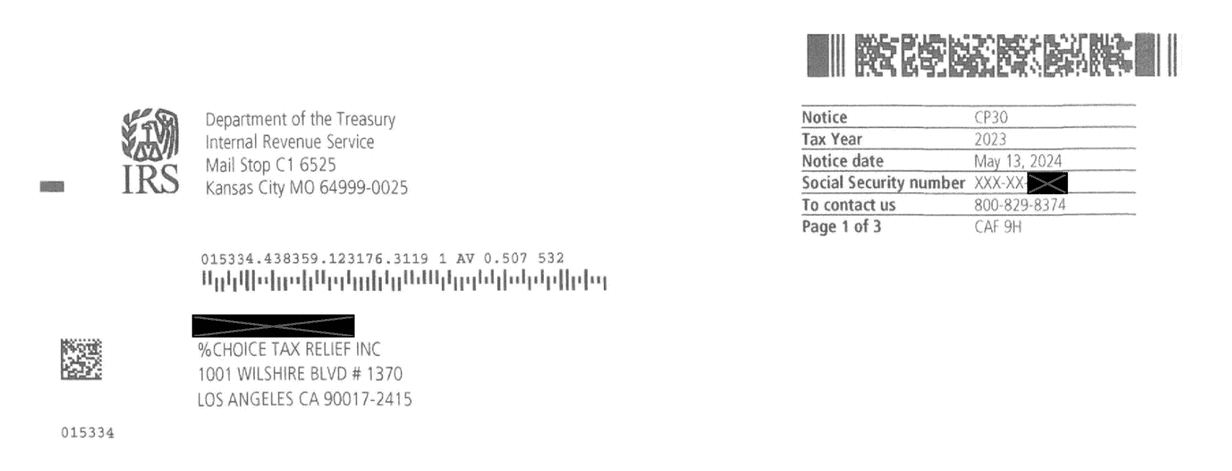
The box in the upper right is the fastest way to confirm what you are holding.
It shows the notice number CP30, the tax year 2023, the notice date of May 13, 2024, a partially masked Social Security number, the phone number 800-829-8374, and the page count.
The “CAF 9H” stamp in that box and the “%CHOICE TAX RELIEF INC” line in the address block mean this was the representative copy, generated because the taxpayer had a Form 2848 power of attorney on file with the IRS Centralized Authorization File.
If your own CP30 arrived from a different campus, that is normal, because the return address simply reflects the service center that processed your return.
Part 2: The Headline and the Summary Box
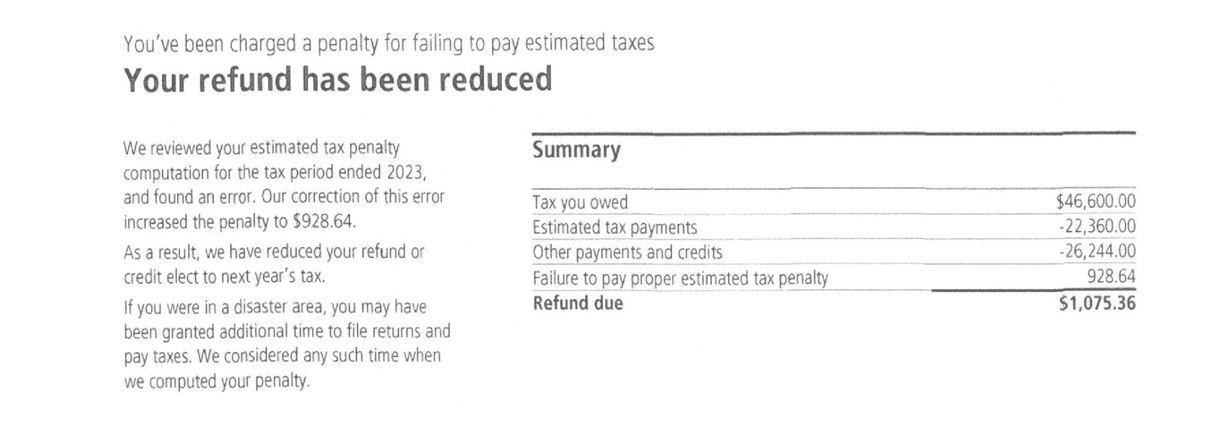
The left column tells you what happened and the right column shows you the arithmetic.
The IRS says it reviewed the estimated tax penalty computation for the tax period ended 2023, found an error, and that its correction of that error increased the penalty to $928.64.
That sentence is important, because it means this taxpayer had already reported an estimated tax penalty on the return and the IRS disagreed with the amount.
The next paragraph explains the consequence: the IRS reduced the refund or the credit elect to next year’s tax by the penalty amount.
The third paragraph is the disaster-area disclaimer, confirming that the IRS already accounted for any postponed deadlines when it ran the computation.
Part 3: Next Steps and When the Rest of Your Refund Arrives

For a refund version of the CP30, the entire Next Steps section is one sentence.
The IRS says the remaining $1,075.36 should arrive within four to six weeks, as long as the taxpayer does not owe other tax or debts the government is required to collect.
That last clause is the Treasury Offset Program, and it is how a refund can quietly disappear into child support arrears, defaulted student loans, or a state tax debt.
If the penalty had exceeded the refund, this section would instead show a balance due and a payment deadline.
Part 4: The Penalty Computation Table
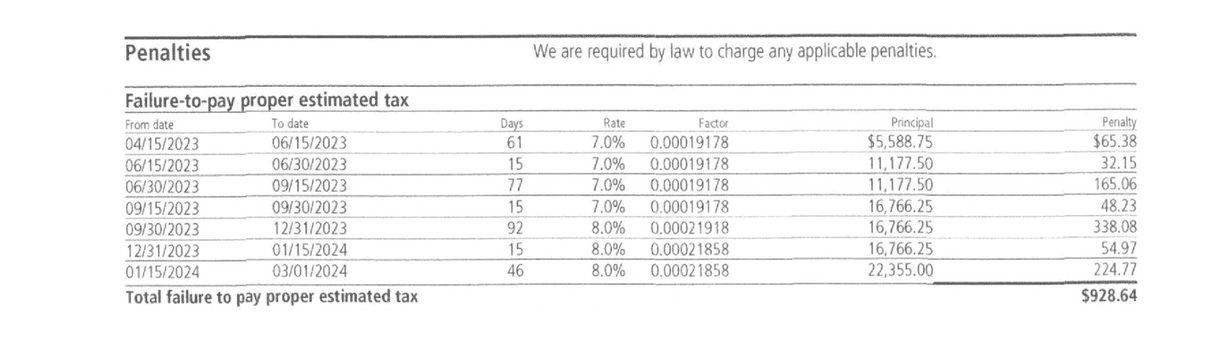
This table is the most useful thing on the notice, and it is the part almost everyone skips.
Each row is a slice of time during which some amount of estimated tax was underpaid, and the seven rows here run from April 15, 2023 through March 1, 2024.
The columns give you the number of days in the slice, the annual interest rate, the daily factor, the underpaid principal, and the resulting penalty.
Read the Principal column from top to bottom and you can reverse-engineer what the IRS expected: $5,588.75, then $11,177.50, then $16,766.25, then $22,355.00.
Those are exact multiples of $5,588.75, which tells you the IRS required $5,588.75 per quarter and $22,355.00 for the whole year.
Because $22,355.00 is far below 90% of the $46,600.00 tax on the return, the IRS was measuring this taxpayer against the prior-year safe harbor rather than the current-year test.
Part 5: Why the IRS Charges This Penalty
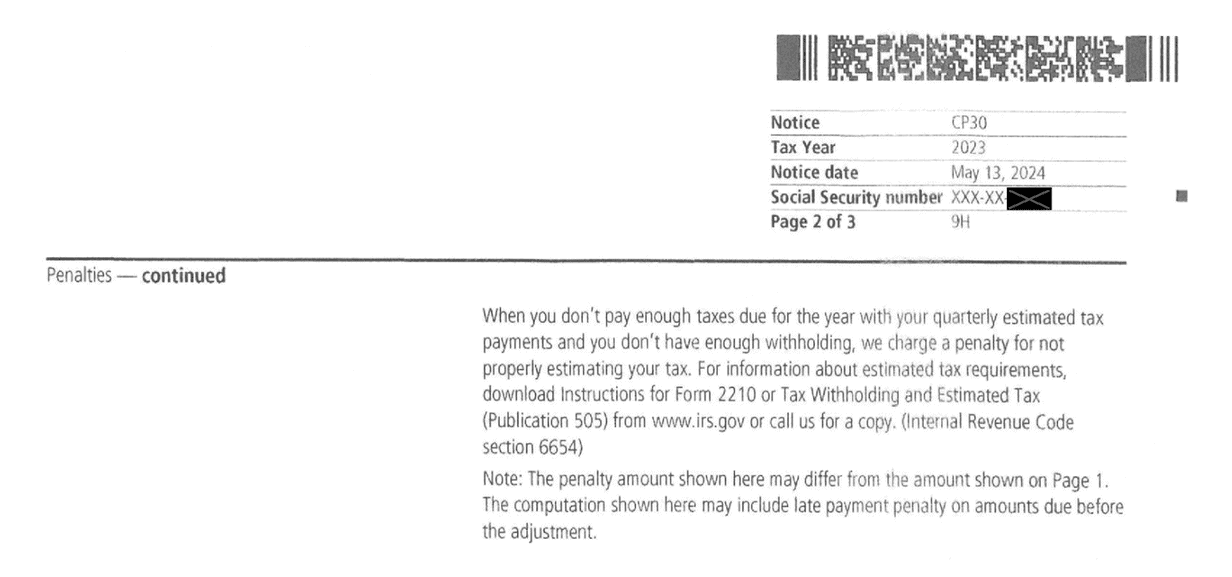
Page 2 opens with the statutory explanation and the citation to Internal Revenue Code section 6654.
It points you to the instructions for Form 2210 and to Publication 505, Tax Withholding and Estimated Tax, which are the two documents that actually govern how this number is calculated.
The Note underneath warns that the penalty figure on page 2 may differ from the one on page 1 because the page 2 computation can include late payment penalty on amounts that were due before the adjustment.
Part 6: Removal or Reduction of Penalties
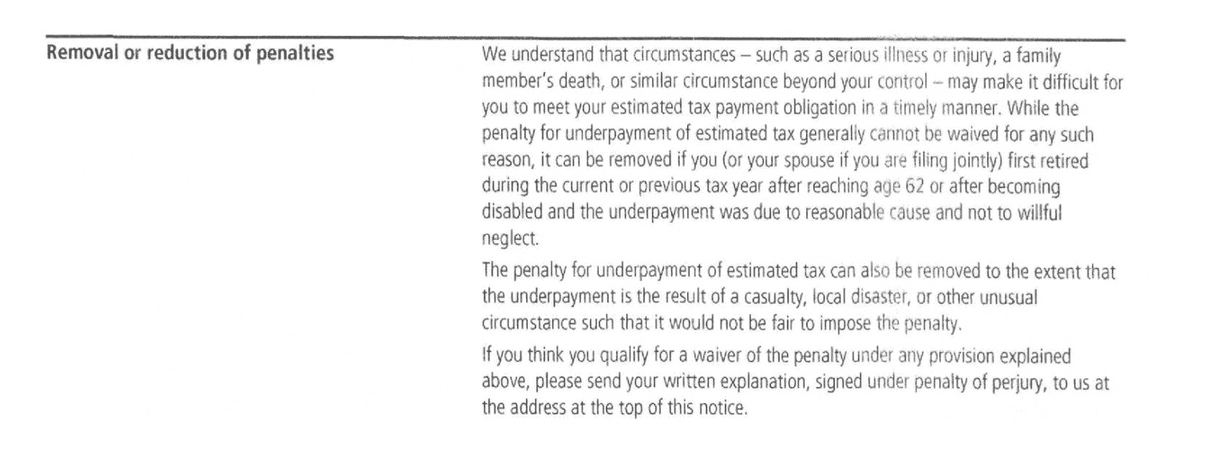
This is the section people read too quickly, and it deserves a slow re-read.
The IRS acknowledges that serious illness, injury, or a death in the family can make it hard to keep up with estimated payments, and then says that the penalty generally cannot be waived for any of those reasons.
The only version of that hardship that works is narrow: you or your spouse first retired after reaching age 62, or first became disabled, during the current or previous tax year, and the underpayment was due to reasonable cause and not willful neglect.
The second paragraph covers the other statutory waiver, which applies to the extent the underpayment resulted from a casualty, a local disaster, or another unusual circumstance where charging the penalty would not be fair.
The third paragraph tells you the mechanics: send a written explanation, signed under penalty of perjury, to the address at the top of the notice.
Part 7: The Form 2210 Route
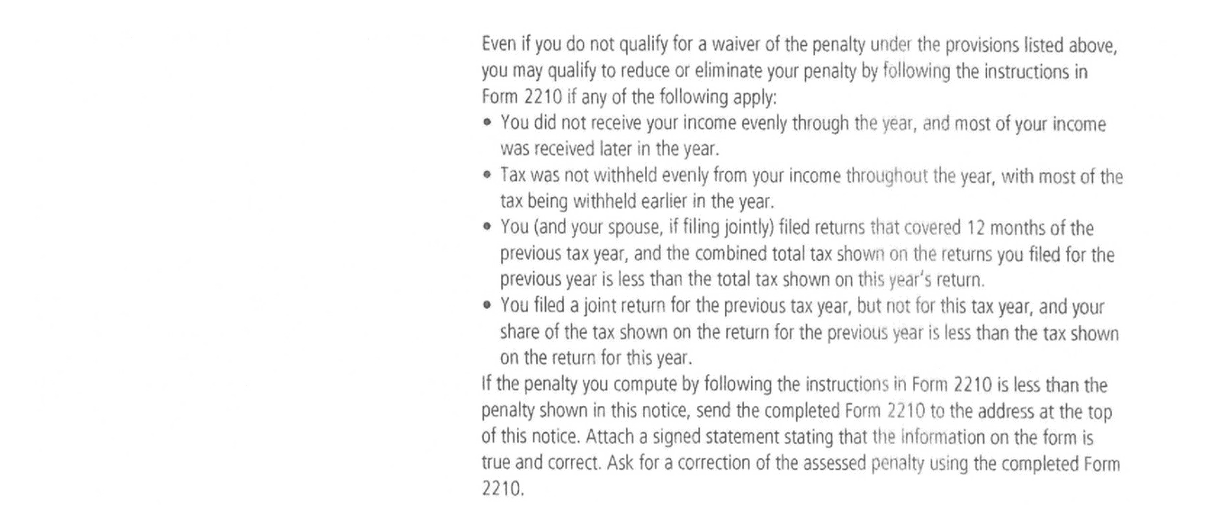
This is where most real reductions actually come from.
The notice lists four fact patterns that let you recompute the penalty on Form 2210 even when no waiver applies:
- Uneven income. You did not receive your income evenly through the year and most of it arrived later in the year.
- Front-loaded withholding. Tax was not withheld evenly and most of it was withheld earlier in the year.
- A smaller prior-year tax. You filed returns covering 12 months of the prior tax year and the combined total tax on those returns is less than the total tax on this year’s return.
- A change in filing status. You filed jointly for the prior year but not for this one, and your share of the prior-year tax is less than this year’s tax.
The closing paragraph gives the procedure: if your Form 2210 computation produces a smaller penalty than the notice, mail the completed form to the address at the top of the notice with a signed statement that the information is true and correct, and ask for a correction of the assessed penalty.
Part 8: Additional Information
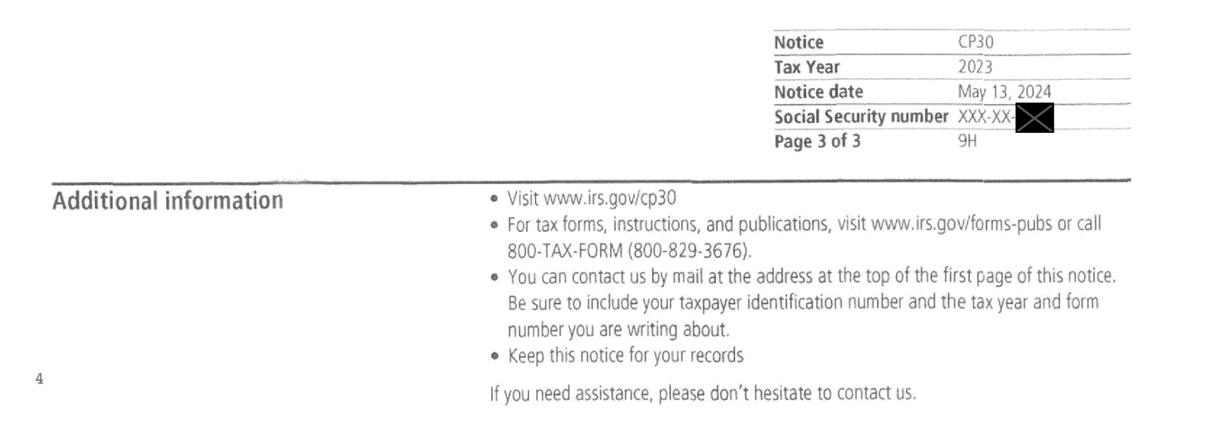
Page 3 is short and administrative.
It points you to the IRS explainer page for the CP30, gives 800-TAX-FORM (800-829-3676) for forms and publications, and reminds you to include your taxpayer identification number, the tax year, and the form number on any correspondence.
The last bullet — keep this notice for your records — is not filler, because the penalty computation table is the only place the IRS shows you its quarter-by-quarter math.
How the IRS Calculated the $928.64
The estimated tax penalty is not really a penalty at all in the way most people picture one.
It is interest, charged at the federal underpayment rate set under section 6621, running on each quarter’s shortfall from the installment due date until the money is paid.
Under section 6654(b)(2), each period ends on the earlier of the date the underpayment is paid or April 15 of the following year, which is why the last row on this client’s table stops on March 1, 2024 rather than running the full period.
Three details in that table are worth pointing out, because they explain numbers that otherwise look like typos:
- The rate changes mid-table. The first four rows use 7.0% and the last three use 8.0%, because the underpayment rate is reset quarterly and it rose at the end of 2023.
- The daily factor changes twice. The factor goes from 0.00019178 to 0.00021918 when the rate changes, and then to 0.00021858 on December 31, 2023.
- That last change is the leap year. 0.00021918 is 8% divided by 365 days, and 0.00021858 is 8% divided by the 366 days in 2024.
Multiply each row out and you get $65.38, $32.15, $165.06, $48.23, $338.08, $54.97, and $224.77, which add up to exactly the $928.64 the notice charged.
For context, the underpayment rate for the third quarter of 2026 is 7%, so an underpayment today accrues at close to the same pace as the one on this notice.
Can the CP30 Penalty Be Removed or Reduced?
Sometimes, but the list of ways is much shorter than for other penalties, and the two most popular arguments do not work here.
Reasonable cause on its own does not work
Internal Revenue Manual 20.1.3, which governs estimated tax penalties, states that the penalty for underpayment of estimated tax cannot be removed or waived for reasonable cause alone.
That is a real departure from the failure-to-file and failure-to-pay penalties, where a well-documented reasonable cause letter is often the whole ballgame.
First-Time Abate never applies
The IRS First-Time Abate program covers failure to file, failure to pay, and failure to deposit, and it expressly excludes the estimated tax penalty.
A clean compliance history will not help you here, no matter how spotless it is.
The two statutory waivers
Section 6654(e)(3) contains the only two true waivers, and both are narrow:
- Casualty, disaster, or other unusual circumstances. The penalty is waived to the extent that charging it would be against equity and good conscience given what happened.
- Newly retired or newly disabled taxpayers. The penalty is waived if you retired after reaching age 62 or became disabled in the year of the underpayment or the year before, and the underpayment was due to reasonable cause and not willful neglect.
Either waiver is requested with a written statement, signed under penalty of perjury, sent to the address on the notice.
Recomputing on Form 2210
The highest-percentage play on most CP30s has nothing to do with waivers.
If your income arrived unevenly, Schedule AI of Form 2210 lets you annualize each period and match the required installment to the income you actually earned in that period.
That single move routinely wipes out most or all of the penalty for consultants, business owners, people who sold an asset late in the year, and anyone whose fourth quarter carried the year.
Tip: Before you write a waiver letter, run the annualized income installment method. In our experience it produces a bigger reduction, more often, than either statutory waiver — and unlike a waiver request, it is a computation the IRS has to accept if the math is right.
Still have questions? Talk to a tax expert — free.
What You Should Do After Receiving a CP30
Step 1: Confirm the year and compare the notice to your return
Pull the return for the tax year printed in the notice box and find the estimated tax penalty line.
If you reported a penalty there and the CP30 shows a bigger one, the IRS recomputed your Form 2210, and you need to know which of you is right before you do anything else.
Step 2: Check whether a safe harbor should have protected you
Find the total tax on your prior-year return and compare it to what you actually prepaid through withholding and estimated payments.
If you paid in at least that amount — or 110% of it when your prior-year adjusted gross income topped $150,000 — the penalty should not exist, and the fix is a corrected Form 2210 rather than a waiver request.
Step 3: Run the annualized income method if your income was lumpy
Rebuild your income quarter by quarter and complete Schedule AI of Form 2210 to see what the penalty looks like when each installment is matched to the income actually earned in that period.
Do this before anything else if you are self-employed, take irregular distributions, or had a large capital gain in the second half of the year.
Step 4: Send the right document to the right address
For a recomputation, mail the completed Form 2210 with a signed statement that the information on it is true and correct, and ask for a correction of the assessed penalty.
For a waiver, mail a written explanation signed under penalty of perjury describing the casualty, disaster, unusual circumstance, retirement, or disability that applies.
Both go to the address at the top of the notice, and you should keep proof of mailing.
Step 5: Make sure it does not happen again next year
The CP30 is a lagging indicator, which means by the time it lands you are usually already behind on the current year as well.
Adjust your withholding or your estimated payments now, while there are still installment dates left in the year to fix it with.
How to Avoid a CP30 Next Year
The prior-year safe harbor is the most reliable protection available, because it is the only one based on a number you already know.
Take the total tax from your last filed return, multiply by 110% if your adjusted gross income on that return exceeded $150,000, divide by four, and pay that amount on each installment date.
Do that and the penalty cannot apply, no matter how much your income grows during the year.
If you are already behind, remember the withholding rule from section 6654(g).
Because withholding is treated as paid evenly across all four installment dates regardless of when it actually came out, increasing withholding on a paycheck, a pension, or a year-end retirement distribution in November or December can retroactively cure shortfalls from April and June in a way that a December estimated payment simply cannot.
The IRS Tax Withholding Estimator and your IRS online account will both tell you where you currently stand.
And if the penalty on your notice was large enough that paying it leaves you with a balance you cannot cover, that balance follows the ordinary collection path through the CP14 and CP503 notices, and an installment agreement or other penalty relief may be worth exploring.
Frequently Asked Questions About IRS Notice CP30
Do I need to respond to IRS Notice CP30?
Not if you agree with it. A CP30 that reduces a refund has no reply form, no payment stub, and no deadline, and the IRS simply mails you what is left of the refund within four to six weeks. You only need to respond if you believe the penalty is wrong, in which case you send either a corrected Form 2210 or a signed waiver request to the address printed at the top of the notice.
Is the CP30 penalty the same as the failure-to-pay penalty?
No, and the similar wording causes real problems. The CP30 charges the addition to tax under section 6654 for failing to pay proper estimated tax, which is computed like interest on each quarter’s shortfall. The failure-to-pay penalty under section 6651(a)(2) is a separate charge of 0.5% per month on a balance you did not pay by the filing deadline. They have different relief rules, so an argument that works on one will not necessarily work on the other.
Can I get the estimated tax penalty removed for reasonable cause?
Not on reasonable cause alone. Internal Revenue Manual 20.1.3 states that the estimated tax penalty cannot be removed or waived for reasonable cause by itself, which is why the notice tells you that illness, injury, and a death in the family generally will not qualify. Reasonable cause matters only as a second requirement inside the newly retired or newly disabled waiver under section 6654(e)(3)(B).
Does First-Time Abate work on a CP30?
No. First-Time Abate covers the failure-to-file, failure-to-pay, and failure-to-deposit penalties, and the IRS excludes the estimated tax penalty from the program entirely. A perfect three-year compliance history does nothing for a section 6654 charge, which surprises a lot of otherwise well-informed taxpayers.
Why did I get a CP30 when I am getting a refund?
Because the penalty tests each quarter separately rather than the year as a whole. The client notice in this article shows a taxpayer who prepaid $48,604 against $46,600 of tax and still owed $928.64, because the payments arrived after the installment deadlines they were supposed to cover. Paying more than your total tax for the year does not protect you if the timing was wrong.
What is the difference between a CP30 and a CP30A?
They move in opposite directions. A CP30 tells you the IRS charged or increased your estimated tax penalty and reduced your refund by that amount. A CP30A tells you the IRS reduced or removed the estimated tax penalty you reported on your return, which usually means a refund increase or a credit posting to your account. Receiving a CP30A after you send in a corrected Form 2210 is the outcome you are hoping for.
An estimated tax penalty on its own is usually a nuisance rather than a crisis.
The reason we take CP30 notices seriously is that they are almost always a symptom of something structural — income that outgrew a withholding setup, a business that stopped making quarterly payments, or a year where the tax bill was far larger than anyone planned for.
If you would like us to look at whether your penalty can be recomputed, and at what the rest of your account looks like, schedule your free consultation or call us at 866-8000-TAX.

“This tax service is professional and reliable! They handled our business like family! We highly recommend them!”
Get Help Now
Got a CP30 notice? Get a straight answer before you respond.
Talk to a tax expert — free, no obligation. We’ve resolved over $20 million in IRS debt for our clients.


Author:

Logan Allec, CPA, Founder and Owner
Logan Allec has been serving taxpayers as a CPA for over 14 years. After leaving his role at a "Big 4" firm, he started Choice Tax Relief to help everyday Americans who have found themselves behind on their taxes. He also educates thousands of people daily about tax relief on his YouTube channel. In addition to his CPA license, Logan also has a Master's Degree in Taxation from the University of Southern California (USC). He lives with his wife and children in the Los Angeles area. Learn more about Logan here.