

IRS Notice CP521: Why Is The IRS Sending You A Monthly Bill

IRS Notice CP521 is the monthly reminder the IRS mails when a payment on your installment agreement is about to come due.
It is a statement for a payment plan you already have, not a new tax bill and not a levy notice.
In this article I will walk you through a real CP521 that one of our clients received, part by part, using the actual figures printed on it.
Our client’s notice asked for $100.00 by March 15, 2024, toward a 2022 Form 1040 balance of $1,596.91.
I will also cover what a missed payment sets in motion, what the plan costs while it runs, and how to change it.
Here is a redacted CP521 notice that one of our clients received (PDF).
Key Takeaways
- CP521 is a reminder that your monthly installment agreement payment is due, and it does not assess any new tax.
- The payment must be received by the due date, which on our client’s notice was nine days after the notice date.
- A missed payment can default the agreement, and the IRS’s default notice is CP523, an intent to terminate the agreement and levy.
- Penalties and interest keep accruing, and our client’s $1,596.91 balance included $14.77 of failure-to-pay penalty and $105.14 of interest.
- If you can’t make a payment, call the number on your notice or revise the plan online before the due date.
Table of Contents
What Is IRS Notice CP521?
The IRS’s own page on the notice says that if you received a CP521, “the IRS is reminding you that you have an installment payment due.”
The “CP” stands for computer paragraph, which I cover in my article on what CP stands for on IRS notices.
The agreement behind it exists under Internal Revenue Code Section 6159, which lets the IRS accept payment of a tax debt in installments under a written agreement.
A CP521 does not assess new tax and describes no appeal rights of its own, because it is not proposing to do anything.
It is not the default notice, which is Notice CP523, and it is not the yearly statement of your agreement, which is Notice CP89.
If your notice is numbered CP521D, that is a separate version of the reminder, and I walk through one in my article on IRS Notice CP521D.
Free Consultation
Got a CP521 notice? Don’t wait for the IRS’s next move.
Talk to a tax expert — free, no obligation. We’ve resolved over $20 million in IRS debt for our clients.
IRS Notice CP521 at a Glance
| Detail | What It Means |
|---|---|
| Notice type | Monthly reminder that an installment agreement payment is due |
| Who gets it | Taxpayers on an installment agreement, except that the Form 9465 instructions say direct debit payers do not get one |
| Our client’s notice | Dated March 6, 2024, for tax year 2022, Form 1040 |
| Payment due | $100.00, to be received by March 15, 2024 |
| Balance shown | $1,596.91, including $14.77 of failure-to-pay penalty and $105.14 of interest |
| Phone number on this notice | 833-678-7020 |
| What you have to do | Pay by the due date, or call before it if you can’t |
| If the payment is missed | The agreement may default, and reinstating it may cost a user fee |
| Appeal rights | None described on CP521; a proposed termination on CP523 can be appealed |
Why Did the IRS Send You a CP521?
The IRS sent you a CP521 because you have an installment agreement in effect and a monthly payment is coming due.
The Form 9465 instructions say it plainly: “Each month, we will send you a notice showing the remaining amount you owe, and the due date and amount of your next payment.”
The next sentence carves out direct debit: “But if you choose to have your payments automatically withdrawn from your checking account (also known as a direct debit), you won’t receive a notice.”
The Internal Revenue Manual says the IRS’s computer system issues the reminder for accounts in active installment agreement status “not more than 3 weeks prior to the payment due date.”
Nothing you did wrong triggers a CP521, and getting one every month is the agreement working as designed.
This one came to our office because we hold a power of attorney for the client.
A Part-by-Part Walkthrough of IRS Notice CP521
Here is our client’s CP521 in the order the IRS printed it, with what each part says and what I would check on yours.
Part 1: The Headline and Payment Information
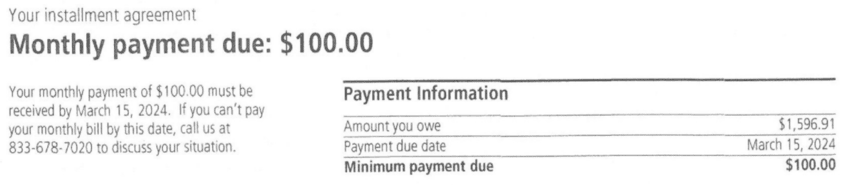
The headline reads “Your installment agreement” and, directly under it, “Monthly payment due: $100.00”.
The first full sentence sets the deadline: “Your monthly payment of $100.00 must be received by March 15, 2024.”
The word I would circle is “received”, because the notice is dated March 6, 2024, which left nine days for it to arrive and for the payment to get back to the IRS.
The payment information box lists three figures:
- Amount you owe: $1,596.91
- Payment due date: March 15, 2024
- Minimum payment due: $100.00
The $100.00 is a minimum, so nothing stops you from sending more.
If the date is a problem, the notice says, “If you can’t pay your monthly bill by this date, call us at 833-678-7020 to discuss your situation.”
Tip: Treat the due date as the day the IRS must have your money in hand, and pay electronically if that date is close.
Part 2: What You Need to Do Immediately


This section repeats the deadline with a consequence: “Your payment of $100.00 must be received by March 15, 2024, or you may default on your agreement.”
The next sentence names the price: “If you default, you may have to pay a user fee to reinstate it.”
Both sentences say “may”, and I would not test what that word means with a real payment.
The continuation page says that when you mail a check, the IRS may use the information on it to make a one-time electronic fund transfer from your account.
In the notice’s words, “funds may be withdrawn from your account as soon as the same day we receive your payment, and you will not receive your check back from your financial institution.”
So the money needs to be in the account the day you mail the check, and a payment that bounces carries its own IRS penalty, which on a payment under $1,250 is the amount of the payment or $25, whichever is less.
Part 3: The Payment Coupon
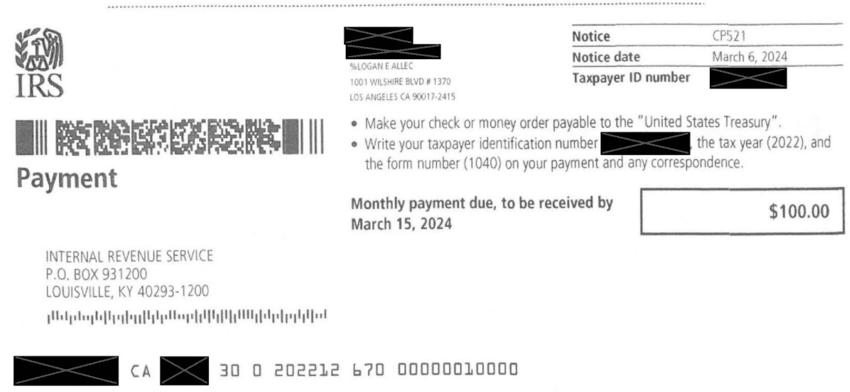
The coupon repeats the notice number, the notice date, March 6, 2024, and the amount: “Monthly payment due, to be received by March 15, 2024: $100.00”.
It is addressed to our client, whose name is blacked out, followed by “%LOGAN E ALLEC” and what was then our Los Angeles office address, because we hold a power of attorney for this client.
It says to make the check or money order payable to the “United States Treasury” and to write your taxpayer identification number, the tax year (2022) and the form number (1040) on the payment.
This coupon’s mailing address is a P.O. box in Louisville, Kentucky, but use the address printed on your own coupon.
The scan line at the bottom ends “30 0 202212 670 00000010000”, which the notice does not explain.
My reading is that 202212 is the tax period ending December 2022, 00000010000 is $100.00 with no decimal point, 30 is the IRS’s master file tax code for Form 1040 and 670 is its transaction code for a subsequent payment.
Whatever the codes mean, the IRS’s page on CP521 says to “Include the bottom part of the notice to make sure we correctly credit your account.”
Part 4: Payment Options
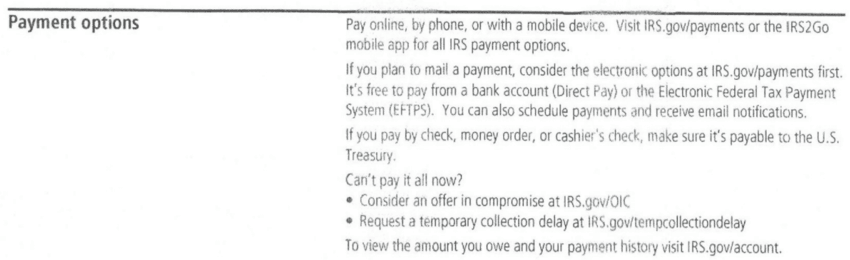
This section opens with “Pay online, by phone, or with a mobile device” and says “It’s free to pay from a bank account (Direct Pay) or the Electronic Federal Tax Payment System (EFTPS).”
Two details are out of date now: the IRS’s EFTPS page says “Individual taxpayers can no longer create new EFTPS accounts”, and the IRS2Go app the notice mentions is now called the IRS app.
Direct Pay is still free, and you can also pay from your bank account inside your IRS Online Account.
Under “Can’t pay it all now?” the notice points to two alternatives, an offer in compromise and a temporary collection delay.
An offer in compromise settles the debt for less than the full amount if the IRS accepts it, and I cover the numbers in my article on how much to offer in compromise.
A temporary collection delay is what the IRS also calls currently not collectible status, which is for taxpayers who cannot pay because of financial hardship, and my guide to the IRS hardship program explains what counts.
Part 5: If We Don’t Hear From You

This short section restates the warning: “If we don’t receive your payment of $100.00 by March 15, 2024, you may default on your installment agreement.”
It repeats that a default may cost “a user fee to reinstate it”, without saying how much.
When I checked the IRS payment plans page on October 4, 2026, the fee to revise or reinstate a plan was $6 online and $89 by phone, mail or in person, or $43 instead of $89 for low-income taxpayers.
Notice what is missing: this section says nothing about liens or levies, because those warnings belong to the default notice, CP523.
Part 6: Installment Agreement Summary
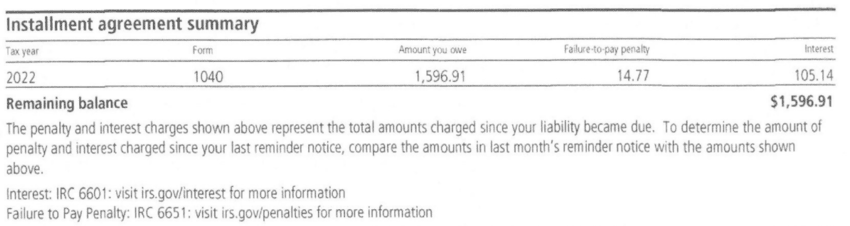
The summary table has a single row, for tax year 2022 and Form 1040:
- Amount you owe: $1,596.91
- Failure-to-pay penalty: $14.77
- Interest: $105.14
- Remaining balance: $1,596.91
The note under the table says “The penalty and interest charges shown above represent the total amounts charged since your liability became due.”
So the $14.77 and the $105.14 are running totals, not what last month cost.
Run the arithmetic and $14.77 plus $105.14 is $119.91, and $1,596.91 minus $119.91 leaves exactly $1,477.00.
I read that round $1,477.00 as the unpaid tax, although the notice does not label it.
To see what one month cost, the notice says to “compare the amounts in last month’s reminder notice with the amounts shown above”, which is why I tell clients to keep every CP521.
Part 7: Penalties
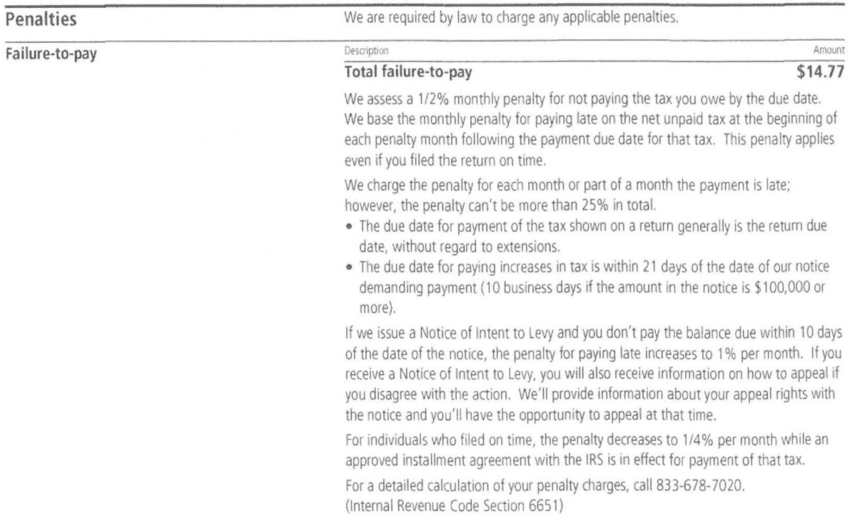
The “Penalties” section reports a total failure-to-pay penalty of $14.77.
It states the general rule, “We assess a 1/2% monthly penalty for not paying the tax you owe by the due date”, charged for each month or part of a month and capped at 25%.
Under Internal Revenue Code Section 6651, the rate rises to 1% per month if the IRS issues a Notice of Intent to Levy and the balance is not paid within 10 days.
It falls under an agreement: “For individuals who filed on time, the penalty decreases to 1/4% per month while an approved installment agreement with the IRS is in effect for payment of that tax.”
Here is a check you can run: $14.77 is exactly 1% of the $1,477.00 above, which is what two months at 1/2% or four months at 1/4% would produce.
The notice does not show the computation, but its bullets say the payment due date is generally the return due date for tax shown on a return and 21 days after the notice demanding payment for an increase in tax.
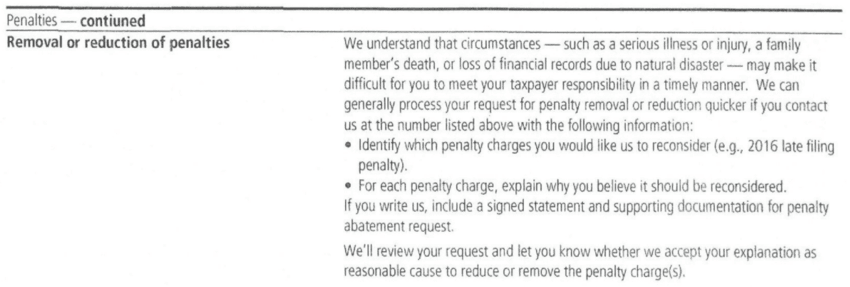
The continuation page covers penalty relief, listing circumstances “such as a serious illness or injury, a family member’s death, or loss of financial records due to natural disaster”.
We prepare those requests for clients, and my guide to penalty abatement covers the grounds the IRS accepts.
Part 8: Removal of Penalties Due to Erroneous Written Advice From the IRS
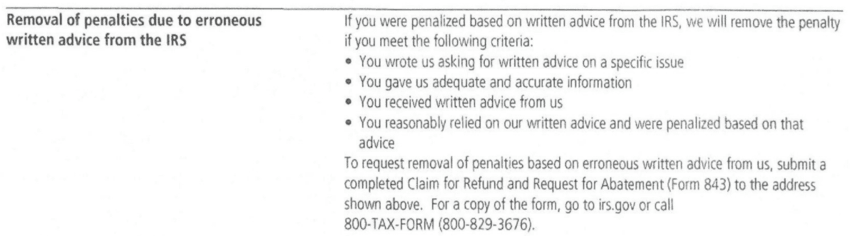
This section says the IRS will remove a penalty that resulted from its own written advice if you meet four conditions:
- You asked the IRS in writing for advice on a specific issue.
- You gave adequate and accurate information.
- You received written advice from the IRS.
- You reasonably relied on that advice and were penalized because of it.
The request goes on Form 843, Claim for Refund and Request for Abatement.
The rule comes from Internal Revenue Code Section 6404(f), and I read it as narrow, because the advice has to be in writing and has to answer a written request from you.
Part 9: Interest Charges
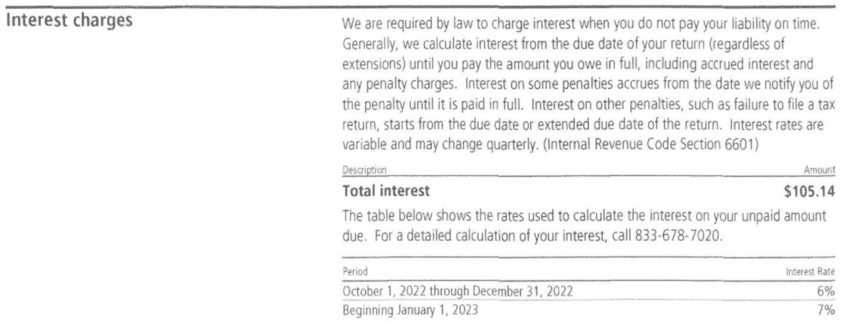
The “Interest charges” section reports total interest of $105.14.
Its table of “the rates used to calculate the interest on your unpaid amount due” has two rows: 6% for October 1, 2022 through December 31, 2022, and 7% “Beginning January 1, 2023”.
That table stops short, because the IRS’s published quarterly rates show the underpayment rate for individuals rising to 8% on October 1, 2023 and staying there through the quarter this notice was printed in.
As a check, I computed daily compounded interest on $1,477.00 from April 15, 2023, the statutory due date for a 2022 return and the date interest runs from, to March 15, 2024, the payment due date, at the published rates and got $105.15, one cent from the notice.
The same computation at 7% throughout gives $97.94, so the 8% rate appears to be in the charge even though the table does not print it.
That reconstruction is mine, and it assumes the full $1,477.00 was unpaid the whole time, which the notice does not state, so I would confirm it on the account transcript.
It also covers more months than the penalty in Part 7, which can happen because interest on an increase in tax runs from the original due date while the penalty starts later.
The rate itself is the federal short-term rate plus 3 percentage points, reset quarterly and compounded daily, and I explain the rest in my article on IRS interest.
Part 10: Money-Saving Tips
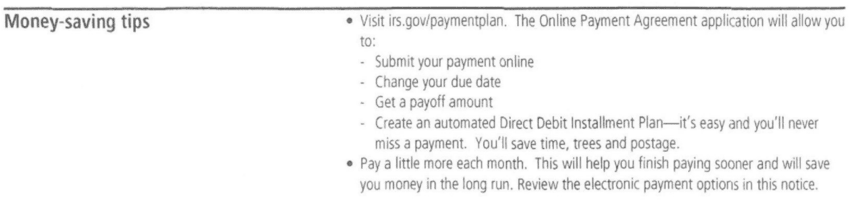
This section sends you to irs.gov/paymentplan, where the notice says you can submit a payment, change your due date, get a payoff amount and create a direct debit plan.
On direct debit the notice says “it’s easy and you’ll never miss a payment.”
The second tip is the one I repeat to clients: “Pay a little more each month.”
I put numbers on both tips below, using our client’s balance.
Part 11: Additional Information
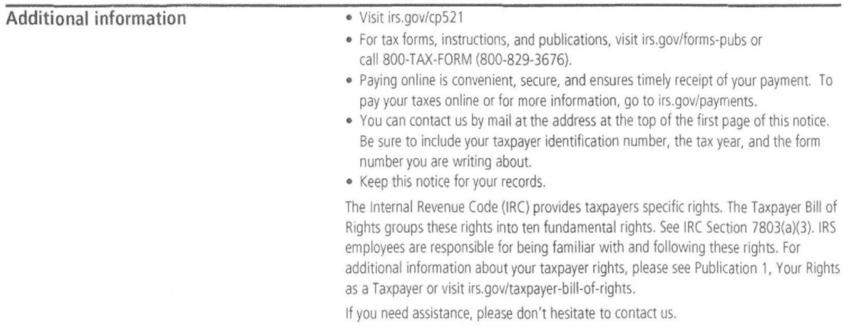
The last section points to irs.gov/cp521 and gives 800-TAX-FORM (800-829-3676) for forms.
It makes one more pitch for paying electronically: “Paying online is convenient, secure, and ensures timely receipt of your payment.”
If you write to the IRS, the notice says to include your taxpayer identification number, the tax year and the form number.
It tells you to keep the notice for your records, which I would do anyway, and closes with a paragraph on the Taxpayer Bill of Rights.
What Counts as a Default on an Installment Agreement
The notice warns about default in two sections without ever defining it, so here is how I explain it to clients.
Under Internal Revenue Code Section 6159(b)(4), the IRS may alter, modify or terminate an agreement if you fail to pay an installment when it is due, fail to pay any other tax liability when it is due, or fail to provide a financial update the IRS asks for.
The Internal Revenue Manual adds giving inaccurate or incomplete information before the agreement was made, and it says agreements may not be defaulted for reasons outside its list.
The IRS’s own guidance on staying out of default is practical:
- Pay at least your minimum monthly payment when it is due.
- File all required returns on time and pay all taxes in full and on time.
- Make all scheduled payments even if the IRS applies a refund to your balance.
Important: A balance due on a later return that you do not pay on time can default the agreement even if every monthly payment arrived on time.
When an agreement defaults, the IRS sends CP523, which its website describes as notice of “the intent to terminate your installment agreement and seize (levy) your assets.”
A default is not yet a termination, because the law requires notice at least 30 days before the IRS terminates an agreement.
Levy does not follow immediately either, because the manual says “No levies may be issued on tax periods included in agreements for 90 days after mailing Notice CP 523”.
You can appeal a proposed termination through the Collection Appeals Program, and IRS Publication 1660 gives you 30 days from the date of the notice to ask, plus another 30 days after termination.
That appeal is decided by the IRS’s Independent Office of Appeals, and Publication 1660 says you cannot take the decision to court.
The Cost of Paying $100 a Month
Divide our client’s $1,596.91 balance by the $100.00 payment and you get about 16 payments.
That count is too low, because the IRS states that penalties and interest continue to accrue until the balance is paid in full.
Here is a rough estimate of one month, using the 8% annual rate in effect when this notice was printed: interest on $1,596.91 runs about $10.65.
If the reduced 1/4% rate applies, the failure-to-pay penalty on $1,477.00 of unpaid tax adds about $3.69, so roughly $14 of the first $100.00 goes to new charges.
Repeat that arithmetic month by month as the balance shrinks, and my estimate is about 18 payments at $100.00, with something like $130 in added penalty and interest.
At $150.00 a month the same estimate comes out to about 12 payments and less than $90 in added charges.
Those estimates assume the 1/4% penalty rate, an 8% interest rate that never changes, payments that go to tax first and nothing else added to the account, so treat them as illustrations and not as a payoff quote.
The rate does change, because the IRS resets it every quarter, and for the quarter that began October 1, 2026 it is 7% for individuals.
Tip: If you pay extra this month, still make next month’s payment on time, because the IRS says to make all scheduled payments even when it applies a refund to your balance.
Moving to Direct Debit or Changing the Agreement
You are not stuck with the terms printed on the notice.
The IRS’s Online Payment Agreement tool lets an existing plan holder change the monthly payment amount, change the due date, convert to direct debit and reinstate after a default.
Converting to direct debit ends the monthly mailing, because the Form 9465 instructions say that with automatic withdrawals you won’t receive a notice.
A revision carries the same fee as a reinstatement, and the Internal Revenue Manual says the $6 online fee took effect July 5, 2026, so older forms may show different numbers.
Changing the due date is the fix I suggest when the payment keeps landing a few days before your paycheck, and the Form 9465 instructions allow any day from the 1st to the 28th.
Lowering the payment is harder, because if you cannot pay the minimum the tool requires, it directs you to a request with a financial statement, Form 433-F or Form 433-H.
Whatever the change, ask for it before you miss a payment, because after a miss you are asking the IRS to fix a default.
CP521 vs. CP523
These two notices come from the same agreement and mean very different things.
| Detail | CP521 | CP523 |
|---|---|---|
| What it is | Monthly reminder that a payment is due | Notice of intent to terminate the agreement and levy |
| Why it is sent | The agreement is active and a payment is coming due | The IRS says you have defaulted |
| What the IRS asks for | The monthly payment by the due date | Payment before the termination date, or a call about reinstating |
| Time to act | The due date on the notice | No later than 30 days from the notice date |
| If you do nothing | The agreement may default | The IRS says it will terminate the agreement and begin collection action, which can include a lien filing or a levy |
| Appeal rights | None described | Collection Appeals Program |
Owe the IRS? Talk to a tax expert — free.
How to Respond to IRS Notice CP521
Responding to a CP521 mostly means paying it, and this is the order I would do it in.
Step 1: Check the Notice Against Your Agreement
Confirm the tax year, the payment amount and the due date against the agreement you set up, and compare the balance with last month’s CP521.
If a year is missing or a number looks wrong, call the number on your notice before the due date, and if we represent you, we make that call under our power of attorney.
Step 2: Get the Payment to the IRS by the Due Date
The deadline is a received-by date, so I tell clients to pay electronically whenever the due date is less than a week away.
If you mail a check, send the coupon with it and send at least the minimum shown on the notice.
Step 3: Confirm the Payment Posted
Your IRS Online Account shows your balance and payment history, and the IRS says to allow one to three weeks for a recent payment to be credited.
Keep your bank record of each payment with that month’s notice.
Step 4: Call Before the Due Date If You Can’t Pay
If this month’s payment is not going to happen, call the number on your notice before the due date and say so.
When we represent a client in that position, we pull the account transcripts first, so we know what the IRS’s records show before we call.
Step 5: Stay Current on Everything Else
File this year’s return on time and pay this year’s tax in full, because failing to pay another tax liability when it is due is one of the statutory grounds for ending the agreement.
The Form 9465 instructions put it the other way around: when the IRS approves your plan, you agree to meet all your future tax obligations.
What Happens If You Ignore IRS Notice CP521
Ignoring the paper is harmless if the payment is made, because a CP521 asks for money and not for a reply.
Ignoring the payment is what causes trouble, and the IRS describes the first consequence this way: “If you don’t send us a payment, the interest and penalties you’ll have to pay will increase and you could default on your installment agreement.”
If the agreement defaults and you do not respond to the CP523, the IRS says it will terminate the agreement and begin collection action, “which can include filing a federal tax lien or seizing (levying) your wages and/or bank accounts.”
While an agreement is in effect, Internal Revenue Code Section 6331(k) generally bars the IRS from levying for the tax it covers, and that protection ends 30 days after a termination unless you appeal within those 30 days.
The penalty rate changes too, because the 1/4% rate applies only while an agreement is in effect, and the notice warns of a 1% rate if a Notice of Intent to Levy goes unpaid for 10 days.
Before its first levy for that tax year, the IRS also has to send notice of your right to a Collection Due Process hearing at least 30 days ahead, if it has not already.
All of that starts with one missed payment, which is why I would rather a client call us the week before the due date than the week after.
Get Help With IRS Notice CP521
A CP521 by itself does not need a tax professional, and if the payment is affordable and the numbers match, I would just pay it.
Where we come in is when the payment no longer fits, the balance is not going down the way you expected, or a CP523 has already arrived.
At Choice Tax Relief we pull your IRS account transcripts, check the penalty and interest behind the balance, call the IRS under a power of attorney, and then work out which fits your situation: a revised installment agreement, a penalty abatement request, an offer in compromise or currently not collectible status.
Call us at 866-8000-TAX or book a free consultation and we will tell you where your account stands.

“Lulu was my case manager and she did an amazing job setting up a tax payment plan with great terms. She was kind, professional and very thorough. I could not have asked for a better case manager.”
Frequently Asked Questions About IRS Notice CP521
Is IRS Notice CP521 a new tax bill?
No. It is a reminder that a payment on your existing installment agreement is due. The balance on it is what remains on the agreement, including penalty and interest charged so far.
Do I need to call the IRS when I get a CP521?
Not if you can make the payment by the due date, because the notice asks for a payment and not for a reply. Call the number on your notice before the due date if you can’t pay or if something on the notice looks wrong.
Why do some people on payment plans never get a CP521?
The Form 9465 instructions say that if your payments are automatically withdrawn from your checking account, you won’t receive a monthly notice. Your checking account statement is your record of payment instead.
Can I pay more than the amount on my CP521?
Yes. The amount on the notice is a minimum, and the notice itself suggests paying a little more each month. Keep making every scheduled payment on time even after you pay extra.
What happens if my CP521 payment is late?
The notice says you may default on the agreement and may have to pay a user fee to reinstate it. If the agreement defaults, the IRS sends CP523, its notice of intent to terminate the agreement and levy.
Can the IRS levy while I am on an installment agreement?
Generally no. Internal Revenue Code Section 6331(k) bars levy for the tax covered by an installment agreement while the agreement is in effect, with limited exceptions. That protection ends 30 days after the IRS terminates the agreement unless you appeal within those 30 days.
Get Help Now
Got a CP521 notice? Don’t wait for the IRS’s next move.
Talk to a tax expert — free, no obligation. We’ve resolved over $20 million in IRS debt for our clients.


Author:

Logan Allec, CPA, Founder and Owner
Logan Allec has been serving taxpayers as a CPA for over 14 years. After leaving his role at a "Big 4" firm, he started Choice Tax Relief to help everyday Americans who have found themselves behind on their taxes. He also educates thousands of people daily about tax relief on his YouTube channel. In addition to his CPA license, Logan also has a Master's Degree in Taxation from the University of Southern California (USC). He lives with his wife and children in the Los Angeles area. Learn more about Logan here.