

IRS Notice CP14J: What It Is and How to Respond

If you just received IRS Notice CP14J in the mail, the IRS is telling you one thing: your most recently filed Form 1040 shows a balance that has not been paid in full.
A CP14J is the very first bill the IRS sends after it processes a return you filed with tax due that was not fully covered by your payments and credits.
It is an early-stage balance-due notice, not a levy, a lien, or a threat of enforced collection, and you almost always have several ways to resolve it.
Below is a plain-English, part-by-part walkthrough of the CP14J, using a redacted version of an actual CP14J that one of our clients received, followed by exactly what to do next.
Important: The dollar figures in this article come from a redacted version of an actual CP14J that one of our clients received.
Your own notice will list your tax year, your balance, and your due date, so always follow the numbers printed on your copy.
Key Takeaways
- What it is: the IRS’s first notice of a balance due on a Form 1040 you already filed.
- Why you got it: the tax on your return was more than the payments and credits applied to your account, and the difference was not paid by the filing deadline.
- What is in the balance: the unpaid tax, a failure-to-pay penalty under IRC §6651, and interest under IRC §6601.
- The deadline: pay by the date on the notice to stop additional penalties and interest from adding up.
- If you cannot pay: you can request a payment plan, an offer in compromise, or currently-not-collectible status.
- If you ignore it: the balance grows and the IRS escalates to CP501, CP503, and CP504, opening the door to liens and levies.
Table of Contents
Where the CP14J Fits in the CP14 Series
The CP14J is the version of the CP14 whose balance is unpaid tax plus a failure-to-pay penalty and interest, one of several closely related CP14 notices that each carry a different letter after “CP14.”
Use the table below to see how the CP14J compares to the rest of the series and confirm what your notice means.
| Notice | What It Is | When the IRS Sends It |
|---|---|---|
| CP14 | The IRS's standard first bill for unpaid taxes — the most common balance-due notice it sends. | After you file a return showing a balance due and don't pay it in full by the return's due date. |
| CP14C | A CP14 issued with a disaster-relief cover page that postpones your payment deadline. | When your address of record is in a federally declared disaster area; penalties and interest are paused until the relief period ends. |
| CP14D | The same first bill in the IRS's redesigned “scan-and-pay” layout, with a QR code and resolve-your-balance boxes. | After you file with a balance due and don't pay by the due date — same meaning as a CP14, newer format. |
| CP14E | A version of the first balance-due notice, issued under IRC § 6303 just like the CP14. | After you file with a balance due and don't pay in full — in our experience, often after filing Form 1040-SR (the return for seniors). |
| CP14F | A version of the IRS's first bill in its redesigned “Notice of Balance Due” format. | After the IRS processes your return, finds the tax you reported exceeds your payments and credits, and you haven't paid the balance. |
| CP14G | Another version of the redesigned first bill for unpaid taxes. | After the IRS processes your return, sees an amount due, and doesn't receive full payment by the return's due date. |
| CP14IA | The installment-agreement version — confirms your payment plan is set up while the balance keeps accruing penalties and interest. | After you successfully set up an installment agreement (payment plan) on a balance you owe. |
| CP14J | The failure-to-pay-penalty version — your balance is unpaid tax plus a failure-to-pay penalty and interest. | After you file on time but don't pay in full, so a failure-to-pay penalty (but no failure-to-file penalty) applies. |
| CP14K | A version of the IRS's first bill, nearly identical in meaning to the CP14. | After you file a return with an amount owed and some balance remains unpaid once your payments and credits are applied. |
Free Consultation
Got a CP14J notice? Don’t wait for the IRS’s next move.
Talk to a tax expert — free, no obligation. We’ve resolved over $20 million in IRS debt for our clients.
What Is IRS Notice CP14J?
IRS Notice CP14J is a version of the CP14, the IRS’s standard first “Notice of Balance Due.”
The IRS sends it after you file a Form 1040 that reports tax owed, once its systems confirm the balance was not fully paid by the return due date.
The letter “J” is an internal version indicator the IRS uses within the CP14 family, and the notice does the same job as a CP14, which is to bill you for the first time and start the collection clock.
On this version, the balance is made up of three things:
- The unpaid tax you reported on your own return.
- A failure-to-pay penalty under Internal Revenue Code §6651, because the tax was not paid by the deadline.
- Interest under Internal Revenue Code §6601 on the unpaid balance.
Notably, this CP14J carries no failure-to-file penalty, which indicates the return was filed on time, and no estimated-tax penalty.
The CP14 is the first stop in the IRS’s automated balance-due notice stream, a sequence the IRS documents in Internal Revenue Manual (IRM) 5.19.1, Balance Due.
IRS Notice CP14J at a Glance
| Notice type | First notice of balance due (a version of the CP14) |
| What it means | You filed a return showing tax due and did not pay it in full |
| Amount on this client’s notice | $731.58 (tax, plus a §6651 penalty and §6601 interest) |
| Typical deadline | About 21 days from the notice date |
| Main options | Pay in full, set up a payment plan, or pursue relief |
| If ignored | Escalates to CP501, CP503, then CP504 |
CP14 vs. CP14J: What’s the Difference?
Functionally, a CP14 and a CP14J do the same thing, so if you have read about the CP14 you already understand the heart of your notice.
| IRS Notice CP14 | IRS Notice CP14J | |
|---|---|---|
| What it is | The IRS’s first notice of a balance due on a filed return. | A specific version of the CP14 balance-due notice. |
| Why it is issued | An unpaid balance on a filed return, which may include failure-to-file, failure-to-pay, and estimated-tax penalties. | You filed a Form 1040 on time reporting tax due and underpaid it, so the balance is unpaid tax plus a failure-to-pay penalty and interest. |
| Penalties shown | Any combination that applies to your account. | Failure-to-pay penalty under §6651, with interest under §6601. |
| What comes next | CP501, then CP503, then CP504 if unpaid. | The same escalation path if left unpaid. |
| Your options | Pay, payment plan, or relief options. | Identical: pay, payment plan, or relief options. |
Why Did I Get a CP14J?
A CP14J means the tax reported on your Form 1040 came out higher than the payments and credits the IRS had on file for you.
The most common reasons that happens include:
- Under-withholding: not enough tax was taken out of your paychecks, pension, or other income during the year.
- Underpaid estimated taxes: self-employment or investment income was not covered by high-enough quarterly payments.
- A balance you reported but could not pay: your return correctly showed tax due, but you were not able to send full payment with it.
- A credit or payment that did not post: an expected credit was smaller than you thought, or a payment was applied to a different year.
Because a CP14J is generated from the numbers on your own return, the balance is usually not in dispute, but you should still confirm every figure before you pay.
IRS Notice CP14J Explained, Part by Part
Here is a section-by-section tour of the redacted CP14J that one of our clients received so you can find the same information on your own copy.
Part 1: The notice header and “amount you owe”
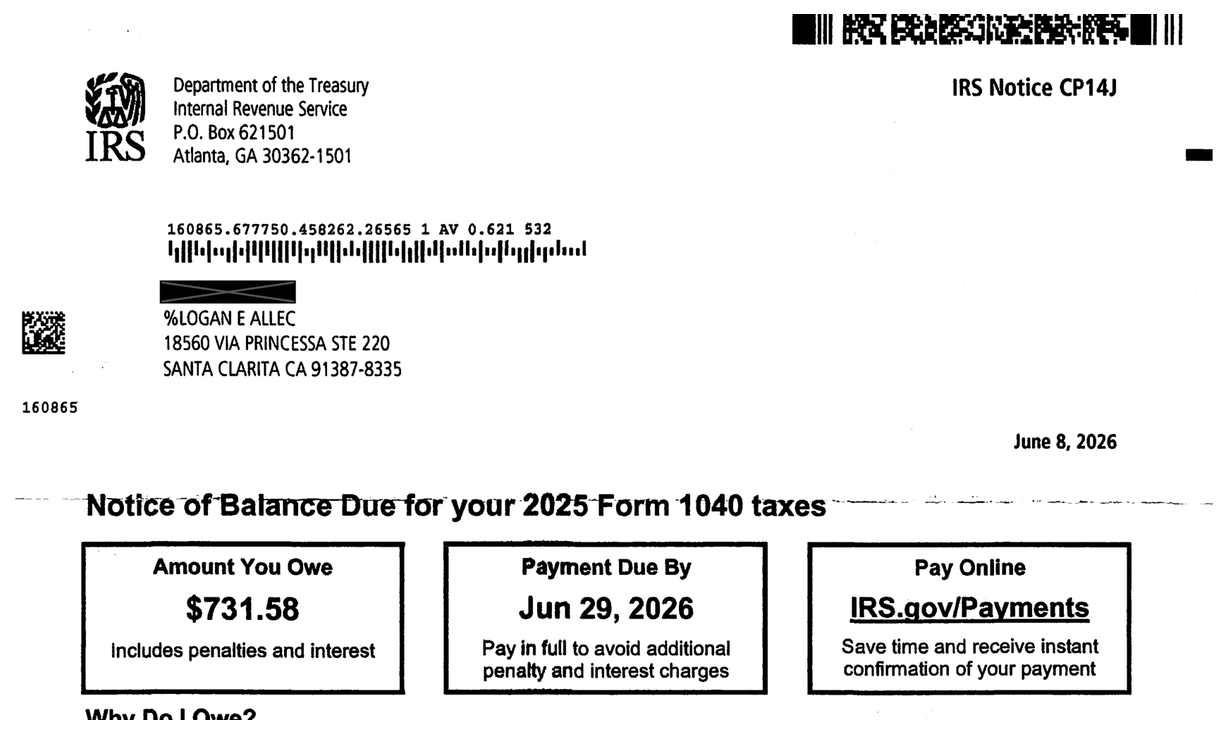
The top-right corner names the notice (“IRS Notice CP14J”) and the return address is an IRS service center, in this client’s case the campus in Atlanta, Georgia.
The notice date on this client’s notice is June 8, 2026, and the title confirms it is a “Notice of Balance Due for your 2025 Form 1040 taxes.”
The three boxes summarize the essentials: the amount you owe ($731.58, including penalties and interest), the pay-by date (June 29, 2026), and a reminder that you can pay online at IRS.gov/Payments.
Part 2: “Why do I owe?” and the billing summary
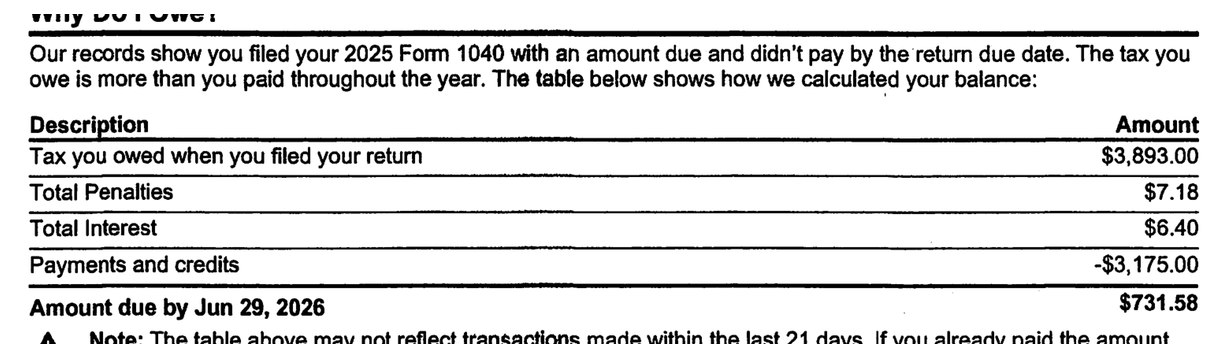
This table breaks the balance into its parts so you can check the math against your own records.
On this redacted client notice the figures are:
- Tax owed when you filed: $3,893.00
- Total penalties: $7.18
- Total interest: $6.40
- Payments and credits: −$3,175.00
- Amount due: $731.58
The IRS also notes that this table may not reflect payments made in the last 21 days, so if you paid recently, give it time to post before assuming the balance is wrong.
Part 3: Your options and the cost of waiting
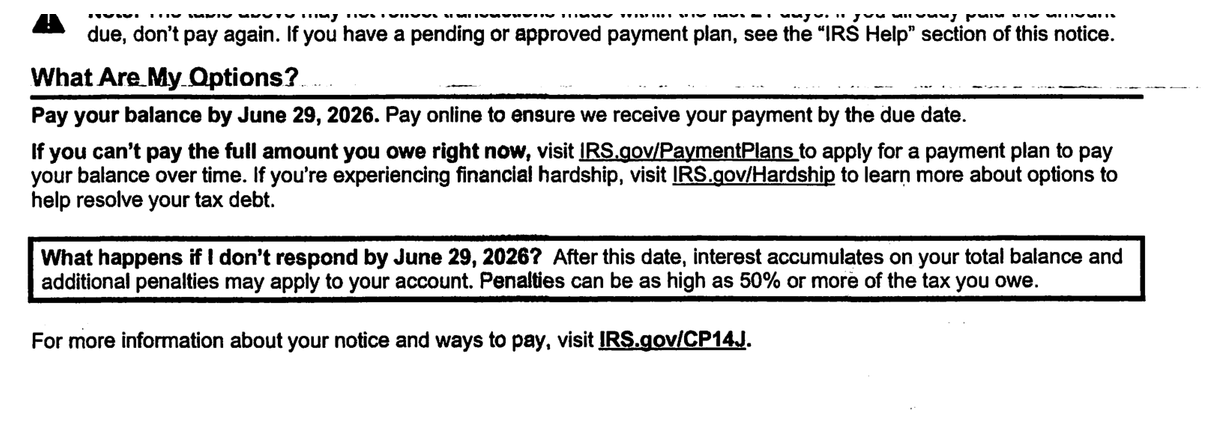
The notice tells you to pay by the due date and points you to IRS.gov/PaymentPlans if you cannot pay in full, and to IRS.gov/Hardship if you are facing financial hardship.
The boxed warning is the part to take seriously, because after the due date interest keeps accumulating and additional penalties may apply.
The IRS spells out that penalties can climb to 50% or more of the tax you owe, which is why acting before the deadline matters.
Part 4: The failure-to-pay penalty (IRC §6651)
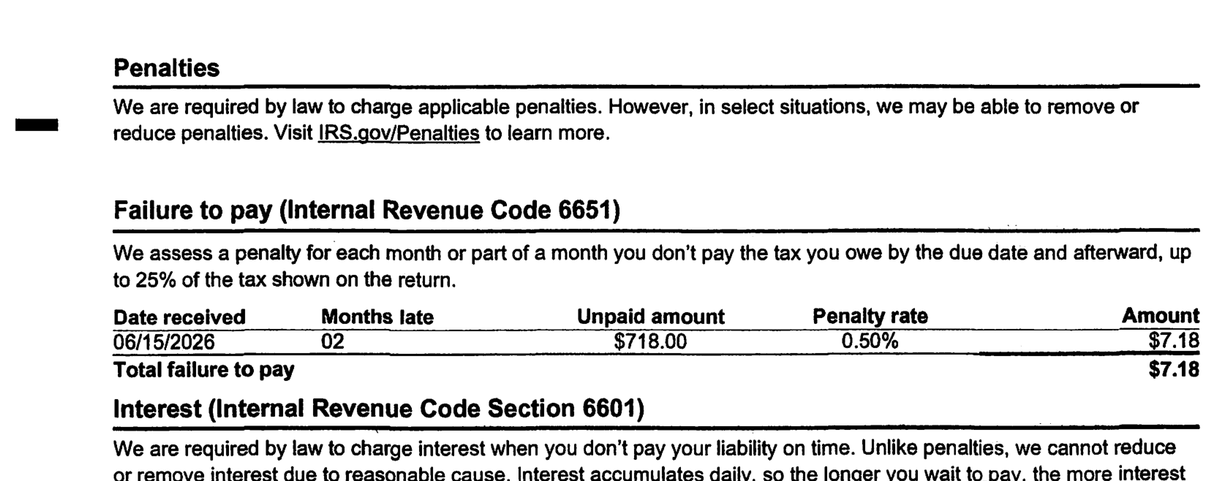
Page 2 breaks out the penalty so you can see how it was built.
The failure-to-pay penalty is charged for each month or part of a month the tax goes unpaid, at 0.5% of the unpaid amount, up to a maximum of 25%.
On this notice, the penalty is calculated on $718.00 of unpaid tax, at 0.50% per month for two months, for a total of $7.18.
The rules the IRS follows when assessing this penalty are set out in IRM 20.1.2, Failure To File/Failure To Pay Penalties, and general penalty information is at IRS.gov/Penalties.
Part 5: Interest (IRC §6601)
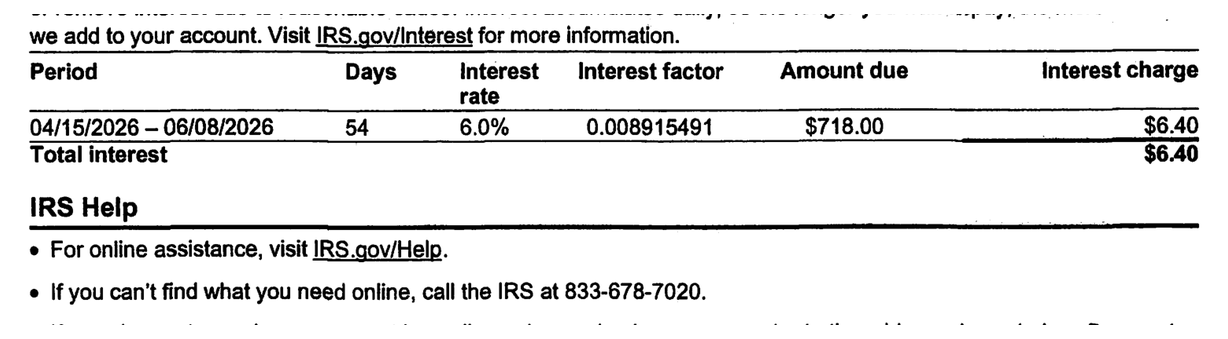
Interest is charged by law on any unpaid tax and, unlike penalties, it generally cannot be removed for reasonable cause.
This notice shows interest running from April 15, 2026 to June 8, 2026, a period of 54 days, at an annual rate of 6.0%, which works out to $6.40 on the unpaid balance.
Because interest compounds daily, the longer a balance sits, the faster it grows, so paying sooner always costs less.
Part 6: IRS help and how to pay
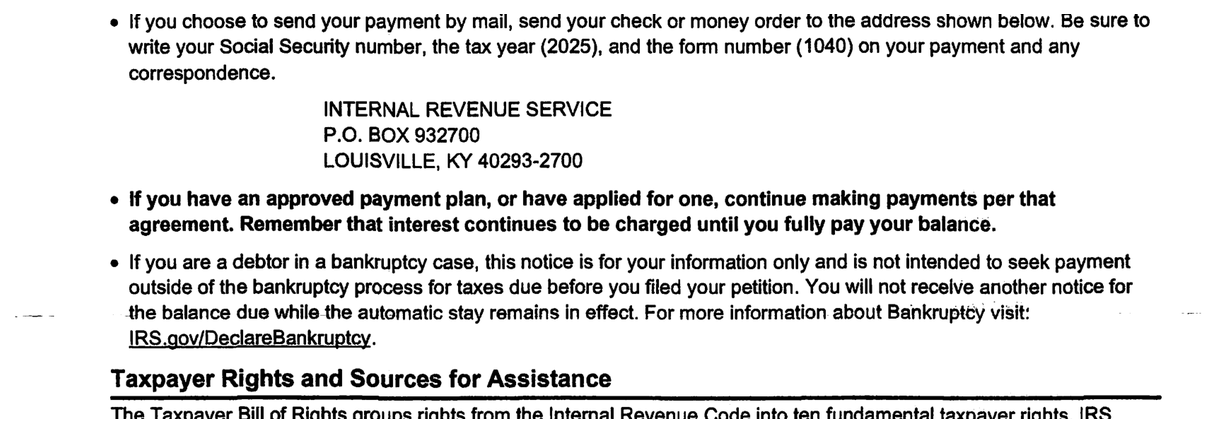
This section lists the phone number for questions (833-678-7020 on this client’s notice) and online help at IRS.gov/Help.
If you mail a check, this notice directs payment to Internal Revenue Service, P.O. Box 932700, Louisville, KY 40293-2700, with your Social Security number, the tax year (2025), and the form number (1040) written on it.
It also reminds anyone on a payment plan to keep paying and points taxpayers in bankruptcy to the resources at IRS.gov/DeclareBankruptcy.
Finally, it explains your right to free help from the Taxpayer Advocate Service at 877-777-4778.
When Does the IRS Send Notice CP14J?
The IRS issues a CP14J after two things happen in sequence:
- Your return is processed: the IRS posts your filed Form 1040 and records the balance you reported.
- The due date passes unpaid: the balance remains after the return due date, so the account is flagged for a first notice.
Most taxpayers receive it within a few weeks to a couple of months after filing, and it typically gives you about 21 days from the notice date to pay before the next notice generates.
Owe the IRS? Talk to a tax expert — free.
What to Do If You Got a CP14J
- Verify the balance. Compare the tax, penalties, interest, and payments on the notice against your filed return and your IRS online account, and make sure every payment was credited to the right year.
- Pay in full if you can. Paying the full amount by the due date at IRS.gov/Payments stops the penalty and interest from growing.
- Set up a payment plan if you cannot. You can apply online for an installment agreement at IRS.gov/OPA, or let a professional set one up on terms that fit your budget.
- Explore relief options. Depending on your situation, you may qualify for penalty abatement, an offer in compromise, or currently-not-collectible status.
- Get help if it is large or you disagree. If the balance is significant, spans multiple years, or looks wrong, a licensed tax professional can deal with the IRS for you.
Can You Get the CP14J Penalty Removed?
The failure-to-pay penalty on a CP14J can sometimes be reduced or removed, though the interest usually cannot.
Two of the most common ways to remove the penalty are:
- First-Time Abate: if you have a clean compliance history for the prior three years, the IRS may remove the penalty on request.
- Reasonable cause: if circumstances beyond your control, such as serious illness or a disaster, kept you from paying, you can ask the IRS to abate the penalty.
You can read more about penalty abatement and how to request it.
Tip: Interest charged on a penalty is removed automatically if that penalty is later abated, so always ask about the penalty first.
What Happens If You Ignore a CP14J
A CP14J is the friendliest letter the IRS will send you about this balance, and ignoring it only makes things worse.
If the balance stays unpaid, the IRS moves through its standard collection notice stream:
- CP501: a reminder that you still have a balance due.
- CP503: a second, more urgent reminder.
- CP504: a notice of intent to levy your state tax refund and other assets.
After that, the IRS can file a federal tax lien and ultimately levy your wages or bank accounts, so it is far cheaper to resolve the balance while it is still a CP14J.
Frequently Asked Questions About IRS Notice CP14J
Is a CP14J the same as a CP14?
Essentially, yes. A CP14J is a version of the CP14 first balance-due notice, and both tell you that you have an unpaid balance on a filed return. The “J” is an internal IRS version indicator and does not change what you need to do.
Does a CP14J mean I am being audited?
No. A CP14J is a bill based on the numbers you reported on your own return, not an examination of them. It simply means the tax you reported was not fully paid.
What if I already paid the amount due?
The notice may not reflect payments made within the last 21 days. Check your IRS online account, and if your payment was posted to the correct year, you can usually disregard the notice.
Can I set up a payment plan on a CP14J balance?
Yes. Most taxpayers can apply online for an installment agreement at IRS.gov/OPA, or have a tax professional arrange one. Interest and the failure-to-pay penalty continue at a reduced rate while you are on an approved plan.
Will the penalty and interest keep growing?
Yes, until the balance is paid. The failure-to-pay penalty runs at 0.5% per month up to 25%, and interest compounds daily, so paying sooner always costs less.
What should I do if I think the CP14J is wrong?
Compare the notice to your filed return and account transcript, call the number on the notice, and consider having a licensed tax professional review it before you pay a balance you may not owe.

“Very highly recommend their service! Caleb was extremely helpful and cleared up my tax issues with ease! Very friendly and knowledgeable!”
Get Help Now
Got a CP14J notice? Don’t wait for the IRS’s next move.
Talk to a tax expert — free, no obligation. We’ve resolved over $20 million in IRS debt for our clients.


Author:

Logan Allec, CPA, Founder and Owner
Logan Allec has been serving taxpayers as a CPA for over 14 years. After leaving his role at a "Big 4" firm, he started Choice Tax Relief to help everyday Americans who have found themselves behind on their taxes. He also educates thousands of people daily about tax relief on his YouTube channel. In addition to his CPA license, Logan also has a Master's Degree in Taxation from the University of Southern California (USC). He lives with his wife and children in the Los Angeles area. Learn more about Logan here.