

IRS Notice CP134B: What To Do About a Federal Tax Deposit Discrepancy

IRS Notice CP134B is a balance-due notice telling you that the federal tax deposits you claimed on an employment tax return do not match the deposits the IRS actually has posted to your account.
The gap between those two numbers becomes an underpayment, and the IRS adds penalties and interest on top of it.
What makes a CP134B different from an ordinary IRS bill is that the number printed on the front page is usually not the whole story.
There is almost always a failure-to-deposit penalty sitting behind it that the IRS has not assessed yet, and how much that penalty ends up being depends on a deadline buried on page 2.
In this article I will walk you through an actual CP134B one of our clients received, page by page, and show you how to work out whether the IRS is right before you pay a dime.
Here is a redacted copy of the CP134B notice we will be walking through.
Key Takeaways
- A CP134B means the total federal tax deposits reported on your employment tax return are higher than the deposits the IRS credited to your account for that period, and the difference has become a balance due.
- The notice carries two different deadlines that do two different things: one holds a not-yet-assessed failure-to-deposit penalty at 10% instead of 15%, and the other stops additional interest and failure-to-pay penalty.
- In our experience most CP134B discrepancies are not missing money at all — they are deposits that posted to the wrong EIN, the wrong tax period, or the wrong form.
- When a deposit was misapplied, the fix is a credit transfer rather than a payment, and the penalties charged because of the misapplication should come off with it.
- If the deposit really was short, both first-time abate and reasonable cause can reach the failure-to-deposit penalty, not just the failure-to-file and failure-to-pay penalties.
Table of Contents
IRS Notice CP134B at a Glance
| Detail | What It Means |
|---|---|
| Notice type | Balance-due notice for a federal tax deposit discrepancy on an employment tax return |
| What the IRS is saying | The deposits you reported on your return are more than the deposits we have credited to your account |
| Who receives it | Employers and other businesses that file federal employment tax returns and make federal tax deposits |
| Returns involved | Employment tax returns such as Form 940, Form 941, Form 943, Form 944, and Form 945 |
| What is on the bill | The underpaid tax, plus failure-to-file penalty, failure-to-pay penalty, and interest |
| What is not on the bill yet | A failure-to-deposit penalty of 10% or 15% of the unpaid tax |
| Key deadlines | 10 days from the notice date to hold the deposit penalty at 10%, and 21 days from the notice date to stop additional interest |
| Code sections | IRC §6656 (failure to deposit), IRC §6651 (failure to file and failure to pay), IRC §6601 (interest) |
| Phone number on our client’s notice | 800-829-0115 |
| The refund version | Notice CP134R, which the IRS sends when the discrepancy runs the other way |
Free Consultation
Got a CP134B notice? Get a straight answer before you respond.
Talk to a tax expert — free, no obligation. We’ve resolved over $20 million in IRS debt for our clients.
A Real IRS Notice CP134B, Page by Page
The CP134B our client received runs five pages, and every one of them contains something you need.
Here is what each section says and what it actually tells you.
Part 1: The Notice Header
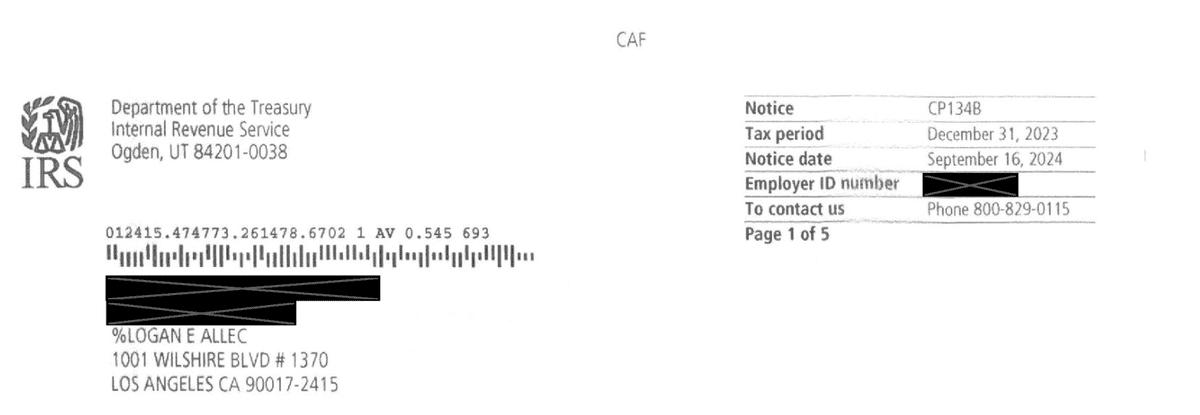
The top-right box is where you confirm you are reading what you think you are reading.
On our client’s notice it identifies the notice as a CP134B, the tax period as December 31, 2023, the notice date as September 16, 2024, and the phone number as 800-829-0115.
The tax period matters more than people expect on an employment tax notice.
A period ending December 31, 2023 on a Form 940 means the full 2023 calendar year, because Form 940 is an annual return — but on a Form 941 the same date would mean the fourth quarter of 2023 only.
The return this notice is about is identified further down the page, and on our client’s notice it is the 2023 Form 940, the annual federal unemployment (FUTA) tax return.
The word “CAF” printed at the top of the page and the mailing address are also worth noticing.
CAF stands for Centralized Authorization File, and it means this particular copy went to the authorized representative the IRS has on file rather than to the business itself.
That is why our firm’s Los Angeles address appears on the copy above.
If you do not have a Form 2848 on file, no one but you receives a copy of a notice like this, which is one reason these get missed.
Part 2: The Adjusted Amount Due and the Billing Summary
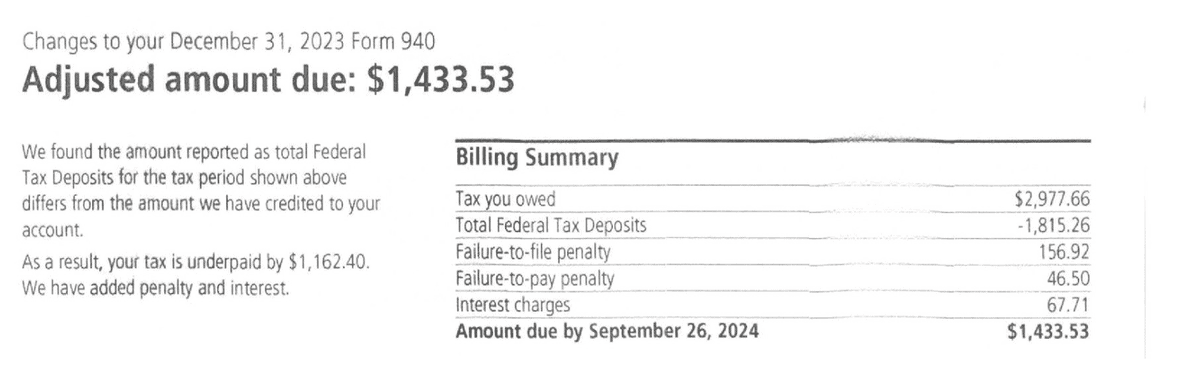
This is the part of the notice everyone reads first, and it is worth slowing down on.
The headline reads “Changes to your December 31, 2023 Form 940” followed by “Adjusted amount due: $1,433.53.”
The explanation to the left is the actual definition of a CP134B: the amount reported as total federal tax deposits for the period differs from the amount the IRS has credited to the account, so the tax is underpaid by $1,162.40.
The billing summary on the right breaks the $1,433.53 into five pieces:
- Tax you owed: $2,977.66
- Total federal tax deposits: minus $1,815.26
- Failure-to-file penalty: $156.92
- Failure-to-pay penalty: $46.50
- Interest charges: $67.71
- Amount due by September 26, 2024: $1,433.53
The whole notice hangs on one subtraction: $2,977.66 in tax owed minus $1,815.26 in deposits the IRS credited leaves $1,162.40 unpaid.
Notice what the IRS is not saying here.
It is not saying the FUTA tax our client calculated was wrong, and it is not challenging any wage figure or any credit on the return.
It accepted the tax exactly as filed and is disputing only the payments, which is a very different problem from an audit and usually a far easier one to fix.
Part 3: The Payment Stub
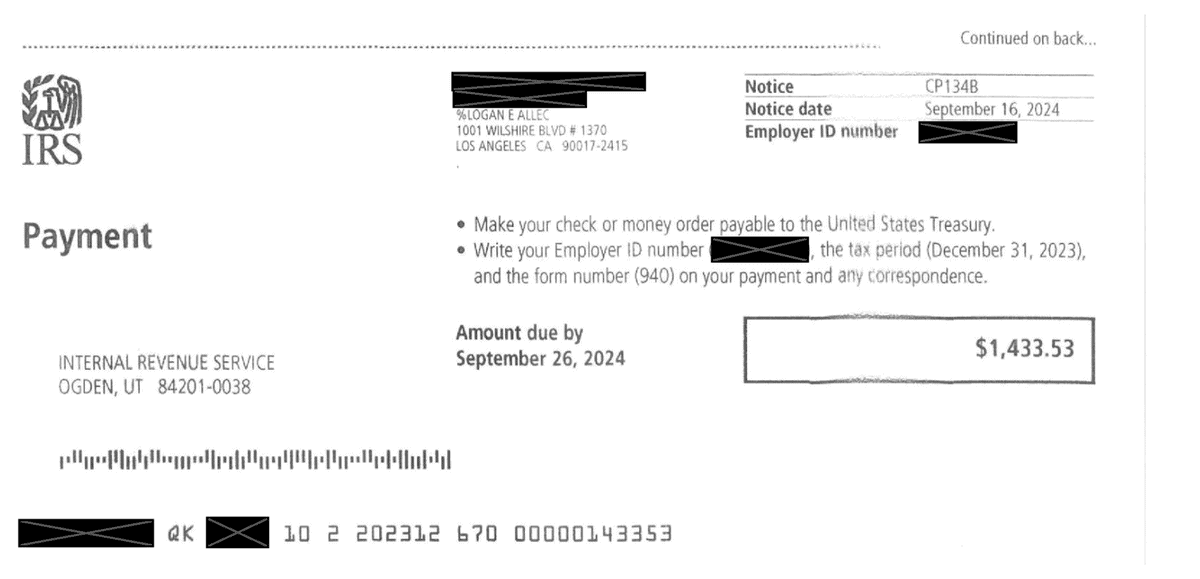
The detachable stub at the bottom of page 1 tells you to make a check or money order payable to the United States Treasury and to write your employer ID number, the tax period (December 31, 2023), and the form number (940) on the payment and on any correspondence.
On a CP134B in particular, that instruction is not boilerplate.
A payment that arrives without an EIN, a period, and a form number is exactly how deposits end up on the wrong account in the first place, which is the problem this notice exists to report.
The row of digits along the bottom of the stub is the IRS scanline, and it is a quick way to confirm which return the notice is really about.
On our client’s stub it reads 10 2 202312 670 00000143353, where 10 is the IRS’s internal code for Form 940, 202312 is the tax period ending December 2023, 670 is the transaction code for a subsequent payment, and the trailing digits are the amount of $1,433.53.
If any of that does not match the return you think you are being billed for, you have found your discrepancy before you have even opened your records.
Tip: Pay through your IRS business tax account or EFTPS rather than by check whenever you can, because both let you specify the form and the exact tax period and both give you a confirmation number you can quote later.
Part 4: What You Need To Do Immediately
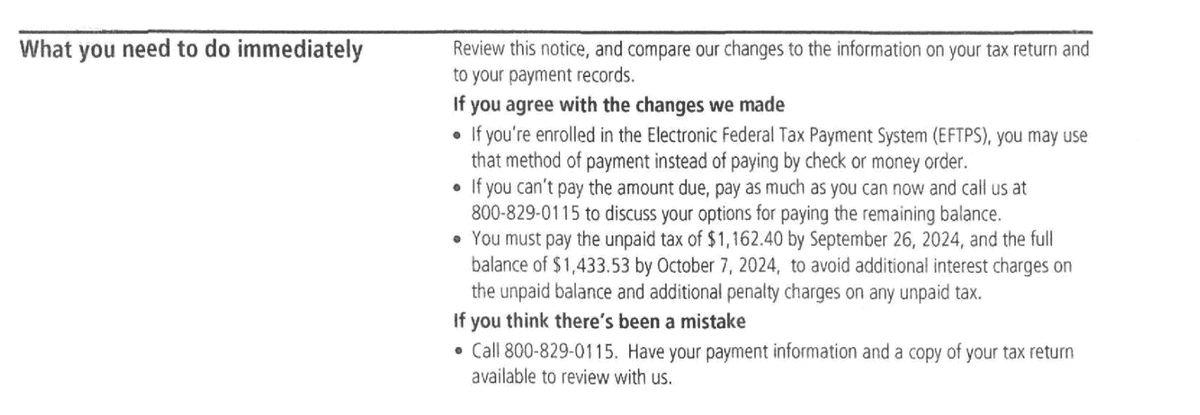
Page 2 opens by asking you to review the notice and compare the changes to the information on your tax return and to your payment records.
That second half of the sentence is the important one, because your payment records are where a CP134B is usually won or lost.
If you agree with the changes, the notice gives you three instructions:
- Use EFTPS to pay if you are enrolled, instead of a check or money order.
- Pay as much as you can now and call 800-829-0115 to discuss options for the remaining balance if you cannot pay in full.
- Pay the unpaid tax of $1,162.40 by September 26, 2024 and the full balance of $1,433.53 by October 7, 2024.
Read that last bullet again, because it is doing something unusual.
The IRS is naming two different amounts with two different deadlines, and most people who skim this page pay the wrong one on the wrong date.
If you think the IRS has made a mistake, the notice tells you to call the same number with your payment information and a copy of your tax return in front of you.
Part 5: The Penalty the IRS Has Not Charged You Yet

This short section is the single most valuable paragraph on the notice, and it is the one clients almost never mention when they call us.
It says our client is likely to be subject to a 10% failure-to-deposit penalty that the IRS has not assessed yet, and that if the unpaid tax of $1,162.40 is not paid by September 26, 2024, the IRS will assess that penalty at 15% instead of 10%.
On a $1,162.40 underpayment, a 10% failure-to-deposit penalty is $116.24 and a 15% penalty is $174.36.
So the real cost of this notice is not the $1,433.53 in the box on page 1 — it is closer to $1,550 if our client moved quickly, and closer to $1,608 if he did not.
The failure-to-deposit penalty under IRC §6656 runs on a sliding scale that gets steeper the longer a required deposit goes unmade:
- 2% of the deposit if it is made one to five days late.
- 5% if it is made six to fifteen days late.
- 10% if it is made more than fifteen days late, and also for amounts paid within 10 days of the first notice asking for payment.
- 15% for amounts still unpaid more than 10 days after the first notice requesting payment, or after notice and demand for immediate payment, whichever comes first.
That last tier is where the September 26 date comes from.
The notice is dated September 16, 2024, and 10 days later is September 26, 2024 — the day the penalty tier flips from 10% to 15% under IRC §6656(b)(1)(B).
The October 7 date is a different rule entirely.
Under IRC §6601(e)(3), if you pay the full amount of a notice within 21 calendar days of the notice date, the IRS does not charge interest for that 21-day window, and September 16 plus 21 days is October 7.
Important: The dollar figure in the “Amount due” box on a CP134B is not your total exposure, because the failure-to-deposit penalty is calculated separately and billed later on its own notice.
The section closes by warning that if the full balance is not paid by October 7, 2024, interest will increase and an additional failure-to-pay penalty may apply.
Part 6: The Payments the IRS Actually Credited
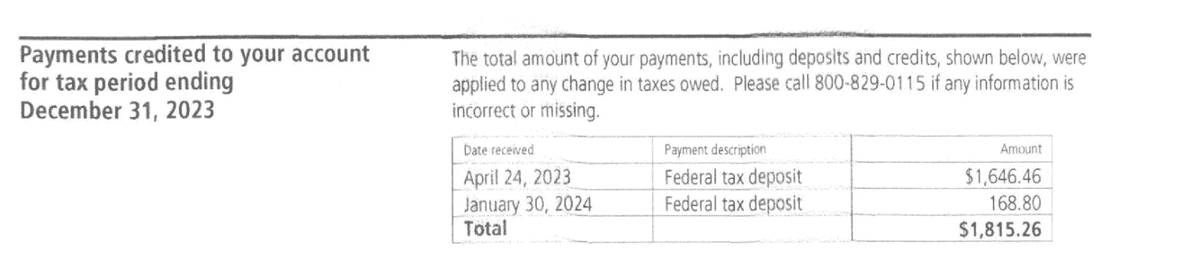
Page 3 opens with the most useful table on the entire notice, and hardly anyone uses it.
This is the IRS showing its work: every payment, deposit, and credit it applied to the period, with dates and amounts.
On our client’s notice there are exactly two entries:
- April 24, 2023 — federal tax deposit — $1,646.46
- January 30, 2024 — federal tax deposit — $168.80
Those add to the $1,815.26 the IRS credited, against a return that claimed enough deposits to cover $2,977.66 in FUTA tax.
This table is what you compare, line by line, against your own bank statements and your EFTPS payment history.
If a deposit you actually made is missing from this list, the money did not vanish — it went somewhere else in the IRS system, and the rest of your work is finding where.
It also helps to know how FUTA deposits are supposed to work before you judge whether this pattern looks wrong.
Federal unemployment tax is deposited quarterly, but only once your accumulated FUTA liability for the year passes $500, and anything under that carries forward to the next quarter.
Whatever is still owed at the end of the fourth quarter is due by January 31 with the Form 940 itself, which is exactly what the January 30, 2024 deposit above appears to be.
One deposit pattern that catches employers every year is the FUTA credit reduction.
When a state has borrowed from the federal unemployment fund and not repaid it in time, employers in that state lose part of their 5.4% FUTA credit, and the extra tax is treated as a fourth-quarter liability due by January 31 — long after most payroll systems have already deposited at the normal 0.6% rate all year.
Part 7: The Failure-to-File Penalty
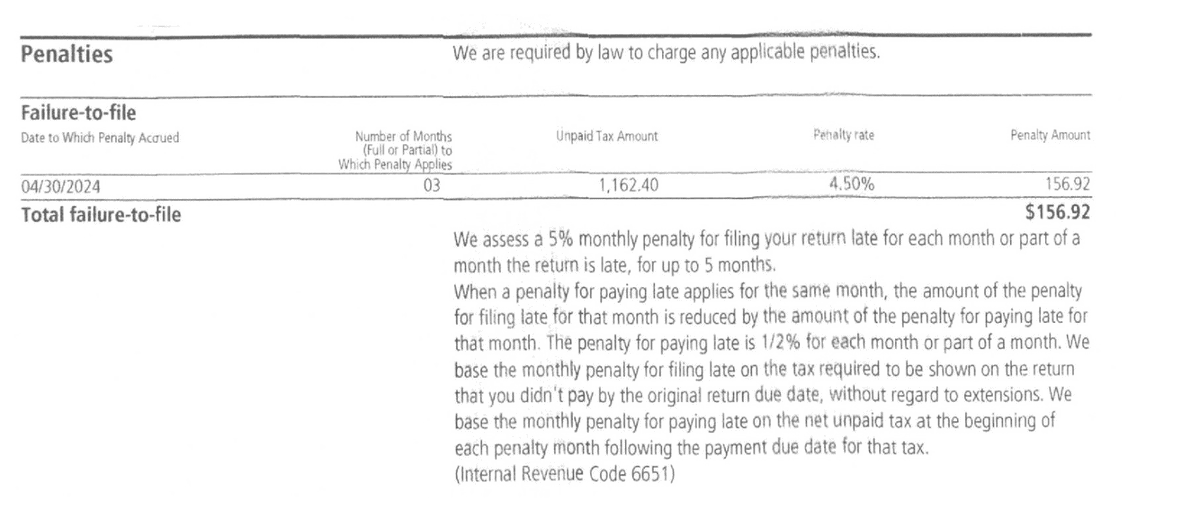
The penalties section of the notice starts with a line the IRS uses on every balance-due notice: it is required by law to charge any applicable penalties.
The failure-to-file table on our client’s notice shows a penalty accrued to 04/30/2024, three months of accrual, an unpaid tax amount of $1,162.40, a rate of 4.50%, and a penalty of $156.92.
Those numbers tell you something the rest of the notice does not say out loud.
A 2023 Form 940 was due January 31, 2024, so three months of failure-to-file penalty means the return was filed roughly three months late.
The 4.50% rate is not a typo either.
The failure-to-file penalty under IRC §6651(a)(1) is 5% per month or part of a month, capped at five months and 25%, but IRC §6651(c)(1) requires the IRS to reduce it by the failure-to-pay penalty for any month both apply.
Five percent minus the half-percent failure-to-pay penalty is 4.5%, and 4.5% times three months times $1,162.40 is the $156.92 on the notice.
Note also what the penalty is charged on: it is 4.5% of the unpaid tax, not of the full $2,977.66 the return reported.
Part 8: The Failure-to-Pay Penalty
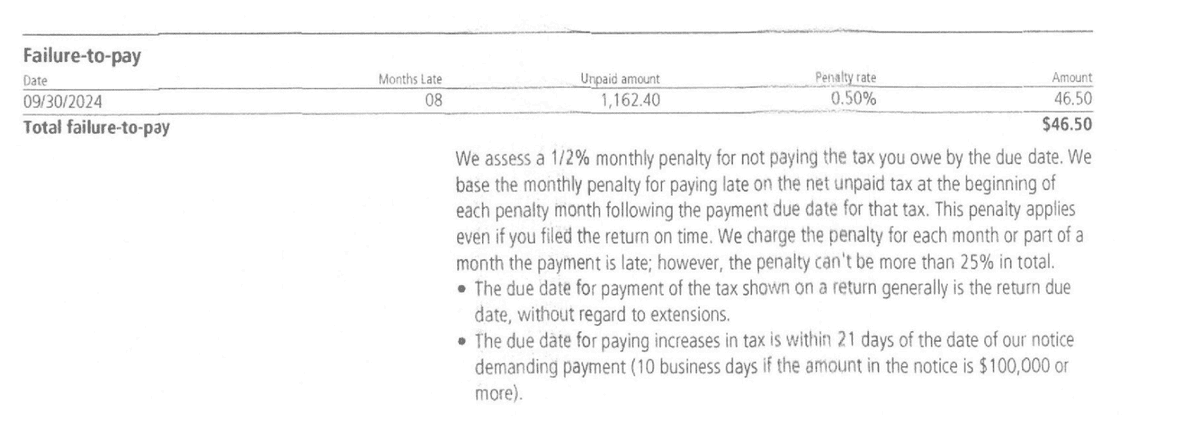
The failure-to-pay table shows a date of 09/30/2024, eight months late, the same $1,162.40 unpaid amount, a rate of 0.50%, and a penalty of $46.50.
The failure-to-pay penalty under IRC §6651(a)(2) is half a percent of the net unpaid tax for each month or part of a month it stays unpaid, up to a maximum of 25%.
Eight months at half a percent is 4%, and 4% of $1,162.40 is $46.50.
Unlike the failure-to-file penalty, this one keeps running every month until the balance is paid, which is the practical argument for paying the tax portion even while you dispute the rest.
The notice also spells out two rate changes most business owners have never heard of.
If the IRS issues a Notice of Intent to Levy and the balance is not paid within 10 days of that notice, the failure-to-pay penalty jumps from 0.5% to 1% per month.
Going the other direction, a sole proprietor who filed on time and has an approved installment agreement in place sees the rate drop to a quarter of a percent per month while that agreement is in effect.
Part 9: How the Notice Itself Tells You To Ask for Penalty Relief
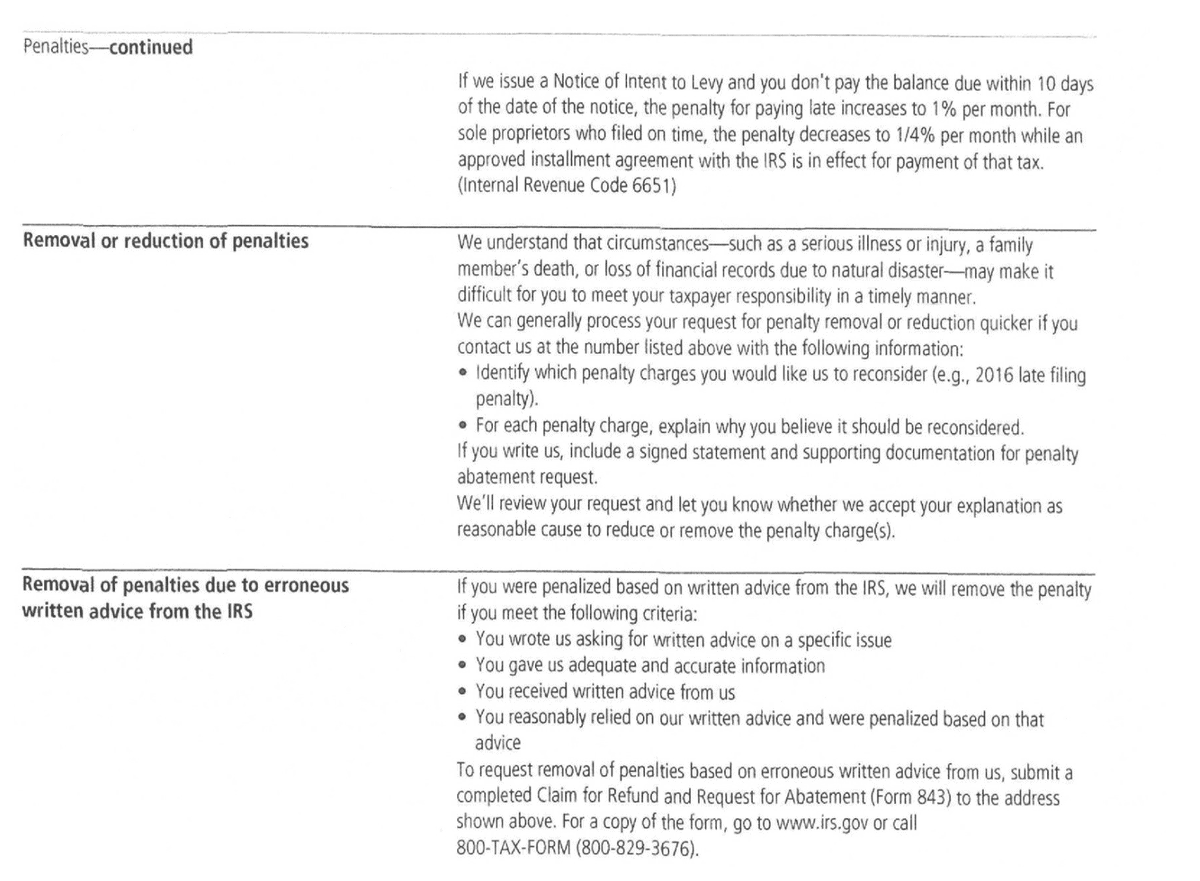
Page 4 contains an invitation that a lot of taxpayers read right past.
The IRS says it understands that circumstances such as a serious illness or injury, a family member’s death, or the loss of financial records in a natural disaster can make it difficult to meet a deadline, and it explains how to ask for those penalties to be removed or reduced.
To make the request move faster, the notice asks you to call and give it two things:
- Which specific penalty charges you want reconsidered.
- For each one, why you believe it should be reconsidered.
If you write instead of calling, the notice asks for a signed statement and supporting documentation.
The section below it covers a narrower path: if you were penalized because you relied on written advice from the IRS, you can request removal by filing Form 843, the Claim for Refund and Request for Abatement.
What the notice does not tell you is that reasonable cause is not your only option.
The IRS also has an administrative waiver called first-time abate, and under IRM 20.1.1.3.3.2.1 it reaches the failure-to-file penalty, the failure-to-pay penalty, and the failure-to-deposit penalty alike.
First-time abate does not require a hardship story at all — it requires a clean compliance history, meaning you filed the same return for the three years before the penalized period without an unreversed penalty on any of them.
There is also a separate statutory waiver in IRC §6656(c) for first-time depositors, which lets the IRS waive an inadvertent failure to deposit during the first quarter a business is required to make deposits, as long as the return was filed on time.
Our full guide to IRS penalty abatement walks through how to build each of these requests.
Part 10: The Interest Charges
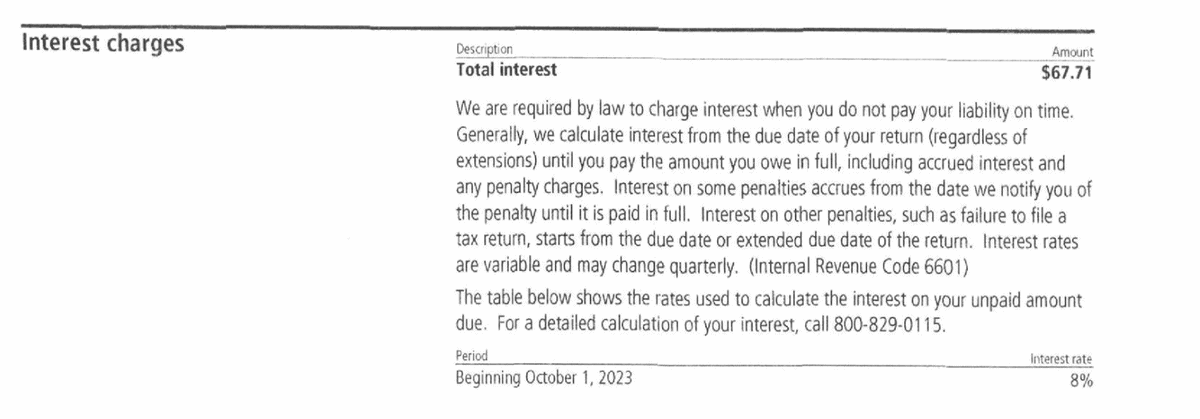
The interest section on our client’s notice shows $67.71 in total interest and cites IRC §6601.
The rate table below it shows a single period beginning October 1, 2023 at 8%.
Interest is charged from the due date of the return regardless of extensions and runs until the liability is paid in full, including accrued interest and penalties, and the rate is reset quarterly.
Interest also runs on the penalties themselves, not just the tax, which is why a small balance grows faster than most people expect.
One thing worth understanding before you spend energy on it: interest is very rarely abated on its own.
It generally comes off only when the tax or penalty underneath it comes off, because IRC §6404(e) allows abatement only in narrow situations involving unreasonable IRS error or delay in performing a ministerial or managerial act.
That is another reason to attack the underlying discrepancy rather than the interest line.
Part 11: Additional Information and the Corporate Interest Warning
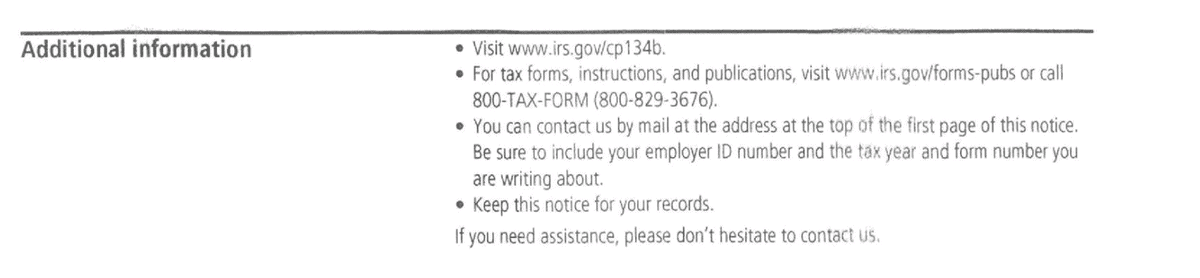
Page 5 finishes with a warning aimed at larger businesses and a short list of housekeeping items.
The corporate interest paragraph explains that a C corporation that underpaid by more than $100,000 for any taxable period is charged an additional 2% of interest if the full amount shown on the notice is not paid within 30 days of the notice date, with the higher rate starting on the 31st day.
That is the large corporate underpayment rate under IRC §6621(c), often called hot interest, and once it starts it applies to all underpayments of that tax type and period until the balance is paid in full.
The additional information section then tells you to visit irs.gov/cp134b, points you to irs.gov/forms-pubs or 800-TAX-FORM for forms and publications, and asks you to include your employer ID number, tax year, and form number in any correspondence.
Why You Got IRS Notice CP134B
A CP134B is generated by a matching program, not by a human reviewing your business.
The IRS compares the total federal tax deposits you reported on your employment tax return against the deposits actually posted to that exact combination of EIN, form, and tax period, and any shortfall becomes a balance due automatically.
That is why the causes are so often clerical rather than financial.
Here are the ones we see most often:
- The deposit was made under the wrong EIN, which happens constantly after an entity change, a reorganization, or a switch in payroll providers.
- The deposit was tagged to the wrong tax period in EFTPS, so a fourth-quarter payment posted to the first quarter of the following year.
- The deposit was tagged to the wrong form or tax type, so money meant for Form 940 landed on Form 941 or vice versa.
- The return over-reported deposits because of a transposition or a carryover error on the deposit line of the return.
- A payroll service or professional employer organization reported a deposit it never actually made, or made it under its own EIN rather than yours.
- A FUTA credit reduction created an extra fourth-quarter liability that was never deposited by January 31.
- The IRS moved a payment off the period to cover a balance on a different period, so a deposit you correctly made is no longer sitting where you left it.
- A payment was reversed after a dishonored check or a failed ACH debit, and the reversal never made it into your bookkeeping.
Notice how many of those involve money that was actually paid.
That is the reason we tell clients not to write a check the day a CP134B arrives.
Still have questions? Talk to a tax expert — free.
What To Do If You Get IRS Notice CP134B
Step 1: Build Your Own Deposit Record First
Before you look at anything the IRS produced, assemble your side of the story.
Pull your EFTPS payment history, which keeps roughly 16 months of activity available online, along with the bank statements covering the period and your payroll provider’s deposit confirmations.
What you want out of this is a simple list of every deposit you believe you made for that form and period, with dates, amounts, and confirmation numbers.
Step 2: Get the Business Account Transcript
Next, request the business account transcript for the specific form and period on the notice, which for our client would be Form 940 for the period ending December 2023.
The transcript shows every transaction the IRS posted, including payments it later moved elsewhere, which the notice’s payment table does not always make obvious.
If a deposit appears on the transcript and then disappears, you are looking at a transfer rather than a missing payment, and that changes your whole approach.
Step 3: Compare Three Numbers, Not Two
Most people compare what they paid against what the IRS credited and stop there.
Compare three numbers instead: what your bank shows leaving your account, what the IRS shows credited to the period, and what your return actually reported on its deposit line.
If your bank and the IRS agree but the return is higher, the return was wrong and the tax is genuinely owed.
If your bank and the return agree but the IRS is lower, a deposit was misapplied and you should not be paying this bill twice.
Step 4: If a Deposit Was Misapplied, Ask for a Credit Transfer
When you can show the money left your account and reached the IRS, the remedy is a credit transfer, not a payment.
Call 800-829-0115 with the deposit date, the exact amount, the EFTPS acknowledgment number, and the bank confirmation, and ask that the payment be transferred to the correct EIN, form, and period.
Then ask for the penalties and interest that were charged because of the misapplication to be abated once the transfer posts, because they were never properly owed in the first place.
Get the name and identification number of the person you speak with, and follow up in writing to the address at the top of the notice with copies of your proof.
Step 5: If the Deposit Really Was Short, Pay the Tax and Then Fight the Penalties
If your own records confirm the shortfall, the sequencing matters.
Pay the unpaid tax first, because that is what stops the failure-to-pay penalty from accruing and what determines whether the failure-to-deposit penalty is assessed at 10% or 15%.
Only after the tax is handled should you turn to the penalties, and you can request abatement even after you have paid them.
Step 6: Respect Both Deadlines, Not Just the Later One
The earlier deadline on a CP134B is 10 days from the notice date, and hitting it is worth real money because it holds the deposit penalty at the lower tier.
The later deadline is 21 days from the notice date, and hitting that one stops interest from being charged for those 21 days and heads off additional failure-to-pay penalty.
If you can only make one of them, make the first, because a five-percentage-point swing on the deposit penalty is almost always larger than three weeks of interest.
Step 7: If You Cannot Pay, Do Not Simply Ignore It
An unpaid employment tax balance does not sit quietly.
It moves into the business collection notice stream, where you can expect a balance-due notice like CP161, then a CP504B notice of intent to levy, and eventually a revenue officer if the balance is large enough.
There are real options short of paying in full, including an installment agreement, currently not collectible status, and in some cases an offer in compromise.
Our guide to payroll tax debt relief covers what is realistic for a business carrying employment tax debt.
CP134B vs. CP134R: Which One Did You Get?
The CP134B has a mirror image, and reading the letter at the end of the notice number tells you which side of the discrepancy you are on.
| Feature | Notice CP134B | Notice CP134R |
|---|---|---|
| What the IRS found | You reported more deposits than the IRS credited to your account | The IRS credited more deposits than you reported on your return |
| Result | A balance due | An overpayment and a refund |
| Penalties | Failure-to-file, failure-to-pay, and a failure-to-deposit penalty that is usually still coming | None from the discrepancy itself |
| What you should do | Verify the deposits the IRS credited before paying anything | Verify the payments are really yours and were not misapplied from another account or period |
| Timing | Act within 10 days to hold the deposit penalty at 10% | Confirm the credit is correct before you spend the refund |
The CP134R is the friendlier notice, but it deserves the same verification work.
A refund created by someone else’s deposit landing on your account is a refund the IRS will eventually want back, with interest.
Does a CP134B Mean the Trust Fund Recovery Penalty Is Coming?
This is one of the first questions business owners ask us, and the answer depends entirely on which return the notice is about.
Our client’s CP134B was on a Form 940, and federal unemployment tax is paid entirely by the employer.
Because no money withheld from an employee’s paycheck is involved, a Form 940 balance is not a trust fund liability and does not expose an owner or officer to the trust fund recovery penalty under IRC §6672.
A CP134B on a Form 941 is a different situation, because a 941 includes withheld federal income tax and the employee share of Social Security and Medicare.
Those are trust fund taxes, and an unpaid trust fund balance can be assessed personally against any responsible person who willfully failed to pay it.
If your CP134B is on a Form 941, read our guide to the trust fund recovery penalty before you decide how to handle the balance.
Get Help With Your CP134B
A CP134B is one of the more fixable notices the IRS sends, but only if someone actually reconstructs where the deposits went instead of assuming the IRS is right.
At Choice Tax Relief we do that reconstruction for business clients every week, and we handle the credit transfers, the penalty abatement requests, and the collection alternatives that follow when the balance turns out to be real.
Call us at 866-8000-TAX or book a free consultation and we will tell you what we see in your account.

“This tax service is professional and reliable! They handled our business like family! We highly recommend them!”
Frequently Asked Questions About IRS Notice CP134B
What is IRS Notice CP134B?
IRS Notice CP134B is a balance-due notice telling you that the total federal tax deposits reported on your employment tax return are more than the deposits the IRS has credited to your account for that period. The difference becomes an underpayment, and the IRS adds a failure-to-file penalty, a failure-to-pay penalty, and interest on top of it.
Does a CP134B mean my business is being audited?
No. A CP134B is generated by an automated matching program that compares the deposits reported on your return against the deposits posted to your account, and it does not question your wages, your tax calculation, or any credit on the return. The IRS is accepting your return as filed and disputing only the payments.
Why does my CP134B have two different deadlines?
The two dates do different jobs. The earlier one, 10 days from the notice date, is the cutoff for paying the unpaid tax before the failure-to-deposit penalty rises from 10% to 15% under IRC 6656(b)(1)(B). The later one, 21 days from the notice date, is the window under IRC 6601(e)(3) for paying the full balance without being charged interest for that 21-day period.
What if the IRS applied my deposit to the wrong period or the wrong EIN?
Then you need a credit transfer rather than a payment. Call the number on the notice with the deposit date, the exact amount, the EFTPS acknowledgment number, and your bank confirmation, and ask that the payment be moved to the correct EIN, form, and tax period. Once it posts correctly, ask for the penalties and interest that resulted from the misapplication to be abated as well.
Can the failure-to-deposit penalty be removed?
Yes, in several ways. First-time abate covers the failure-to-deposit penalty along with the failure-to-file and failure-to-pay penalties and requires only a clean three-year compliance history, and reasonable cause is available if circumstances outside your control caused the failure. There is also a statutory waiver in IRC 6656(c) for a first-time depositor’s inadvertent failure during the first quarter deposits were required.
What happens if I ignore a CP134B?
The failure-to-deposit penalty gets assessed at the higher 15% rate, the failure-to-pay penalty keeps accruing at half a percent per month, and interest continues to compound. The account then moves into the business collection stream, which means further balance-due notices, a notice of intent to levy, a possible federal tax lien, and eventually assignment to a revenue officer.
Can I set up a payment plan for the balance on my CP134B?
Yes. Businesses can request an installment agreement for employment tax balances, though the terms are tighter than they are for individual income tax and the IRS will expect you to stay current on all future deposits and filings. If the business genuinely cannot pay, currently not collectible status and an offer in compromise are also worth evaluating.
Does a CP134B create trust fund recovery penalty exposure?
Only if the notice is about a return that includes trust fund taxes. A CP134B on a Form 940 involves federal unemployment tax, which the employer pays entirely, so there is no trust fund component and no IRC 6672 exposure. A CP134B on a Form 941 does involve withheld income tax and the employee share of FICA, and an unpaid balance there can be assessed personally against responsible persons.
Get Help Now
Got a CP134B notice? Get a straight answer before you respond.
Talk to a tax expert — free, no obligation. We’ve resolved over $20 million in IRS debt for our clients.


Author:

Logan Allec, CPA, Founder and Owner
Logan Allec has been serving taxpayers as a CPA for over 14 years. After leaving his role at a "Big 4" firm, he started Choice Tax Relief to help everyday Americans who have found themselves behind on their taxes. He also educates thousands of people daily about tax relief on his YouTube channel. In addition to his CPA license, Logan also has a Master's Degree in Taxation from the University of Southern California (USC). He lives with his wife and children in the Los Angeles area. Learn more about Logan here.