

IRS Notice CP15B: What It Is and How to Respond

If you’ve received IRS Notice CP15B, the IRS is telling you that it has charged you the Trust Fund Recovery Penalty (TFRP) — a personal penalty for a business’s unpaid employment (payroll) taxes. Unlike most IRS notices, a CP15B isn’t about your own 1040 balance. It’s a bill sent to you personally because the IRS has decided you were a “responsible person” who willfully failed to collect, account for, or pay over the taxes a business withheld from its employees’ paychecks.
This is one of the most serious civil penalties the IRS assesses, and the amount can be substantial. In this client’s notice below, the taxpayer was billed $30,813.07 for a single calendar quarter. In this article, a CPA walks you through exactly what IRS Notice CP15B means, why you received it, and—most importantly—what your options are for responding.
See a redacted IRS Notice CP15B that one of our clients received (PDF) so you can follow along with each section as we break it down.
Key Takeaways
- CP15B is a bill for the Trust Fund Recovery Penalty (TFRP) under Internal Revenue Code (IRC) Section 6672 — charged to you personally for a business’s unpaid payroll taxes.
- The “trust fund” portion is the income tax and the employee share of Social Security and Medicare that a business withholds from wages but fails to pay over to the IRS.
- You were assessed because the IRS believes you were a “responsible person” who acted “willfully.” Owners, officers, partners, bookkeepers, and anyone with authority over paying the bills can qualify.
- The penalty equals 100% of the unpaid trust fund taxes — which is why the TFRP is often called the “100% penalty.” Interest keeps accruing until it’s paid in full.
- You have options. You can pay, dispute it by filing a claim for refund and (if needed) a refund suit, or—if you can’t pay in full—pursue an installment agreement, an offer in compromise, or a temporary collection delay.
- Deadlines are short. This client’s notice asked for documents within 30 days and set a payment deadline of September 1, 2025, with a bond deadline of September 10, 2025, to suspend collection.
Table of Contents
What Is IRS Notice CP15B?
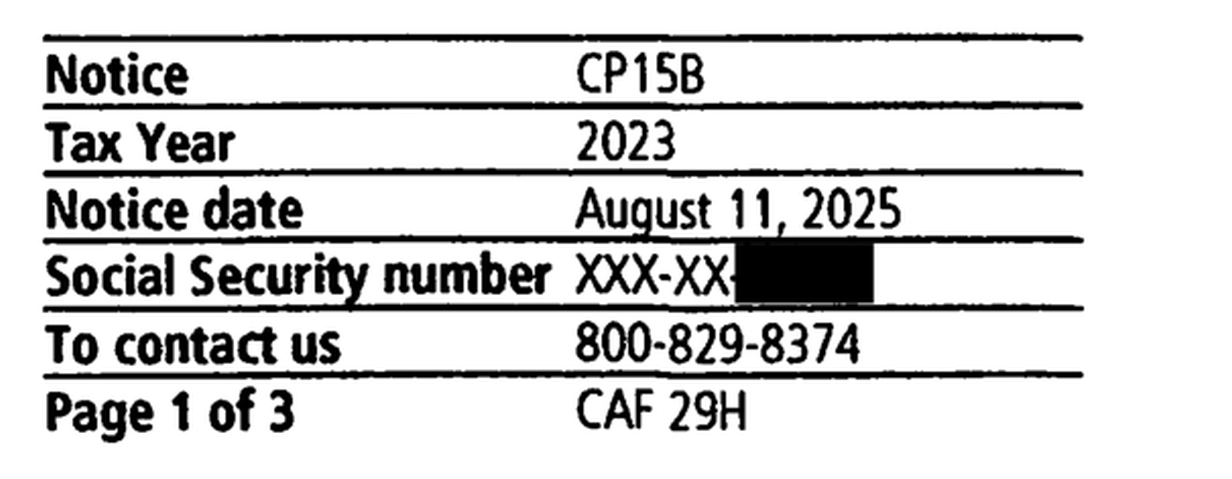
IRS Notice CP15B is the notice the IRS uses to tell you it has assessed the Trust Fund Recovery Penalty against you individually. In plain English, it’s the bill. The header of the notice spells out the basics: the notice type (CP15B), the tax year, the notice date, and the amount due.
The top of the notice states the bottom line in large type: “We charged you a penalty for not paying employment taxes” and an Amount due. The left column explains why, and the Billing Summary on the right shows how the balance is built.
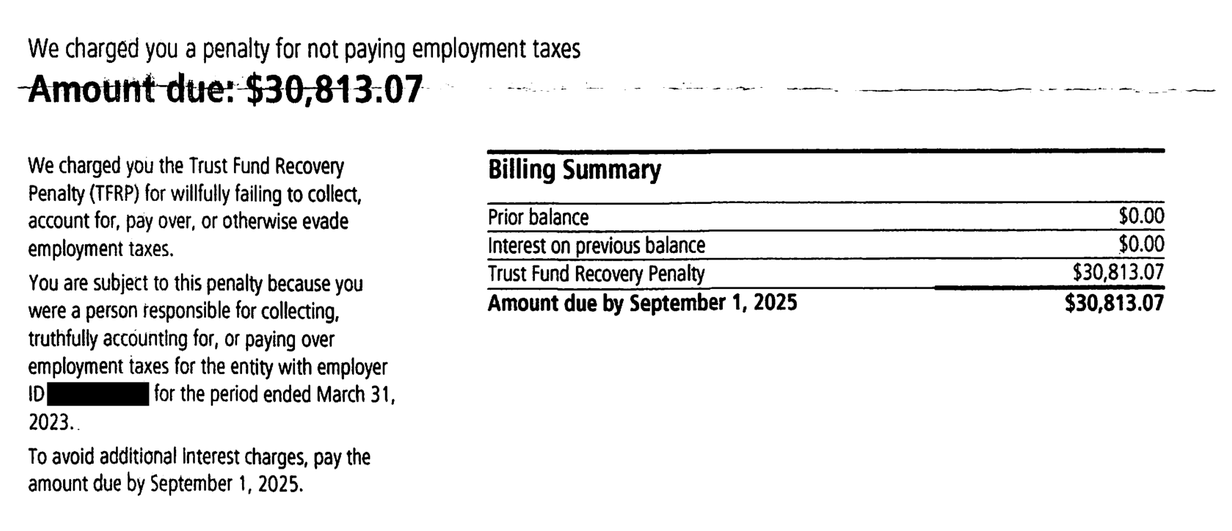
In this client’s notice, the IRS states: “We charged you the Trust Fund Recovery Penalty (TFRP) for willfully failing to collect, account for, pay over, or otherwise evade employment taxes. You are subject to this penalty because you were a person responsible for collecting, truthfully accounting for, or paying over employment taxes for the entity… for the period ended March 31, 2023.” The Billing Summary shows a Trust Fund Recovery Penalty of $30,813.07, with the full amount due by September 1, 2025.
Tip: A CP15B is tied to a specific business and a specific quarter (here, the period ended March 31, 2023 — the first quarter of 2023). If the business fell behind on payroll taxes for several quarters, you may receive more than one CP15B, or a penalty covering multiple quarters. Look at the “period ended” date on each notice so you know exactly which quarter is at issue.
Free Consultation
Got a CP15B notice? Get a straight answer before you respond.
Talk to a tax expert — free, no obligation. We’ve resolved over $20 million in IRS debt for our clients.
What Is the Trust Fund Recovery Penalty (and Why Did You Get CP15B)?
When a business pays employees, it’s required to withhold two things from their paychecks: federal income tax and the employee’s share of Social Security and Medicare taxes (FICA). That money doesn’t belong to the business — it’s held “in trust” for the federal government until it’s deposited. That’s why it’s called trust fund tax.
When a business withholds those taxes but doesn’t pay them over to the IRS — often because cash got tight and payroll taxes were used to keep the doors open — the IRS can’t always collect from the business itself (it may be out of money or out of business). So Congress gave the IRS a powerful tool under IRC Section 6672: it can collect the unpaid trust fund portion directly from the individuals responsible for it. That collection tool is the Trust Fund Recovery Penalty, and CP15B is how the IRS bills you for it. You can read our in-depth guide, Trust Fund Recovery Penalty Explained by a CPA, for a deeper dive.
Important: The TFRP only covers the trust fund portion of the payroll taxes — the withheld income tax and the employees’ half of Social Security and Medicare. It does not include the employer’s matching share of Social Security and Medicare, federal unemployment (FUTA) tax, penalties, or interest owed by the business. That’s an important distinction, because it means the CP15B amount is usually smaller than the business’s total payroll tax debt.
How CP15B Fits Into the TFRP Process
A CP15B rarely arrives out of the blue. Before the IRS assesses the penalty, a revenue officer usually investigates who was responsible, and the IRS sends Letter 1153 (with Form 2751) proposing the penalty. You then have 60 days to appeal. CP15B is what comes next — the notice that the penalty has now been formally assessed and is being collected. Here’s how the two notices differ:
| Letter 1153 (Proposed) | Notice CP15B (Assessed) | |
|---|---|---|
| What it means | The IRS proposes to charge you the TFRP. | The IRS has assessed the TFRP — this is the bill. |
| Your main deadline | 60 days to appeal within the IRS. | Pay, or file a claim for refund, by the notice’s due dates. |
| How to challenge it | Administrative appeal (IRS Office of Appeals). | Claim for refund on Form 843, then potentially a refund suit in court. |
| Is it collectible yet? | Not yet — still a proposal. | Yes — interest accrues and collection can begin. |
If the notice you received is a plain CP15 — the “Notice of Penalty Charge” the IRS uses for other civil penalties, like the $5,000 frivolous tax return penalty — see our full guide to IRS Notice CP15 instead.
If you never received or responded to Letter 1153, you may have missed the easiest window to contest the penalty administratively. That doesn’t mean you’re out of options, but it does make the steps below more important.
IRS Notice CP15B, Section by Section
Let’s walk through the rest of the notice so you understand exactly what the IRS is asking you to do.
1. “What You Need to Do Immediately” — Agree or Disagree
The heart of the notice gives you two paths: agree and pay, or disagree and dispute.
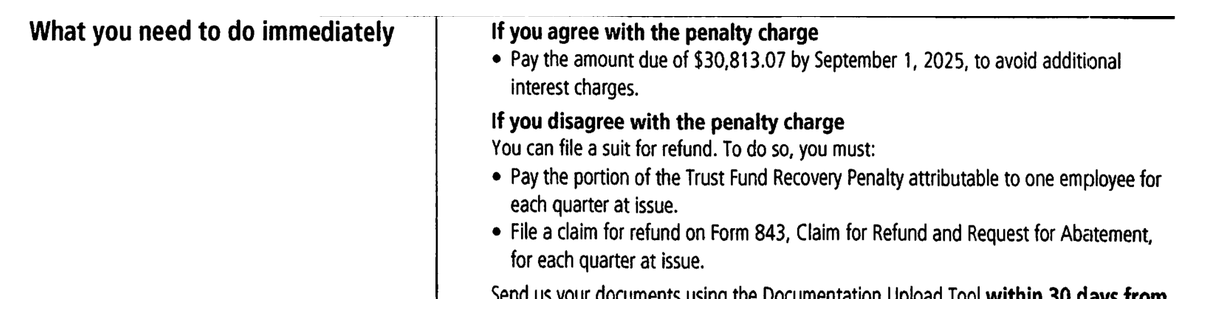
If you agree, the notice tells you to pay the amount due by the deadline (September 1, 2025, in the notice) to avoid additional interest charges.
If you disagree, the notice explains that you can file a suit for refund. To do that, it says you must: (1) pay the portion of the Trust Fund Recovery Penalty attributable to one employee for each quarter at issue, and (2) file a claim for refund on Form 843, Claim for Refund and Request for Abatement, for each quarter at issue.
Tip: That “one employee per quarter” rule is not a typo. The TFRP is what’s called a divisible tax, so you don’t have to pay the entire penalty before you can challenge it in court. You can pay just the tax attributable to a single employee for one quarter, file your refund claim, and—if the IRS denies it or six months pass—take the case to federal court. This is a meaningful, and often overlooked, advantage. Because the mechanics are strict, it’s worth talking to a tax professional before you pay anything or file Form 843.
2. How to Send Documents — and How to Suspend Collection
The notice tells you to send supporting documents through the IRS Documentation Upload Tool within 30 days of the notice date, using the QR code or by visiting IRS.gov/dutreply and entering the access code printed on your notice.
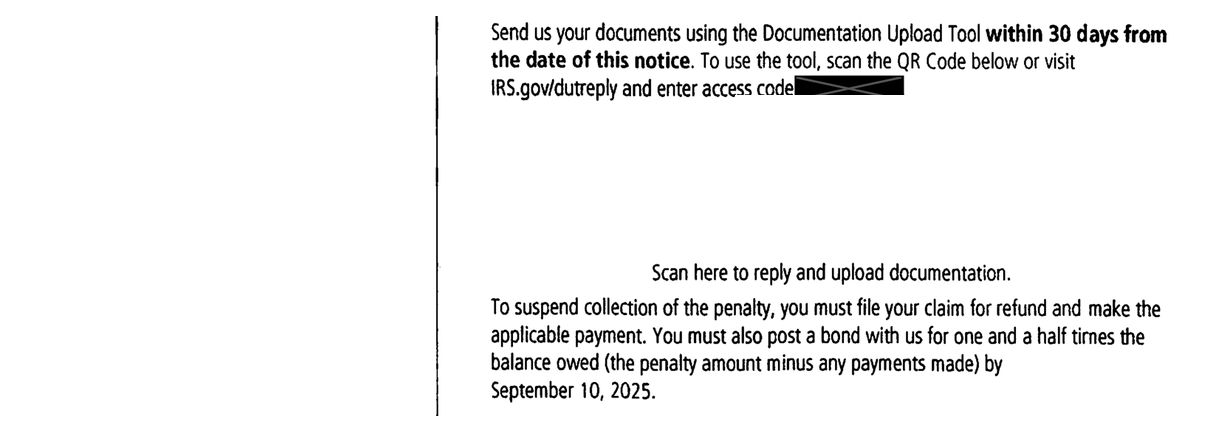
It also explains how to suspend collection while you dispute the penalty. To do that, you must file your claim for refund, make the applicable payment, and post a bond with the IRS for one and a half times the balance owed (the penalty minus any payments made) by the bond deadline — September 10, 2025, in the notice. Posting a 150% bond is a high bar, so many people focus instead on either resolving the balance or litigating without a bond and managing collection through other means.
3. Payment Options
The notice lists the ways you can pay and what to do if you can’t pay the full amount right now.
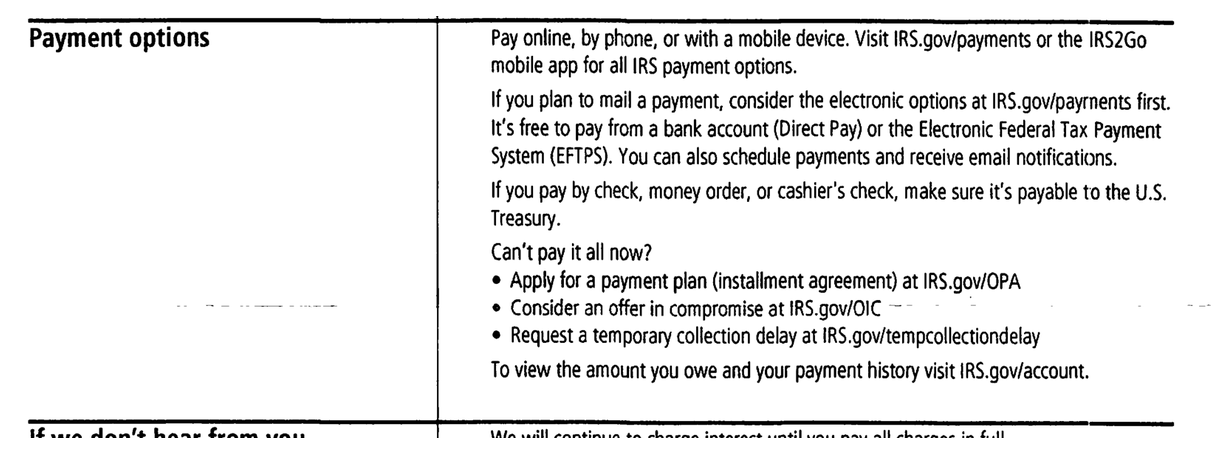
You can pay online, by phone, or with a mobile device at IRS.gov/payments or through the IRS2Go app. Paying directly from a bank account with Direct Pay or the Electronic Federal Tax Payment System (EFTPS) is free. If you pay by check, make it payable to the U.S. Treasury and write your identifying number, the tax year (2023), and the form number (CVL PEN) on it.
Can’t pay it all now? The notice points you to three relief options:
- A payment plan (installment agreement) at IRS.gov/OPA
- An offer in compromise at IRS.gov/OIC — potentially settling for less than the full amount
- A temporary collection delay at IRS.gov/tempcollectiondelay if you’re facing financial hardship
4. “If We Don’t Hear From You” and the IRS’s Authority
Finally, the notice makes clear the meter keeps running and cites the law behind the penalty.

Under “If we don’t hear from you,” the IRS states it will continue to charge interest until you pay all charges in full. And under “Our authority for charging this penalty,” it cites Internal Revenue Code (IRC) Section 6672 — the statute that authorizes the Trust Fund Recovery Penalty.
Who Can Be Held Responsible for the TFRP?
The IRS can assess the Trust Fund Recovery Penalty against anyone who was both a responsible person and acted willfully. Both parts have to be met:
- Responsible person: Someone who had the duty and the authority to collect, account for, or pay over the trust fund taxes. This can include owners, corporate officers, partners, LLC members, bookkeepers, controllers, check-signers, and even outside individuals with enough control over the finances. It’s about function and authority, not just job title.
- Willfulness: This does not require a bad motive or intent to defraud. It simply means you knew (or should have known) the taxes were unpaid and chose to pay other creditors — rent, suppliers, other employees — instead of the IRS. Using withheld payroll taxes to keep the business running is the classic example of willful conduct.
Important: The IRS can assess the full penalty against more than one responsible person at the same time — this is called joint and several liability. If you and a business partner are both assessed, each of you can receive a CP15B for the full trust fund amount. The IRS will only collect the underlying trust fund taxes once in total, but until it’s paid, each responsible person remains on the hook. If you believe someone else was truly responsible, that’s something to raise when you respond.
When Is IRS Notice CP15B Sent?
You’ll typically receive a CP15B after the IRS has:
- Determined that a business failed to pay its withheld payroll taxes,
- Investigated who was responsible (usually through a revenue officer interview and Form 4180),
- Proposed the penalty against you with Letter 1153 and Form 2751, and
- Either received no timely appeal, or finished the appeal process.
At that point, the penalty is assessed, and CP15B is the notice and demand for payment. From here, if you don’t respond, the IRS can move into active collection — including federal tax liens and levies against your personal assets, wages, and bank accounts.
Still have questions? Talk to a tax expert — free.
What To Do If You Receive IRS Notice CP15B
Here’s a practical, step-by-step approach:
- Confirm the details. Check the business, the tax period (“period ended” date), and the amount. Make sure the penalty is being charged for the right entity and the right quarter, and that the trust fund figure looks correct.
- Don’t ignore the deadlines. Note the payment due date, the 30-day document window, and the bond deadline. Interest is accruing, and missing these dates narrows your options.
- Decide whether you agree or disagree. If you don’t believe you were a responsible person, or you didn’t act willfully, you may have grounds to dispute the penalty using the divisible-tax refund procedure (pay one employee’s share for a quarter, file Form 843, then litigate if necessary).
- If you agree but can’t pay, choose a resolution. An installment agreement or other payroll tax debt relief option can make the balance manageable, and an offer in compromise may settle it for less if you qualify.
- Get professional help. The TFRP is one of the most technical areas of tax law, and the responsible-person and willfulness questions are fact-intensive. A CPA, enrolled agent, or tax attorney can evaluate your exposure and respond on your behalf.
Tip: Even if you can’t challenge whether you owe the penalty, you may still be able to reduce what you actually pay. Because the TFRP is a penalty, the usual first-time penalty abatement doesn’t apply, but resolution tools like installment agreements and offers in compromise can. Learn more in our guide to IRS penalty abatement and how relief is decided.
What Happens If You Ignore IRS Notice CP15B?
Ignoring a CP15B is risky. Because the penalty has already been assessed, the IRS can move directly into collection against you personally. Over time you can expect:
- Continued interest on the unpaid balance until it’s paid in full.
- A federal tax lien, which attaches to your property and can damage your credit and ability to borrow or sell assets.
- Levies on your bank accounts and garnishment of your wages.
- Loss of your dispute rights, since the refund-claim and bond deadlines on the notice won’t wait.
The good news: responding — even just to set up a payment plan or request more time — keeps you in control and preserves your options. The worst outcome almost always comes from doing nothing.
Frequently Asked Questions About IRS Notice CP15B
What is IRS Notice CP15B?
IRS Notice CP15B is the notice the IRS sends to bill an individual for the Trust Fund Recovery Penalty (TFRP) under IRC Section 6672. It means the IRS has assessed a penalty against you personally for a business’s unpaid trust fund payroll taxes — the income tax and employee share of Social Security and Medicare that were withheld from wages but never paid over to the IRS.
Why did I receive a CP15B if the taxes were owed by my business?
The Trust Fund Recovery Penalty lets the IRS collect the unpaid trust fund taxes directly from the individuals responsible for them, rather than only from the business. If the IRS determined you were a “responsible person” who “willfully” failed to pay those taxes over, it can assess the penalty against you personally — which is why a CP15B comes to you by name, not to the company.
How much is the Trust Fund Recovery Penalty on a CP15B?
The TFRP equals 100% of the unpaid trust fund taxes — the withheld income tax plus the employees’ share of Social Security and Medicare — which is why it’s nicknamed the “100% penalty.” It does not include the employer’s share of FICA, unemployment tax, or the business’s own penalties and interest. In this client’s notice, the penalty for a single quarter was $30,813.07, and interest continues to accrue until it’s paid.
Can I fight or appeal a CP15B?
Yes. Because the TFRP is a “divisible tax,” you can dispute it without paying the whole thing first: pay the portion attributable to one employee for one quarter, file a claim for refund on Form 843 for each quarter at issue, and—if the IRS denies the claim or six months pass—file a refund suit in federal court. If you received Letter 1153 earlier, you may also have had the chance to appeal administratively before the penalty was assessed. The procedures are strict, so it’s wise to work with a tax professional.
What happens if I ignore IRS Notice CP15B?
The penalty is already assessed, so ignoring the notice lets the IRS begin collection against you personally. That can mean continued interest, a federal tax lien, and levies against your wages, bank accounts, and other assets. You also risk losing your window to dispute the penalty. Responding — even to request a payment plan or more time — protects your options.
Can the Trust Fund Recovery Penalty be reduced or settled?
If you can’t pay the full amount, you may qualify for an installment agreement (IRS.gov/OPA), an offer in compromise (IRS.gov/OIC) that settles the debt for less than you owe, or a temporary collection delay if you’re in financial hardship. Whether an offer in compromise is a fit depends on your specific finances, so it’s worth having a tax professional evaluate your situation before you apply.
IRS Notice CP15B and the Trust Fund Recovery Penalty involve complex tax and legal rules, and this article is general information, not legal or tax advice for your specific situation. If you’ve received a CP15B, consider speaking with a licensed tax professional who can review the facts of your case.

“Choice Tax Relief is a lifesaver. Lulu handled my case and did a fantastic job. I owed almost $200,000 of IRS debt and she was able to negotiate an installment agreement that reduced it down to $48,600 over 10 years. I almost couldn’t believe it. Can’t recommend this company enough. Thank you Lulu!”
Get Help Now
Got a CP15B notice? Get a straight answer before you respond.
Talk to a tax expert — free, no obligation. We’ve resolved over $20 million in IRS debt for our clients.


Author:

Logan Allec, CPA, Founder and Owner
Logan Allec has been serving taxpayers as a CPA for over 14 years. After leaving his role at a "Big 4" firm, he started Choice Tax Relief to help everyday Americans who have found themselves behind on their taxes. He also educates thousands of people daily about tax relief on his YouTube channel. In addition to his CPA license, Logan also has a Master's Degree in Taxation from the University of Southern California (USC). He lives with his wife and children in the Los Angeles area. Learn more about Logan here.