

IRS Notice CP15: What It Is and How to Respond

If you’ve received IRS Notice CP15, the IRS is telling you that it has charged you a civil penalty — and that it expects you to pay it.
The IRS calls CP15 the “Notice of Penalty Charge,” and it uses this notice to bill penalties it can assess directly, without an audit or a trip to Tax Court first.
In this client’s notice below, that penalty is $5,000 for filing a “frivolous tax return” under Internal Revenue Code (IRC) Section 6702(a) — one of the most common reasons individuals receive a CP15.
In this article, a CPA walks you through exactly what IRS Notice CP15 means, section by section, and — most importantly — what your options are for responding.
See a redacted IRS Notice CP15 that one of our clients received (PDF) so you can follow along with each section as we break it down.
Important: This client’s notice in this article is a copy the IRS mailed to our office because we are the taxpayer’s authorized representative — that’s why our firm’s name and address appear in the address block. Choice Tax Relief did not prepare the tax return that triggered this penalty. The taxpayer engaged us after receiving the penalty to help resolve it.
Key Takeaways
- CP15 is a bill for a civil penalty the IRS has already assessed — in this client’s notice, a $5,000 frivolous tax return penalty under IRC Section 6702(a) for tax year 2023.
- The frivolous return penalty is $5,000 per return, per person — spouses who filed a joint frivolous return can each be charged $5,000, and every additional frivolous filing can trigger a new penalty.
- The payment window is short. The notice asks for payment within 21 calendar days of the notice date — 10 business days if the amount due is over $100,000 — before additional interest is charged.
- You generally can’t fight this penalty in Tax Court first. To contest it, you must pay the penalty in full and file a claim for refund, then sue in federal court if the IRS denies your claim.
- There’s a one-time way to shrink it. Under IRC Section 6702(d), the IRS can reduce unpaid frivolous return penalties to $500 if you withdraw the frivolous position and get compliant — requested on Form 14402.
- Not all CP15s are the same. The IRS also uses CP15 to assess other civil penalties — such as penalties for late-filed foreign information returns like Form 3520 — and your response options depend on which penalty appears on your notice.
Table of Contents
What Is IRS Notice CP15?
IRS Notice CP15, titled “Notice of Penalty Charge,” is the notice the IRS sends to tell an individual it has assessed a civil penalty against them.
Unlike a tax bill that follows an audit, the penalties billed on a CP15 are “assessable penalties” — the IRS can charge them immediately, without first sending you an examination report or giving you a chance to petition the U.S. Tax Court.
The most common penalties that show up on a CP15 include:
- The frivolous tax return penalty under IRC Section 6702 — $5,000 for filing a return or other submission that takes a position the IRS has identified as frivolous or that reflects a desire to delay or impede tax administration.
- Penalties for late or incomplete international information returns — for example, Form 3520 for foreign gifts, inheritances, and trusts — which can easily run into five or six figures.
- Other miscellaneous civil penalties that the IRS can assess without going through deficiency procedures.
Your CP15 tells you which penalty you’re dealing with in the explanation section below the billing summary — on this client’s notice, that section is headed “666 – civil penalty for frivolous tax returns” and cites IRC Section 6702(a).
This article focuses on the frivolous return penalty, since that’s what this client’s notice CP15 assesses — but the anatomy of the notice is the same no matter which penalty you’ve been charged.
Tip: If your CP15 is for a late-filed Form 3520 or another international information return, don’t assume the pay-first rules for the frivolous return penalty apply to you — international information return penalties can often be contested through a reasonable-cause statement or an administrative appeal, so read the explanation section of your notice carefully before deciding on a strategy.
Free Consultation
Got a CP15 notice? Get a straight answer before you respond.
Talk to a tax expert — free, no obligation. We’ve resolved over $20 million in IRS debt for our clients.
CP15 vs. CP15B: Two Different Penalty Notices
The IRS also sends a similarly numbered notice — CP15B — and the two are easy to confuse.
Both are “Notice of Penalty Charge” bills, but they cover very different penalties:
| Notice CP15 | Notice CP15B | |
|---|---|---|
| What it bills | An assessable civil penalty — most commonly the $5,000 frivolous tax return penalty under IRC Section 6702. | The Trust Fund Recovery Penalty under IRC Section 6672 for a business’s unpaid payroll taxes. |
| Who gets it | An individual who filed a frivolous return or owes another directly assessable civil penalty. | A “responsible person” at a business — an owner, officer, bookkeeper, or check-signer. |
| Typical amount | $5,000 per frivolous return, per person. | 100% of the business’s unpaid trust fund payroll taxes — often tens of thousands of dollars. |
| How to contest | Generally pay in full, then file a claim for refund and sue in federal court if the claim is denied. | Pay a divisible portion per quarter, file Form 843 refund claims, and sue if denied. |
If your notice says CP15B — or mentions trust fund taxes or IRC Section 6672 — head over to our full guide to IRS Notice CP15B instead.
Why You Got a CP15: The Frivolous Tax Return Penalty (IRC Section 6702)
Congress created the frivolous return penalty to deter filings built on arguments the courts have rejected time and time again.
Under IRC Section 6702(a), the penalty applies when you file something that purports to be a tax return but suffers from one of two defects:
- It doesn’t contain enough information for the IRS to judge whether the self-assessed tax is substantially correct, or
- It contains information that on its face indicates the self-assessed tax is substantially incorrect.
In addition, one of two things must be true about the conduct behind the filing:
- The position taken is one the IRS has formally identified as frivolous, or
- The filing reflects a desire to delay or impede the administration of federal tax laws.
The IRS publishes its official list of frivolous positions in Notice 2010-33, which catalogs dozens of arguments that have never once succeeded in court.
Common examples include claims that wages aren’t taxable income, that filing a return is “voluntary,” that only federal employees owe income tax, and “zero returns” that report nothing but zeros despite W-2 or 1099 income.
Interestingly, the text of the CP15 — including the 2026 notice this client received — still cites Notice 2007-30, an earlier version of the frivolous positions list that Notice 2010-33 superseded.
The penalty is $5,000 for each frivolous return — and it’s charged per person, so both spouses on a joint frivolous return can each receive their own $5,000 penalty.
It also isn’t limited to tax returns — under IRC Section 6702(b), the IRS can charge the same $5,000 for “specified frivolous submissions,” including frivolous collection due process hearing requests, installment agreement applications, and offer in compromise applications.
Important: Responding to a frivolous return penalty with more frivolous paperwork is the fastest way to turn $5,000 into $10,000 or $15,000 — each new frivolous submission can generate its own penalty, and the IRS doesn’t have to warn you before charging it.
The Internal Revenue Manual and Letter 3176C — Your Warning Shot
The IRS’s internal playbook for these penalties is the Frivolous Return Program section of the Internal Revenue Manual, IRM 25.25.10.
Under those procedures, potentially frivolous filings are screened by the IRS’s Frivolous Return Program unit, which generally first sends Letter 3176C — a warning letter giving you 30 days to withdraw the filing or file a corrected return before the $5,000 penalty is assessed.
A companion section of the manual, IRM 5.20.10, instructs IRS collection employees on identifying and routing frivolous documents they encounter in the field.
If you’re holding a CP15, that warning window has usually come and gone — the penalty is now on the books, and your remaining options are the ones described below.
IRS Notice CP15, Section by Section
Now let’s walk through this client’s notice from top to bottom so you can see exactly what each section means.
1. The Notice Header
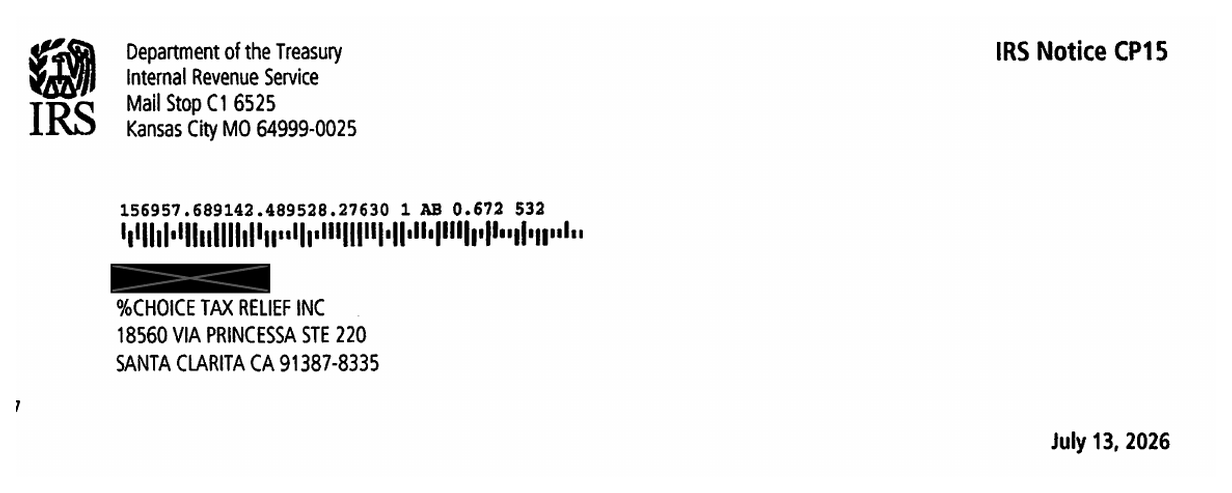
The first thing to check is the header block, which identifies the notice type (CP15), the notice date (July 13, 2026, on this client’s notice), and the IRS campus that sent it — here, Kansas City.
The footer of each page confirms the tax year at issue — 2023 on this client’s notice.
You’ll notice this client’s notice is addressed in care of our firm — the IRS mails a courtesy copy of notices like this one to the taxpayer’s authorized representative under a power of attorney, which is how a CPA firm ends up with a redacted CP15 to share.
And to repeat what we said above: Choice Tax Relief did not prepare the return this penalty relates to — the taxpayer hired us after the penalty was assessed to help deal with it.
2. “Amount Due” and What the IRS Wants You to Do
Next comes the headline number — “Amount due: $5,000.00” — followed by a one-line explanation that the IRS charged a civil penalty under IRC Section 6702(a) for a frivolous tax return for 2023.
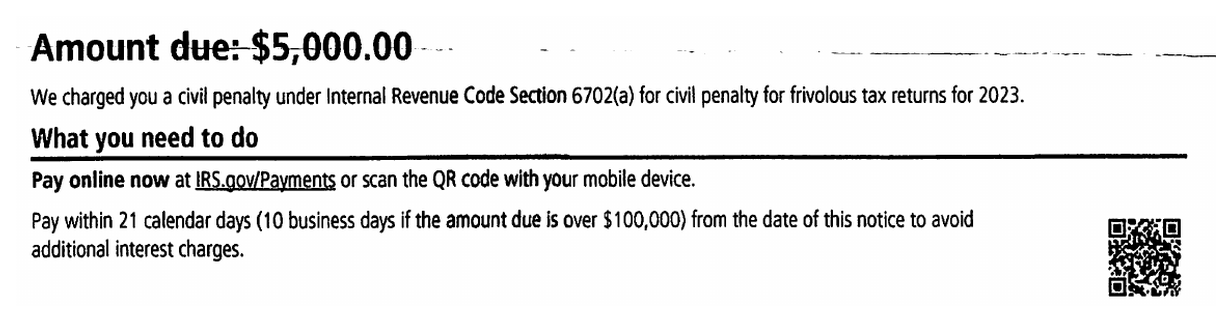
The “What you need to do” section asks you to pay online at IRS.gov/Payments or by scanning the QR code with your phone.
It also sets the deadline: pay within 21 calendar days of the notice date — or within 10 business days if the amount due is over $100,000 — to avoid additional interest charges.
On this client’s notice, that works out to a due date of August 3, 2026, which appears on the payment stub at the end of the notice.
3. The Billing Summary
The summary table shows how the balance is built — and on a CP15, it’s usually short.

Here there’s a single line item — a $5,000 penalty assessment — which is also the entire amount due.
Note what’s not on the bill: there’s no underlying tax and, at least for now, no interest — though interest will begin to accrue if the penalty isn’t paid by the due date.
4. “666 – Civil Penalty for Frivolous Tax Returns”
The heart of the notice is the explanation section, headed with the IRS’s penalty reference number — 666 — and the words “civil penalty for frivolous tax returns.”
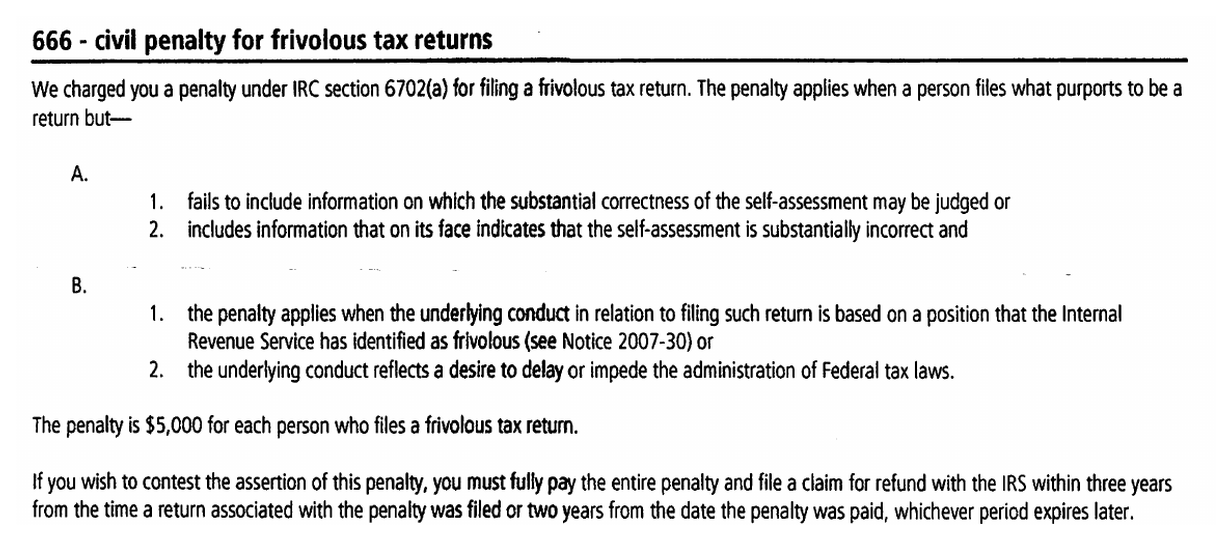
This section restates the two-part legal test from IRC Section 6702(a) that we covered above — a purported return that’s missing key information or facially incorrect, combined with a frivolous position or an intent to delay.
It confirms that the penalty is $5,000 “for each person who files a frivolous tax return.”
And it lays out the unusual rules for contesting the penalty, which deserve their own section.
5. How to Contest the Penalty: Pay First, Then Fight
The most important paragraph on the entire notice sits at the bottom of page 1.
To contest a frivolous return penalty, you must fully pay the entire penalty and file a claim for refund with the IRS — within three years from when the return associated with the penalty was filed, or two years from the date you paid the penalty, whichever period expires later.
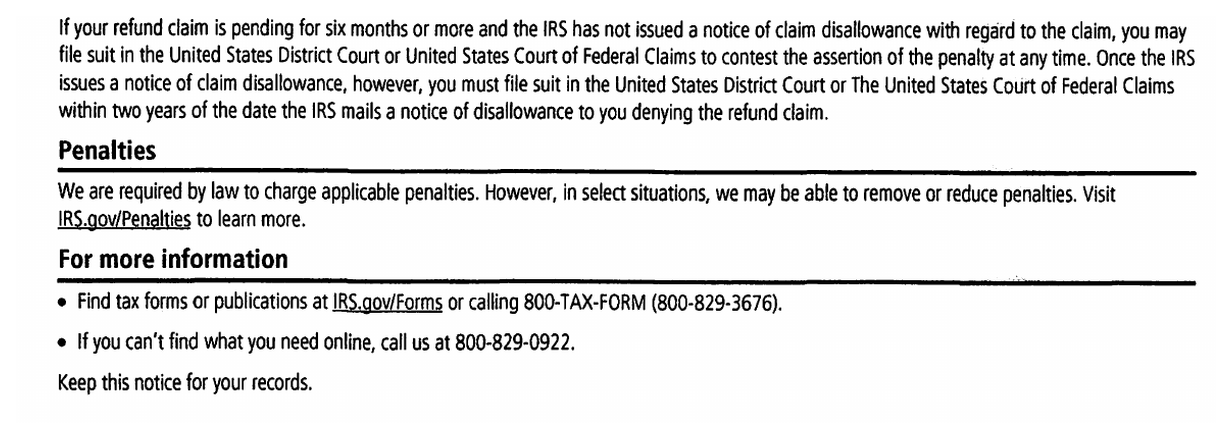
Page 2 continues the roadmap: if your refund claim has been pending for six months or more with no decision, you can file suit in U.S. District Court or the U.S. Court of Federal Claims at any time.
And once the IRS issues a notice of claim disallowance, a clock starts — you have two years from the date the IRS mails the disallowance to file suit.
Why can’t you just petition the Tax Court the way you could after an audit?
Because assessable penalties like this one aren’t subject to deficiency procedures — there’s no “90-day letter” and no prepayment Tax Court option, which is exactly why the notice jumps straight to refund-claim procedures.
The “Penalties” section on page 2 offers one ray of hope — the IRS acknowledges that “in select situations” it may be able to remove or reduce penalties, and it points to IRS.gov/Penalties.
The “For more information” section lists the contact number for this notice — 800-829-0922.
6. The Payment Stub
The notice ends with a detachable payment stub confirming the notice type, the notice date, and the payment due date — August 3, 2026, on this client’s notice.
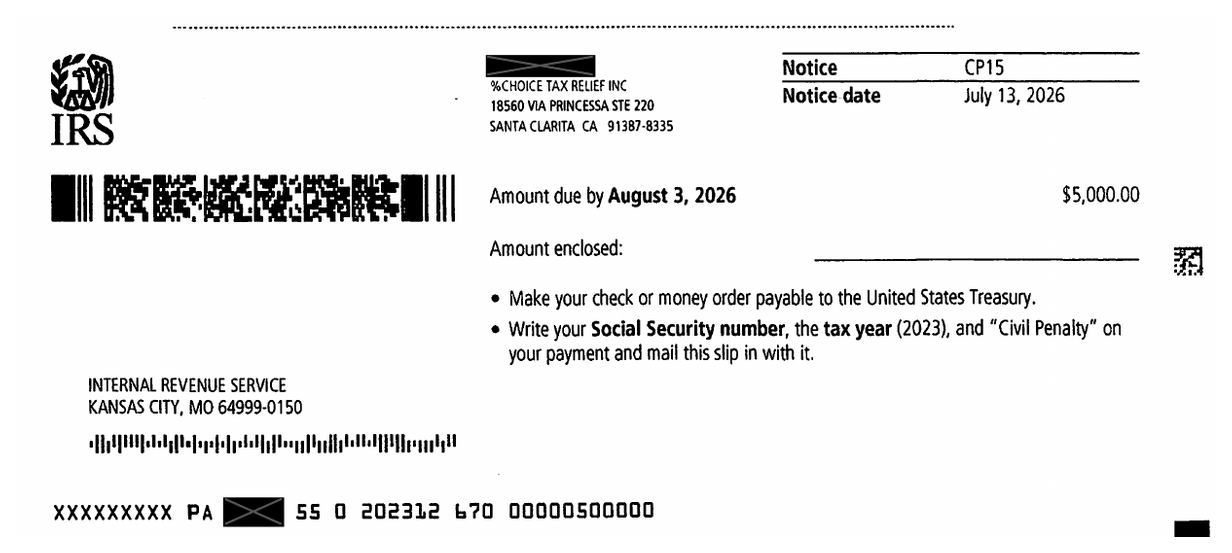
If you pay by mail, the stub instructs you to:
- Make your check or money order payable to the United States Treasury.
- Write your Social Security number, the tax year (2023 here), and “Civil Penalty” on the payment.
- Mail the payment and the stub to the IRS’s Kansas City address.
Can You Get a CP15 Frivolous Return Penalty Removed or Reduced?
Here’s the hard truth: the frivolous return penalty is one of the most difficult IRS penalties to make go away.
There is no reasonable-cause exception for IRC Section 6702 penalties — unlike late-filing or late-payment penalties, you can’t get this one removed by showing you had a good excuse.
First-time penalty abatement doesn’t apply to it either.
That said, you do have real options:
- A one-time reduction to $500. Under IRC Section 6702(d) and Revenue Procedure 2012-43, the IRS will reduce all of your unpaid Section 6702 penalties to a single $500 payment if you formally withdraw the frivolous position, have filed valid returns for all required years, and are current on your other tax obligations or in a payment arrangement for them — you request it on Form 14402.
- Pay and claim a refund. If you believe the penalty was wrongly assessed — because the return wasn’t actually frivolous — you can pay the $5,000 in full, file a claim for refund (typically on Form 843), and take the government to court if the claim is denied.
- Resolve the balance. If the penalty is going to stick and you can’t pay it all at once, the usual collection alternatives apply — a payment plan, an offer in compromise, or currently-not-collectible status.
Our IRS penalty abatement team can tell you quickly which of these paths — if any — fits your situation.
Tip: The Form 14402 reduction is a one-shot deal — the IRS will grant it only once per person, and only while the penalty remains unpaid — so before you apply, make sure every open filing requirement is satisfied with a legitimate, accurate return.
When Is IRS Notice CP15 Sent?
A CP15 for a frivolous return typically arrives months — sometimes years — after the filing that triggered it.
Under the procedures in IRM 25.25.10, the sequence usually looks like this:
- You file a return or other document taking a position on the IRS’s frivolous list, or one designed to delay or impede collection.
- The filing is flagged and routed to the IRS’s Frivolous Return Program unit for screening.
- The IRS sends Letter 3176C, giving you 30 days to withdraw the filing or correct it.
- If you don’t, the IRS assesses the $5,000 penalty — and CP15 is the bill that follows.
This client’s notice is dated July 13, 2026, and assesses the penalty for a 2023 return — a reminder of just how long these cases can take to surface.
Still have questions? Talk to a tax expert — free.
What To Do If You Receive IRS Notice CP15
Here’s the game plan we recommend.
Step 1: Identify exactly which penalty you’ve been charged.
Read the explanation section of your notice, note the IRC section it cites, and confirm the tax year — everything about your strategy flows from which penalty this is.
Step 2: Don’t fire back a protest letter.
If the penalty is for a frivolous filing, responding with the same arguments — or with a frivolous hearing request — can generate additional $5,000 penalties.
Step 3: Pick your track.
Depending on your facts, that means withdrawing the frivolous position and requesting the one-time Form 14402 reduction to $500, paying in full and filing a refund claim if you genuinely dispute the penalty, or arranging a payment solution if the penalty will stand.
Step 4: Mind the deadlines.
Pay within 21 calendar days of the notice date to stop additional interest, track the three-year/two-year refund-claim window if you plan to contest, and remember the two-year deadline to sue after a claim disallowance — you can monitor your balance at IRS.gov/account.
Step 5: Get a professional in your corner.
A licensed tax professional can tell you whether the penalty was properly assessed, whether you qualify for the Section 6702(d) reduction, and how to keep a $5,000 problem from becoming a $15,000 one.
What Happens If You Ignore IRS Notice CP15?
Ignoring a CP15 doesn’t make it go away — it starts the IRS collection machine.
Interest begins accruing on the unpaid penalty after the payment deadline on the notice.
The IRS will follow up with escalating balance-due notices — the same collection stream that follows any unpaid IRS bill, including Notice CP503 and eventually Notice CP504, the IRS’s notice of intent to levy.
From there, the IRS can file a federal tax lien, levy your bank accounts or wages, and offset any future tax refunds against the penalty.
And remember — answering the collection notices with more frivolous paperwork only stacks new $5,000 penalties on top of the first one.
Frequently Asked Questions About IRS Notice CP15
What is IRS Notice CP15?
IRS Notice CP15, the “Notice of Penalty Charge,” is the notice the IRS sends to bill an individual for a civil penalty it has assessed directly — without an audit or Tax Court proceeding first. Common examples include the $5,000 frivolous tax return penalty under IRC Section 6702(a) and penalties for late-filed international information returns such as Form 3520. The explanation section of your notice identifies the specific penalty you’ve been charged.
Why did the IRS charge me a $5,000 frivolous return penalty?
Under IRC Section 6702(a), the IRS charges $5,000 when someone files what purports to be a tax return that either omits the information needed to judge the reported tax or shows on its face that the reported tax is substantially incorrect — and the filing either takes a position on the IRS’s official frivolous positions list (Notice 2010-33) or reflects a desire to delay or impede tax administration. The penalty applies per return and per person, so each spouse on a joint frivolous return can be charged separately.
Can I appeal a CP15 frivolous return penalty to the U.S. Tax Court?
Generally, no — the frivolous return penalty is an assessable penalty that isn’t subject to deficiency procedures, so there’s no prepayment Tax Court option. To contest it, you must pay the penalty in full and file a claim for refund within three years of when the associated return was filed or two years from when you paid the penalty, whichever is later. If the IRS denies the claim — or sits on it for six months — you can sue in U.S. District Court or the U.S. Court of Federal Claims.
Can the frivolous return penalty be removed or reduced?
There’s no reasonable-cause exception and no first-time abatement for IRC Section 6702 penalties. However, under IRC Section 6702(d) and Revenue Procedure 2012-43, the IRS will reduce unpaid frivolous return penalties to a one-time $500 payment if you withdraw the frivolous position, file valid returns for all required years, and stay current on your other tax obligations. The request is made on Form 14402, and the IRS will only grant it once.
What if I can’t pay the $5,000 penalty?
Interest will accrue on the unpaid balance, and the IRS will pursue it like any other tax debt — with collection notices, refund offsets, and eventually liens or levies. If the penalty is valid but unaffordable, you can set up an installment agreement, apply for an offer in compromise, or request currently-not-collectible status if paying would create a hardship. A tax professional can help you pick the option that fits your finances.
What’s the difference between IRS Notice CP15 and CP15B?
Both are “Notice of Penalty Charge” bills, but they cover different penalties. CP15 bills an individual for an assessable civil penalty such as the $5,000 frivolous tax return penalty under IRC Section 6702. CP15B bills a “responsible person” for the Trust Fund Recovery Penalty under IRC Section 6672 — a personal penalty equal to 100% of a business’s unpaid trust fund payroll taxes.

“I was initially skeptical reaching-out to any company that provided back-tax relief assistance, but Choice Tax gave me confidence in their abilities from the first call we had. They were very empathetic to my personal reasons of being behind… I am thrilled to say this cloud over my head has finally been rectified and I’m so thankful to the entire team.”
Get Help Now
Got a CP15 notice? Get a straight answer before you respond.
Talk to a tax expert — free, no obligation. We’ve resolved over $20 million in IRS debt for our clients.


Author:

Logan Allec, CPA, Founder and Owner
Logan Allec has been serving taxpayers as a CPA for over 14 years. After leaving his role at a "Big 4" firm, he started Choice Tax Relief to help everyday Americans who have found themselves behind on their taxes. He also educates thousands of people daily about tax relief on his YouTube channel. In addition to his CPA license, Logan also has a Master's Degree in Taxation from the University of Southern California (USC). He lives with his wife and children in the Los Angeles area. Learn more about Logan here.