

IRS Notice CP39: Why The IRS Won’t Give You Your Refund

IRS Notice CP39 tells you that the IRS used a tax refund from you, your spouse or a former spouse to pay down a past-due tax balance, which is why the refund never arrived.
In this article I walk through a real CP39 that one of our clients received, part by part, using the figures printed on it.
That notice is dated December 2, 2024, and it shows an $8,170.00 overpayment from tax year 2022 applied to a 2015 balance, with $22,832.13 still owed.
It came to our office because we hold a power of attorney for this client.
I also cover what the notice leaves out, including whose refund was used and how long the IRS can keep collecting on a balance this old.
Here is a redacted CP39 notice that one of our clients received (PDF).
Key Takeaways
- A CP39 means the IRS applied a refund from you, your spouse or a former spouse to a past-due tax balance, and you may still owe money.
- Our client’s notice shows $31,002.13 owed for 2015, less $8,170.00 applied from 2022, leaving $22,832.13 due by December 23, 2024.
- Section 6402(a) of the Internal Revenue Code lets the IRS credit an overpayment against a federal tax debt without asking you first.
- A spouse whose share of a joint refund paid the other spouse’s separate debt can ask for it back on Form 8379.
- The IRS generally has 10 years from the assessment date to collect, so on an old balance I check the account transcript before agreeing to anything long term.
Table of Contents
What Is IRS Notice CP39?
The IRS’s own Understanding your CP39 notice page describes it in one line: “We used a refund from you, your spouse, or a former spouse to pay your past due tax.”
The next line is shorter still: “You might still owe money.”
The Internal Revenue Manual is more specific, titling the notice “Overpaid Taxes Applied to Your Balance Due from a Secondary Social Security Number (SSN)”, and an IRS glossary equates a secondary Social Security number with a spouse’s number.
Put plainly, a CP39 goes to the person with the unpaid balance and reports that a credit from another year’s return, possibly a joint return, has been posted against it.
It is not a new tax assessment, because the only transaction our client’s notice reports is a credit of $8,170.00.
It is not a Treasury Offset Program notice either, since the Form 8379 instructions say that “A Notice of Offset for federal tax debts is issued by the IRS.”
And it is not a levy notice, since the notice the IRS calls its Notice of Intent to Levy is the CP504.
Free Consultation
Got a CP39 notice? Get a straight answer before you respond.
Talk to a tax expert — free, no obligation. We’ve resolved over $20 million in IRS debt for our clients.
IRS Notice CP39 at a Glance
| Detail | What It Means |
|---|---|
| Notice type | CP39, a notice that a refund was applied to a past-due federal tax balance |
| Who sends it | The IRS, not the Treasury Offset Program |
| Legal authority | Internal Revenue Code section 6402(a) |
| Our client’s notice date | December 2, 2024 |
| Balance year | Tax year 2015, Form 1040, with $31,002.13 owed before the credit |
| Overpayment applied | $8,170.00 from tax year 2022 |
| Amount still due | $22,832.13 by December 23, 2024, which is 21 days after the notice date |
| If you cannot pay | The notice lists a payment plan, an offer in compromise and a temporary delay in collection |
| If you disagree | IRS.gov says to write or call using the contact information on the notice |
Why Did the IRS Send You a CP39 Notice?
Three facts on our client’s notice explain why it was sent.
- There was an unpaid balance on the account: $31,002.13 for tax year 2015.
- An overpayment of $8,170.00 from a different tax year, 2022, was applied to that balance.
- The credit did not pay the balance off, so $22,832.13 was still owed.
The Internal Revenue Manual’s priority list for refund offsets explains why a spouse comes into it: after federal tax owed under the primary taxpayer identification number, it lists “Federal Tax (Secondary TIN)” as a separate category.
In other words, an overpayment on a joint return can be applied to a federal tax balance under either spouse’s number before anything is refunded.
What our client’s notice never says is whose return the 2022 overpayment came from: it calls the credit “your overpayment” and says only that a balance was owed “by you, your spouse or a former spouse” on another tax year.
A Part-by-Part Walkthrough of IRS Notice CP39
Our client’s CP39 is two pages long, and I have split it into the four parts shown below.
Part 1: The Headline and Balance Summary
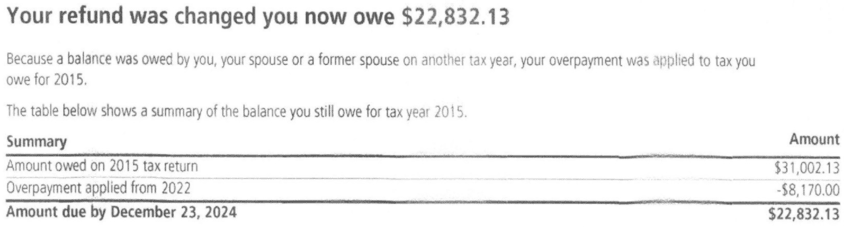
The headline says “Your refund was changed you now owe $22,832.13” and the rest of the page explains how the IRS got to that number.
The explanation is a single sentence: “Because a balance was owed by you, your spouse or a former spouse on another tax year, your overpayment was applied to tax you owe for 2015.”
The notice then introduces its figures with “The table below shows a summary of the balance you still owe for tax year 2015.”
- Amount owed on 2015 tax return: $31,002.13
- Overpayment applied from 2022: -$8,170.00
- Amount due by December 23, 2024: $22,832.13
The arithmetic works: $31,002.13 minus $8,170.00 is $22,832.13, so the summary reconciles to the penny.
The credit covered a little more than a quarter of what was owed, about 26% of the $31,002.13.
What the summary does not do is break the $31,002.13 into tax, penalties and interest, which is why I want the 2015 account transcript in front of me before I accept that number for a client.
Part 2: What You Need to Do
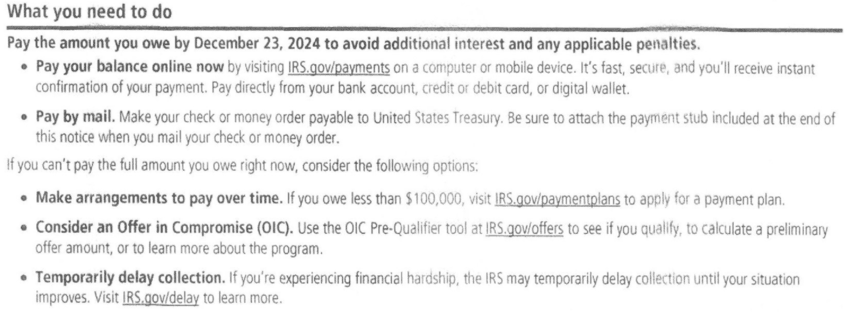
The second part opens with one instruction in bold: “Pay the amount you owe by December 23, 2024 to avoid additional interest and any applicable penalties.”
December 23, 2024 is exactly 21 days after the notice date, and IRS.gov says that if you pay the amount shown on a notice in full by its pay-by date, you will not be charged interest on that amount.
After that date the figure goes stale, since IRS interest accrues daily on any unpaid amount, including on penalties and on interest already charged.
The IRS underpayment rate was 8% a year in the last quarter of 2024, which works out to roughly $5 a day on $22,832.13, and the rate for the quarter that began October 1, 2026 is 7%.
For anyone who cannot pay in full, the notice lists three options.
- A payment plan: “If you owe less than $100,000, visit IRS.gov/paymentplans to apply for a payment plan.”
- An offer in compromise, with a pointer to the OIC Pre-Qualifier tool at IRS.gov/offers.
- A temporary delay in collection for financial hardship, with details at IRS.gov/delay.
Our client’s $22,832.13 is well under that $100,000 figure, and I cover the IRS’s online limits for an installment agreement in the steps below.
Part 3: Where to Find More Information
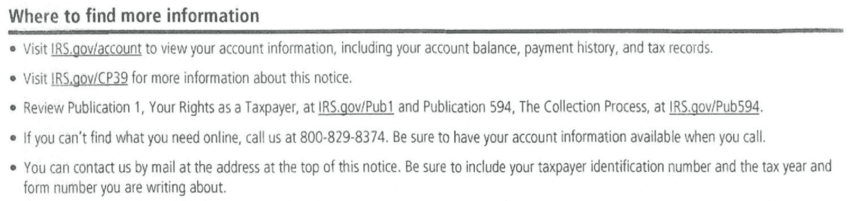
The third part lists where to look things up: IRS.gov/account for your balance, payment history and tax records, IRS.gov/CP39 for more about the notice, and Publication 1 and Publication 594 for your rights and the collection process.
It also gives a phone number: “If you can’t find what you need online, call us at 800-829-8374.”
We have a separate page about the IRS phone number 800-829-8374 that appears on this notice.
I start with the online account, because IRS.gov says it shows balances owed by tax year, so you can find out what you owe the IRS for every year and not only the one on the notice.
There is one limit on an old year: IRS.gov says account transcripts are generally available online for the current tax year and nine prior years, and that older years can be requested with Form 4506-T.
Part 4: The Payment Coupon
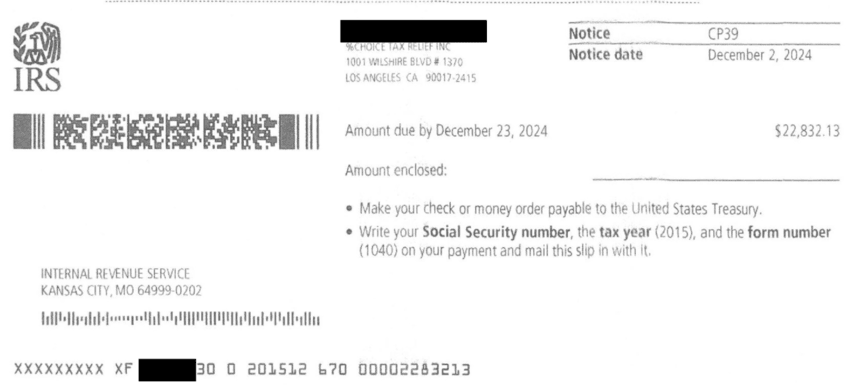
The last part is the payment coupon, which repeats the notice date of December 2, 2024 and the line “Amount due by December 23, 2024: $22,832.13” in one place.
On our copy the coupon is addressed to the client’s blacked-out name followed by “%CHOICE TAX RELIEF INC” and what was then our Los Angeles office address, because we hold a power of attorney for this client.
The payment instructions are specific: “Write your Social Security number, the tax year (2015), and the form number (1040) on your payment and mail this slip in with it.”
The row of numbers along the bottom ends “30 0 201512 670 00002283213”, and the pieces I can check tie back to the notice.
In the IRS’s published code tables, 30 is the tax code listed for Form 1040, 201512 fits the six-digit format for a tax period ending in December 2015, 670 is the transaction code labeled “Subsequent Payment”, and 00002283213 is $22,832.13 without the decimal point.
I have not found an IRS document that maps this line field by field, so treat that as my reading of the codes.
Tip: Whether you pay by mail or online, tie the payment to the tax year printed on your notice, which is 2015 here, so it is credited to the balance you mean to pay.
How the IRS Can Take a Refund for a Different Year
The authority is section 6402(a) of the Internal Revenue Code, which says the IRS “may credit the amount of such overpayment” against a tax liability of “the person who made the overpayment” and refund only the balance.
Nothing in that section asks for your consent, and our client’s notice speaks in the past tense, saying the overpayment “was applied” to the 2015 tax.
Federal tax debts are first in line, because the Internal Revenue Manual says “A tax overpayment must offset to an outstanding Federal tax debt before it offsets against other debts or is applied to a credit elect.”
Only then does the Treasury Offset Program get its turn for debts such as past-due child support, federal agency debts and state income tax.
It is also not a one-time event, because IRS.gov says of payment plans that “Your future refunds will be applied to your tax debt until it is paid in full.”
Tip: If you are facing economic hardship and expect a refund next year, the Taxpayer Advocate Service explains that an offset bypass refund must be requested before the offset occurs and applies only to federal tax debts.
When the Refund Belonged Partly to Your Spouse
Our client’s notice does not mention injured spouse relief or innocent spouse relief, even though its own wording brings a spouse or former spouse into the picture.
Form 8379, Injured Spouse Allocation, is about the refund: its instructions say it “is filed by one spouse (the injured spouse) on a jointly filed tax return when the joint overpayment was (or is expected to be) applied (offset) to a past-due obligation of the other spouse.”
So if you are the one who owes the old balance and the refund came from a joint return, Form 8379 is your spouse’s form to file, not yours, a situation we cover in our article on what happens when one spouse owes taxes and the other does not.
The instructions set a deadline of “within 3 years from the due date of the original return (including extensions) or within 2 years from the date you paid the tax that was later offset, whichever is later.”
In the nine community property states they list, which include California and Texas, the instructions warn that “state laws differ on the amount of a joint overpayment that can be applied to a federal tax debt.”
Form 8857, Request for Innocent Spouse Relief, is about the debt itself.
The Form 8857 instructions explain that when you file a joint return “the law makes both you and your spouse responsible for the entire tax liability”, and the form asks the IRS to hold only your spouse or former spouse responsible for all or part of it.
That is the form to look at if the old balance came from a joint return with a former spouse and you believe the debt should be theirs, which we discuss in our article on divorce and taxes owed.
Its instructions say “you must generally file Form 8857 no later than 2 years after the first IRS attempt to collect the tax from you”, with an exception for equitable relief, and they add that “By law, the IRS must contact your spouse or former spouse.”
Important: The Form 8379 instructions say not to file that form if you are claiming innocent spouse relief, so decide first whether your problem is the refund or the debt.
A 2015 Balance in 2024: Check the Collection Clock
The detail on our client’s notice that I keep coming back to is the gap between the tax year, 2015, and the notice date, December 2, 2024.
Section 6502 of the Internal Revenue Code generally allows collection by levy or court proceeding only “within 10 years after the assessment of the tax”, and IRS.gov calls the end of that period the Collection Statute Expiration Date, or CSED.
The clock starts on the assessment date, not at the end of the tax year.
A 2015 return was due in April 2016, so a balance assessed that spring was already more than eight years into its ten when this notice was printed.
The notice does not give an assessment date or mention the CSED, and IRS.gov points out that one account can hold several assessments, each with its own CSED, such as tax from the original return, an amended return or an audit.
The clock can also stop, and IRS.gov lists events that suspend the CSED, including a pending installment agreement request, a bankruptcy case, a pending offer in compromise and a request for innocent spouse relief.
The IRS explains how to find the CSED on your account transcript on its Time IRS can collect tax page, and we go deeper in our guide to the IRS statute of limitations.
I read the transcript before a client with an old balance asks for a payment plan or files an offer, because the time left affects which option makes sense and a pending request stops the clock while the IRS reviews it.
CP39 vs. CP49
The CP39 has a close relative in the CP49, and since both report a refund applied to a federal tax debt, here is how I tell them apart.
| Detail | CP39 | CP49 |
|---|---|---|
| How IRS.gov describes it | “We used a refund from you, your spouse, or a former spouse to pay your past due tax.” | “We used all or part of your refund to pay a tax debt.” |
| Description in IRS Document 6209 | An overpayment “from a secondary SSN account” applied to the taxpayer’s balance due | An overpayment applied “to an unpaid IMF liability or liabilities”, IMF being the Individual Master File |
| A spouse’s share of the refund | The IRS.gov page does not mention Form 8379 | A question on the IRS.gov page points a spouse who does not owe to Form 8379 |
| If you disagree | Write or call using the contact information on the notice | Call the number on the notice and have your paperwork ready |
A third notice, the CP42, is the mirror image of the CP39, because Document 6209 describes it as telling a taxpayer that “an overpayment from their account has been applied to pay a balance due in a secondary SSN account.”
Still have questions? Talk to a tax expert — free.
How to Respond to IRS Notice CP39
Here is the order I work through when a CP39 comes in.
Step 1: Match the Notice to the Returns Behind It
Start by identifying the return that produced the overpayment, which on our client’s notice is a 2022 return, and compare the amount applied with the refund that return showed.
If you did not file the return that claimed the refund, the Taxpayer Advocate Service says to call the IRS immediately, because you may be a victim of tax-related identity theft.
Step 2: Pull the Account Transcript for the Balance Year
The CP39 gives you one number for the old balance, and the account transcript is where you find out what it is made of.
I look for three things: the assessment dates, how much of the balance is penalties and interest, and whether the credit from the notice posted in the right amount.
The Internal Revenue Manual lists transaction code 826 for an overpayment transferred out of a tax year and 706 for a credit transferred into one, so those are the entries I match against the notice.
Step 3: Decide Whether You Agree
If the balance or the credit looks wrong, IRS.gov says you can write or call using the contact information on the notice, and that a letter should explain why you disagree and include what you have, such as cancelled checks or an amended return.
Step 4: Pay by the Date on the Notice If You Can
If you agree and can pay, paying in full by the date on the notice keeps further interest off the amount shown.
If the pay-by date has already passed, check your online account or call the number on the notice for the current balance before you send anything.
Step 5: Choose a Payment Arrangement If You Cannot Pay in Full
IRS.gov says you can apply online for a short-term plan of 180 days or less if you owe less than $100,000, and for a long-term monthly plan if you owe $50,000 or less and have filed all required returns.
As I write this in October 2026, IRS.gov lists the online setup fee for a long-term plan as $29 with direct debit and $69 without it, and no setup fee for a short-term plan.
An offer in compromise asks the IRS to settle for less than the full amount, and IRS.gov says it generally approves one when the offer is the most it can expect to collect within a reasonable period of time.
If you cannot pay anything right now, the IRS may place the account in currently not collectible status, but IRS.gov is plain that you still owe the full amount, that penalties and interest continue, and that it may apply your refunds to the debt.
Whichever route fits, I also check for penalty abatement, since IRS.gov lists first time abate, reasonable cause and statutory exception as types of penalty relief, while interest is not removed for reasonable cause or as first-time relief.
What Happens If You Ignore IRS Notice CP39
Setting a CP39 aside does not make the balance go away.
The balance keeps growing, because interest accrues daily and the failure to pay penalty is 0.5% of the unpaid tax for each month or part of a month, up to 25%.
Later refunds can keep going to the debt, since Publication 594 lists “applying your subsequent tax year refunds to tax due (until paid in full)” among the IRS’s collection actions.
The IRS may also file a Notice of Federal Tax Lien, which IRS.gov describes as a public document that alerts creditors that the government has a legal right to your property.
A levy on wages or bank accounts is a further step, and the Internal Revenue Code requires written notice “no less than 30 days before the day of the levy.”
I cannot tell you which of these the IRS will use on your account or when, but each one is easier to deal with before it happens than after.
Get Help With IRS Notice CP39
A CP39 is a short notice, and the hard questions sit behind it: whose refund was used, what the old balance is made of, and how much time the IRS has left to collect it.
When someone brings us a CP39, we get a power of attorney on Form 2848, pull the IRS account transcripts for every open year, and confirm that the credit on the notice landed where it should have.
From there we can call the IRS on your behalf, prepare any unfiled returns, request penalty abatement, and negotiate an installment agreement, an offer in compromise or currently not collectible status.
Call us at 866-8000-TAX or book a free consultation and we will tell you where your account stands.

“Our tax debt had grown to over $120,000 and had become a constant source of stress and worry. In a matter of days, they were able to reduce our tax liability to less than $15,000.”
Frequently Asked Questions About IRS Notice CP39
What does IRS Notice CP39 mean?
A CP39 means the IRS applied a refund from you, your spouse or a former spouse to a past-due tax balance. On the notice our client received, an $8,170.00 overpayment from 2022 was applied to a 2015 balance and $22,832.13 was still due.
Can the IRS take my refund without asking me first?
Yes. Section 6402(a) of the Internal Revenue Code lets the IRS credit an overpayment against a federal tax liability and refund only the balance, and nothing in that section requires your consent.
My spouse’s share of our joint refund went to my old tax debt. Can my spouse get it back?
Your spouse may be able to file Form 8379, Injured Spouse Allocation, to ask for their share of the joint refund. The form’s instructions set a deadline of 3 years from the due date of the original return, including extensions, or 2 years from the date the tax that was later offset was paid, whichever is later.
What is the difference between a CP39 and a CP49?
IRS.gov says a CP49 means the IRS used all or part of your refund to pay a tax debt. A CP39 means it used a refund from you, your spouse or a former spouse, and the IRS’s internal title for it refers to a secondary Social Security number.
What if I cannot pay the balance shown on my CP39?
The notice our client received lists a payment plan, an offer in compromise and a temporary delay in collection. IRS.gov says you can apply online for a short-term plan if you owe less than $100,000, and for a long-term monthly plan if you owe $50,000 or less and have filed all required returns.
How long can the IRS collect the balance on a CP39?
The IRS generally has 10 years from the date a tax was assessed to collect it, and events such as a pending offer in compromise or a bankruptcy case suspend that period. The CP39 our client received does not show the assessment date, so I look for it on the account transcript.
Get Help Now
Got a CP39 notice? Get a straight answer before you respond.
Talk to a tax expert — free, no obligation. We’ve resolved over $20 million in IRS debt for our clients.


Author:

Logan Allec, CPA, Founder and Owner
Logan Allec has been serving taxpayers as a CPA for over 14 years. After leaving his role at a "Big 4" firm, he started Choice Tax Relief to help everyday Americans who have found themselves behind on their taxes. He also educates thousands of people daily about tax relief on his YouTube channel. In addition to his CPA license, Logan also has a Master's Degree in Taxation from the University of Southern California (USC). He lives with his wife and children in the Los Angeles area. Learn more about Logan here.