

IRS Notice CP77: What It Means and How to Respond

If you just pulled IRS Notice CP77 out of your mailbox, take a breath.
The headline — “We intend to seize your assets to pay your balance” — is one of the scariest sentences the IRS prints.
But a CP77 also comes with something valuable: a legal right to stop the seizure before it starts.
In this article, I’ll walk you through a redacted CP77 notice that one of our clients actually received, section by section, and show you exactly what to do before the deadline on your notice passes.
You can view the full redacted CP77 notice our client received here (PDF).
Important: The images in this article come from a redacted CP77 notice one of our clients received — not a mock-up. Because we are the client’s authorized representative, the IRS mailed this copy to our office, which is why our firm’s address appears in the recipient block. All of the client’s personal information has been redacted.
Key Takeaways
- CP77 means the IRS intends to levy your assets. That includes wages, bank accounts, Social Security benefits, state tax refunds, and even personal property like your car or home.
- It’s a final notice. You generally have 30 days from the notice date to act — on our client’s notice, dated July 6, 2026, the deadline was August 5, 2026.
- You have the right to a Collection Due Process (CDP) hearing. Filing Form 12153 by the deadline generally pauses levy action while the IRS Independent Office of Appeals reviews your case.
- A timely CDP request protects your Tax Court rights. Miss the deadline and your ability to challenge Appeals’ decision in the U.S. Tax Court will be limited.
- You don’t need to pay in full to stop a levy. An installment agreement, currently-not-collectible status, or an offer in compromise can each take a levy off the table.
- Ignoring a CP77 has consequences beyond the levy. The IRS can also file a Notice of Federal Tax Lien, and large enough debts can put your passport at risk.
Table of Contents
What Is IRS Notice CP77?
IRS Notice CP77 is a final notice of intent to levy and notice of your right to a hearing.
In plain English, the IRS is telling you that it is done sending reminders about your unpaid balance and is now legally positioning itself to take your money and property.
Per the IRS’s own description of the CP77, the agency intends to levy certain assets for unpaid taxes, and you have the right to a Collection Due Process hearing.
The “right to a hearing” language is what makes this notice different from the reminder notices that came before it.
Under Internal Revenue Code Section 6330, the IRS generally cannot levy your property until it has notified you of your right to a hearing at least 30 days before the levy.
The CP77 is that notification.
IRS collection employees work these cases under the procedures in IRM 5.11 (Notice of Levy) and IRM 5.19.4 (Enforcement Action), which require this due-process notice before most levies.
So while the CP77 is genuinely serious, it is also the moment the law hands you your strongest set of appeal rights in the entire IRS collection process.
Free Consultation
Got a CP77 notice? Get a straight answer before you respond.
Talk to a tax expert — free, no obligation. We’ve resolved over $20 million in IRS debt for our clients.
IRS Notice CP77 at a Glance
| Notice Name | CP77 |
| What It Says | “We intend to seize your assets to pay your balance” |
| Notice Type | Final notice of intent to levy with Collection Due Process (CDP) hearing rights |
| Legal Authority | Internal Revenue Code Sections 6330 and 6331; 26 C.F.R. Section 301.6330-1 |
| Response Deadline | 30 days from the notice date (August 5, 2026 on our client’s notice) |
| How to Appeal | File Form 12153 to request a CDP hearing by the deadline on the notice |
| Balance on Our Client’s Notice | $5,386.95 for tax year 2024 |
| IRS Phone Number on the Notice | 800-829-3903 |
CP77 vs. CP504 vs. LT11 and CP90: Where It Fits
The CP77 usually arrives after you’ve already ignored a string of balance-due notices.
A typical individual collection stream looks like this: a CP14 when the balance is first assessed, then a CP501 and CP503 reminder, then a CP504, and finally a full intent-to-levy notice with hearing rights.
The CP77 sits in that final tier, alongside the LT11 and CP90.
| CP504 | CP77 | LT11 / CP90 | |
|---|---|---|---|
| What It Threatens | Levy of your state tax refund and a search for other assets to levy | Seizure of your assets to pay your balance | Seizure of your assets to pay your balance |
| CDP Hearing Rights? | No — it is not the Section 6330 hearing notice | Yes — full CDP rights via Form 12153 | Yes — full CDP rights via Form 12153 |
| What the IRS Can Levy After It | Generally just your state tax refund | Wages, bank accounts, Social Security, and other property once the deadline passes | Wages, bank accounts, Social Security, and other property once the deadline passes |
| Urgency | High — a final notice is coming next | Highest — the 30-day CDP clock is running | Highest — the 30-day CDP clock is running |
Functionally, a CP77 carries the same legal weight as the better-known LT11 and CP90 — all three are the government’s formal Section 6330 notice.
Which one you receive mostly comes down to which IRS function is handling your account at the time.
Why Did I Get a CP77?
You received a CP77 because the IRS’s records show an unpaid balance that earlier notices didn’t resolve.
In practice, that usually means some combination of the following:
- You filed a return with a balance due and didn’t pay it in full by the due date.
- Earlier notices went unanswered — a CP14, CP501, CP503, or CP504 that was ignored, lost, or mailed to an old address.
- Penalties and interest kept growing under IRC Sections 6651 and 6601, so the balance is now larger than the number you remember.
- No collection alternative is in place — there’s no active installment agreement, currently-not-collectible status, or offer in compromise pausing enforcement.
On our client’s notice, the balance traces back to a 2024 Form 1040 with $4,833.12 in unpaid tax that had grown to $5,386.95 with penalties and interest.
IRS Notice CP77 Explained, Part by Part
Below, I’ll walk through the redacted CP77 notice our client received — a five-page notice dated July 6, 2026 — one section at a time.
Part 1: The notice header
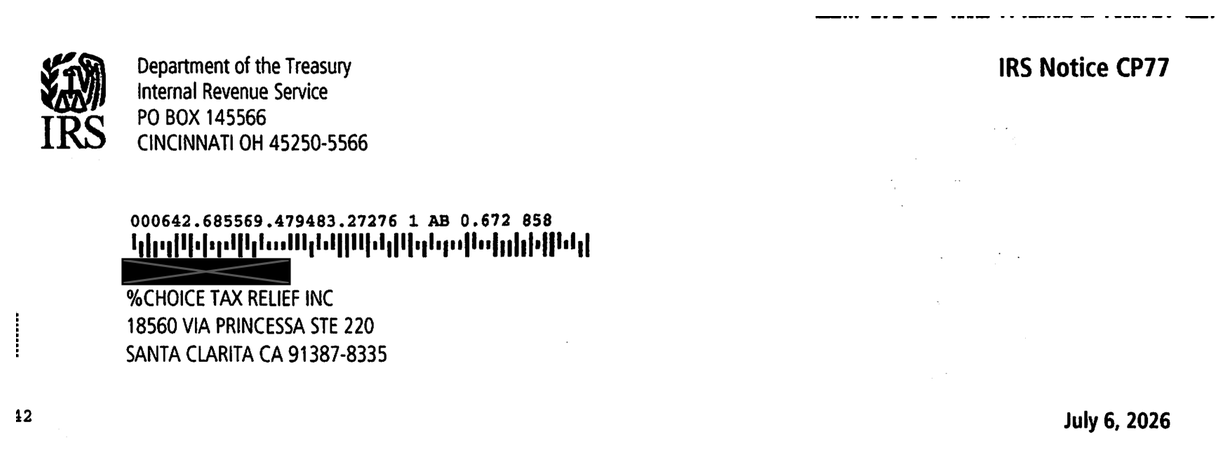
The first page identifies the notice as an IRS Notice CP77 in the top-right corner and shows the IRS return address — here, the IRS campus in Cincinnati, Ohio.
The notice date matters more on a CP77 than on almost any other IRS notice, because your 30-day Collection Due Process window is measured from it.
On our client’s notice, that date is July 6, 2026.
Because we are this client’s authorized representative, the IRS mailed this copy to our office — that’s the “%CHOICE TAX RELIEF INC” you see in the recipient block.
Part 2: “We intend to seize your assets to pay your balance”

The headline is blunt by design.
But notice the very next sentence: “You still have time to act.”
The IRS is demanding the full balance — $5,386.95 on our client’s notice — while acknowledging that the levy hasn’t happened yet.
Part 3: What you need to do immediately
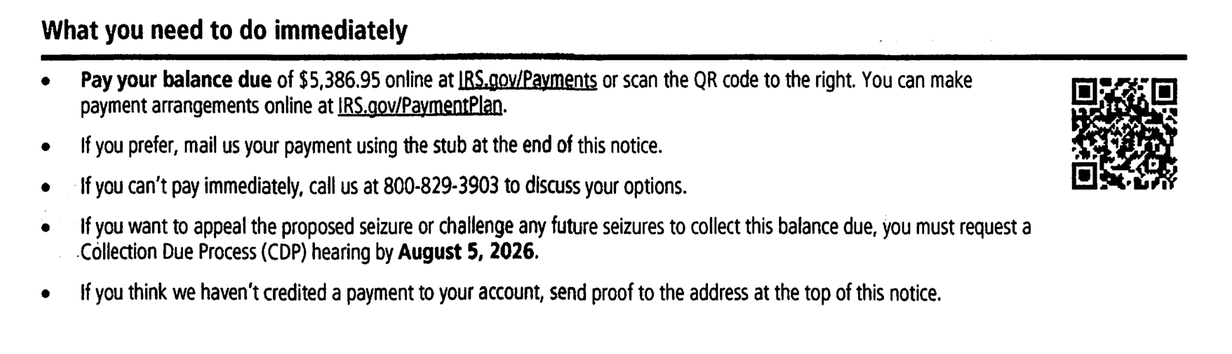
This section lays out your immediate options:
- Pay the balance online at IRS.gov/Payments, by scanning the QR code on the notice, or by mailing the payment stub on the last page.
- Set up payment arrangements online at IRS.gov/PaymentPlan if you can’t pay in full.
- Call the IRS at 800-829-3903 to discuss your options.
- Request a Collection Due Process hearing by the deadline — August 5, 2026 on our client’s notice — if you want to appeal the proposed seizure.
- Send proof of any payment the IRS hasn’t credited to your account.
The CDP deadline buried in the middle of that bullet list is the single most important line on the entire notice.
Part 4: If you don’t respond
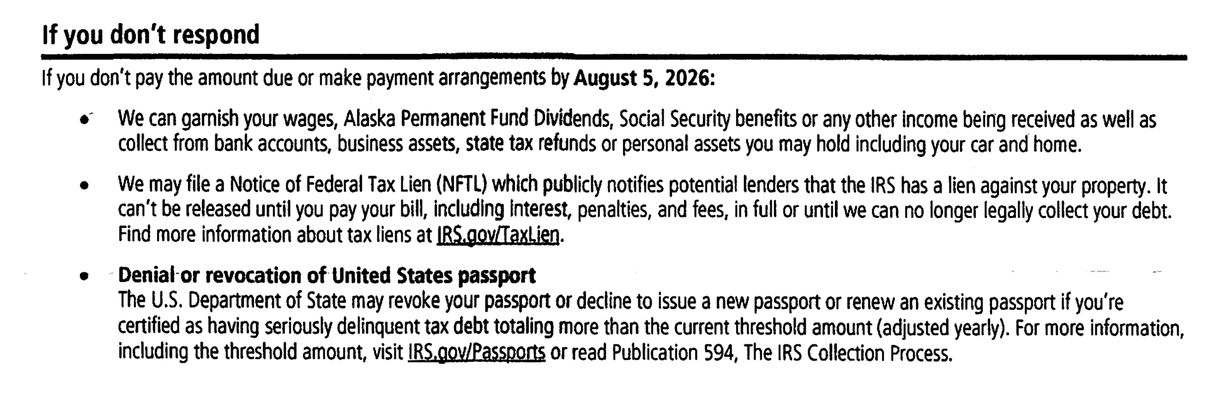
This is where the IRS spells out what “seize your assets” actually means.
If you don’t pay or make arrangements by the deadline, the IRS says it can:
- Garnish your income — wages, Social Security benefits, and even Alaska Permanent Fund Dividends.
- Take your other assets — bank accounts, business assets, state tax refunds, and personal property including your car and home.
- File a Notice of Federal Tax Lien, which publicly notifies potential lenders that the IRS has a claim against your property.
- Certify your debt to the State Department, which can deny, revoke, or refuse to renew your U.S. passport if your debt is seriously delinquent — more than the current threshold, which is $66,000 for 2026.
If the passport warning applies to your situation, our article on the CP508C notice covers exactly how that certification process works.
Part 5: Your appeal rights
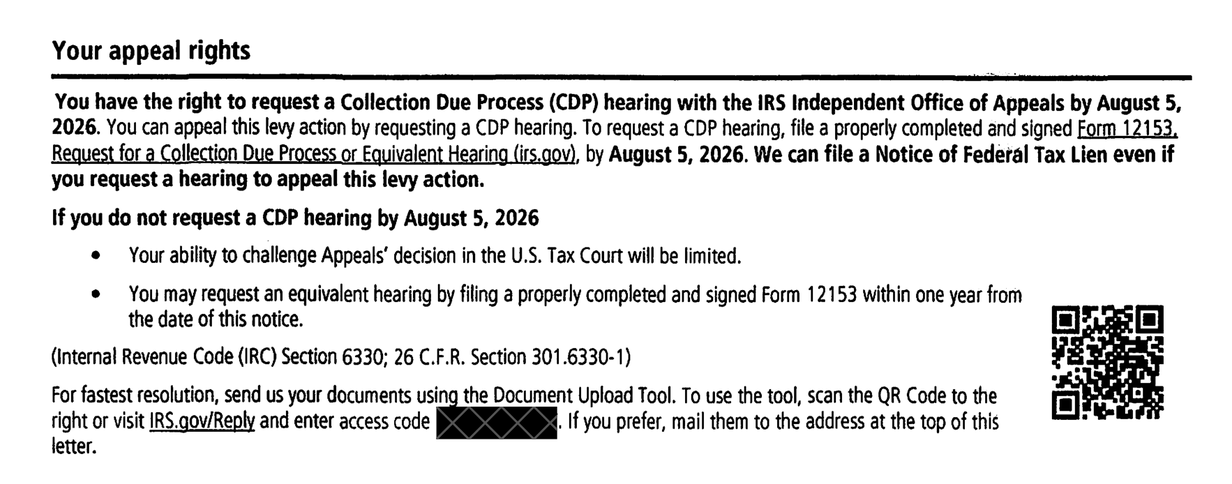
Page 2 opens with the most valuable section of the notice: your appeal rights.
You have the right to request a Collection Due Process hearing with the IRS Independent Office of Appeals by filing Form 12153 by the deadline on the notice.
A timely CDP request generally stops levy action on the tax periods at issue while your case is in Appeals.
At the hearing, you can propose collection alternatives — an installment agreement, an offer in compromise, or hardship status — and in some cases challenge the underlying liability itself.
The notice also warns you what happens if you miss the deadline:
- Your Tax Court rights shrink. Your ability to challenge Appeals’ decision in the U.S. Tax Court will be limited.
- You can still get an equivalent hearing by filing Form 12153 within one year of the notice date, but it doesn’t stop the levy clock or preserve Tax Court review.
One more detail worth noting: the IRS can file a Notice of Federal Tax Lien even if you request a hearing to appeal the levy.
Our client’s notice also promotes the IRS Document Upload Tool at IRS.gov/Reply, with a personalized access code for sending documents electronically.
Part 6: Your billing details
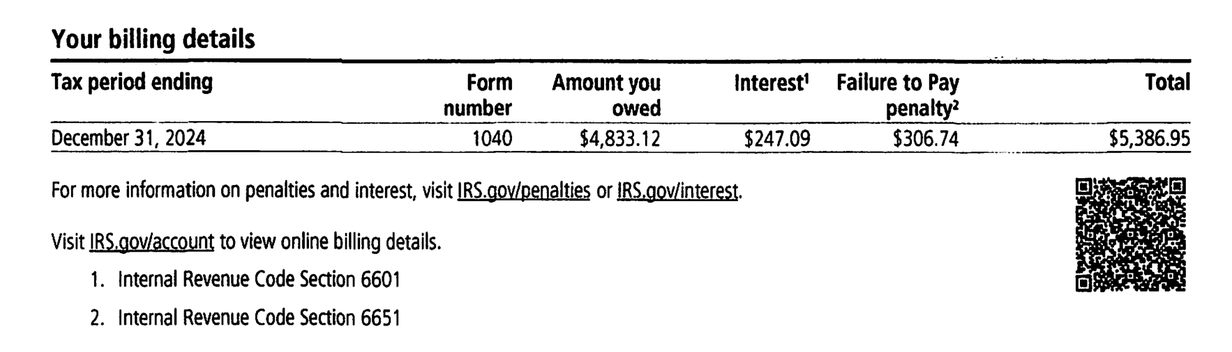
The billing table breaks the balance down by tax period.
On our client’s notice, the entire balance comes from one year — the Form 1040 for the tax period ending December 31, 2024:
- Amount owed: $4,833.12 in unpaid tax.
- Interest: $247.09, charged under IRC Section 6601.
- Failure-to-pay penalty: $306.74, charged under IRC Section 6651.
- Total: $5,386.95.
Check this table carefully against your own records, because levies have been stopped over billing errors as simple as an uncredited payment.
Part 7: The failure-to-pay penalty
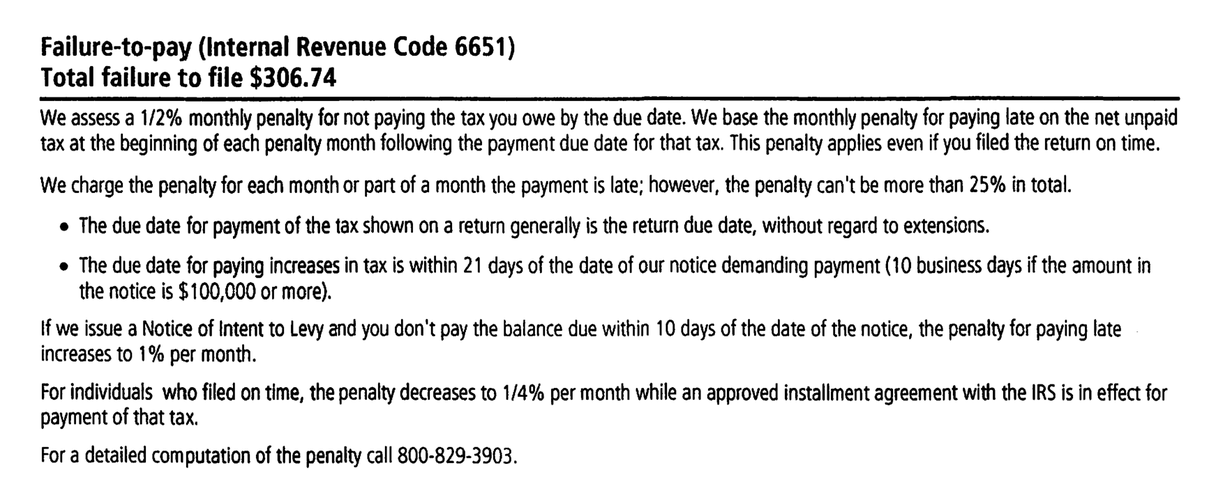
Page 3 explains how the failure-to-pay penalty works.
The IRS assesses one-half of one percent of the unpaid tax for each month or part of a month the balance goes unpaid, up to a maximum of 25 percent.
And there’s a CP77-specific trap in the fine print: once the IRS issues a notice of intent to levy, the monthly rate doubles to 1 percent if you don’t pay within 10 days of the notice date.
The flip side is that getting into an approved installment agreement cuts the monthly rate in half, to one-quarter of one percent, for taxpayers who filed on time.
In other words, the same balance gets penalized at four times the rate for someone who ignores a CP77 versus someone who responds to it with a payment plan.
Part 8: Interest charges
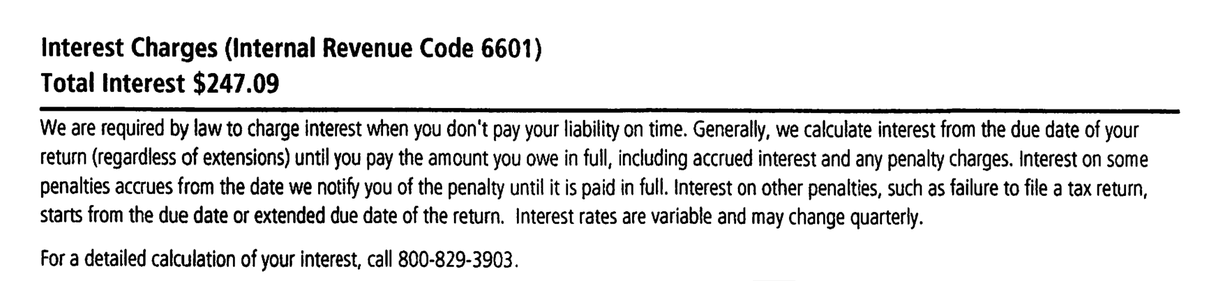
The interest section explains that the IRS charges interest from the return’s due date until the balance is paid in full.
Interest rates are variable and can change quarterly, and interest compounds on penalties as well as tax.
That’s why our client’s $4,833.12 tax bill had already grown by more than $550 in penalties and interest by the time the CP77 arrived.
Part 9: The payment stub
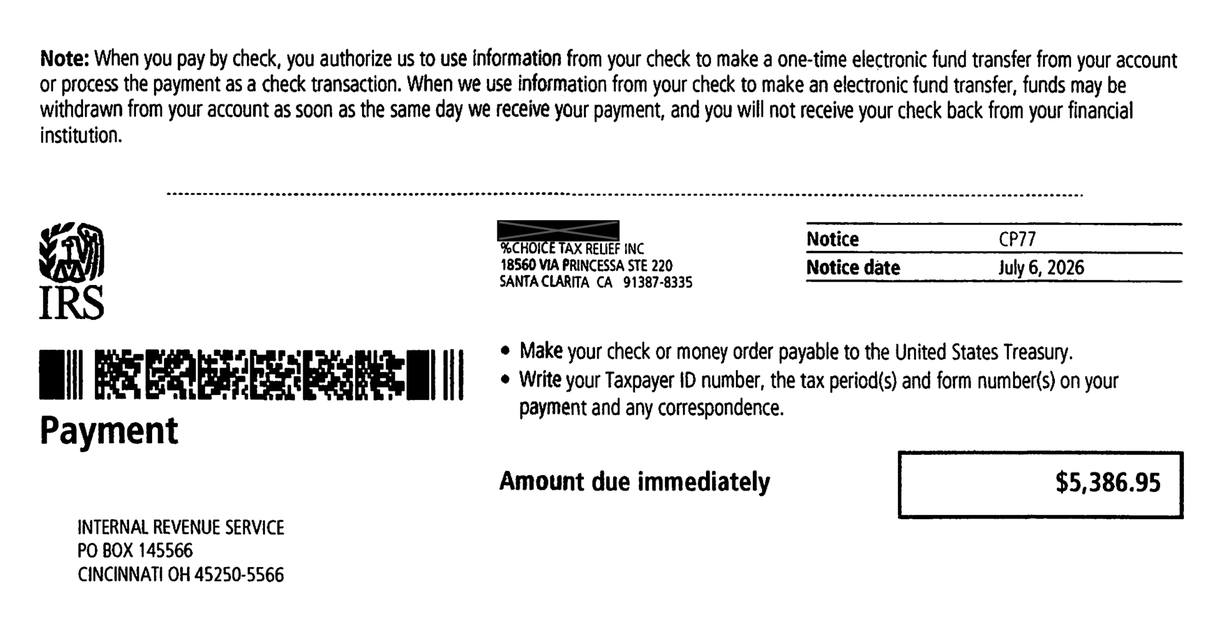
The last page is a tear-off payment stub for taxpayers who want to pay by mail.
If you go this route, make your check or money order payable to the United States Treasury and write your taxpayer ID number, tax period, and form number on the payment.
Note the label on the amount box: “Amount due immediately.”
By the time a CP77 arrives, the IRS is no longer offering a future due date.
Still have questions? Talk to a tax expert — free.
What to Do If You Got a CP77
Here’s the step-by-step approach we use when a client brings us a CP77.
Step 1: Find your deadline.
Look for the Collection Due Process date on page 1 — it’s 30 days from the notice date, and every option below gets harder once it passes.
Step 2: Verify the balance.
Compare the billing details against your IRS online account and your own payment records before you agree to pay anything.
Step 3: Decide whether to request a CDP hearing.
If you dispute the balance, need time to propose a collection alternative, or simply cannot afford to pay, filing Form 12153 before the deadline pauses the levy and puts your case in front of the Independent Office of Appeals.
Step 4: Get a collection alternative in place.
Depending on your finances, that might be an installment agreement, currently-not-collectible status, or an offer in compromise.
Step 5: Attack the penalties.
If this is your first slip-up or you had a good reason for falling behind, penalty abatement can shave hundreds or thousands of dollars off the balance.
Tip: You do not have to pay the balance in full to stop a levy. The IRS’s own procedures generally bar levies while an installment agreement request, offer in compromise, or timely CDP hearing request is pending — so the fastest way to protect your paycheck is usually to get one of those on file before the deadline.
What Happens If You Ignore a CP77
If the CDP deadline passes with no payment, no arrangement, and no hearing request, the IRS can begin levying.
That can look like a garnishment notice landing on your employer’s desk, a freeze on your bank account, or the interception of your state tax refund.
Certain payments — state tax refunds, Alaska Permanent Fund Dividends, and federal contractor payments — can even be levied without the usual 30-day wait.
The failure-to-pay penalty also accelerates to 1 percent per month, and interest keeps compounding on top of it.
And unlike a scary-but-toothless reminder notice, the CP77 is the legal green light: once those 30 days run out, the IRS doesn’t owe you another warning before it takes your property.
For a deeper look at what the IRS can and can’t seize, see Publication 594, The IRS Collection Process, and Publication 1660, Collection Appeal Rights.
Frequently Asked Questions About IRS Notice CP77
Is IRS Notice CP77 serious?
Yes — the CP77 is a final notice of intent to levy, which means the IRS has satisfied its legal requirement to warn you before seizing wages, bank accounts, or other property. It is one of the last notices you will receive before actual collection action begins.
How long do I have to respond to a CP77?
You generally have 30 days from the notice date to pay, make arrangements, or request a Collection Due Process hearing. Our client’s notice was dated July 6, 2026, and the deadline printed on it was August 5, 2026.
Can the IRS really take my paycheck or bank account after a CP77?
Yes. Once the 30-day deadline passes without a response, the IRS can garnish wages and Social Security benefits, levy bank accounts, take state tax refunds, and seize other personal or business assets.
What is a Collection Due Process hearing?
A CDP hearing is an independent review of the proposed levy by the IRS Independent Office of Appeals, requested by filing Form 12153 by the deadline on your notice. A timely request generally pauses levy action and lets you propose alternatives like an installment agreement or offer in compromise, and it preserves your right to take the case to the U.S. Tax Court if you disagree with the outcome.
What if I already missed the CDP deadline on my CP77?
You can still file Form 12153 within one year of the notice date to request an equivalent hearing, and you can still set up an installment agreement or other resolution directly with IRS collections. The difference is that an equivalent hearing does not stop the levy clock and does not preserve your Tax Court rights, so acting quickly still matters.
What if I can’t afford to pay the balance on my CP77?
You have options even if you cannot pay anything right now. Depending on your financial situation, you may qualify for an installment agreement, currently-not-collectible hardship status, or an offer in compromise that settles the debt for less than you owe — and getting one of these in place stops the levy.
If the IRS is threatening to seize your assets, you don’t have to face it alone.
Our team negotiates with the IRS every single day, and we know how to use the CDP process to protect what you’ve earned.
If you’d like help responding to your CP77 before the deadline, schedule a free tax relief consultation with us today.

“Working with Choice Tax Relief has honestly been such a huge ‘relief’ in finally handling my back-taxes. I was initially skeptical reaching-out to any company that provided back-tax relief assistance, but Choice Tax gave me confidence in their abilities from the first call we had.”
Get Help Now
Got a CP77 notice? Get a straight answer before you respond.
Talk to a tax expert — free, no obligation. We’ve resolved over $20 million in IRS debt for our clients.


Author:

Logan Allec, CPA, Founder and Owner
Logan Allec has been serving taxpayers as a CPA for over 14 years. After leaving his role at a "Big 4" firm, he started Choice Tax Relief to help everyday Americans who have found themselves behind on their taxes. He also educates thousands of people daily about tax relief on his YouTube channel. In addition to his CPA license, Logan also has a Master's Degree in Taxation from the University of Southern California (USC). He lives with his wife and children in the Los Angeles area. Learn more about Logan here.