

IRS Notice LT24: What It Is and How to Complete Your Payment Plan

IRS Notice LT24 means you asked the IRS about a payment plan, but the IRS did not get everything it needs to set one up.
It is not a rejection, and it is not a bill for a new amount.
It is the IRS telling you that your request is unfinished.
That matters more than it sounds, because an unfinished request does not give you the protection from levies that a complete payment plan request does.
The good news is that finishing the request is usually simple, and many people can do it online the same day.
Here is a redacted Notice LT24 that one of our clients received (PDF).
Important: The notice in this article is the copy the IRS mailed to Choice Tax Relief as the client’s authorized representative, which is why it says CAF Copy at the top. We blacked out the client’s name, case reference number, taxpayer identification number, and the access code for the IRS upload tool, along with two QR codes and the barcode on the payment stub, since codes like these can carry account details.
Key Takeaways
- Notice LT24 means the IRS received your request for a payment plan but did not get the full terms, so it cannot set up the plan yet.
- The notice gives you two ways to finish: send Form 9465 through the IRS Document Upload Tool, or set up the plan by phone with your income and expense information ready.
- Until your request is complete, the IRS generally does not treat it as pending, and a pending request is what stops the IRS from levying while it decides.
- If you owe $50,000 or less and have filed all your returns, you can usually set up a plan online the same day, for a $29 setup fee if you pay by direct debit.
- If you do not respond, the IRS stops considering your request and goes back to collecting, which can mean a levy if you have already received a final notice of intent to levy.
- Interest keeps growing while your request sits unfinished, at 7% a year for individuals in the last quarter of 2026.
Table of Contents
What Is IRS Notice LT24?
Notice LT24 is a collection notice from the IRS Automated Collection System, the part of the IRS that collects overdue balances by phone and by mail.
Its headline says it plainly: “We need more information to set up your payment plan.”
The IRS sends it when it has a record that you asked about an installment agreement, but it did not receive the full terms of your proposal.
An installment agreement is the IRS’s formal name for a payment plan, and the law behind it is Internal Revenue Code section 6159.
Other notices from the same unit carry the same LT prefix, such as Notice LT11, the final notice of intent to levy.
Put simply, a Notice LT24 means the IRS is waiting on you to finish what you started.
Free Consultation
Got an LT24 notice? Don’t wait for the IRS’s next move.
Talk to a tax expert — free, no obligation. We’ve resolved over $20 million in IRS debt for our clients.
IRS Notice LT24 at a Glance
| Question | Answer |
|---|---|
| What is it? | A notice that the IRS needs more information before it can set up the payment plan you asked about. |
| Who sends it? | ACS Support, part of the IRS Automated Collection System, from Kansas City, Missouri. |
| What does the IRS want? | The full terms of your payment plan request, on Form 9465 or over the phone. |
| Is there a deadline? | This version prints no response date, but the IRS will stop considering your request if it does not hear from you, so respond right away. |
| Does it stop collection? | No. A request generally has to be complete before the IRS treats it as pending, and only a pending request blocks a levy. |
| Does it change what you owe? | No. It shows your current balance, which keeps growing with interest. |
| How do you respond? | Send Form 9465 through the IRS Document Upload Tool, call the IRS at 800-829-7650, or set up a plan online if you qualify. |
Why the IRS Sent You Notice LT24
You received Notice LT24 because the IRS has a payment plan request from you, or from your representative, that it cannot act on yet.
Under the IRS’s own manual, a payment plan request counts as pending only when it does all of the following:
- Gives enough information to identify you.
- Identifies the tax debts the plan will cover.
- Proposes a specific monthly payment amount.
- Comes from someone who has filed all required tax returns.
- Includes a completed financial statement, when one is required.
When any of those pieces is missing, the IRS asks for the rest, and Notice LT24 is how the Automated Collection System asks.
That can happen when a phone call ends before the plan is finished, when a mailed request leaves out the monthly amount, or when a required return is still unfiled.
IRS Notice LT24 Explained, Part by Part
Below is the redacted client notice, part by part, with what each section means for you.
The notice is dated September 2, 2025, and it covers individual income tax for 2010, 2012, and 2013.
Part 1: The Notice Header
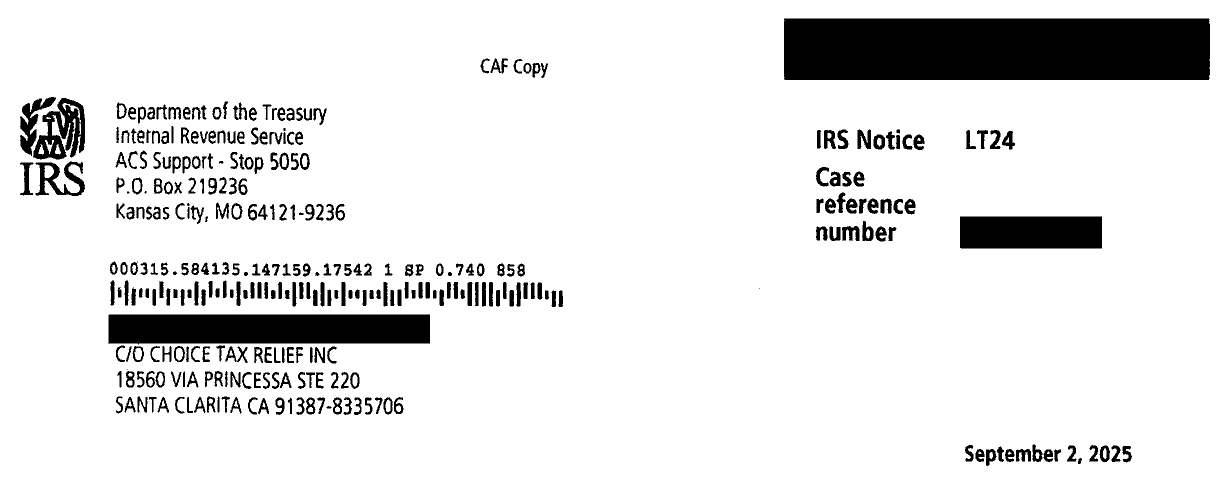
The top of the notice tells you who sent it and when.
This one came from ACS Support, Stop 5050, in Kansas City, Missouri, which is part of the IRS Automated Collection System.
The words CAF Copy at the top mean this is the copy the IRS sent to the client’s authorized representative.
CAF stands for Centralized Authorization File, the IRS database that records who can represent you or receive your tax information.
When a representative is on file with a power of attorney, the IRS can mail them copies of notices like this one, so they can respond for you.
The case reference number on the right identifies your account in IRS collection, so keep it handy for any call or letter.
The date on the right, September 2, 2025, starts the 21-day payment window the notice mentions on page 2.
Part 2: The Headline and Why You Got It

The headline is the clearest part of the notice: “We need more information to set up your payment plan.”
The paragraph below it thanks you for asking about an installment agreement and says the IRS “didn’t receive the full terms of your payment proposal.”
In other words, the IRS has not said no to a payment plan.
It just cannot approve a plan it does not have the details for.
Part 3: What You Need to Do Now
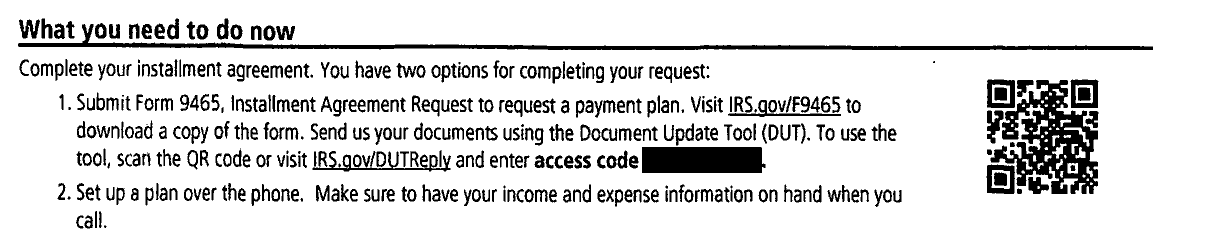
This section gives you two ways to finish your request.
The first is to fill out Form 9465, Installment Agreement Request, and send it through the IRS’s online upload tool, using the access code printed on your notice.
The notice calls it the Document Update Tool, but it is the IRS Document Upload Tool at IRS.gov/DUTReply, and the QR code next to this option simply opens that page.
The access code ties your upload to your case, which is why we blacked it out.
The second option is to set up the plan over the phone, with your income and expense information on hand when you call.
Have it ready before you dial, because the IRS says on its LT24 page that it cannot set up the plan without that information and will not hold the line while you look for it.
What the notice does not mention is a third route: if you owe $50,000 or less and have filed all your required returns, you can usually set up the plan yourself with the IRS Online Payment Agreement tool at IRS.gov/OPA.
Part 4: Paying in Full Instead

If you do not want a payment plan, the notice asks you to pay the balance in full to stop interest and penalties from growing.
If you cannot pay it all, it asks you to pay what you can now, which reduces the interest that keeps building on the rest.
The two payment methods are IRS Direct Pay, which takes the money straight from your bank account at no cost, and a check or money order mailed with the payment stub on page 3.
A partial payment helps, but by itself it does not set up a payment plan or stop collection on the rest.
Part 5: If the IRS Does Not Hear From You

This is the line that matters most: “If we don’t hear from you, we won’t consider your request for an installment agreement, and we may take further action to collect the amount you owe.”
This version of LT24 does not print a deadline to respond.
Older versions told taxpayers to contact the IRS within 7 days, so treat this notice as urgent even without a date on it.
The boxed line at the bottom points you to IRS.gov/LT24, the IRS’s page about this notice.
Part 6: Your Billing Summary

Page 2 opens with the balance, broken out by tax year.
This client owes on three individual income tax returns (Form 1040):
- 2010: $4,898.74 owed, plus $1,118.68 of interest, for a total of $6,017.42.
- 2012: $12,762.72 owed, plus $3,078.23 of interest, for a total of $15,840.95.
- 2013: $6,677.92 owed, plus $1,524.95 of interest, for a total of $8,202.87.
Together that comes to $30,061.24, the same total that appears without a decimal point in the scan line at the bottom of the payment stub.
The failure-to-pay penalty column shows $0.00 for every year, and on debts this old the likely reason is that the penalty has already reached its legal cap of 25% of the unpaid tax.
Interest has no cap, which is why it keeps growing on balances from more than a decade ago.
Notice also how old these years are, because the IRS generally has 10 years from the date it assesses a tax to collect it.
A 2010 balance still being collected in 2025 suggests the tax was assessed later than usual, or the collection clock was paused at some point, and that is worth checking before you agree to anything.
Part 7: Payment Due Immediately

“Payment due immediately” sounds alarming, but it is standard language on IRS balance due notices.
The notice says your payment must be received within 21 calendar days of the notice date, or 10 business days if you owe $100,000 or more, to avoid additional penalty and interest charges.
Those windows come from the interest and failure-to-pay penalty rules in Internal Revenue Code sections 6601 and 6651, which are the two footnotes at the bottom of this section.
The notice also points you to IRS.gov/Account, where you can log in to see your balance and your payment history.
That is a good first stop, because payments you made in the last 21 days may not show on the notice.
Part 8: Additional Information
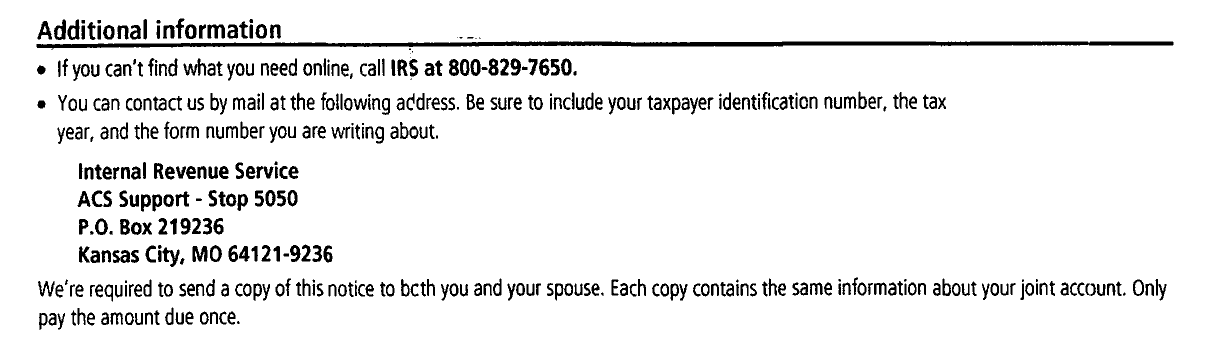
The phone number on this notice, 800-829-7650, is the IRS Automated Collection System line for individuals.
If you write instead, the notice asks you to include your taxpayer identification number, the tax year, and the form number you are writing about.
The IRS’s LT24 page also lists this address for mailing Form 9465, if you would rather not use the upload tool.
The last paragraph is easy to miss: the IRS sends a separate copy of this notice to each spouse on a joint account.
Both copies show the same balance for the joint account, so you only need to pay it once.
A balance on a joint return is owed in full by both spouses, which is why the IRS writes to both of you.
Part 9: Taxpayer Rights and Sources for Assistance
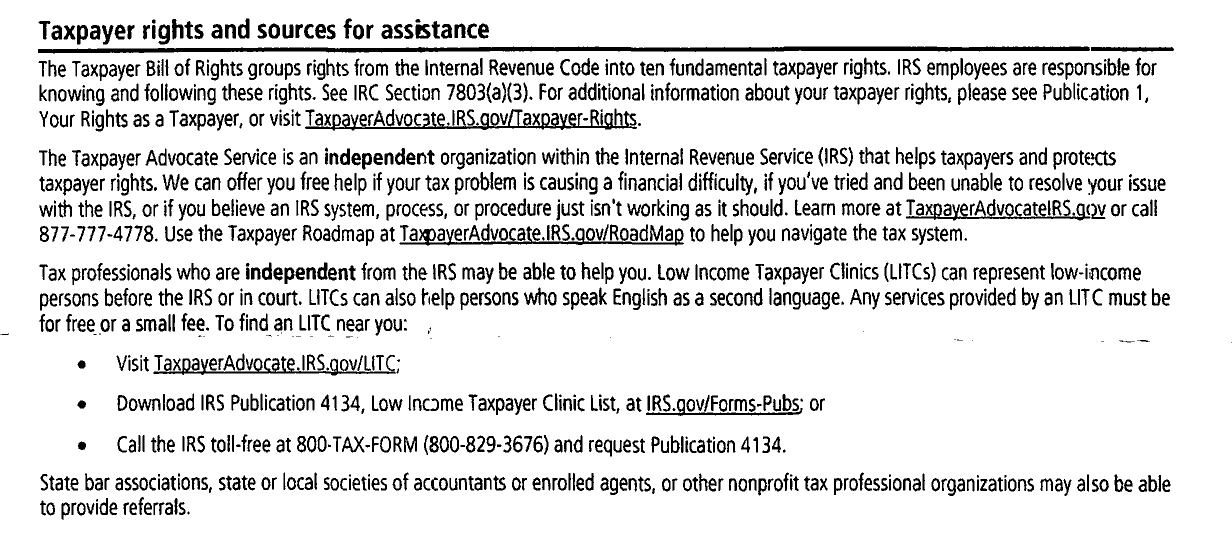
This section is standard on IRS collection notices.
It points you to the Taxpayer Bill of Rights, the Taxpayer Advocate Service, and Low Income Taxpayer Clinics, along with a reminder that independent tax professionals can help.
The Taxpayer Advocate Service can step in when an IRS problem is causing you financial hardship, or when you have tried and failed to resolve it through normal channels.
Part 10: The Payment Stub
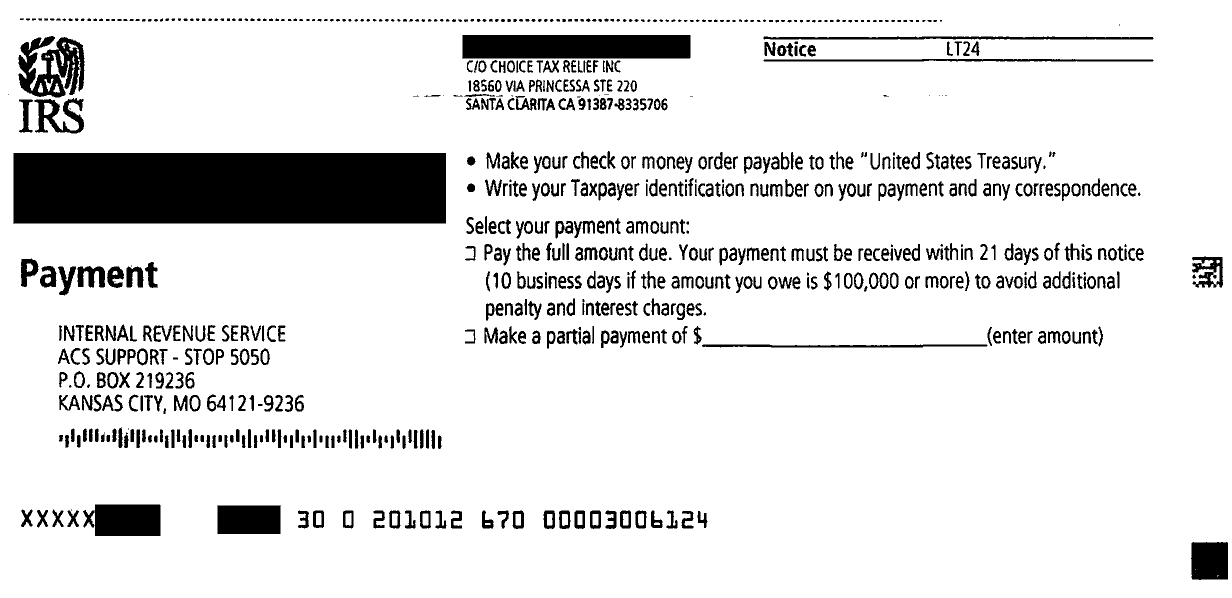
The last page is the payment stub for mailing a check or money order.
It gives you two boxes, one to pay the full amount due and one to make a partial payment.
Make the check payable to the United States Treasury and write your taxpayer identification number on it.
The IRS masked most of the identification number in the scan line at the bottom, and we blacked out the rest, along with the barcode under the IRS logo.
Why an Unfinished Request Leaves You Exposed
The biggest reason to act on Notice LT24 quickly is levy protection.
Federal law bars the IRS from levying while a payment plan request is pending, for 30 days after it rejects one, and while you appeal a rejection.
The same protection applies while a payment plan is in effect.
But the IRS treats a request as pending only once it accepts it for processing, and its manual says a request without a specific monthly amount, or without a required financial statement, does not qualify.
So while your request sits unfinished, the IRS can keep collecting, including a levy on your wages or bank account if it has already sent you a final notice of intent to levy and your appeal window has passed.
Once your request is complete and pending, the levy protection starts, and the IRS pauses its 10-year collection clock while it decides.
That pause is worth knowing about if your balances are old, like the 2010 year on this notice, because each pending request gives the IRS a little more time to collect.
Finishing the request is still usually the right move, but it is one more reason to check each year’s collection deadline before you choose a plan.
Owe the IRS? Talk to a tax expert — free.
How to Respond to Notice LT24
- Check your balance and your filing status. Log in at IRS.gov/Account to confirm what you owe, and make sure every required return is filed, because the IRS will not set up a plan while a return is missing.
- Decide what you can pay each month. If you leave the payment amount blank on Form 9465, the IRS divides your balance by 72 months, which for this notice works out to about $418 a month.
- Use the online tool if you qualify. If you owe $50,000 or less in tax, penalties, and interest and have filed all your returns, the Online Payment Agreement tool at IRS.gov/OPA can approve a plan right away.
- Otherwise, send Form 9465 through the upload tool. Use the access code on your notice at IRS.gov/DUTReply so the form is matched to your case, and save the confirmation. You can also mail the form to the address on page 2 of the notice.
- Or call the number on your notice. Have your monthly income, your expenses, and your bank account details ready before you dial 800-829-7650.
- Choose direct debit if you can. It lowers the setup fee and makes it less likely that a missed payment puts your plan in default.
- If you owe more than $50,000, get your financial statement ready. The IRS will usually want Form 433-F, or the information on it, before it approves the plan.
- Check the collection deadline on old years. Your account transcripts show when each year was assessed, and if you cannot pay everything before those deadlines, a partial payment installment agreement may let the rest expire.
Tip: If you have a tax professional, they can finish the request for you. A representative with a power of attorney on file can call the IRS on your behalf or use the Online Payment Agreement tool, and the IRS can send them copies of your notices, like the CAF Copy in this article.
What a Payment Plan Will Cost You
A payment plan does not stop interest, and it adds a one-time setup fee.
Here are the setup fees the IRS lists for long-term payment plans:
| How you pay | Set up online | Set up by phone, mail, or in person |
|---|---|---|
| Direct debit from your bank account | $29 | $107 |
| Any other payment method | $69 | $178 |
| Low-income taxpayers | Waived with direct debit, otherwise $43, which may be reimbursed | |
Short-term plans of 180 days or less have no setup fee, and individuals who owe less than $100,000 can request one online.
Interest continues on the unpaid balance at the IRS underpayment rate, which is 7% a year for individuals through the end of 2026.
The failure-to-pay penalty also continues, but if you filed your return on time, the rate drops from 0.5% to 0.25% a month while a payment plan is in effect.
On this client’s notice that penalty appears to have stopped growing already, so interest is the only charge still adding up.
Any tax refund you are due while the plan is in place will be applied to your balance, and you still have to make your regular monthly payment.
How LT24 Compares With Other IRS Payment Plan Notices
LT24 is one of several notices you may see on the way to an IRS payment plan, and while you are on one.
The table below shows how they differ.
| Notice | What it means | What to do |
|---|---|---|
| Notice LT24 | The IRS needs more information before it can set up your payment plan. | Finish your request with Form 9465, by phone, or online. |
| Letter 484C | The IRS could not set up the payment plan you asked for. | Read the reason given, fix the problem, and ask again. |
| Notice CP521 | A monthly reminder of a payment due under your plan. | Make the payment by the due date shown. |
| Notice CP523 | The IRS intends to end your payment plan and levy. | Act before the date on the notice to keep your plan. |
What Happens If You Ignore Notice LT24
If you do not respond, the IRS will stop considering your payment plan request.
Your account then goes back into the normal collection process, with interest still growing.
If you have not yet received a final notice of intent to levy, the IRS has to send one, such as Notice LT11, and give you 30 days to ask for a Collection Due Process hearing before it can levy most property.
If you have already received that notice and the 30 days have passed, the IRS can move ahead with levies on your wages, bank accounts, or other income.
The IRS can also file a Notice of Federal Tax Lien, a public record that can affect your ability to get credit.
And any payment plan you set up later starts from a bigger balance, because interest never stopped.
Getting Help With IRS Notice LT24
Notice LT24 is the IRS giving you a second chance to finish a payment plan.
The details you send now decide what your monthly payment is, how long the plan runs, and whether the IRS is likely to file a lien.
Our licensed tax professionals can pull your IRS transcripts, check the collection deadline on each year, and set up the payment plan that fits your budget, or tell you whether an offer in compromise or currently not collectible status makes more sense.
If the IRS is waiting on you to finish a payment plan, we know how to deal with this the smart way.
Call 866-8000-TAX or schedule a free consultation and we will look at your notice with you.

“I chose Choice Tax Relief for a large unexpected tax liability. I am so glad I did. Lulu Peralta was my case manager and she did an amazing job setting up a tax payment plan with great terms.”
IRS Notice LT24 FAQs
What is IRS Notice LT24?
Notice LT24 is a letter from the IRS Automated Collection System saying it needs more information before it can set up the payment plan you asked about. It lists your balance and gives you two ways to finish the request: send Form 9465 through the IRS Document Upload Tool, or set up the plan by phone.
Does Notice LT24 mean my payment plan was rejected?
No. It means the IRS did not receive the full terms of your request, such as a specific monthly payment amount. If you do not respond, though, the IRS will stop considering the request.
How long do I have to respond to Notice LT24?
The current version of LT24 does not print a response date, and older versions gave taxpayers 7 days. Respond as soon as you can, because the IRS will drop your request if it does not hear from you, and interest keeps growing in the meantime.
Can the IRS levy my bank account after Notice LT24?
It can if collection is far enough along. A payment plan request generally blocks levies only once it is complete and accepted for processing, so if you have already received a final notice of intent to levy and the 30-day appeal window has passed, finish your request quickly or get help.
How do I respond to Notice LT24?
Send Form 9465 through the IRS Document Upload Tool using the access code on your notice, or call the IRS at the number on the notice with your income and expense information ready. If you owe $50,000 or less and have filed all your returns, you can usually set up a plan online at IRS.gov/OPA instead.
How much does an IRS payment plan cost?
The IRS charges a one-time setup fee for long-term plans: $29 online with direct debit, $69 online with other payment methods, $107 by phone, mail, or in person with direct debit, and $178 by phone, mail, or in person without it. Low-income taxpayers can have the fee waived or reduced, and interest continues until the balance is paid.
Why is the failure-to-pay penalty $0.00 on my Notice LT24?
On older balances, the failure-to-pay penalty has often already reached its maximum of 25% of the unpaid tax, so no more is added. Interest has no maximum and keeps accruing until you pay in full.
Why did my spouse get the same notice?
When a balance comes from a joint return, the IRS sends each spouse a separate copy of the notice. Both copies show the same balance for the joint account, so you only need to pay it once.
Get Help Now
Got an LT24 notice? Don’t wait for the IRS’s next move.
Talk to a tax expert — free, no obligation. We’ve resolved over $20 million in IRS debt for our clients.


Author:

Logan Allec, CPA, Founder and Owner
Logan Allec has been serving taxpayers as a CPA for over 14 years. After leaving his role at a "Big 4" firm, he started Choice Tax Relief to help everyday Americans who have found themselves behind on their taxes. He also educates thousands of people daily about tax relief on his YouTube channel. In addition to his CPA license, Logan also has a Master's Degree in Taxation from the University of Southern California (USC). He lives with his wife and children in the Los Angeles area. Learn more about Logan here.