

IRS Notice CP27: What It Is and How to Claim Your Refund

Almost every notice the IRS mails is about money you owe.
IRS Notice CP27 is one of the rare exceptions.
It is the IRS telling you that it looked at the return you already filed, saw that you had earned income, and noticed that you never claimed the Earned Income Credit you may have been entitled to.
Put plainly, the IRS is offering to send you a refund you did not ask for.
The catch is that the money is not automatic, because you have to complete and return the worksheet that comes with the notice.
If the envelope goes in the trash, the credit quietly goes with it.
Here is a redacted CP27 notice that one of our clients received: IRS Notice CP27 (PDF).
Important: The images in this article come from a redacted CP27 that one of our clients received — not a mock-up. We blacked out the taxpayer’s name, address, and Document Upload Tool access code, and everything else appears exactly as the IRS printed it.
Key Takeaways
- CP27 is good news. The IRS is telling you that your return showed earned income but no Earned Income Credit, and that you may be owed a refund because of it.
- It is the no-children version of the notice. CP27 goes to taxpayers the IRS does not show as having a qualifying child, which is why the worksheet enclosed with it is Form 15112 rather than the Form 15111 that comes with a CP09.
- Nothing happens unless you respond. There is no penalty for ignoring a CP27, but there is also no refund, because the IRS will not add the credit to your account on its own.
- The dollar figure in the headline is a ceiling, not a promise. The notice on this page says “up to $632.00,” which was the maximum childless Earned Income Credit for the 2024 tax year, and the actual credit depends on your income.
- The fastest route is the Document Upload Tool. The notice carries a one-time access code for IRS.gov/DUTReply, which beats mailing the worksheet back in the enclosed envelope.
- If you owe back taxes, the credit will be applied to the balance first. The notice says so directly, and for a lot of people that offset is the more important conversation.
Table of Contents
What Is IRS Notice CP27?
IRS Notice CP27 is a letter the IRS sends after it processes your return, when its records suggest you had earned income but did not claim the Earned Income Credit.
The Earned Income Credit — you will also see it written as the EIC or the EITC, and the two abbreviations mean the same thing — is a refundable credit for working people with low to moderate income, authorized by Internal Revenue Code § 32.
Refundable means it is not just a discount on tax you owe, because the credit can generate a refund even if your tax liability for the year was zero.
The IRS handles CP27 under IRM 21.3.1.6.19, which describes it as the notice that tells a taxpayer without children about possible EITC eligibility, with the substantive procedures sitting in IRM 21.6.3.4.2.7.8.
That phrase — a taxpayer without children — is the single most useful thing to understand about this notice.
Most people assume the Earned Income Credit is a benefit for parents, and the credit is much larger when there are qualifying children involved, but there is a smaller version of it for workers who have no qualifying children at all.
CP27 exists because a lot of eligible people never claim that smaller version.
Free Consultation
Got a CP27 notice? Get a straight answer before you respond.
Talk to a tax expert — free, no obligation. We’ve resolved over $20 million in IRS debt for our clients.
IRS Notice CP27 at a Glance
Here is what the notice is and what it is asking for, in one place.
| Notice Name | CP27 (printed as “Notice CP27” at the bottom of every page) |
| What It Says | “You may be eligible for a refund of up to $632.00” |
| Notice Type | Informational and optional — no penalty and no interest for not responding |
| Who Sends It | The IRS campus that processed your return (Kansas City, MO 64999-0052 on this client’s notice) |
| Tax Year Involved | One specific year, printed at the bottom of each page (2024 on this notice) |
| Credit at Issue | The Earned Income Credit under IRC § 32, in the version for taxpayers with no qualifying children |
| Form Enclosed | Form 15112, Earned Income Credit Worksheet (CP 27) |
| Deadline Printed on the Notice | None — but the refund statute in IRC § 6511 eventually closes the year |
| How to Respond | Upload the signed worksheet at IRS.gov/DUTReply with the access code, or mail it back with the stub |
| Turnaround | 6 to 8 weeks for a refund check after the IRS confirms you qualify |
| Phone Number | 800-829-0922 |
| IRM Reference | IRM 21.3.1.6.19 and IRM 21.6.3.4.2.7.8 |
Why Did the IRS Send You a CP27?
The IRS generates a CP27 by comparing what your return reported against what the Earned Income Credit rules allow.
Three things generally have to line up before the notice goes out:
- You filed a return. The IRS cannot notice a missing credit on a year you never filed, which is why a CP27 always refers to a return that is already on file.
- Your return showed earned income. Wages, salary, tips, and net self-employment earnings all count, and investment income, unemployment compensation, and Social Security do not.
- Your income was low enough and you claimed no EIC. The credit line on your return was blank or zero even though your reported income fell inside the range where the childless credit is available.
The IRS also screens out people it can already tell do not qualify, which is why the enclosed worksheet never asks your age even though age is one of the requirements.
It knows your date of birth from its own records, so it filters on that before printing the notice.
What the IRS cannot see from a return is whether you lived in the United States for more than half the year, whether someone else can claim you as a dependent, or whether your Social Security card is valid for employment.
Those four unknowns are exactly what Form 15112 asks you about.
A Part-by-Part Walkthrough of IRS Notice CP27
The CP27 our client received runs three pages, with Form 15112 enclosed as a separate document.
Here is every section of it.
Part 1: The Notice Header and the Kansas City Address
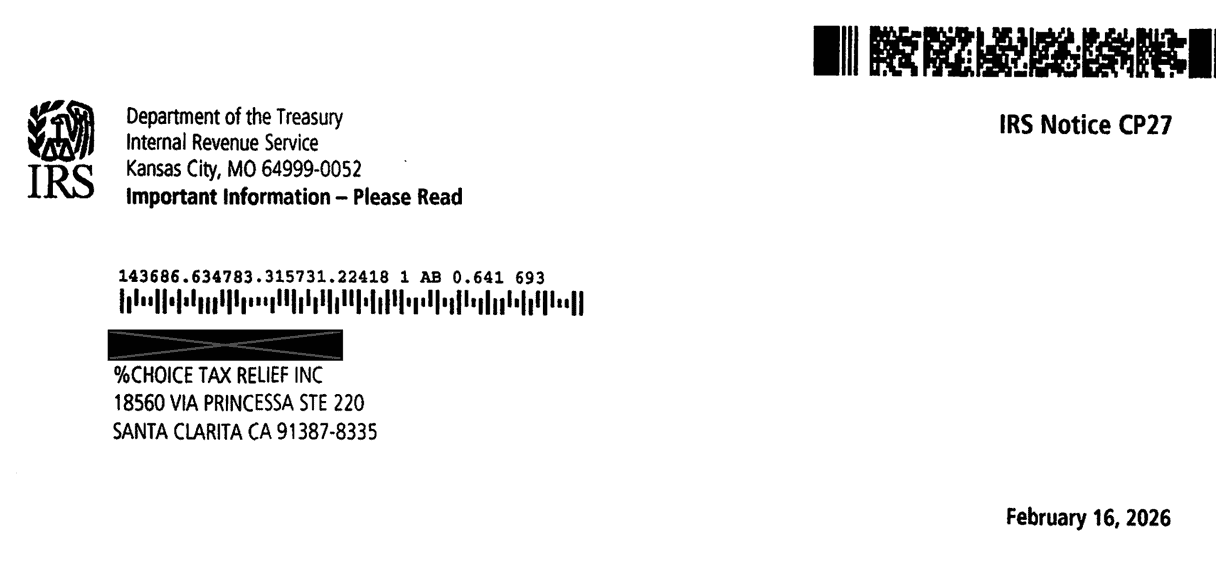
The top of the notice identifies it as an IRS Notice CP27 and gives the return address for the IRS campus in Kansas City, Missouri.
Directly under the IRS seal is the line “Important Information – Please Read,” which is the IRS signalling that this is not a bill.
The notice date on this one is February 16, 2026.
This particular copy went to the taxpayer’s representative rather than to the taxpayer directly, which is why our firm’s name and address appear in the window block with the client’s own name blacked out.
The small “CAF 18H” marking in the footer of page one is the internal code showing that a copy was routed through the Centralized Authorization File, which is the database of powers of attorney the IRS maintains.
Part 2: The Headline and the Dollar Amount

The headline is the whole point of the notice: “You may be eligible for a refund of up to $632.00.”
Underneath it, the IRS explains that the 2024 return showed earned income and possible eligibility for the Earned Income Credit, but that the credit was never claimed on the return.
Read the two qualifiers in that sentence carefully, because “may be eligible” and “up to” are doing real work.
The $632.00 figure is not a calculation of your credit — it is the statutory maximum childless Earned Income Credit for the 2024 tax year, and your actual credit could be a fraction of it.
The credit phases in as your earned income rises, plateaus at the maximum, and then phases back out, so someone with very little earned income and someone near the top of the range can both end up with far less than the headline number.
Part 3: What You Need to Do
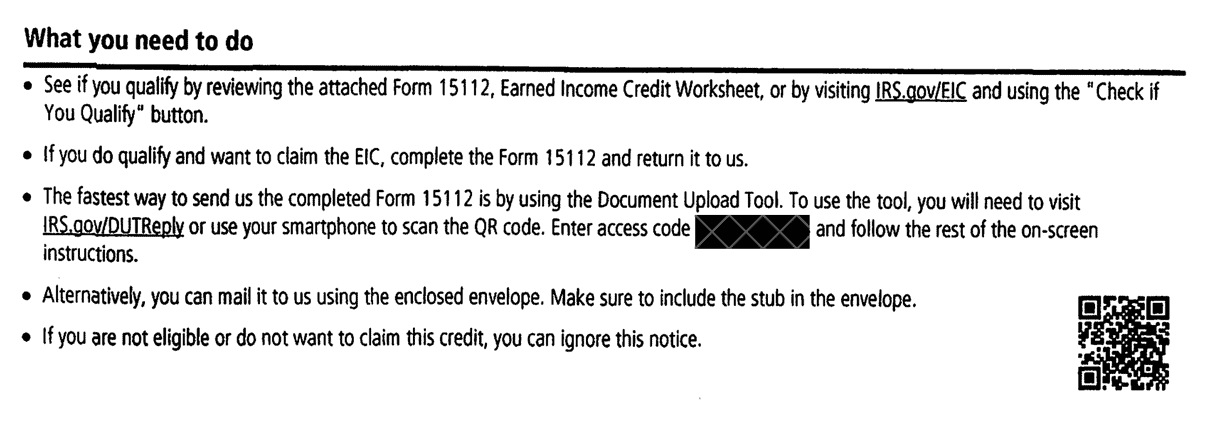
This is the section that actually asks something of you, and it lays out five points:
- Check whether you qualify. The notice points you to the enclosed Form 15112 or to the “Check if You Qualify” button at IRS.gov/EIC.
- Complete and return Form 15112 if you do qualify. The worksheet is the claim, and without it there is nothing for the IRS to process.
- Use the Document Upload Tool for the fastest turnaround. You go to IRS.gov/DUTReply, or scan the QR code printed on the notice, and enter the access code the IRS assigned to your notice.
- Or mail it in the enclosed envelope. The notice specifically asks you to include the detachable stub in the envelope so the response is matched to your account.
- Or do nothing. The last bullet says that if you are not eligible, or you simply do not want the credit, you can ignore the notice.
The access code on our client’s notice has been blacked out in the image above, because it is tied to that specific taxpayer’s account.
The fact that the IRS gives you an explicit permission slip to ignore the notice tells you something about its legal character.
A CP27 is an invitation, not a demand, and no penalty, interest, or enforcement follows from throwing it away.
Part 4: What Comes Next After You Submit Your Forms
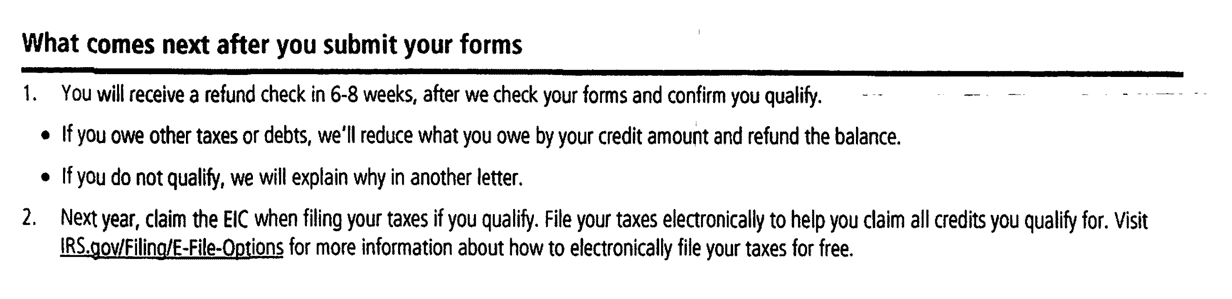
The IRS sets expectations here for what happens after your worksheet arrives.
It says you will receive a refund check in six to eight weeks once it has reviewed your forms and confirmed that you qualify.
Two sub-bullets add the conditions that matter most:
- An existing balance gets paid first. If you owe other taxes or debts, the IRS reduces what you owe by the credit amount and refunds only the balance.
- A denial comes by mail. If you do not qualify, the IRS says it will explain why in a separate letter.
The section closes with advice for the following year, which is to claim the credit at filing time and to file electronically so that the software catches credits you qualify for.
Part 5: The “To Learn More” Box
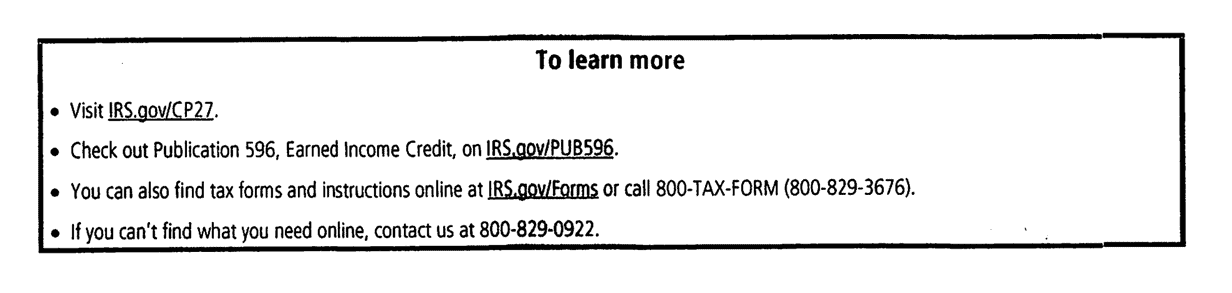
Page two of the notice is almost entirely blank except for a boxed resource list.
It points you to IRS.gov/CP27 for the notice itself, to Publication 596 for the full Earned Income Credit rules, to IRS.gov/Forms for blank forms, and to 800-TAX-FORM (800-829-3676) if you want paper copies mailed to you.
The last line gives the number to call about the notice itself, which is 800-829-0922.
That is the number to use if your worksheet has been sitting with the IRS for more than eight weeks with no response.
Part 6: The Detachable Stub
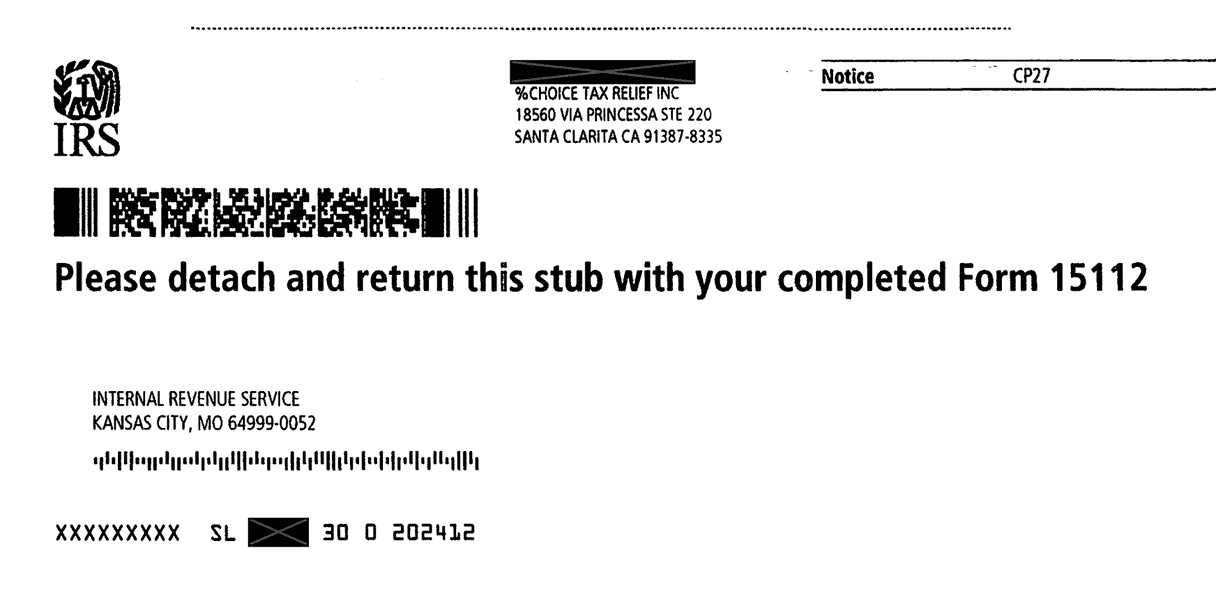
Page three is the tear-off stub, and it reads “Please detach and return this stub with your completed Form 15112.”
The stub carries the notice type, a scannable barcode, and the Kansas City mailing address, and its whole job is to make sure your response is matched to the right account and the right tax year.
The string at the bottom of the stub ends in 202412, which is IRS shorthand for a tax period ending in December 2024.
If you mail your worksheet back without the stub, your response can still be processed, but it has a much better chance of being matched quickly if the stub is in the envelope.
If you upload through the Document Upload Tool instead, the access code does the same job the stub would have done.
Part 7: Form 15112, Page 1 — Contact Information
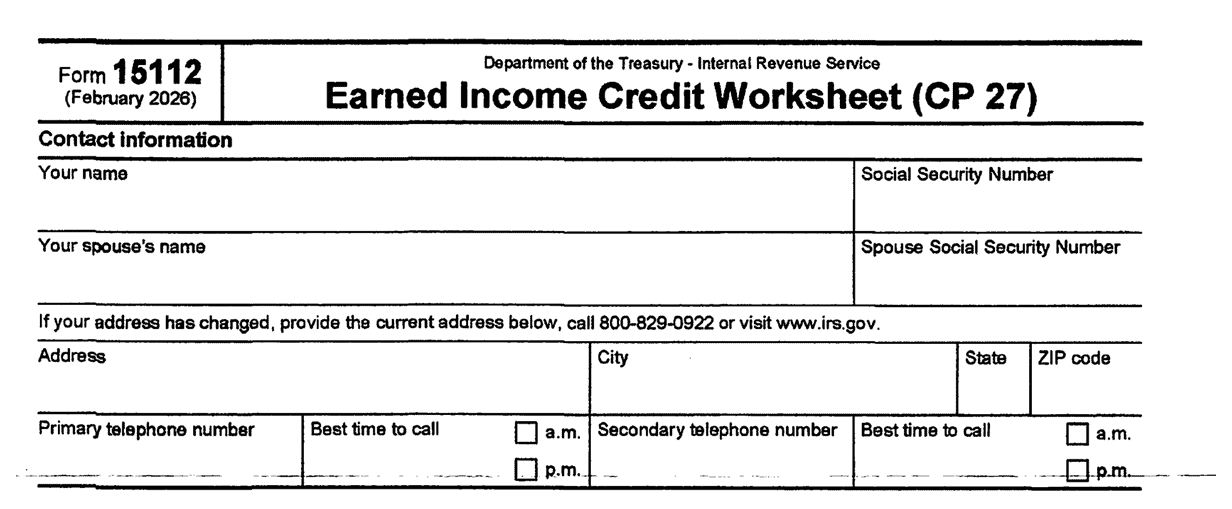
Form 15112 is titled “Earned Income Credit Worksheet (CP 27),” and it exists only to answer this notice.
The revision enclosed with our client’s notice is dated February 2026 and carries catalog number 69807V.
The top of the form collects your name, your Social Security number, your spouse’s name and Social Security number if you filed jointly, your address, and two phone numbers with the best time to reach you.
There is a line telling you to call 800-829-0922 if your address has changed.
This section is worth filling in completely, because a worksheet that cannot be matched to a return is a worksheet that sits in a queue.
Part 8: Form 15112, Step 1 — The Four Disqualifying Statements
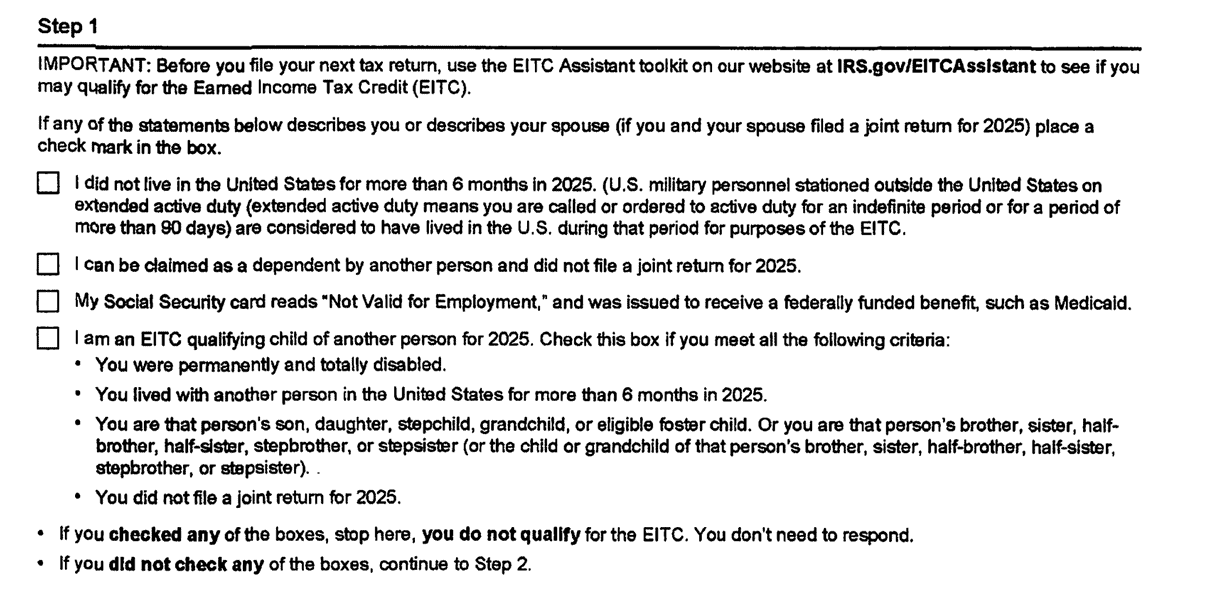
Step 1 is the heart of the worksheet, and it is written backwards from what most people expect.
You do not check boxes to show that you qualify, because you check boxes only if a statement describes you, and any checked box means you do not qualify.
The four statements are:
- You did not live in the United States for more than six months. Military personnel stationed abroad on extended active duty are treated as having lived in the United States for this purpose.
- Someone else can claim you as a dependent. This applies if you can be claimed as a dependent by another person and you did not file a joint return.
- Your Social Security card reads “Not Valid for Employment.” This is the card issued to receive a federally funded benefit such as Medicaid rather than to authorize work.
- You are an EITC qualifying child of another person. Because of the age screen, this generally means someone who is permanently and totally disabled, lived with a relative for more than six months, and did not file a joint return.
At the bottom of Step 1, the form gives you the two possible outcomes.
If you checked any box, you stop there and do not respond.
If you checked none of them, you continue to Step 2.
Part 9: Form 15112, Step 2 — Sign and Date
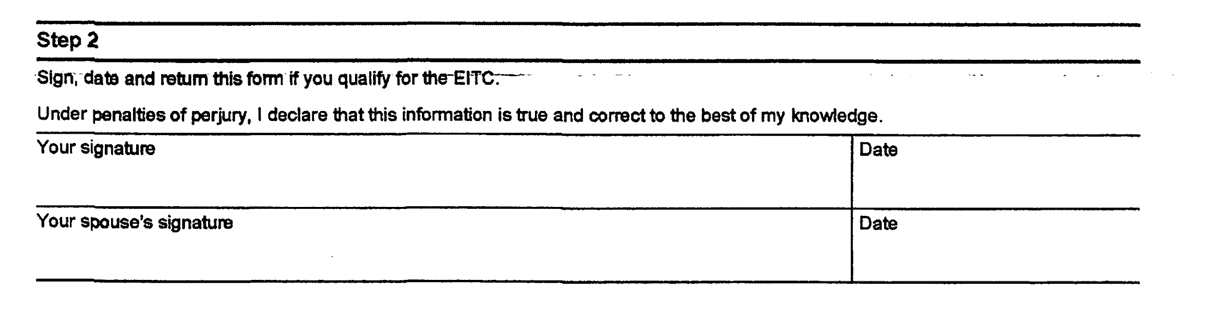
Step 2 is short but it is the part people get wrong.
You sign and date the form under penalties of perjury, and if you filed a joint return, your spouse has to sign it too.
An unsigned worksheet is not a valid claim, and a jointly filed year with only one signature is the most common reason a CP27 response comes back for correction.
The perjury language is a reminder that this is a sworn statement about your eligibility, not a survey.
Do You Actually Qualify for the Earned Income Credit Without a Qualifying Child?
Form 15112 asks about four disqualifiers, but the statute has more requirements than that, and the IRS screens most of them before it prints the notice.
Here is the complete picture for the childless version of the credit:
- You must have earned income. Wages, tips, salary, and net earnings from self-employment count, and pensions, unemployment compensation, alimony, and investment income do not.
- You must be at least 25 and under 65 at the end of the year. This is the rule in IRC § 32(c)(1)(A)(ii), and it applies only to the childless version of the credit.
- Your main home must have been in the United States for more than half the year. The 50 states, the District of Columbia, and U.S. military bases count, and Puerto Rico, Guam, and the U.S. Virgin Islands do not.
- You cannot be another person’s dependent or qualifying child. The credit is for the household that supports itself, not for someone who is claimed on another return.
- You need a Social Security number valid for employment. Under IRC § 32(m) it has to have been issued on or before the due date of the return, and an ITIN does not work.
- Your investment income has to stay under the annual cap. The limit was $11,600 for 2024, $11,950 for 2025, and $12,200 for 2026.
- You must be a U.S. citizen or resident alien for the whole year. There is an exception for a nonresident alien married to a citizen or resident who elects to be taxed as a resident on a joint return.
- You cannot file Form 2555. Claiming the foreign earned income exclusion rules out the credit for that year.
- Married filing separately usually rules you out, but not always. Since 2021 a separated spouse can claim the credit if the child-related or separation conditions in IRC § 32(d) are met, which generally means living apart from your spouse for the last six months of the year or having a written separation agreement.
If you clear all of that, you qualify, and the only remaining question is how much the credit is worth.
How Much Is the Childless Earned Income Credit Worth?
The maximum credit and the income cutoffs are indexed for inflation, so the answer depends on which tax year your notice covers.
Here are the numbers for the three most recent years, taken from the IRS inflation adjustment tables:
| Tax Year | Maximum Credit | Income Limit (Single, HOH, or MFS) | Income Limit (Married Filing Jointly) |
|---|---|---|---|
| 2024 | $632 | $18,591 | $25,511 |
| 2025 | $649 | $19,104 | $26,214 |
| 2026 | $664 | $19,540 | $26,820 |
Those income limits apply to both your earned income and your adjusted gross income, and going over either one ends the credit.
The credit is not a flat amount, because it phases in from the first dollar of earned income, holds at the maximum across a narrow band, and then phases out.
For 2026, for example, the maximum of $664 is reached at $8,680 of earned income and the credit is fully gone at $19,540 for an unmarried filer.
One thing worth checking after you claim the federal credit is whether your state offers one too.
Thirty-one states plus the District of Columbia and Puerto Rico have their own earned income credits, and most of them are computed as a straight percentage of the federal credit, which means a federal credit you just claimed can pull a state credit along with it.
California is one of the exceptions that runs its own calculation rather than piggybacking on the federal number, so a California filer should look at the CalEITC rules separately.
Still have questions? Talk to a tax expert — free.
How to Respond to IRS Notice CP27
If the notice is in front of you and you think you might qualify, here is the order of operations.
Step 1: Confirm the Notice Is Really From the IRS
A letter that says the government wants to send you money is exactly the shape of a scam, so it is worth thirty seconds of verification.
A real CP27 arrives by mail on paper, names a specific tax year, and matches a return you actually filed.
The IRS does not initiate contact about a CP27 by text message, email, or social media, and it will never ask for a gift card or a wire transfer to release a credit.
You can confirm what the IRS has on file by logging into your account at IRS.gov/account.
Step 2: Answer Step 1 for the Right Tax Year
This is the trap on the notice in front of us.
Our client’s CP27 covers tax year 2024, but the Form 15112 enclosed with it is the February 2026 revision, and every question in its Step 1 asks about 2025.
The IRS mails whatever revision of the worksheet is current when the notice prints, and that will not always line up with the year on your notice.
Answer the questions for the tax year printed at the bottom of your notice, not for the year printed on the worksheet.
Tip: Before you sign anything, check the tax year at the bottom of your notice against the year referenced in the worksheet questions. If they do not match, write the correct tax year next to the Step 1 heading so the person processing your response can see which year you answered for, and call 800-829-0922 if you are not sure which year the IRS is asking about.
Step 3: Check the Rules the Worksheet Does Not Ask About
Form 15112 covers residency, dependent status, Social Security card validity, and qualifying-child status, and that is all it covers.
It never asks about your investment income, your filing status, or whether you filed Form 2555, even though each of those can disqualify you.
Run through the full list in the section above before you sign, because you are signing under penalties of perjury.
Step 4: Send It Back the Fast Way
The Document Upload Tool at IRS.gov/DUTReply is the quickest option, and it needs the access code printed in the third bullet of the “What you need to do” section of your notice.
You can also reach the same place by scanning the QR code on the notice with your phone.
If you would rather mail it, put the signed worksheet and the detachable stub in the enclosed envelope, and keep a copy of everything you send.
Mailing by certified mail with return receipt costs a few dollars and gives you proof of the date the IRS received your claim, which matters if the year is close to the refund deadline.
Step 5: Track It and Follow Up After Eight Weeks
The notice promises a refund check in six to eight weeks after the IRS confirms you qualify.
If eight weeks pass with no check and no letter, call 800-829-0922 and have the notice in front of you.
You can also watch for the credit to post to your account transcript, which usually shows movement before a check arrives.
What Happens After You Send Form 15112
The IRS reviews the worksheet against the return and the information already in its systems.
There are three realistic outcomes:
- The credit is allowed and you get a refund. The IRS adjusts your account for that tax year and issues a check, typically within the six to eight week window the notice describes.
- The credit is allowed but applied to a balance. If you owe federal tax for any year, the credit is applied there first, and you receive only what is left over.
- The credit is denied. The IRS sends a separate letter explaining why, and that letter is what you would respond to or appeal.
Claiming the Earned Income Credit does put your return in a category the IRS reviews more closely than average, because the credit has a long history of improper payments.
That is not a reason to skip a credit you are entitled to, but it is a reason to be accurate.
If the IRS ever disallows an Earned Income Credit for a reason other than a math error, you can be required to file Form 8862 to recertify before claiming the credit again, and the notice that eventually clears you is IRS Notice CP74.
What If You Already Owe the IRS?
The sentence in the notice about reducing what you owe is easy to skim past, and for a lot of people it is the most important line on the page.
Under IRC § 6402, the IRS applies an overpayment to any outstanding federal tax liability before it refunds anything to you.
Beyond federal tax, the Treasury Offset Program can also take a refund for past-due child support, state income tax, and certain other federal debts.
So if you have an unpaid balance from a prior year, responding to your CP27 is still worth doing, because a few hundred dollars against the balance is better than nothing, but the refund may never reach your mailbox.
If that is your situation, the credit is not really the problem you need to solve.
The notice that tells you a refund was applied to a balance is IRS Notice CP49, and the notice that starts the collection process on an unpaid balance is IRS Notice CP14.
If a balance like that is sitting on your account, options such as an installment agreement, an offer in compromise, or currently not collectible status are worth looking at.
Is There a Deadline to Claim the Credit?
Nothing on the CP27 gives you a date, which leads a lot of people to assume the offer stays open forever.
It does not.
Under IRC § 6511(a), a claim for refund generally has to be filed within three years of when the return was filed or two years from when the tax was paid, whichever is later.
For a typical wage earner, that means roughly three years from the original April due date of the return in question.
Notices that arrive shortly after a return is processed leave you plenty of room, but a CP27 for an older year that you filed late can be much closer to the line than it looks.
The practical rule is simple: respond now rather than filing the envelope in a drawer.
What IRS Notice CP27 Is Not
Because it arrives in an IRS envelope, a CP27 gets mistaken for several things it is not.
- It is not a bill. There is no amount due, no payment stub for money, no penalty, and no interest anywhere on the notice.
- It is not an audit. The IRS is not questioning anything you reported, and the audit-style notice for a questioned Earned Income Credit is a different letter entirely.
- It is not a math error notice. The IRS has not changed your return, which is what notices like CP11 and CP13 do.
- It is not a scam. CP27 is a real notice with its own page at IRS.gov, even though the offer of unexpected money makes it feel otherwise.
- It is not a guarantee. The IRS is telling you that you might qualify, and the worksheet is how that gets decided.
- It is not the same as a CP09. The CP09 is the version of this notice that goes to taxpayers the IRS shows as having a qualifying child, and it encloses Form 15111 instead of Form 15112.
That last distinction matters more than it sounds.
If you received a CP27 but you actually did have a qualifying child that year whom you never claimed, the credit available to you is far larger than the childless maximum, and Form 15112 is the wrong way to get it.
In that situation you would file an amended return on Form 1040-X for the year rather than returning the worksheet.
If you are not sure which situation you are in, our overview of what CP stands for in IRS notices lays out how the different notice families relate to each other.
Get Help Responding to IRS Notice CP27
A CP27 on its own is usually something you can handle yourself in an afternoon, and if the only thing on your account is a missed credit, that is exactly what we would tell you to do.
Where it gets complicated is when the notice is a symptom of something larger, like several years of returns that were filed late, a balance that has been quietly growing, or a refund that keeps disappearing into an offset.
If that describes your situation, our team of CPAs, enrolled agents, and tax attorneys can look at the whole account rather than just the notice, and you can start with a free tax relief consultation or call us at 866-8000-TAX.
Frequently Asked Questions About IRS Notice CP27
Is IRS Notice CP27 good or bad news?
It is good news. A CP27 means the IRS reviewed the return you already filed, saw earned income, and noticed that you did not claim the Earned Income Credit you may have been entitled to. There is no balance due, no penalty, and no enforcement action attached to it, and the only thing the IRS is asking for is a completed worksheet so it can decide whether to send you money.
What happens if I ignore IRS Notice CP27?
Nothing bad happens to your account, and the notice says so directly in its last bullet under “What you need to do.” The consequence is simply that you do not get the credit, because the IRS will not add it to your account unless you return Form 15112. If you actually qualified, ignoring the notice means giving up a refund of up to a few hundred dollars, and once the refund statute of limitations under IRC § 6511 closes for that year, the money is gone for good.
How long does it take to get the refund after I return Form 15112?
The notice says six to eight weeks after the IRS reviews your forms and confirms you qualify. Uploading the worksheet through the Document Upload Tool at IRS.gov/DUTReply is generally faster than mailing it, because it skips the mail and the scanning queue. If more than eight weeks pass with no refund and no letter, the IRS asks you to call 800-829-0922.
What is the difference between IRS Notice CP27 and IRS Notice CP09?
They are the same notice for two different groups of taxpayers. A CP09 goes to people the IRS shows as having a qualifying child and encloses Form 15111, while a CP27 goes to people the IRS does not show as having a qualifying child and encloses Form 15112. The childless credit a CP27 relates to is much smaller, which is exactly why so many eligible people never bother to claim it in the first place.
Do I have to send Form 15112 back if I do not qualify?
No. If any of the four statements in Step 1 of the worksheet describes you, the form tells you to stop there and not respond at all. The IRS is not asking you to prove that you do not qualify, and there is no follow-up notice for a CP27 that goes unanswered.
The tax year on my notice does not match the year in the worksheet questions. Which one do I use?
Use the tax year printed at the bottom of your notice. The IRS encloses whatever revision of Form 15112 is current on the day the notice prints, so a notice covering an older tax year can arrive with a worksheet whose questions reference a more recent year. Answer for the year the IRS is actually asking about, note the correct year on the form so the processor can see it, and call 800-829-0922 if you are unsure.
If your CP27 turned out to be the smallest of your IRS problems, we can help you sort out the rest — schedule a free consultation and we will look at the whole account.

“Very professional and super easy to communicate with! It was easy from start to finish. We gathered all documents together and Logan and his team pretty much took care of the rest. We highly recommend them to anyone!”
Get Help Now
Got a CP27 notice? Get a straight answer before you respond.
Talk to a tax expert — free, no obligation. We’ve resolved over $20 million in IRS debt for our clients.


Author:

Logan Allec, CPA, Founder and Owner
Logan Allec has been serving taxpayers as a CPA for over 14 years. After leaving his role at a "Big 4" firm, he started Choice Tax Relief to help everyday Americans who have found themselves behind on their taxes. He also educates thousands of people daily about tax relief on his YouTube channel. In addition to his CPA license, Logan also has a Master's Degree in Taxation from the University of Southern California (USC). He lives with his wife and children in the Los Angeles area. Learn more about Logan here.