

IRS Notice CP62: What It Is and Why You Still Owe

If an envelope from the IRS just told you that it applied a payment to your account, you are holding a Notice CP62.
The headline sounds like good news, and sometimes it is.
But on most CP62 notices there is a second line directly underneath it that tells you what you still owe, and that is the line that sends people looking for answers.
This guide walks through a real CP62 line by line, explains what the IRS actually did inside your account before it printed the notice, and shows you what to do about the balance that is left over.
Here is a redacted CP62 notice that one of our clients received (PDF).
Key Takeaways
- Notice CP62 is the IRS’s confirmation that it moved a payment or credit onto one of your tax years — its internal name in the Internal Revenue Manual is “Notice of Credit Transfer – We Credited Your Account.”
- The money on a CP62 usually did not come from a check you just mailed; most of these notices are generated when an IRS employee transfers a payment that was already sitting somewhere else in the system.
- A CP62 is not automatically good news, because if a balance remains after the credit, the notice doubles as a bill with a short deadline.
- Your balance can go up on a CP62 even though you paid, because the notice adds the penalty and interest that accrued since your last statement at the same moment it credits your payment.
- On the redacted client notice below, the IRS credited a $1,499.56 payment and the balance still rose by $738.26.
- Before you do anything else, confirm the payment amount, the payment date and the tax year on the notice, because a CP62 exists precisely because a payment moved — and payments sometimes move to the wrong place.
Table of Contents
What Is IRS Notice CP62?
IRS Notice CP62 tells you that the IRS applied a payment to your account for a specific tax year, and like every notice in the CP series it is computer generated.
The IRS’s own public description of the notice is exactly one sentence long: “We applied a payment to your account.”
That description is accurate but it leaves out the part that actually matters, which is where the payment came from.
Inside the IRS, CP62 has a longer and much more revealing name.
The Internal Revenue Manual calls it “CP 62, Notice of Credit Transfer – We Credited Your Account,” and it explains that the notice generates when an employee completes the correspondence-date field while inputting a credit transfer.
A credit transfer, in the words of the same manual section, “moves a payment or credit from one module to another, or reverses a credit previously applied.”
A module is simply one tax year of one tax form on your account — your 2021 Form 1040 is one module, your 2022 Form 1040 is another.
So a CP62 is not usually the IRS acknowledging a check you mailed last week.
It is the IRS telling you that money which was already in its system has been picked up from one place and set down on the tax year named on the notice.
Tip: The fastest way to understand your CP62 is to stop reading it as a receipt and start reading it as a record of a transfer. Something moved. Your job is to confirm that it moved from the right place, to the right place, in the right amount.
Free Consultation
Got a CP62 notice? Don’t wait for the IRS’s next move.
Talk to a tax expert — free, no obligation. We’ve resolved over $20 million in IRS debt for our clients.
IRS Notice CP62 at a Glance
| Detail | What the CP62 Says |
|---|---|
| Notice type | Notice of Credit Transfer — a payment or credit was applied to your account |
| Is it a bill? | Only if a balance remains after the credit is applied; many CP62 notices show a balance due |
| Who sends it | An IRS campus — the redacted client notice below came from Kansas City, Missouri |
| Typical length | Three pages, including a detachable payment stub |
| Deadline shown | 21 calendar days from the notice date on the client notice below (10 business days if the amount is $100,000 or more) |
| Phone number on the notice | 800-829-8374 |
| Does it give you Tax Court rights? | No — a CP62 is not a Notice of Deficiency |
| Does it threaten a levy? | No — a CP62 is not a final notice of intent to levy, though ignoring it can lead to one |
| Main risk of ignoring it | Penalties and interest keep compounding and the account moves further into the collection stream |
Why Did the IRS Send You a CP62?
A CP62 is almost always the downstream result of a payment that was not where it belonged.
The Internal Revenue Manual section that governs credit transfers lists the classic ways a payment ends up in the wrong place:
- The payment posted to a completely different taxpayer’s account
- The payment posted to a related account, such as a parent’s account instead of a minor child’s
- The payment posted to the wrong business entity
- The payment was intended for one spouse’s account but landed on the other spouse’s account
Beyond those, there are several everyday situations that produce a CP62:
- You or your representative called the IRS, pointed out that a payment was applied to the wrong tax year, and an employee moved it
- A payment arrived without a tax year or form number written on it, sat in an unapplied credit account, and was later matched to you
- An overpayment from one year was applied against a balance you owed on a different year, which is the same mechanic behind Notice CP49
- An estimated tax payment was credited to the wrong quarter or the wrong year
- A joint payment had to be split between two separate accounts after a change in filing status
The notice itself will not tell you which of these happened.
That is one of the genuine weaknesses of the CP62: it reports the result of the transfer without reporting the reason for it.
A Part-by-Part Walkthrough of IRS Notice CP62
Everything below comes from a redacted CP62 that one of our clients received, and every figure on it is real.
Part 1: The Header, the Notice Date and the Mailing Block
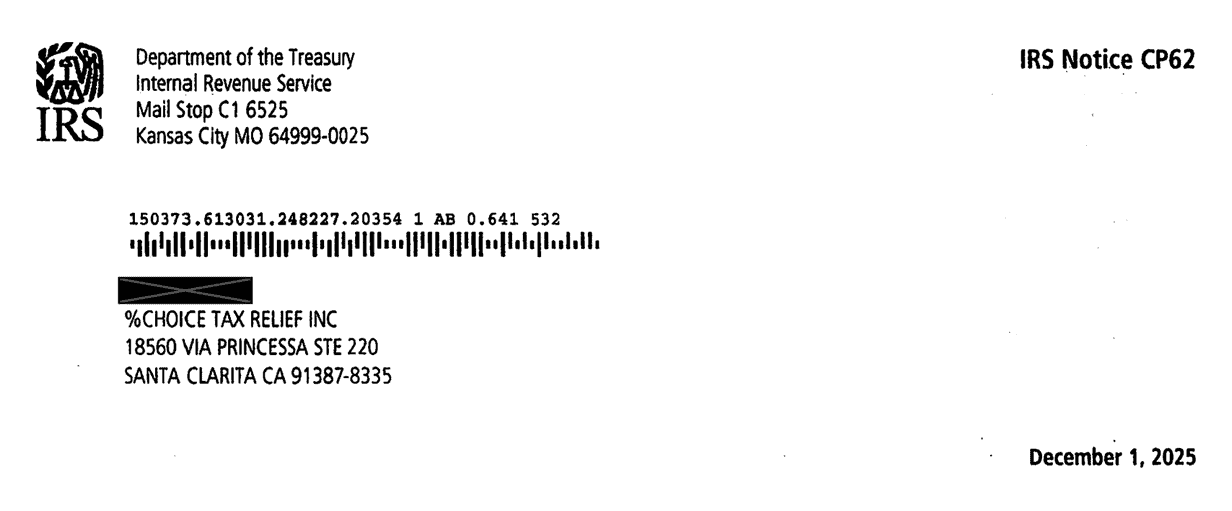
The top-right corner names the notice, and everything else on the page depends on getting that right.
The return address is the IRS campus in Kansas City, Missouri, at Mail Stop C1 6525.
The notice date is December 1, 2025, and that date drives every deadline on the notice.
The name in the address window is blacked out, but the address underneath is our firm’s office in Santa Clarita.
That is because this copy was mailed to us as the client’s authorized representative, which is also why the footer on page one reads “Internal use only: CAF 29H.”
Part 2: The Headline and the Line That Actually Matters

The headline reads “We applied payments totaling $1,499.56 to your account.”
Directly beneath it, in the same bold type, is the sentence that changes the tone of the whole notice: “You now owe $11,329.08.”
Those two lines are the entire CP62 in miniature.
The IRS credited $1,499.56, and this taxpayer still owes more than eleven thousand dollars for a tax year that ended nearly four years before the notice was printed.
Part 3: What the IRS Wants You to Do Immediately
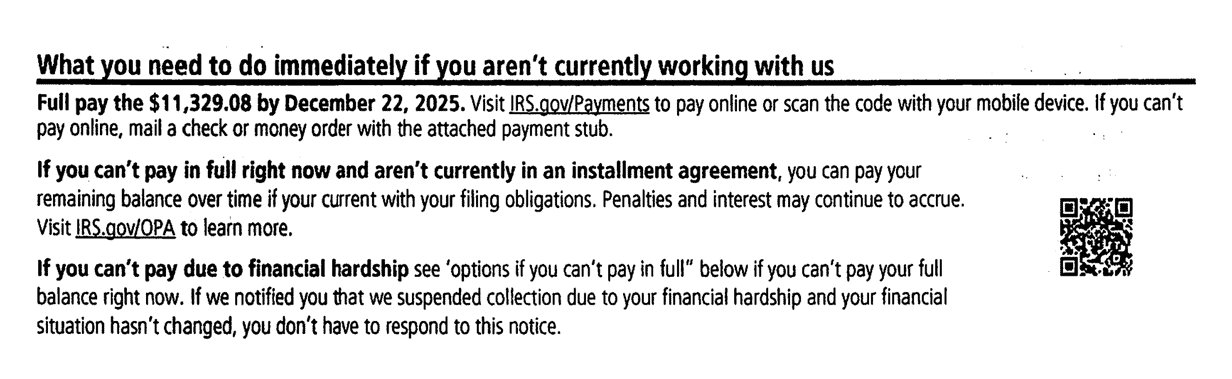
This section is headed “What you need to do immediately if you aren’t currently working with us,” which is the IRS’s way of saying that the instructions change if you already have an arrangement in place.
The IRS gives three paths here:
- Pay the full $11,329.08 by December 22, 2025, online at IRS.gov/Payments or by mailing a check with the payment stub
- Pay over time through an installment agreement at IRS.gov/OPA if you cannot pay in full and are current on your filing obligations
- Look at the options on page two if you cannot pay because of financial hardship
There is a sentence buried in the third bullet that is easy to miss and worth a great deal to the right reader.
It says that if the IRS previously told you it suspended collection because of your financial hardship, and your situation has not changed, you do not have to respond to this notice at all.
That is the IRS confirming that an account already in currently not collectible status stays there, even though the notice looks like a demand for payment.
Part 4: The Billing Summary
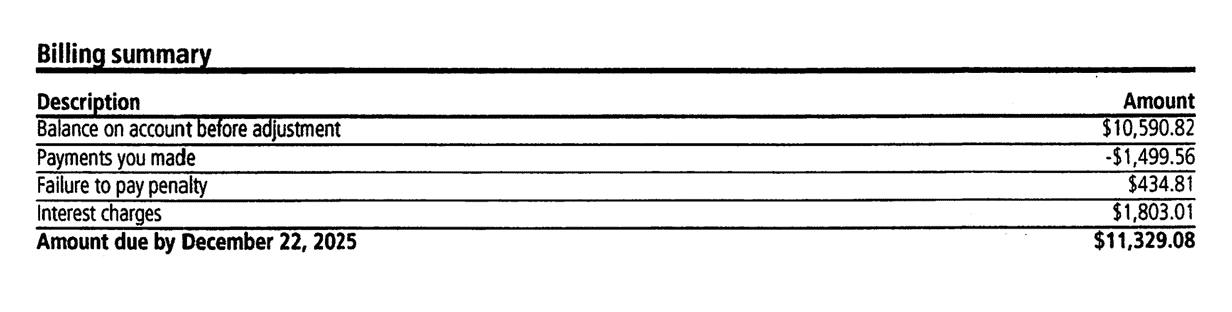
The billing summary is the most important box on the notice, and it breaks the balance into four moving parts:
- Balance on account before adjustment — $10,590.82
- Payments you made — minus $1,499.56
- Failure to pay penalty — $434.81
- Interest charges — $1,803.01
Those four lines produce an amount due of $11,329.08 by December 22, 2025.
Run the arithmetic and the numbers reconcile exactly, which is worth checking on your own notice because they do not always.
What the arithmetic also reveals is that this taxpayer’s balance went up rather than down, and the next major section of this guide is devoted to why.
Part 5: If You Disagree, Plus the Footer Nobody Reads
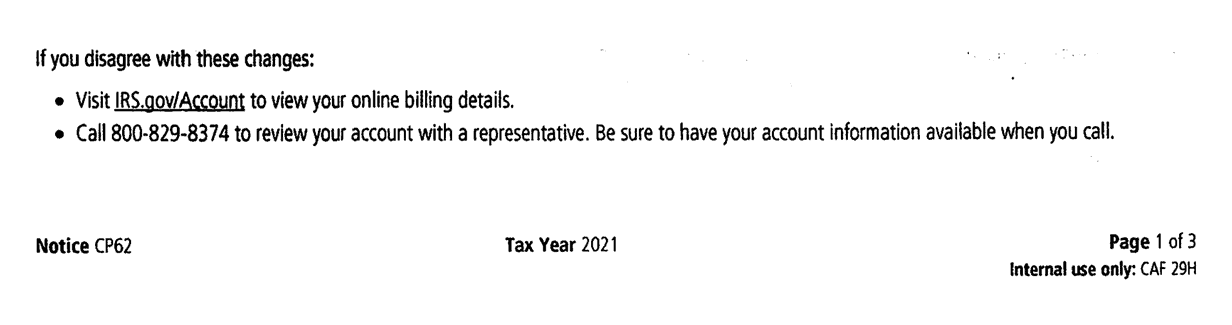
The disagreement instructions are thin, and they amount to two options.
- Visit IRS.gov/Account to view your online billing details
- Call 800-829-8374 to review your account with a representative
Notice what is absent: there is no form to file, no deadline to protest, and no appeal rights described anywhere on the notice.
The footer is the other half of this image, and it carries three facts you need before you can do anything useful.
It confirms the notice number, it confirms that this is page one of three, and it confirms that the tax year at issue is 2021.
The tax year is the single most important item on the whole notice, because a payment credited to 2021 does nothing for a balance you owe on 2022.
Part 6: Options If You Can’t Pay in Full
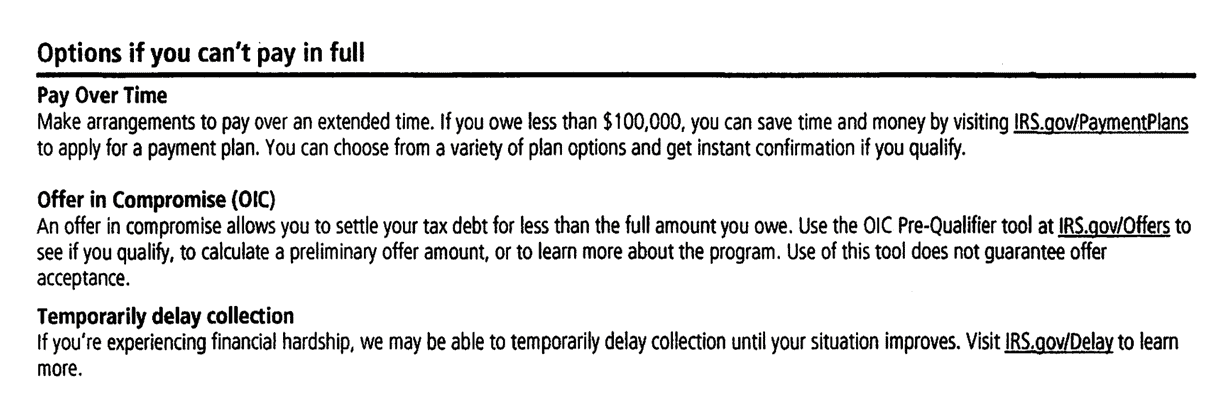
Page two opens with the three resolution paths the IRS is willing to describe on a notice.
- Pay Over Time, which points you to an installment agreement and notes that taxpayers who owe less than $100,000 can apply online
- Offer in Compromise, which lets you settle for less than the full amount if you qualify, with a warning that the Pre-Qualifier tool does not guarantee acceptance
- Temporarily delay collection, which is currently not collectible status under a friendlier name
The list is accurate as far as it goes, but it is written as though these were three equally available menu items.
In practice they have very different qualification standards, and the right one depends on your income, your equity in assets and how much time is left on the collection statute for that tax year.
Part 7: Payments Credited to Your Account

This short table is the heart of the CP62 and the first place you should look.
It shows one payment of $1,499.56 received on September 18, 2025, and a total of the same amount.
Three things on this table need to be verified against your own records before you accept the rest of the notice:
- The date received, because that date determines how much interest kept running before the credit landed
- The amount, because a transposed figure here flows through every other number on the notice
- The tax year in the heading, because this table is specific to one year and one year only
Notice the gap on this client’s notice between the date the payment was received and the date the notice was printed.
The payment was received on September 18, 2025, and the notice is dated December 1, 2025, which is 74 days later.
Part 8: Penalties and the Failure-to-Pay Charge
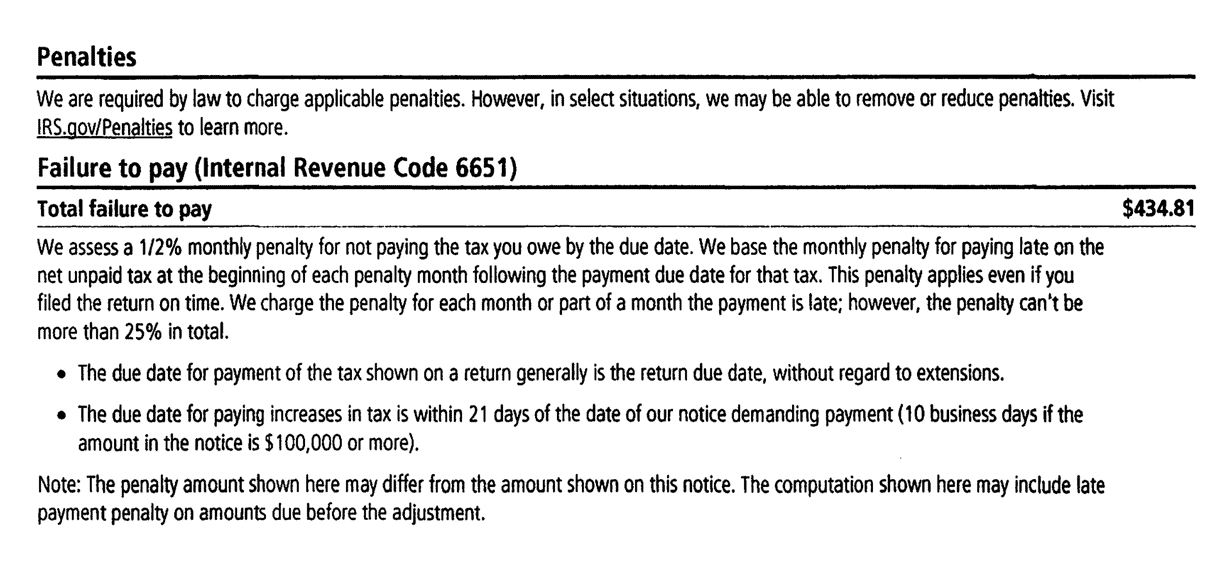
The IRS opens with a line that quietly matters: it is required by law to charge applicable penalties, but in select situations it may be able to remove or reduce them.
The failure-to-pay penalty on this notice is $434.81, and it is charged under Internal Revenue Code section 6651.
The notice explains the mechanics in its own words, and they are worth restating plainly:
- The penalty runs at one-half of one percent per month on the net unpaid tax
- It applies even if you filed your return on time
- It is charged for each month or part of a month the payment is late
- It cannot exceed 25 percent of the tax in total
Two bullets on the notice then explain when the clock starts.
For tax shown on a return, the clock starts on the original return due date without regard to extensions.
For an increase in tax, the clock starts 21 days after the date of the notice demanding payment, or 10 business days if the amount in the notice is $100,000 or more.
The IRS closes the section with a caution that the penalty figure shown may include late-payment penalty on amounts that were already due before the adjustment.
Part 9: Interest and the Rate Table
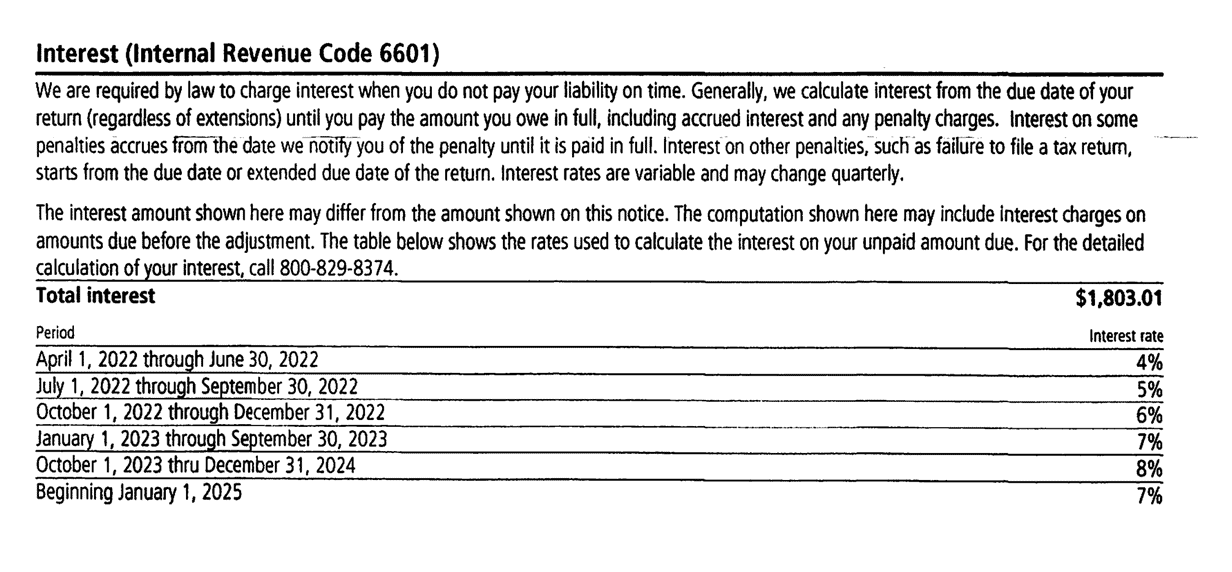
Interest on this notice comes to $1,803.01, charged under Internal Revenue Code section 6601.
The rate table beneath it is the most useful thing on page two, because it lets you audit the IRS’s own math.
This client’s notice lists six rate periods:
- April 1, 2022 through June 30, 2022 — 4 percent
- July 1, 2022 through September 30, 2022 — 5 percent
- October 1, 2022 through December 31, 2022 — 6 percent
- January 1, 2023 through September 30, 2023 — 7 percent
- October 1, 2023 through December 31, 2024 — 8 percent
- Beginning January 1, 2025 — 7 percent
Every one of those rates matches the quarterly underpayment rates the IRS published for those periods, which tells you the table was generated correctly.
The table also stops where the notice was printed, so it says nothing about what has happened since.
Under Internal Revenue Code section 6621 the underpayment rate for individuals is the federal short-term rate plus three percentage points, and it is reset every quarter.
For readers looking at an older notice today, the rate was 7 percent for all of 2025, 7 percent in the first quarter of 2026, 6 percent in the second quarter, and back to 7 percent effective July 1, 2026.
Interest also compounds daily under section 6622, which is why an old balance grows faster than a simple percentage calculation suggests.
Part 10: Where to Find More Information
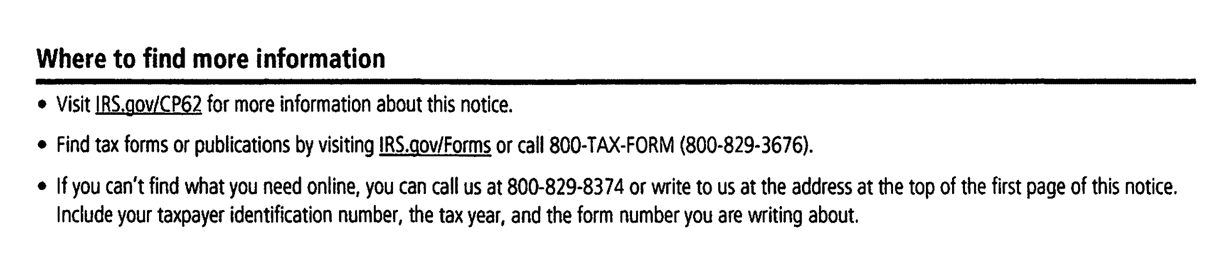
Page three opens with three reference bullets.
- IRS.gov/CP62 for the IRS’s own page about this notice
- IRS.gov/Forms or 800-TAX-FORM for forms and publications
- 800-829-8374, or a letter to the address at the top of page one, if you cannot find what you need online
If you do write, the notice asks you to include your taxpayer identification number, the tax year and the form number.
That instruction is not boilerplate on a CP62, because the entire notice exists as a result of a payment that was not matched to the right account in the first place.
Part 11: The Payment Stub and Its Hidden Line
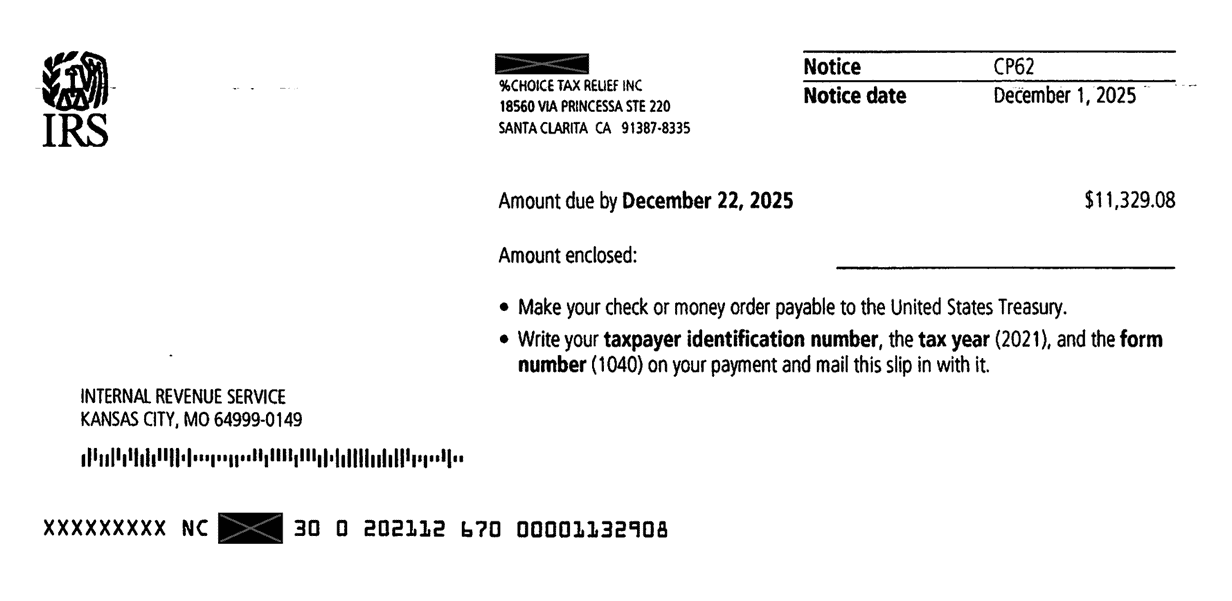
The detachable stub repeats the notice number, the notice date and the amount due of $11,329.08.
It instructs you to make the check payable to the United States Treasury and to write your taxpayer identification number, the tax year and the form number on the payment itself.
The mailing address on the stub is not the same as the return address on page one, which catches people out.
Page one comes from Kansas City, MO 64999-0025, while payments go to Kansas City, MO 64999-0149.
The line running across the very bottom of the stub is the one almost nobody looks at, and it is a compressed summary of your entire account.
On this client’s stub it reads, after the masked identification number, “30 0 202112 670 00001132908,” and each piece means something:
- 30 is the master file tax code for a Form 1040 individual income tax return
- 202112 is the tax period, meaning the year ending December 2021
- 670 is the transaction code for a subsequent payment, which is what the IRS expects your check to post as
- 00001132908 is the amount, $11,329.08, with the decimal point removed
If the tax period in that string is not the year you think you are paying, stop and call before you mail anything.
Why Your Balance Went Up Even Though You Made a Payment
This is the question almost every CP62 recipient with a remaining balance ends up asking.
On our client’s notice the balance before the adjustment was $10,590.82 and the balance after it was $11,329.08.
The IRS credited $1,499.56 and the balance still climbed by $738.26.
The explanation is that a CP62 does two separate things in one document, and only one of them is in your favor.
- It credits the payment that was transferred onto the account, which reduces the balance by $1,499.56
- It brings the penalty and interest current as of the notice date, which increased the balance by $2,237.82
The second number is larger than the first, so the net movement was upward.
None of this means the payment was wasted.
Without it the balance would have been $12,828.64 rather than $11,329.08, and the interest running on that larger figure would have compounded from there.
What it does mean is that on an aged balance, a single payment can be smaller than the carrying cost that accumulated while you were saving up to make it.
Important: If your payments are smaller than the penalty and interest accruing between notices, your balance will keep rising no matter how faithfully you pay. That is the point at which the conversation should shift from how to pay the balance to whether the balance can be reduced or the penalties abated.
How the IRS Decides Which Year Your Payment Pays
The rule that governs this is Revenue Procedure 2002-26, and it is short enough to summarize accurately.
If you give the IRS specific written directions with your payment, the IRS applies the payment according to those directions.
If you do not, the IRS applies the payment “to periods in the order of priority that the Service determines will serve its best interest.”
Within whichever period the IRS picks, the revenue procedure then fixes the order: the money goes to tax first, then penalty, then interest, until it is used up.
That ordering is why a payment can vanish into a year you were not thinking about.
There are two practical consequences worth acting on.
- Designate every voluntary payment in writing, on the check memo line and in a short cover letter, naming the form number and the exact tax period
- Understand that the right to designate applies to voluntary payments only, so money the IRS takes through a levy or a refund offset goes wherever the IRS decides to put it
If you owe for several years, designating deliberately is one of the few levers you control.
Directing payments to the year with the least time left on its collection statute, or to a year where a trust fund penalty could otherwise attach, can matter a great deal more than the dollar amount of the payment.
CP62 vs. CP60: Two Sides of the Same Credit Transfer
Every credit transfer has two ends, and the IRS has a separate notice for each of them.
If a payment is moved onto your account you get a CP62, and if a payment is moved off your account you get a CP60.
Sometimes the same transfer generates both notices, arriving days apart, which is why taxpayers occasionally open one envelope saying they were credited and another saying they now owe more.
| Notice CP62 | Notice CP60 | |
|---|---|---|
| Internal Revenue Manual title | Notice of Credit Transfer — We Credited Your Account | We Removed a Payment Erroneously Applied to Your Account — Balance Due |
| Which way the money moved | Onto the tax year named on the notice | Off the tax year named on the notice |
| Effect on that year’s balance | Decreases by the amount credited | Increases by the amount removed |
| What triggers it | An employee completes the correspondence-date field when inputting the transfer | The transfer leaves the account in a debit balance above a set threshold |
| Is it always a bill? | No — only when a balance remains after the credit | Yes — it always shows a balance due |
| First thing to check | The payment date, amount and tax year in the payments table | Which account the removed payment went to instead |
How to Read Your Account Transcript After a CP62
The CP62 summarizes what happened, but it does not show you the underlying entries.
For that you need the account transcript for the tax year named on the notice, which you can pull from your online account at IRS.gov or request from your representative.
The transcript is a chronological list of transaction codes, and a handful of them tell the whole story of a CP62.
- Transaction code 670 is a subsequent payment, which is how a payment made after the return was filed posts to the account
- Transaction code 276 is the computer-generated failure-to-pay penalty
- Transaction code 196 is computer-generated interest
- A credit transfer shows up as a matched pair of entries, one removing the money from the account it was sitting on and one placing it on the account the CP62 is about
Read the dates on those entries rather than the amounts alone.
The date the payment posted, not the date the IRS moved it, is what determines how much interest should have stopped running and when.
If a payment you made in one year did not get credited until three years later because it was sitting on the wrong module, the interest charged in between is worth a hard look.
Owe the IRS? Talk to a tax expert — free.
How to Respond to IRS Notice CP62
Step 1: Verify That the Payment Is Actually Yours
Match the amount and the date in the payments table against your bank records, your cancelled checks or your IRS online account.
If the payment is not yours, or the amount is wrong, call 800-829-8374 and say so before you do anything else.
The IRS can research the transfer using the document locator number attached to it, and a payment moved onto your account in error can be moved back off it just as easily.
Step 2: Confirm the Tax Year
Check the tax year in the footer, in the payments-table heading and in the scan line on the payment stub, and confirm all three agree.
If the payment landed on a year you did not intend, that is a correctable problem and it is worth correcting.
Interest and penalties are computed per year, so putting the money on the right year can change what you owe overall.
Step 3: Check the Billing Summary Arithmetic
Take the balance before adjustment, subtract the payments, add the penalty and add the interest, and confirm you land on the amount due.
On our client’s notice those four figures reconcile exactly.
If yours do not reconcile, you have a concrete question to ask when you call rather than a vague sense that something is off.
Step 4: Decide How You Are Handling the Remaining Balance
If you can pay the balance in full by the date on the notice, doing so stops the interest clock on the amount stated.
If you cannot, the realistic choices are an installment agreement, an offer in compromise, or currently not collectible status.
Which one fits depends on your monthly income against IRS collection standards, your equity in assets and how much time remains on the ten-year collection statute for that year.
Step 5: Address the Penalties Separately
Handling the balance and handling the penalties are two different projects, and people routinely do only the first one.
Ask about first-time abatement of the failure-to-pay penalty if you have a clean compliance history for the three years before the year at issue.
If first-time abatement does not apply, reasonable cause is the other route, and it turns on the specific facts of why you could not pay.
Step 6: Do Not Let the Deadline Pass Quietly
Our client’s notice was dated December 1, 2025 and asked for payment by December 22, 2025, a window of exactly 21 days.
That 21-day figure is not arbitrary, because under Internal Revenue Code section 6601(e)(3) paying the amount stated in a notice and demand within 21 calendar days stops interest from being charged for the period after the notice date.
The window shrinks to 10 business days if the amount demanded is $100,000 or more.
What Happens If You Ignore Notice CP62
Nothing dramatic happens the day after the deadline, which is exactly why these notices get set aside.
What happens instead is slower and more expensive.
- The failure-to-pay penalty keeps accruing at one-half of one percent per month until it reaches the 25 percent ceiling
- Interest keeps compounding daily on the tax, the penalties and the previously accrued interest
- The account continues through the collection notice stream toward CP501, CP503 and CP504
- A federal tax lien can be filed, which reaches all of your property and rights to property
- Once a final notice of intent to levy is issued, the failure-to-pay rate doubles to one percent per month under section 6651(d)
There is one point in the other direction that is worth knowing.
If you get into an installment agreement and you filed the return on time, the failure-to-pay rate drops to one-quarter of one percent per month for the months the agreement is in effect under section 6651(h).
That is a fifty percent reduction in the penalty rate available simply for having an agreement in place.
Can the Penalties and Interest Be Removed?
The penalty and the interest are governed by different rules, and conflating them is the most common mistake taxpayers make here.
The failure-to-pay penalty is genuinely removable.
First-time abatement is available administratively if you have no penalties for the three tax years before the year in question, you have filed all currently required returns, and you have paid or arranged to pay any tax due.
Reasonable cause is the alternative, and it depends on showing that you exercised ordinary business care and prudence but still could not pay.
Interest is a different animal.
The IRS charges interest because the statute requires it, and it can only be abated in narrow circumstances — principally under Internal Revenue Code section 6404(e), where the interest accrued because of an unreasonable error or delay by an IRS employee in performing a ministerial or managerial act.
Here is the part that gets overlooked, and it matters on a notice like this one.
Interest accrues on penalties as well as on tax, so when a penalty is removed, the interest that accrued on that penalty comes off with it.
On a balance where interest is $1,803.01 and the penalty is $434.81, abating the penalty is worth more than the penalty figure alone suggests.
What IRS Notice CP62 Is Not
Understanding what a CP62 does not do is as useful as understanding what it does.
- It is not an audit and it is not a proposed change to your return
- It is not a Notice of Deficiency, so it does not open a 90-day window to petition the United States Tax Court
- It is not a final notice of intent to levy, so it does not carry Collection Due Process appeal rights
- It is not a lien filing and it is not notice that a lien has been filed
- It is not a bill for newly assessed tax, because the tax on a CP62 was already assessed before the transfer happened
- It is not proof that your account is now correct, only that one specific transfer was made
That last point deserves emphasis.
A CP62 confirms a single movement of money, and it says nothing at all about whether the other years on your account are in order.
Get Help Responding to IRS Notice CP62
A CP62 with a balance on it is rarely a standalone problem.
By the time the IRS is moving payments between years, there is usually an older liability that started with a CP14 and has since been restated every year on a CP71A, an accrual that has outgrown the payments being made against it, and a decision to be made about which resolution path actually fits.
At Choice Tax Relief we pull the account transcripts for every year, confirm that the transfer on your CP62 landed where it should have, and then build the resolution around what the transcripts actually show rather than what a single notice says.
Call us at 866-8000-TAX or schedule a free tax relief consultation and we will tell you where your account stands.

“I can’t thank Kylie Klingman enough for the incredible work she did in helping me resolve my back tax issues with both the IRS and the California Franchise Tax Board.”
Frequently Asked Questions About IRS Notice CP62
Does a CP62 mean the IRS made a mistake?
Not necessarily, but it does mean a payment was not originally where it needed to be. The notice is generated by a credit transfer, which is the process the IRS uses to move a payment or credit from one tax module to another. Sometimes the original misapplication was the IRS’s error, sometimes it happened because a payment arrived without a tax year or form number written on it, and sometimes the transfer is simply an overpayment from one year being applied to a balance on another.
I made a payment, so why does my CP62 say I owe more than before?
Because the notice updates your penalty and interest at the same time it credits your payment. On the redacted client notice in this guide, the IRS credited $1,499.56 but also added $434.81 of failure-to-pay penalty and $1,803.01 of interest, so the balance rose by $738.26 on net. The payment still helped, because the balance would have been roughly $1,500 higher without it, but on an aged liability a single payment can be smaller than the carrying cost that built up while you were saving for it.
What should I do if the payment shown on my CP62 is not mine?
Call the number on the notice and tell the IRS the payment was misapplied. The IRS can research the transfer and reverse it, and its own procedures allow a credit transfer to be authorized by phone as long as the employee documents the account, the amount and the reason. Do not simply ignore a payment you did not make, because if it is later reversed the balance comes back along with the interest that would have accrued in the meantime.
How long does it take for a credit transfer to show up on my account?
Plan on several weeks rather than several days. The credit transfer has to post to the master file before the corresponding notice generates, and the notice itself is printed and mailed on a cycle. On the client notice in this guide the payment was received on September 18, 2025 and the notice confirming it was dated December 1, 2025, a gap of 74 days.
Can I stop the interest while I sort out a CP62?
The only reliable way to stop interest is to pay the balance, because interest is required by statute and is rarely abatable. If you pay the amount stated in the notice within 21 calendar days of the notice date, section 6601(e)(3) prevents interest from being charged for the period after that date, and the window is 10 business days if the amount demanded is $100,000 or more. If you cannot pay in full, getting into an installment agreement at least cuts the failure-to-pay penalty rate in half for the months the agreement is in effect.
Is a CP62 the same as a CP60?
They are opposite ends of the same transaction. A CP62 tells you a payment was moved onto the tax year named on the notice, while a CP60 tells you a payment was removed from it and that a balance is now due. The same credit transfer can generate both notices, which is why some taxpayers receive one letter saying they were credited and another saying they owe more within the space of a few days.
What happens if I just ignore my CP62?
The failure-to-pay penalty keeps running at one-half of one percent per month up to a 25 percent ceiling, interest keeps compounding daily on the tax and the penalties, and the account moves further along the collection notice stream toward a lien or a levy. If the IRS eventually issues a final notice of intent to levy, the failure-to-pay rate doubles to one percent per month. Responding early, even just to get into an agreement, is materially cheaper than responding late.
Get Help Now
Got a CP62 notice? Don’t wait for the IRS’s next move.
Talk to a tax expert — free, no obligation. We’ve resolved over $20 million in IRS debt for our clients.


Author:

Logan Allec, CPA, Founder and Owner
Logan Allec has been serving taxpayers as a CPA for over 14 years. After leaving his role at a "Big 4" firm, he started Choice Tax Relief to help everyday Americans who have found themselves behind on their taxes. He also educates thousands of people daily about tax relief on his YouTube channel. In addition to his CPA license, Logan also has a Master's Degree in Taxation from the University of Southern California (USC). He lives with his wife and children in the Los Angeles area. Learn more about Logan here.