

IRS Notice CP44: Why Your Refund Is Delayed and What Happens Next

Almost every notice the IRS mails is about money you owe.
IRS Notice CP44 is about money the IRS owes you — and is not sending yet.
It arrives after you file a return showing a refund, and it tells you that the refund is being held while the IRS checks whether you owe other federal taxes.
There is no balance printed on it, no deadline, no payment stub, and nothing to sign or return.
That is exactly what makes it unsettling, because the notice tells you your money is on hold without telling you why the IRS thinks there might be a problem.
The most useful clue is buried in the IRS’s own frequently asked questions for this notice, which ask how long it takes to determine any “non-individual liability” — a strong hint that the account being researched is a business or penalty account, not your regular Form 1040.
Here is a redacted CP44 notice that one of our clients received: IRS Notice CP44 (PDF).
Important: The images in this article come from a redacted CP44 that one of our clients received — not a mock-up. We blacked out the taxpayer’s name and address, and everything else appears exactly as the IRS printed it.
Key Takeaways
- CP44 is a delay notice, not a bill. The IRS is holding a refund you already claimed while it verifies whether you owe other federal taxes.
- You do not have to respond. The notice says in plain language that you do not need to do anything, and there is no form, deadline, or payment stub attached.
- Two things can happen next. Within six to eight weeks the IRS will either release the refund with interest or send a second notice explaining that it applied the money to a balance you owe.
- The legal authority is IRC §6402(a). That subsection lets the IRS credit an overpayment against any liability for an internal revenue tax before refunding the balance to you.
- The suspected balance is often not on your Form 1040 account. The IRS’s own guidance frames the delay as research into a non-individual liability, and the offset priority list in IRM 21.4.6.4 includes civil penalty, Business Master File, and Non-Master File accounts.
- Interest is not automatic. Under IRC §6611(e)(1) the IRS owes you nothing if it pays the refund within 45 days of the later of the return due date or the date you actually filed.
Table of Contents
What Is IRS Notice CP44?
IRS Notice CP44 is a one-page notice telling you that your refund has been delayed because the IRS is checking whether you owe other federal taxes.
The IRS describes it on its own website as follows: “There’s a delay sending your refund. We’re checking to see if you owe other federal taxes.”
The legal basis is IRC §6402(a), which allows the Secretary to credit an overpayment “against any liability in respect of an internal revenue tax on the part of the person who made the overpayment” and to refund only the balance.
In other words, the law does not let the IRS mail you a refund while a federal tax debt is sitting unpaid somewhere in your file.
What CP44 really represents is the pause button the IRS presses while it figures out whether such a debt exists.
The notice is generated automatically, it carries no dollar figure for the suspected debt, and it does not identify which account triggered the review.
Free Consultation
Got a CP44 notice? Get a straight answer before you respond.
Talk to a tax expert — free, no obligation. We’ve resolved over $20 million in IRS debt for our clients.
IRS Notice CP44 at a Glance
| Feature | What the CP44 Actually Says |
|---|---|
| Official headline | “Your refund has been delayed” |
| What it means | The IRS is verifying whether you owe other federal taxes before releasing your refund |
| Response required | None — the notice states, “You don’t need to do anything.” |
| Deadline | There is no deadline, because there is nothing to submit |
| Amount due | None — a CP44 never asks you for money |
| Timeframe given | Six to eight weeks on the notice itself, and “up to 8 weeks” on the IRS website |
| Legal authority | IRC §6402(a), the general offset and refund provision |
| Procedural guidance | IRM 21.4.6, Refund Offset Research, Reversals, and Injured Spouse Processing |
| Two possible outcomes | The refund is released with any interest owed, or a second notice explains that it was applied to a balance |
| Phone number on this client’s notice | 800-829-8374 |
| Return address on this client’s notice | P.O. Box 621501, Atlanta, GA 30362-1501 |
| Payment stub | None, because nothing is owed |
Why Did the IRS Send You a CP44?
A CP44 is triggered when two things are true at the same time.
The first is that a return you filed produced an overpayment the IRS agrees you are entitled to.
The second is that something in IRS records suggests a federal tax balance may exist somewhere else in your file, and the system cannot confirm or rule it out automatically.
If the balance were sitting plainly on another Form 1040 year, the computer would usually just apply the refund and send you a CP49 explaining the offset.
The fact that you got a CP44 instead generally means a human has to go look.
The “Non-Individual Liability” Clue
The IRS’s published questions and answers for this notice include one that asks how long it takes to determine any non-individual liability.
That wording matters, because “non-individual” points away from your personal income tax account and toward the other places a federal tax debt can live.
IRM 21.4.6.4 sets out the order in which an overpayment gets applied, and the list is a useful map of where the IRS is looking:
- Federal tax, primary taxpayer identification number. A balance on your own account for another year.
- Individual retirement account. Excise or penalty amounts tied to an IRA.
- Shared responsibility payment. A legacy health coverage assessment.
- Civil penalty. A standalone penalty module, which is where a trust fund recovery penalty assessment sits.
- Federal tax, secondary taxpayer identification number. A balance tied to a spouse on a joint return.
- Business Master File. Employment, excise, or corporate tax accounts.
- Non-Master File. Accounts the IRS maintains outside its main systems.
- Treasury Offset Program. Non-tax debts such as child support and federal student loans.
- Credit elect. An amount you asked to be applied forward to next year’s estimated tax.
Notice how many of those categories have nothing to do with your personal Form 1040.
In our experience the CP44 recipients who end up losing part of the refund are most often people connected to a business with unpaid payroll taxes, people with an assessed trust fund recovery penalty, and people who filed jointly with a spouse who has an older balance.
What Does Not Cause a CP44
It is just as useful to know what this notice is not about.
- Non-tax debts. Child support, defaulted student loans, and state obligations are collected under IRC §6402(c) through (f) through the Treasury Offset Program, and those offsets are announced by the Bureau of the Fiscal Service, not by a CP44.
- An audit or examination. A CP44 does not question anything on your return, and if the IRS wanted to review the return itself you would see a CP05 instead.
- A math error. If the IRS changed a number on your return it would send a CP11, CP13, or similar math error notice showing the recalculation.
- Unfiled returns. When the IRS freezes a refund because you have not filed other years, the notice you get is a CP63.
A Part-by-Part Walkthrough of IRS Notice CP44
The CP44 is a single page, and every element on it is doing a job.
Here is what each section of the redacted notice one of our clients received actually tells you.
Part 1: Who Sent It and Who It Went To
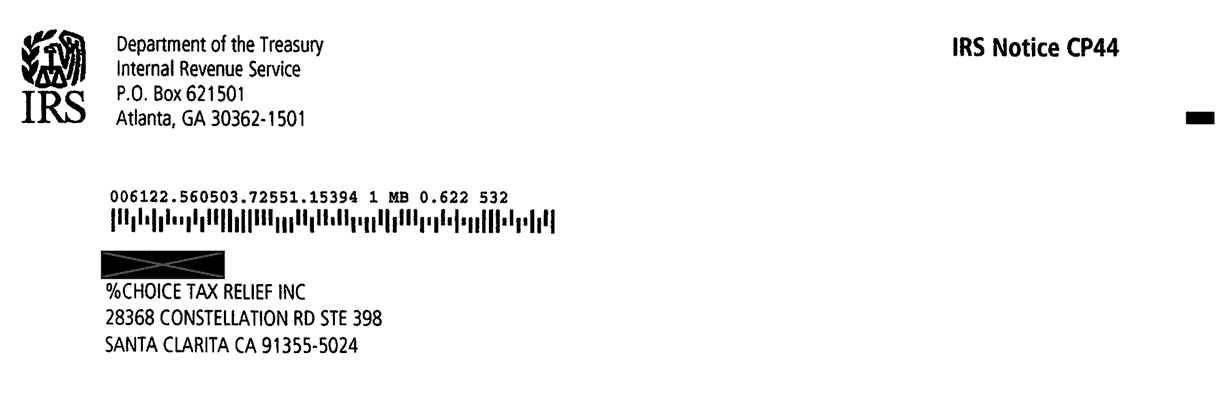
The top-left block identifies the sender as the Department of the Treasury at P.O. Box 621501 in Atlanta, Georgia, and the top-right corner names the notice as CP44.
The address panel on this copy reads “%CHOICE TAX RELIEF INC,” which means it was mailed to us as the taxpayer’s authorized representative rather than to the taxpayer directly.
If you have a valid Form 2848 on file, your representative receives a copy like this one at the same time you receive yours, which is worth knowing because it means your tax professional can start researching the delay without waiting for you to forward the envelope.
Part 2: The Notice Date, the Headline, and Your Refund Amount

The notice date on this client’s copy is June 30, 2025, and that date is the one to count from when you are measuring the six-to-eight-week window.
The headline reads “Your refund has been delayed,” followed by the sentence that explains everything: “We need to make sure you don’t owe other federal taxes, so we’re delayed in processing your 2023 refund of $2,494.00.”
This is the single most valuable line on the page, because it confirms both the tax year under review and the exact dollar amount the IRS agrees you overpaid.
The second sentence is the warning shot: “If you owe other federal taxes, we may apply all or part of your refund to it.”
Read carefully, that sentence is telling you the IRS has not yet decided whether a debt exists, which is different from telling you that one does.
Part 3: What You Need to Do Now

This section opens with four words that are unusual on IRS letterhead: “You don’t need to do anything.”
It then commits the IRS to one of two outcomes within six to eight weeks:
- The refund is released. You receive the money along with any interest you are entitled to under IRC §6611.
- A second notice arrives. The IRS applied some or all of the refund to other federal taxes, and the follow-up notice explains where the money went.
The section closes by asking you to keep the notice for your records, which is worth doing because the notice is your dated proof of both the refund amount and the start of the delay.
Part 4: Additional Information

The IRS points you to IRS.gov/CP44 for a plain-English explanation of the notice and gives 800-829-8374 as the assistance line on this client’s copy.
Calling that number during the six-to-eight-week window is usually unproductive, because the representative who answers can see the same freeze you can see on your transcript and typically cannot override the research that is still in process.
Part 5: The Footer Line That Tells You Which Year Is Affected

The footer confirms the notice number, the tax year, and the page count, and on this copy it reads “Notice CP44,” “Tax Year 2023,” and “Page 1 of 1.”
The “Internal use only: CAF 29H” marking on the far right is the IRS’s own code confirming this was the copy generated for the Centralized Authorization File representative.
Note that the tax year in the footer is the year that generated the refund, not the year of the balance the IRS is hunting for.
The Disaster Relief Insert That Came With This CP44
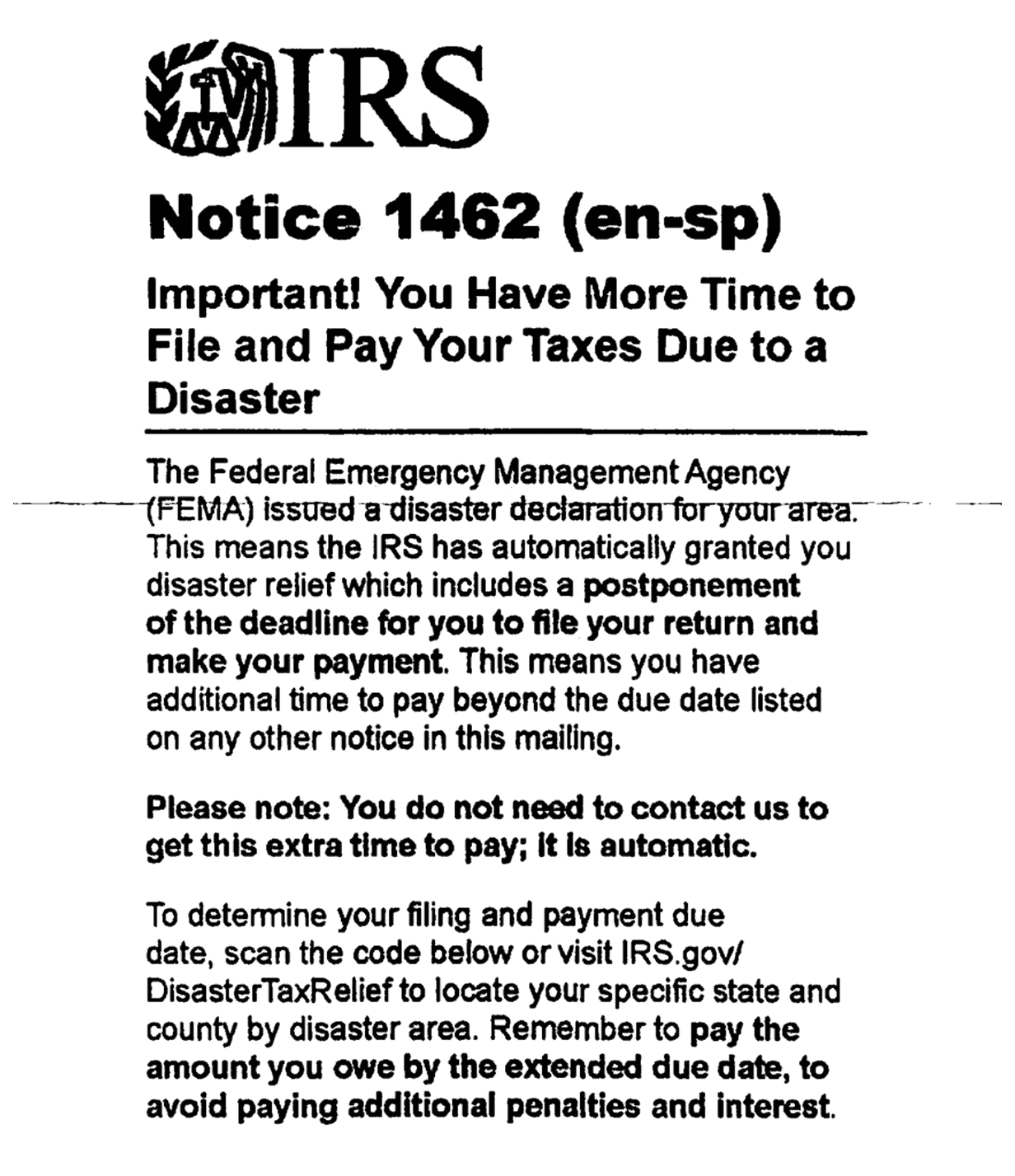
The envelope this client received also contained Notice 1462, a standard insert the IRS adds to mailings sent to addresses inside a federally declared disaster area.
It explains that the Federal Emergency Management Agency issued a disaster declaration covering the recipient’s area and that the IRS has automatically postponed filing and payment deadlines as a result.
The insert is worth understanding for two reasons.
The first is that the postponement is automatic, and the notice says so directly: “You do not need to contact us to get this extra time to pay; it is automatic.”
The second is that Notice 1462 has nothing to do with the refund hold itself, so seeing it in the same envelope does not mean your disaster relief caused the delay.
CP44 vs. CP49 vs. CP05: Three Refund Notices That Are Easy to Confuse
These three notices all involve a refund that is not in your bank account, but they mean very different things.
| Notice CP44 | Notice CP49 | Notice CP05 | |
|---|---|---|---|
| What it says | Your refund has been delayed | We applied your refund to taxes you owe | We are reviewing your return |
| Stage | The IRS is still deciding | The IRS has already decided and acted | The IRS is verifying the return itself |
| What is being questioned | Whether you owe a balance somewhere else | Nothing — the offset is done | Income, withholding, or credits you reported |
| Is your refund gone? | Not yet, and it may come through in full | Some or all of it has already been applied | It is frozen pending the review |
| Response required | None | None, unless you disagree with the offset | None initially, but documents are often requested later |
| Typical timeframe | Six to eight weeks | Already final when the notice arrives | Often 60 days or considerably longer |
| Read our guide | You are reading it | IRS Notice CP49 | IRS Notice CP05 |
How Long Does a CP44 Refund Delay Actually Take?
The notice itself promises an answer within six to eight weeks, and the IRS website states that it takes up to eight weeks to determine whether another balance exists.
Count that window from the notice date printed on your copy rather than from the day the envelope showed up in your mailbox.
If eight weeks pass with no refund and no follow-up notice, the delay has stopped being routine and it is reasonable to escalate.
At that point the productive steps are pulling your account transcript to see whether the freeze has been released, calling the number on the notice, and, if a real hardship has developed, contacting the Taxpayer Advocate Service.
Tip: Your online IRS account and your account transcript will usually show the refund freeze and its release before any paper notice reaches you, so checking IRS.gov/account is faster than waiting for the mail.
Will the IRS Pay You Interest on the Delayed Refund?
The CP44 says the IRS will include “any interest to which you’re entitled,” and that phrasing is doing a lot of work.
Under IRC §6611(e)(1), no interest is allowed at all if the overpayment is refunded within 45 days of the later of the return’s original due date or the date the return was actually filed.
That 45-day grace period is why a CP44 delay can consume most of your patience and still produce a refund check with no interest attached.
Once the IRS blows past that window, interest generally runs from the later of those two dates, and under IRC §6611(b)(2) it is computed to a date no more than 30 days before the refund is actually issued.
The rate is set quarterly under IRC §6621(a)(1) as the federal short-term rate plus three percentage points for taxpayers other than corporations, which works out to 7 percent for the quarter beginning July 1, 2026.
One detail people forget is that refund interest is taxable income in the year you receive it, and the IRS issues a Form 1099-INT when it pays you $10 or more.
Still have questions? Talk to a tax expert — free.
What You Should Do While You Wait
The notice says you do not need to do anything, and strictly speaking that is true.
But there is a difference between what you are required to do and what a well-advised taxpayer actually does with an eight-week head start.
Step 1: Write Down the Two Numbers That Matter
Record the notice date and the refund amount printed in the opening sentence, because those two figures anchor everything else.
The notice date starts your eight-week clock, and the refund amount is the ceiling on what the IRS can apply to any balance it finds.
Step 2: Pull Transcripts for Every Account You Touch
Order your individual account transcripts for the last several years through your IRS online account, and do not stop at your Form 1040.
Given how often a CP44 traces back to a non-individual account, also check any employment tax accounts for a business you own or have owned, any civil penalty modules assessed against you personally, and any year in which you filed jointly with a spouse who had prior balances.
Step 3: Deal With Any Balance You Already Know About
If you already know about an unpaid federal tax balance, the CP44 is not the moment to hope the IRS does not find it.
Getting ahead of a known balance with an installment agreement, an offer in compromise, or a request for currently not collectible status puts you in a far better position than waiting to see how much of your refund disappears.
Step 4: Consider Form 8379 If the Debt Belongs to Your Spouse
If you filed a joint return and the balance the IRS is researching belongs to your spouse alone, Form 8379, Injured Spouse Allocation, is how you claim your share of the refund.
The procedures for these claims sit in IRM 21.4.6.5.4, and filing the form proactively is generally faster than waiting for the offset to happen and then asking for it back.
Step 5: Set a Calendar Reminder for Week Nine
Put a reminder on your calendar for roughly nine weeks after the notice date.
If nothing has arrived by then — no refund, no second notice — that is your signal to start making calls rather than to keep waiting quietly.
What IRS Notice CP44 Is Not
A lot of the anxiety this notice creates comes from people reading things into it that are not there.
- It is not a bill. There is no amount due, no payment stub, and no due date anywhere on the page.
- It is not an audit notice. Nothing on your return is being questioned, and no documentation is being requested.
- It is not a confirmation that you owe the IRS. The notice says the IRS needs to make sure, which means the answer may well turn out to be no.
- It is not a collection notice. It carries no levy warning, no lien language, and none of the appeal rights that come with a CP504 or a final notice of intent to levy.
- It is not something you can speed up by calling. The research is systemic, and the eight-week estimate reflects the queue rather than anything you can influence.
What Happens If the IRS Takes the Whole Refund?
If the research turns up a real balance, the refund gets applied to it and you receive a follow-up notice explaining the offset, most commonly a CP49.
That notice shows which tax period received the money and whether anything was left over to send you.
There is one piece of good news buried in the mechanics, which is that an overpayment credited against an older liability is treated as a payment on that liability rather than as money that vanished.
Under IRC §6601(f), no interest is imposed on the portion of an underpayment that is satisfied by a credit for the period during which the overpayment was available, so an offset can stop the interest clock on the old debt as well as reduce the principal.
If you believe the offset was wrong — the balance was already paid, the assessment was not yours, or the debt belongs to a spouse — the follow-up notice is the document to act on, and the sooner you challenge it the better.
Get Help With Your CP44 Refund Delay
A CP44 by itself is not an emergency, and plenty of them end with the refund simply showing up.
The ones worth taking seriously are the ones where you already suspect what the IRS is going to find, because the refund is rarely the only thing at stake once a federal tax balance surfaces.
If you already know there is a balance out there — an old payroll tax account, a penalty assessed against you personally, or a year you would rather not think about — the eight weeks the IRS spends researching it is time you could spend getting ahead of it.
Our team of CPAs, enrolled agents, and tax attorneys can look at your entire account rather than just the notice, find what the IRS is going to find, and put a resolution in place before the next letter arrives.
You can start with a free tax relief consultation or call us at 866-8000-TAX.
Frequently Asked Questions About IRS Notice CP44
Do I need to respond to IRS Notice CP44?
No. The notice states directly that you do not need to do anything, and there is no form, deadline, or payment stub attached to it. The IRS will contact you again within six to eight weeks either by sending the refund or by sending a second notice explaining that it applied the refund to other federal taxes you owe.
Does a CP44 mean I definitely owe the IRS money?
No. A CP44 means the IRS is checking whether you owe other federal taxes, not that it has concluded you do. Many taxpayers who receive a CP44 get their full refund once the research is finished. The notice is issued at the point of uncertainty, which is precisely why it contains no dollar amount for any supposed debt.
How long does the IRS hold a refund after a CP44?
The notice gives a window of six to eight weeks, and the IRS website says it takes up to eight weeks to determine whether another balance exists. Measure that window from the notice date printed on your copy. If more than eight weeks pass with no refund and no follow-up notice, check your IRS online account and account transcript, then call the number on the notice.
Will the IRS pay me interest for delaying my refund?
Sometimes. Under IRC 6611(e)(1), no interest is allowed if the refund is issued within 45 days of the later of the return’s original due date or the date you filed. Beyond that window, interest generally runs at the federal short-term rate plus three percentage points for individuals, which is 7 percent for the quarter beginning July 1, 2026. Any interest the IRS pays you is taxable income in the year you receive it.
What is the difference between a CP44 and a CP49?
A CP44 is sent while the IRS is still deciding whether to apply your refund to another balance, and a CP49 is sent after it has already done so. Put simply, a CP44 says your money is on hold and a CP49 says your money is gone. It is common to receive a CP44 first and a CP49 several weeks later, though many CP44 recipients never receive a CP49 at all.
Can I get my refund back if the IRS applies it to my spouse’s tax debt?
Possibly, through Form 8379, Injured Spouse Allocation. If you filed a joint return and the balance belongs to your spouse alone, Form 8379 lets you claim the portion of the refund attributable to your own income and withholding. The IRS processes these claims under IRM 21.4.6.5.4, and filing the form as soon as you receive the CP44 is generally faster than waiting for the offset and then requesting a reversal.

“I’m currently working with Nathan and his team at Choice Tax, and the experience so far has been excellent. They’ve been helping me since last year with some complex tax issues, including back taxes, and I’ve already seen how knowledgeable and thorough they are. What sets them apart is their attention to detail.”
Get Help Now
Got a CP44 notice? Get a straight answer before you respond.
Talk to a tax expert — free, no obligation. We’ve resolved over $20 million in IRS debt for our clients.


Author:

Logan Allec, CPA, Founder and Owner
Logan Allec has been serving taxpayers as a CPA for over 14 years. After leaving his role at a "Big 4" firm, he started Choice Tax Relief to help everyday Americans who have found themselves behind on their taxes. He also educates thousands of people daily about tax relief on his YouTube channel. In addition to his CPA license, Logan also has a Master's Degree in Taxation from the University of Southern California (USC). He lives with his wife and children in the Los Angeles area. Learn more about Logan here.