

IRS Notice CP30A: What It Is and Why Your Refund Went Up

If you just opened an envelope from the IRS and the very first line says your refund has been increased, you can exhale — IRS Notice CP30A is one of the few notices the IRS sends that is actually good news.
The CP30A tells you that the IRS looked at the estimated tax penalty reported on your tax return, decided it was too high, and reduced or removed it.
Because that penalty was baked into the bottom line of your return, taking it away either increases your refund or shrinks what you owe.
That said, a CP30A is not a notice to file away unread.
It is telling you something specific about how you paid in your tax last year, and if you don’t act on that information, you can land in the same spot next April — except next time the correction may not go in your favor.
Below is a redacted version of a CP30A that one of our clients received, and we will walk through it section by section so you can find the same information on yours.
View a redacted IRS Notice CP30A that one of our clients received (PDF)
Key Takeaways
- The CP30A is a correction in your favor. The IRS recalculated the estimated tax penalty you reported and found it was larger than the penalty actually due.
- No response is required if you agree. Unlike a CP14 or a CP2000, the CP30A has no reply form, no payment stub, and no response deadline.
- The penalty at issue is the IRC Section 6654 estimated tax penalty. This is the charge for not paying in enough tax during the year through withholding and quarterly estimated payments.
- A refund on a CP30A is not automatic cash. The IRS applies it to other federal tax you owe, and to debts it is required to collect, before anything reaches your bank account.
- The billing summary can still show charges. On the redacted client notice below, the IRS removed the estimated tax penalty but still charged a failure-to-pay penalty and interest on an amount that was paid late.
- The real lesson is forward-looking. If you were penalized for underpaying estimated tax once, the same withholding pattern will usually do it again next year unless you change something.
Table of Contents
Where the CP30A Fits in the CP30 Series
The CP30A is the version of the CP30 that moves in your favor, because it reduces or removes an estimated tax penalty you reported on your own return instead of charging you a new one.
Use the table below to see how the CP30A compares to the CP30 so you can confirm exactly which notice you received and what it means.
| Notice | What It Is | When the IRS Sends It |
|---|---|---|
| CP30 | A notice telling you the IRS charged you a penalty for not paying enough estimated tax during the year, or not paying it on time. | After the IRS reviews your return, computes the estimated tax penalty under IRC Section 6654, and finds you underpaid — which reduces your refund or creates a balance due. |
| CP30A | A notice telling you the IRS reduced or removed the estimated tax penalty that you reported on your own return. | After the IRS recalculates the estimated tax penalty you claimed on your return and finds it is larger than the penalty actually due — which increases your refund or reduces your balance. |
Free Consultation
Got a CP30A notice? Get a straight answer before you respond.
Talk to a tax expert — free, no obligation. We’ve resolved over $20 million in IRS debt for our clients.
What Is IRS Notice CP30A?
IRS Notice CP30A is the notice the IRS sends when it reduces or removes the estimated tax penalty that you reported on your own income tax return.
The penalty in question is the addition to tax under Internal Revenue Code Section 6654, which applies to individuals who do not pay in enough tax during the year through wage withholding and quarterly estimated tax payments.
Most taxpayers never calculate this penalty themselves and simply let the IRS figure it, but if you (or your software, or your preparer) did compute it on Form 2210 and carried it to your Form 1040, the IRS will check that number.
When the IRS’s own calculation comes out lower than yours, it corrects the return in your favor and mails you a CP30A explaining what changed.
The result is either a larger refund or a smaller balance due, depending on where your return stood before the correction.
The IRS’s procedures for computing, asserting, and adjusting this penalty live in IRM 20.1.3, Estimated Tax Penalties, with the individual rules at IRM 20.1.3.3 and post-assessment adjustments at IRM 20.1.3.3.2.
IRS Notice CP30A at a Glance
Here is the CP30A in summary form, using the redacted client notice below as the example.
| Notice number | CP30A |
| What it means | The IRS reduced or removed the estimated tax penalty you reported on your return |
| Penalty involved | Failure to pay estimated income tax, IRC Section 6654 |
| Who sends it | IRS campus operations; the redacted client notice came from Mail Stop C1 6525, Kansas City, MO 64999-0025 |
| Length | 2 pages on the redacted client notice |
| Response required | None if you agree with the change |
| Payment stub | None |
| Phone number on the notice | 800-829-8374 |
| Tax year shown | 2025 on the redacted client notice |
| Notice date shown | May 25, 2026 on the redacted client notice |
| Refund timing | 4 to 6 weeks if you have not already received it and owe nothing else |
| Is it good news? | Yes, in isolation, but read the billing summary for other charges |
Why Did the IRS Send You a CP30A?
The short answer is that you told the IRS you owed an estimated tax penalty, and the IRS disagreed with you in the direction that favors you.
The estimated tax penalty is unusually easy to overstate, because the calculation depends on facts your tax software may not have and that the IRS does have.
Here are the situations that most often produce a CP30A:
- Your software used the general Form 2210 method when the annualized income installment method would have produced a smaller penalty, or none at all.
- Your withholding is treated as paid evenly across the year under IRC Section 6654(g), which can wipe out an underpayment your return assumed was there.
- Your prior-year tax was lower than the figure used in the calculation, so the 100% (or 110%) prior-year safe harbor actually protected you.
- You qualified for the small-balance exception in IRC Section 6654(e)(1), which shuts off the penalty when the tax shown on the return, less withholding, is under $1,000.
- You had no tax liability at all in the preceding 12-month tax year, which turns off the penalty entirely under IRC Section 6654(e)(2).
- You live in a federally declared disaster area and the IRS applied a postponed deadline that your return did not reflect, which the CP30A itself points out.
- You made a payment the return did not account for, or the IRS credited an estimated payment to a period your calculation put somewhere else.
The IRS does not tell you which of these applied on the notice itself.
If the reason matters to you — and it should, because it tells you how to plan for next year — the fastest way to see the detail is to pull your account transcript from your IRS online account and look at the penalty transaction codes for that tax year.
CP30A vs. CP30: Which Notice Did You Get?
The CP30 and the CP30A look similar and sit next to each other in the IRS numbering, but they say opposite things.
| IRS Notice CP30 | IRS Notice CP30A | |
|---|---|---|
| Core message | The IRS charged you a penalty for not paying estimated tax, or not paying it on time | The IRS reduced or removed the estimated tax penalty you reported |
| Direction of the change | Against you | In your favor |
| Effect on your refund | Reduces your refund or creates a balance due | Increases your refund or reduces your balance due |
| Who computed the penalty first | The IRS | You, on your return |
| Typical reaction | Why am I being penalized? | Why is my refund bigger than I expected? |
| Is a response needed? | Only if you disagree or a balance is due | Only if you disagree |
If your notice says a penalty was charged rather than reduced, you are holding a CP30, and the questions worth asking are different.
You can see the full family of notices the IRS sends in our guide to what CP stands for on an IRS notice.
A Part-by-Part Walkthrough of IRS Notice CP30A
The redacted client notice below is a two-page CP30A dated May 25, 2026 for tax year 2025.
The client’s name and address are blacked out, and the notice was addressed in care of our office because we hold the power of attorney on the account.
Part 1: The Header and the Notice Date
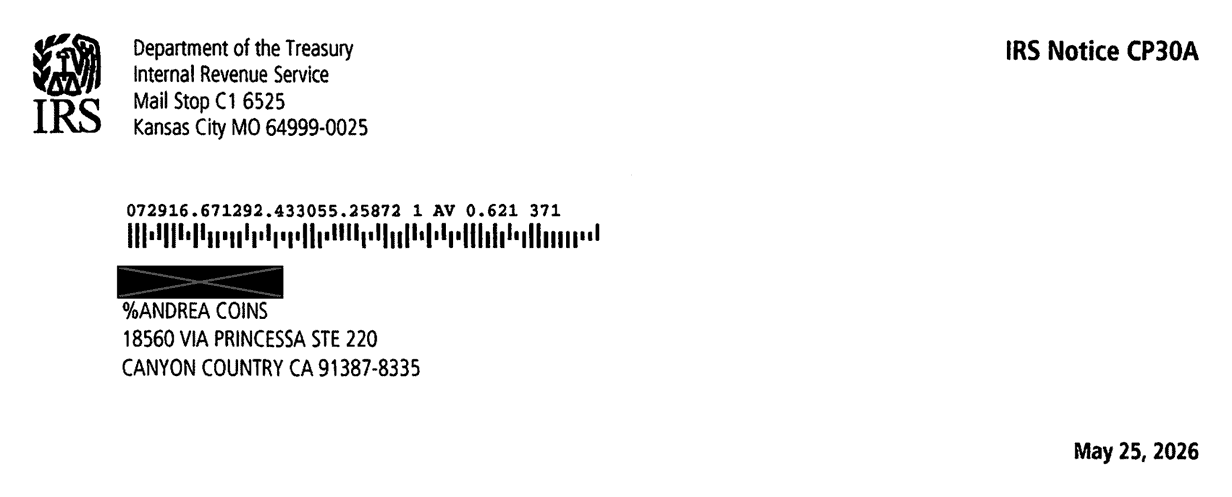
The top right corner is where you confirm what you are actually holding, and on this notice it reads “IRS Notice CP30A.”
The return address is an IRS campus rather than a local office, which is normal for automated notices like this one.
The notice date — May 25, 2026 here — is the date that matters for tracking the 4-to-6-week refund window described later in the notice.
If your name and address block shows a representative’s address instead of yours, as this one does, you are looking at the copy the IRS mailed to the tax professional who holds your power of attorney.
Part 2: The Headline and Why the IRS Changed Your Return

The headline states the outcome and the reason in a single sentence, and on this notice it reads that the refund has been increased to $180.48 because the penalty for failing to pay estimated tax payments was reduced.
The paragraph underneath names the return and the year the IRS reviewed, which here is Form 1040 for tax year 2025.
It then says the IRS found the taxpayer miscalculated the estimated tax penalty and that the penalty reported on the return is greater than the penalty due.
That word “miscalculated” is doing a lot of work and reads more harshly than it should, because in our experience the vast majority of these are software defaults rather than errors anyone made on purpose.
Part 3: What Happens Next

This section repeats the refund figure and gives you the timing, which on this notice is 4 to 6 weeks if the refund has not already arrived.
Read the condition attached to that promise closely, because the refund only comes to you if you don’t owe other tax or debts the IRS is required to collect.
The second paragraph is the disaster-area paragraph, and it tells you that if you were in a federally declared disaster area, the IRS already considered any additional time you were granted when it computed the penalty.
That paragraph is a strong hint about why some CP30A notices exist at all, since disaster postponements are one of the most common reasons a self-computed penalty turns out to be too high.
Part 4: The Billing Summary
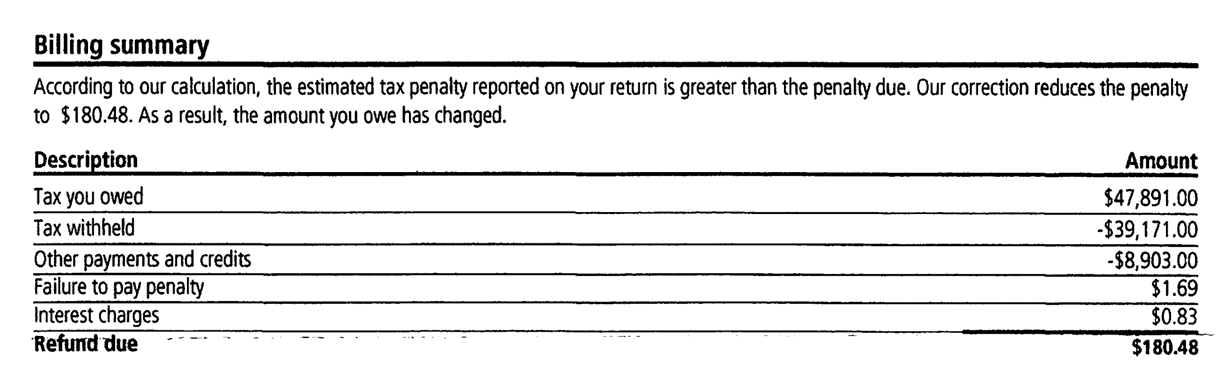
This is the most useful part of the notice and the part most people skip.
On the redacted client notice, the billing summary lays out the following:
- Tax you owed — $47,891.00
- Tax withheld — $39,171.00
- Other payments and credits — $8,903.00
- Failure to pay penalty — $1.69
- Interest charges — $0.83
- Refund due — $180.48
Take the tax owed, subtract the withholding and the other payments and credits, and you get an overpayment of $183.00.
Subtract the $1.69 failure-to-pay penalty and the $0.83 of interest from that $183.00 and you land exactly on the $180.48 refund shown at the bottom.
Notice what is missing from that list, because there is no estimated tax penalty line anywhere in the billing summary on this notice.
That absence is the whole point of the CP30A, since the penalty the client reported has been taken out of the calculation entirely.
Part 5: If You Disagree, and the Penalties Paragraph

The notice gives you one phone number for disagreements, and on this notice it is 800-829-8374.
The instruction to have your account information available before you call is worth following, because the representative will not discuss the account without verifying you.
The penalties paragraph is boilerplate that appears on most IRS notices, and it says the IRS is required by law to charge applicable penalties but may be able to remove or reduce them in select situations.
That sentence is a pointer to penalty relief generally, and you can read how the main relief programs work in our guide to IRS penalty abatement.
Part 6: The Failure-to-Pay Penalty Detail
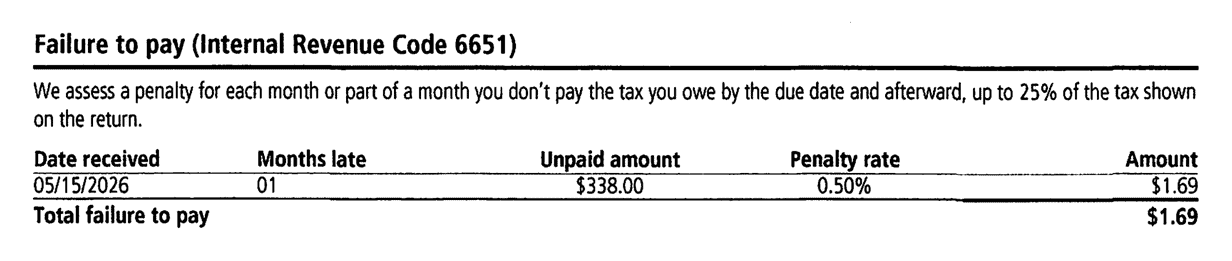
Page 2 opens with the detail behind the failure-to-pay penalty under Internal Revenue Code Section 6651, which is a completely different penalty from the estimated tax penalty the notice just reduced.
The failure-to-pay penalty applies for each month or part of a month you don’t pay the tax you owe by the due date, at 0.5% per month, capped at 25% of the tax shown on the return.
On this client’s notice the table shows a payment date received of 05/15/2026, one month late, on an unpaid amount of $338.00, at a 0.50% rate, for a penalty of $1.69.
In plain English, this taxpayer had a small balance at filing time and paid it about a month after the April deadline, so the IRS charged a penalty on that late payment even while removing the larger estimated tax penalty.
Part 7: The Interest Detail
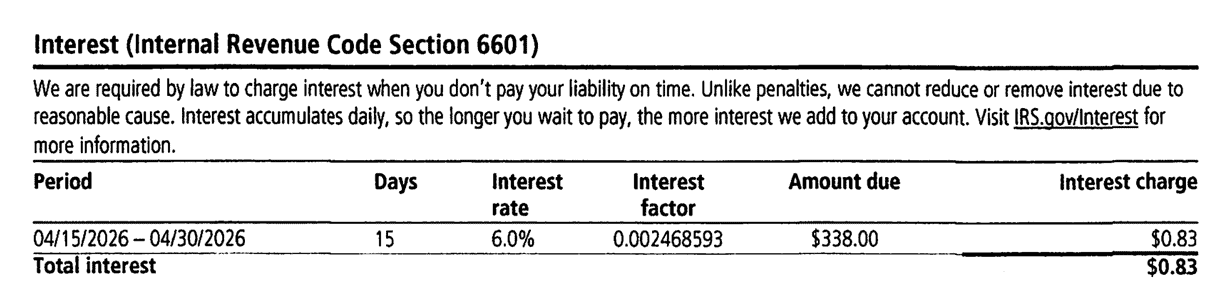
The interest section cites Internal Revenue Code Section 6601 and makes a point worth committing to memory.
Unlike penalties, interest cannot be reduced or removed for reasonable cause, which means a good excuse will not get interest off your account.
The table on this notice shows a period of 04/15/2026 through 04/30/2026, 15 days, a 6.0% interest rate, an interest factor of 0.002468593, an amount due of $338.00, and an interest charge of $0.83.
That 6.0% was the underpayment rate the IRS had set for the second quarter of 2026, and the rate changes every quarter, so the figure on your notice depends on when your balance was outstanding.
You can see how those rates move and what they cost over time in our article on how much interest the IRS charges.
Part 8: Where You Can Find More Information
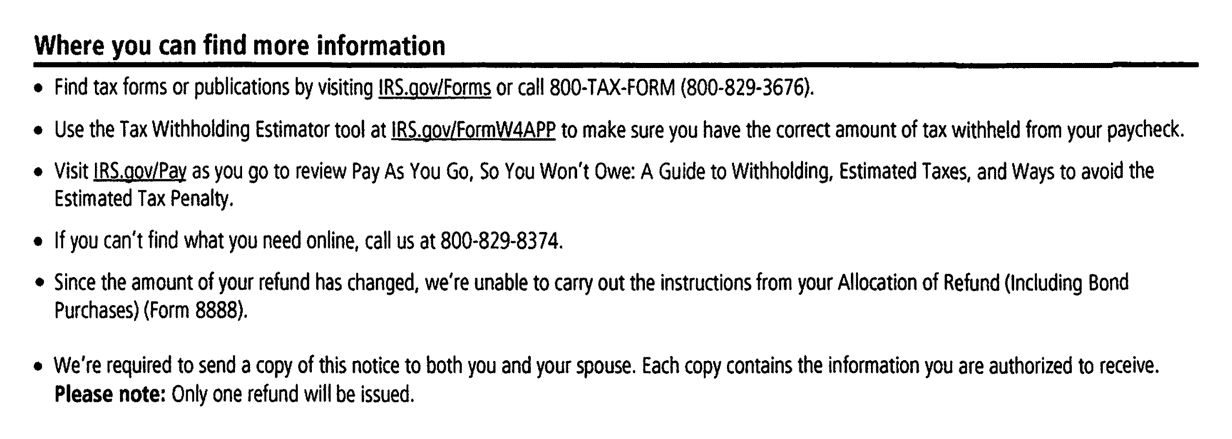
This block is more useful than the usual notice boilerplate because two of its bullets are aimed squarely at preventing a repeat.
The bullets on the redacted client notice cover the following:
- Finding forms and publications at IRS.gov/Forms or by calling 800-829-3676.
- Using the IRS Tax Withholding Estimator at IRS.gov/FormW4APP to check whether enough tax is coming out of your paycheck.
- Reviewing the IRS guide to withholding, estimated taxes, and ways to avoid the estimated tax penalty at IRS.gov/Pay.
- Calling 800-829-8374 if you can’t find what you need online.
- A warning that because the refund amount changed, the IRS cannot follow the split-refund instructions from a Form 8888 you filed.
- A note that on a joint return the IRS sends a copy of the notice to each spouse but issues only one refund.
That Form 8888 bullet catches people out every year, because taxpayers who planned to split a refund across accounts or buy savings bonds will instead receive the whole thing one way.
Part 9: Taxpayer Rights and Free Help
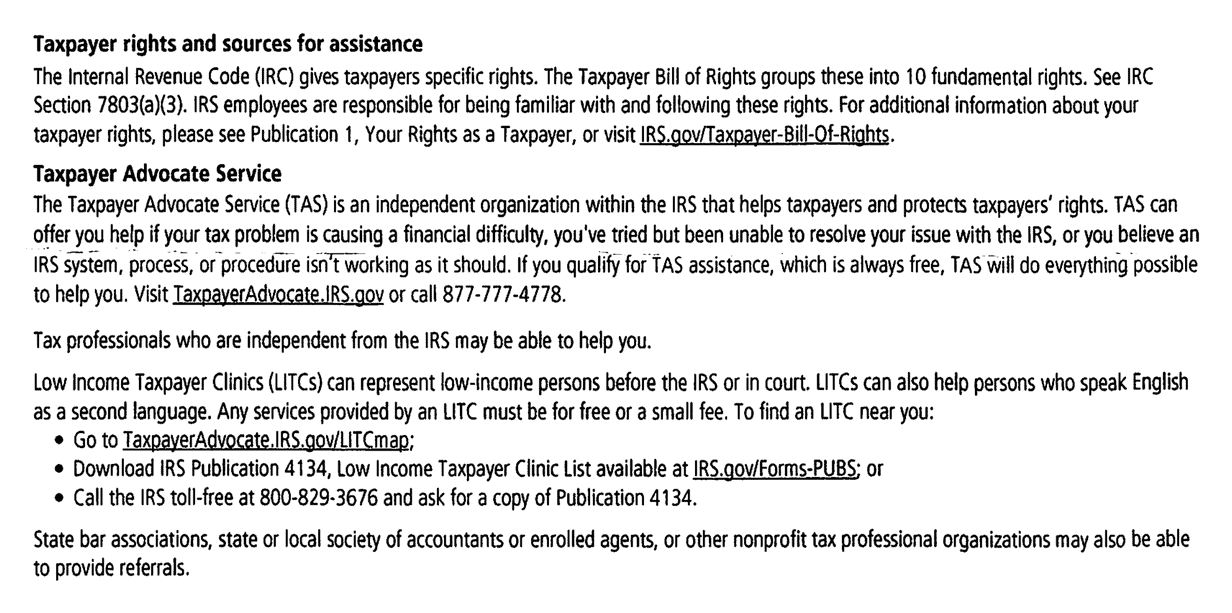
The last block on the notice covers the Taxpayer Bill of Rights under IRC Section 7803(a)(3) and points you to Publication 1.
It also describes two sources of free help that many people don’t realize exist:
- The Taxpayer Advocate Service, an independent organization inside the IRS that helps when a tax problem is causing financial difficulty or the normal channels have failed, reachable at 877-777-4778.
- Low Income Taxpayer Clinics, which can represent low-income taxpayers before the IRS or in court for free or a small fee, listed in Publication 4134.
Neither is usually necessary for a CP30A, since the notice is in your favor, but they are worth knowing about if the refund never shows up and you cannot get an answer.
How the Estimated Tax Penalty Actually Works
Understanding the penalty the CP30A just reduced is what turns this notice from a pleasant surprise into useful information.
The United States runs a pay-as-you-go tax system, which means the government expects your tax to be paid in across the year rather than in one lump at filing.
Under IRC Section 6654, you generally avoid the estimated tax penalty if your total payments for the year hit the lower of these two targets:
- 90% of the tax shown on this year’s return.
- 100% of the tax shown on last year’s return, which rises to 110% if your prior-year adjusted gross income was more than $150,000 ($75,000 if married filing separately).
Those two targets are the safe harbors, and the IRS’s procedures for applying them are at IRM 20.1.3.3.1.1, Determining the Required Annual Payment.
Two exceptions turn the penalty off completely rather than just reducing it:
- The tax shown on your return, less your withholding, is less than $1,000 under IRC Section 6654(e)(1).
- You had no tax liability for the preceding tax year, that year was a full 12 months, and you were a U.S. citizen or resident throughout it, under IRC Section 6654(e)(2).
There are also two narrow statutory waivers under IRC Section 6654(e)(3), which the IRS applies under IRM 20.1.3.3.2.1:
- Casualty, disaster, or other unusual circumstances where imposing the penalty would be against equity and good conscience.
- Retirement after reaching age 62, or becoming disabled, where the underpayment was due to reasonable cause and not willful neglect.
Still have questions? Talk to a tax expert — free.
What You Should Do After Getting a CP30A
If you agree with the change, the CP30A requires nothing from you at all.
But there are five things worth doing anyway, and the last one is the one that saves you money.
Step 1: Confirm the Notice Is Real and Matches Your Return
Check that the tax year on the notice is the year you expect and that the tax and withholding figures match the return you filed.
If the numbers don’t look like your return at all, that is a reason to call, and it is also a reason to be alert to identity theft on your account.
Step 2: Verify the Change in Your IRS Online Account
Log in at IRS.gov/account and look at the balance and the transcript for the tax year on the notice.
The account transcript will show the penalty being abated and the refund being issued, which is a cleaner record than the notice itself.
If you would rather work through the other ways to check what the IRS has on you, we walk through them in our guide on how to know if you owe the IRS.
Step 3: Watch the 4-to-6-Week Window
Mark the notice date and give the refund the 4 to 6 weeks the notice describes before you start chasing it.
If nothing has arrived after six weeks and your account shows no offset, call the number on the notice.
Step 4: Find Out Where the Refund Actually Went If It Never Arrives
A refund shown on a CP30A can be swallowed by other federal tax you owe, and if that happens you will typically receive a CP49 notice telling you the overpayment was applied to another year.
It can also be intercepted through the Treasury Offset Program for non-tax debts like past-due child support, state income tax, and defaulted federal student loans.
And if you have unfiled returns, the IRS may hold the refund while it sorts those out, which is a different and much bigger problem than the penalty this notice just removed.
Step 5: Fix the Pattern That Caused the Penalty
This is the step that matters, because a reduced penalty this year does not mean no penalty next year.
If you are a W-2 employee, run the IRS Tax Withholding Estimator and file a new Form W-4 with your employer so more tax comes out of each paycheck.
If you have self-employment income, investment income, retirement distributions, or income that arrives unevenly across the year, build the quarterly estimated payment schedule now rather than in April.
And if your income really is lumpy, ask your preparer to run the annualized income installment method on Form 2210 rather than accepting the default calculation, because that method matches the penalty to when you actually earned the money.
What IRS Notice CP30A Is Not
Because the CP30A arrives with good news, it is easy to read more into it than it says.
Here is what it does not mean:
- It is not an audit, and it is not a signal that the IRS finished examining your return.
- It is not confirmation that the rest of your return was accepted as filed, since the IRS can still send a CP2000 later if third-party documents don’t match what you reported.
- It is not a bill, and there is no payment stub, so any notice with a payment voucher attached is something else — most likely a CP14.
- It is not a guarantee that money is coming, because the refund is subject to offset against other tax and other federal debts first.
- It is not a removal of every penalty, since the failure-to-pay penalty and interest can survive on the same notice.
- It is not a reason to skip estimated payments next year, because nothing about the correction changes your obligation going forward.
When You Should Actually Call the IRS About a CP30A
Most CP30A notices need no phone call, but a few situations do.
Call the number on your notice if any of the following are true:
- The tax, withholding, or payment figures in the billing summary don’t match the return you filed.
- You believe the estimated tax penalty should have been removed entirely and the notice only reduced it.
- The notice shows a failure-to-pay penalty or interest on an amount you are certain you paid on time.
- Six weeks have passed, the refund has not arrived, and your online account shows no offset explaining where it went.
- The tax year on the notice is one for which you never filed a return.
If the reason you were penalized in the first place is that you are behind on taxes generally, the CP30A is a small piece of a bigger picture, and the phone call worth making may not be to the IRS.
Get Help With Your IRS Notice CP30A
A CP30A on its own is good news that usually needs no help from anyone.
But it often shows up on accounts where something larger is going on — a big balance from a prior year, estimated payments that were never made, or returns that were never filed — and that is where the notice stops being the real story.
Our team of licensed tax professionals reviews your full IRS account, not just the notice in your hand, so you know whether that refund is actually going to reach you and what else is sitting on the account.
Call us at 866-8000-TAX or schedule your free consultation to talk it through with a CPA.
Frequently Asked Questions About IRS Notice CP30A
Do I need to respond to IRS Notice CP30A?
No, not if you agree with the change. The CP30A has no reply form, no payment stub, and no response deadline. You only need to contact the IRS if the figures don’t match your return, if you believe the penalty should have been removed entirely rather than reduced, or if the refund never arrives.
Is a CP30A good news?
Yes. The CP30A means the IRS recalculated the estimated tax penalty you reported on your own return and found that it was larger than the penalty actually due, so it either increased your refund or reduced your balance. The one caveat is that the same notice can still show a failure-to-pay penalty and interest charges, so read the billing summary before you celebrate.
What is the difference between a CP30 and a CP30A?
They point in opposite directions. A CP30 tells you the IRS charged you a penalty because you didn’t pay enough estimated tax or didn’t pay it on time. A CP30A tells you the IRS reduced or removed an estimated tax penalty that you reported on your return. One costs you money and the other gives it back.
How long does it take to get the refund shown on a CP30A?
The notice says 4 to 6 weeks from the notice date if you haven’t already received the refund and you don’t owe other tax or debts the IRS is required to collect. If more than six weeks have passed and your IRS online account doesn’t show the overpayment being applied somewhere else, call the number on the notice.
Can the IRS take the refund shown on my CP30A?
Yes. The IRS will first apply the overpayment to any other federal tax you owe, and you would typically receive a CP49 notice explaining that. Refunds can also be intercepted through the Treasury Offset Program for past-due child support, state income tax, and defaulted federal student loans. Unfiled returns can also cause the IRS to hold the money.
Why did I get a CP30A when I never calculated an estimated tax penalty?
You may not have calculated it by hand, but your tax software or preparer may have computed it on Form 2210 and carried it to your Form 1040 without flagging it. Most taxpayers can simply leave that line blank and let the IRS figure the penalty, which avoids the overstatement that produces a CP30A in the first place.
Does a CP30A mean my return has been fully accepted?
No. The CP30A addresses one line on your return, the estimated tax penalty, and nothing else. The IRS can still question other items later, most commonly through a CP2000 notice when the income reported to it on Forms W-2, 1099, and K-1 doesn’t match what appeared on your return.

“Logan and team are amazing. I had a pressing question for my business before new years and he delivered with sound advice which gave me peace of mind. I highly recommend his practice.”
Get Help Now
Got a CP30A notice? Get a straight answer before you respond.
Talk to a tax expert — free, no obligation. We’ve resolved over $20 million in IRS debt for our clients.


Author:

Logan Allec, CPA, Founder and Owner
Logan Allec has been serving taxpayers as a CPA for over 14 years. After leaving his role at a "Big 4" firm, he started Choice Tax Relief to help everyday Americans who have found themselves behind on their taxes. He also educates thousands of people daily about tax relief on his YouTube channel. In addition to his CPA license, Logan also has a Master's Degree in Taxation from the University of Southern California (USC). He lives with his wife and children in the Los Angeles area. Learn more about Logan here.