

IRS Notice CP508R: What It Is and What It Means for Your Passport

If you just opened an IRS Notice CP508R, take a breath — this is one of the rare IRS notices that is good news.
The CP508R is the notice the IRS sends to tell you that it has reversed its certification of your account as a seriously delinquent tax debt and has notified the U.S. Department of State of that reversal.
In plain English, the tax roadblock that was standing between you and a passport has been lifted.
Below is a redacted IRS Notice CP508R that one of our clients received, and the rest of this guide walks through what every part of it means, why the reversal happened, and what you should still watch out for.
View a redacted IRS Notice CP508R one of our clients received (PDF)
Important: The images in this article come from a redacted CP508R that one of our clients received — not a mock-up. We blacked out the taxpayer’s name and address, and everything else appears exactly as the IRS printed it.
Key Takeaways
- A CP508R is good news. It means the IRS has reversed its certification of your account as a seriously delinquent tax debt and has told the U.S. Department of State about that reversal.
- You do not need to respond to it. The notice says so in its first sentence under “What you need to know,” and there is no deadline, no payment stub, and no reply form anywhere on it.
- A reversal is not the same as a zero balance. Most CP508R notices go out because the debt was resolved or excluded, not erased, and the IRS can still bill, lien, and levy on whatever balance remains.
- The tax hold is lifted, but your passport is still the State Department’s call. The notice itself warns that the State Department can deny or revoke a passport for reasons that have nothing to do with your taxes.
- The IRS generally has 30 days to notify the State Department. Internal Revenue Code § 7345(c)(2) sets that deadline, and taxpayers with imminent travel can ask for expedited decertification.
- You can be certified all over again. Defaulting on the installment agreement or offer in compromise that got you decertified can put you right back over the line.
Table of Contents
Where the CP508R Fits in the CP508 Series
The CP508R is the reversal half of the IRS’s passport certification program, and it exists only because a CP508C came first.
The table below shows how the two CP508 notices relate to each other so you can confirm which one you are holding and what it means for your passport.
| Notice | What It Is | When the IRS Sends It |
|---|---|---|
| CP508C | Notice that the IRS has certified your unpaid balance to the U.S. Department of State as a seriously delinquent tax debt. | After your assessed balance passes the annual threshold and the IRS has either filed a notice of federal tax lien with your appeal rights exhausted or issued a levy. |
| CP508R | Notice that the IRS has reversed that certification and told the U.S. Department of State your debt is no longer seriously delinquent. | After you pay or resolve the debt — or after the IRS determines the certification was erroneous. |
Free Consultation
Got a CP508R notice? Don’t wait for the IRS’s next move.
Talk to a tax expert — free, no obligation. We’ve resolved over $20 million in IRS debt for our clients.
What Is IRS Notice CP508R?
IRS Notice CP508R is a one-page informational notice confirming that the IRS has reversed a previous certification of your account as a seriously delinquent tax debt.
To understand the reversal, you have to understand the certification it undoes.
On December 4, 2015, Congress passed the Fixing America’s Surface Transportation Act, better known as the FAST Act, which added Section 7345 to the Internal Revenue Code.
Section 7345 requires the IRS to certify to the U.S. Department of State the name of any individual who owes a seriously delinquent tax debt, and the State Department is then generally prohibited from issuing or renewing that person’s passport.
When the IRS makes that certification, it sends you a CP508C.
Section 7345(c) requires the IRS to reverse the certification and notify the State Department when the certification no longer holds up, and the CP508R is your written proof that the reversal happened.
Internal Revenue Manual 5.19.25, the section that governs the entire Passport Program, spells this out for IRS employees: IRM 5.19.25.7 provides that every decertified taxpayer is sent a reversal of certification notice, the CP 508R, and IRM 5.19.25.10 sets out the conditions that trigger the reversal in the first place.
Notice what the CP508R is not.
It is not a bill, it is not a request for information, and it does not ask you to sign or return anything.
IRS Notice CP508R at a Glance
| Notice Name | CP508R (printed as “Notice 508R” at the bottom of the page) |
| What It Says | “We notified the U.S. Department of State that we reversed your certification of seriously delinquent tax debt” |
| Notice Type | Informational — no response required |
| Who Sends It | The IRS passport unit at PO Box 8208, Philadelphia, PA 19101-8208 |
| Legal Authority | Internal Revenue Code § 7345(c), enacted by the FAST Act on December 4, 2015 |
| Length | One page, front only |
| Amount Due | None shown — the CP508R never bills you |
| Response Deadline | None |
| What It Changes | The State Department is no longer required to deny your passport application or renewal, and cannot revoke your current passport, because of the tax debt |
| Related Notice | CP508C, the certification notice the CP508R reverses |
| Phone Number | 855-519-4965, or +1-267-941-1004 from outside the United States |
Why Did the IRS Reverse Your Certification?
Internal Revenue Code § 7345(c) gives the IRS three grounds for reversing a certification:
- The debt is fully satisfied or has become legally unenforceable. You paid it off, it was abated, or the ten-year collection statute expired.
- The debt is no longer seriously delinquent. The balance still exists, but it now falls into one of the categories the law or the IRS excludes from certification.
- The certification was erroneous. The IRS certified you when it should not have, and it corrected the error.
The second ground is by far the most common one we see, and it is worth understanding in detail.
Section 7345(b)(2) carves out several debts that can never be treated as seriously delinquent, and IRM 5.19.25.4 calls these the statutory exclusions:
- An installment agreement you are paying on time. A plan under Internal Revenue Code § 6159 keeps the underlying balance from being certified, which is why setting up an installment agreement is one of the fastest routes to a CP508R.
- An accepted offer in compromise. A settlement under Internal Revenue Code § 7122 that you are complying with does the same thing, and so does a Justice Department settlement agreement.
- A timely requested collection due process hearing on a levy. Collection is suspended while a CDP hearing under Internal Revenue Code § 6330 is pending.
- A pending innocent spouse claim. An election or request for relief under Internal Revenue Code § 6015 suspends collection on the requesting spouse.
IRM 5.19.25.5 adds a second list, the discretionary exclusions, which are situations where the IRS chooses not to certify even though the law would allow it:
- Currently not collectible status due to hardship. If the IRS has placed your account in currently not collectible status, the debt is excluded.
- Identity theft. A balance that traces back to a stolen identity should never have been certified.
- Bankruptcy. Debts of a taxpayer in bankruptcy are excluded, as are the debts of a deceased taxpayer.
- A pending offer in compromise or a pending installment agreement. You do not have to wait for acceptance — a pending request is enough.
- A pending adjustment that will full-pay the period. If an adjustment already in process will wipe out the balance, the IRS excludes it.
- A federally declared disaster area. Taxpayers in a disaster zone are excluded while relief is in effect.
If your CP508R arrived shortly after you resolved your account, one of these categories is almost certainly the reason.
IRS Notice CP508R Explained, Part by Part
The CP508R is a single page, and it is one of the shortest notices the IRS sends, so we can walk through it piece by piece.
Part 1: The Notice Header and the Philadelphia Passport Unit
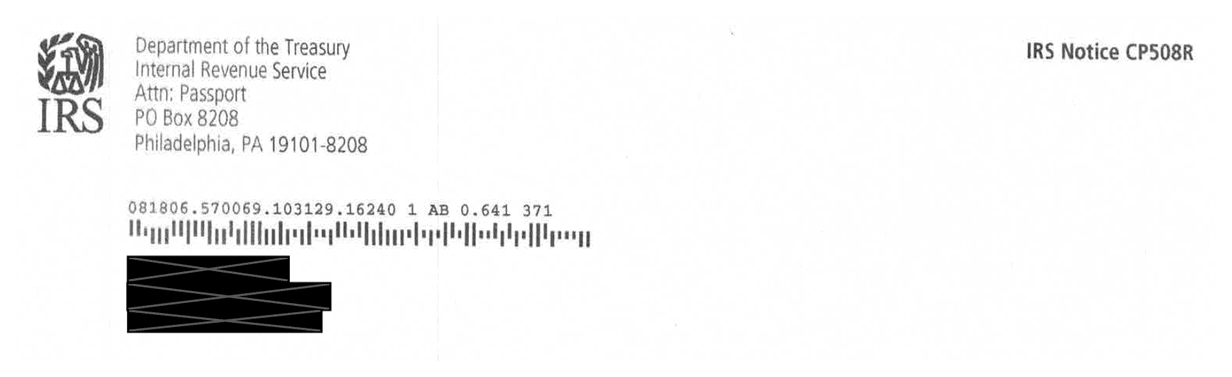
The top-left corner identifies the sender as the Department of the Treasury, Internal Revenue Service, and then adds a line you will not see on an ordinary balance-due notice: “Attn: Passport.”
The return address is PO Box 8208, Philadelphia, PA 19101-8208, which is the IRS unit that handles the entire passport certification program.
The top-right corner names the notice, and the bottom-left corner repeats it as “Notice 508R.”
If your notice says CP508C rather than CP508R in that corner, you are looking at the certification, not the reversal, and our guide to IRS Notice CP508C is the one you want.
Part 2: The Notice Date and the Headline

The notice date on our client’s copy is July 28, 2025, and that date matters more than it looks like it should.
The notice date is roughly when the IRS transmitted the reversal to the State Department, not when the State Department finished processing it, so the date on your notice is the starting point for the clock rather than the finish line.
The headline underneath states the whole point of the notice in one sentence: the IRS notified the U.S. Department of State that it reversed your certification of seriously delinquent tax debt.
The paragraph below the headline confirms both halves of the story — the IRS previously certified you, and it has now reversed that certification and told the State Department.
Notice that the CP508R does not list tax years, balances, or assessment dates.
That is a real limitation of this notice: it confirms the reversal without telling you a thing about what you still owe.
Part 3: What You Need to Know — and Why There Is Nothing to Respond To

This section opens with the sentence most people want to read: you don’t need to respond to this notice.
It then explains the practical effect of the reversal, which is that the State Department is no longer required to deny your application for a passport or a passport renewal, and cannot revoke your current passport, because you owe tax.
The bullet underneath is the fine print, and it is the part readers skip: the State Department may still deny your passport application or revoke your passport for reasons unrelated to your tax debt.
Unpaid child support, certain federal warrants, and prior passport misuse are all examples of holds the IRS has nothing to do with and cannot lift.
Part 4: The FAST Act and Section 7345

This paragraph is the legal background, and the IRS prints the same explanation on every notice in the CP508 family.
It walks through the December 4, 2015 enactment of Section 7345, the requirement that the IRS notify the State Department about certified taxpayers, the State Department’s general prohibition on issuing or renewing a certified taxpayer’s passport, and the parallel requirement that the IRS report reversals.
That last sentence is the authority for the very notice you are holding.
Part 5: Where to Find More Information
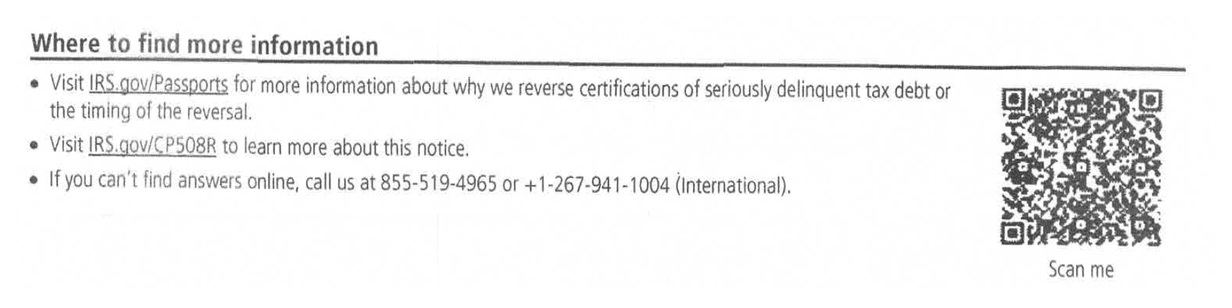
The closing section points you to IRS.gov/Passports for background on why and when the IRS reverses certifications, and to IRS.gov/CP508R for a short page about this specific notice.
It also gives you two phone numbers: 855-519-4965 for domestic callers and +1-267-941-1004 for international callers.
Those numbers reach the passport unit itself rather than general IRS collections, which makes them the right numbers to call about anything certification-related.
The QR code in the right margin simply opens the IRS.gov page for this notice.
What a CP508R Does Not Do
This is where we spend most of our time with clients who call us about a CP508R.
The notice is genuinely good news, but it is narrower than it feels, and it is easy to read more into it than the IRS wrote:
- It does not mean your balance is gone. Unless you paid in full or the collection statute expired, you almost certainly still owe the IRS money, and the CP508R says nothing about how much.
- It does not stop liens or levies. Decertification has no effect on a notice of federal tax lien that is already filed or on the IRS’s power to levy if your resolution falls apart.
- It does not hand you a passport. It removes the tax obstacle; the State Department still has to process your application, and it can say no for reasons of its own.
- It does not refund a passport application fee. If the State Department denied an earlier application, that fee is generally gone and you will need to apply again.
- It does not protect you forever. Certification can happen again on the same balance if the resolution that got you decertified stops being current.
Owe the IRS? Talk to a tax expert — free.
What You Should Do After You Receive a CP508R
You do not owe the IRS a response, but there are five things worth doing anyway.
Step 1: Put the Notice in Your Permanent Records
The IRS itself tells CP508R recipients to keep the notice in their permanent records, and that advice is not filler.
If the State Department’s records lag behind the IRS’s, or if a passport application is questioned months later, the CP508R is the single piece of paper that proves the certification was reversed and when.
Scan it, and keep the digital copy somewhere you will actually find it.
Step 2: Confirm What You Still Owe
Because the CP508R shows no tax years and no balances, you have to look elsewhere to see where your account actually stands.
Pull your IRS Online Account or have a tax professional pull your account transcripts, and check the balance for every year that was part of the certified debt.
If the reversal came from full payment or an expired collection statute, your balance should be zero.
If it came from an installment agreement, an offer in compromise, currently not collectible status, or a pending claim, the balance is still there and still accruing interest.
Step 3: Stay Current on Whatever Got You Decertified
Almost every reversal that is not a full payoff depends on you continuing to do something.
Make installment agreement payments on time, comply with the five-year filing and payment terms of an accepted offer in compromise, and file every future return by its deadline.
A single missed payment or unfiled return can unwind the resolution, and re-certification follows the same rules the first certification did.
Step 4: Follow Up on the Passport Itself if You Have Travel Coming
The IRS reversal and the State Department’s records are two different systems, and they do not update at the same moment.
If you have an application pending or travel booked, contact the National Passport Information Center to confirm the tax hold has cleared before you assume it has.
If the State Department already denied an application, you will generally need to reapply rather than have the old application revived.
Step 5: Get the Underlying Balance Handled for Good
Decertification treats the symptom, and for most taxpayers the disease is still a five- or six-figure balance sitting in IRS collections.
If the resolution you are in is one you cannot realistically sustain, that is worth addressing now rather than after a default notice arrives.
Our team can review the account, confirm the certification is actually clear, and tell you whether a better resolution is available.
How Long Does Decertification Take?
Internal Revenue Code § 7345(c)(2) sets specific deadlines for the IRS to notify the State Department, and they differ depending on why the reversal happened:
- Full payment or an unenforceable debt. The IRS must notify the State Department by the date it would be required to release the federal tax lien, which is within 30 days of the liability being satisfied or becoming unenforceable.
- An installment agreement or an offer in compromise. Notification is due within 30 days after the agreement is entered into or the offer is accepted.
- An innocent spouse election or request. Notification is due within 30 days after the election or request is made.
- An erroneous certification. Notification is due as soon as practicable after the IRS makes that finding.
Those deadlines govern the IRS side only.
The State Department then has to update its own records, so plan on additional time beyond the date printed on your CP508R before a passport application moves.
Tip: If you have international travel scheduled within 45 days and the State Department has already denied your application, you can ask the IRS for expedited decertification. IRM 5.19.25.10.1 lets the passport unit compress the normal timeline to roughly 9 to 16 days, but you have to call 855-519-4965 and provide proof of your travel plans along with a copy of the State Department’s denial letter dated within the last 90 days.
Can the IRS Certify You Again After a CP508R?
Yes, and this is the single most important thing to understand about a reversal.
Decertification is not a permanent pass, and nothing in Section 7345 stops the IRS from certifying the same taxpayer a second time if the conditions are met again.
The threshold is indexed for inflation each year, and for 2026 a seriously delinquent tax debt means an assessed, legally enforceable federal tax liability of more than $66,000, including penalties and interest.
On top of the dollar amount, the IRS must have either filed a notice of federal tax lien with your administrative appeal rights exhausted or lapsed, or issued a levy.
The most common path back to certification is a defaulted installment agreement, which usually announces itself with a CP523 before the passport consequences follow.
New balances count too, so a large assessment on a later year can push a decertified taxpayer back over the threshold even when the original years are still being paid on time.
If any of that sounds like where you are headed, our guide to whether you can get a passport if you owe taxes walks through how the certification rules apply before a CP508C ever shows up.
Frequently Asked Questions About IRS Notice CP508R
Do I need to respond to IRS Notice CP508R?
No. The notice states plainly that you don’t need to respond to it, and there is no deadline, no reply form, and no payment stub anywhere on the page. The IRS recommends only that you keep the notice in your permanent records and stay current on any installment agreement, offer in compromise, innocent spouse claim, or collection due process hearing that applies to your account.
Does a CP508R mean I don’t owe the IRS anymore?
Usually not. A reversal happens when the debt is paid, becomes legally unenforceable, stops meeting the definition of a seriously delinquent tax debt, or was certified in error. Only the first two of those mean the balance is gone. If you were decertified because you entered an installment agreement, had an offer in compromise accepted, were placed in currently not collectible status, or filed an innocent spouse claim, you still owe the money and it is still accruing interest.
How long after a CP508R can I get my passport?
The IRS transmits the reversal to the U.S. Department of State around the date printed on the notice, but the State Department then has to update its own records before an application can move forward. There is no published turnaround time for that step, so if you have travel booked, contact the National Passport Information Center to confirm the tax hold has cleared rather than assuming it has. If the State Department already denied an earlier application, you will generally need to apply again.
What if I need to travel right away?
Ask the IRS for expedited decertification. Under IRM 5.19.25.10.1, the passport unit can shorten the usual timeline to roughly 9 to 16 days for taxpayers with imminent travel, generally meaning travel within 45 days. You will need to call the passport unit at 855-519-4965, provide proof of your travel plans such as an itinerary or ticket, and supply a copy of the letter the State Department sent denying your passport application, dated within the last 90 days.
Can the IRS certify my debt as seriously delinquent again?
Yes. A CP508R reverses one certification; it does not exempt you from future ones. If you default on the agreement that got you decertified, or a new assessment pushes your assessed balance back above the annual threshold of $66,000 for 2026 while a lien has been filed or a levy issued, the IRS can certify you again and send a new CP508C. Staying current on your resolution and filing every return on time is what keeps that from happening.
I got a CP508R but I never got a CP508C. What happened?
This usually means the certification notice went to an address the IRS had on file that you no longer use, since the IRS mails the CP508C to your last known address and is not required to do anything more. It can also mean the certification was erroneous and reversed quickly. Either way, pull your IRS account transcripts to see what was assessed and when, because a certification that already happened tells you the IRS had both a large assessed balance and either a filed lien or an issued levy on your account.
Getting decertified is the easy part to celebrate — keeping it that way is the part that trips people up.
Our team works with the IRS passport unit and with taxpayers carrying large balances every single day, and we can tell you in one call whether your account is genuinely clear or one missed payment away from a second certification.
If you’d like us to review where your account stands, schedule your free consultation or call us at 866-8000-TAX.

“I owed almost $200,000 of IRS debt and she was able to negotiate an installment agreement that reduced it down to $48,600 over 10 years. I almost couldn’t believe it. Can’t recommend this company enough.”
Get Help Now
Got a CP508R notice? Don’t wait for the IRS’s next move.
Talk to a tax expert — free, no obligation. We’ve resolved over $20 million in IRS debt for our clients.


Author:

Logan Allec, CPA, Founder and Owner
Logan Allec has been serving taxpayers as a CPA for over 14 years. After leaving his role at a "Big 4" firm, he started Choice Tax Relief to help everyday Americans who have found themselves behind on their taxes. He also educates thousands of people daily about tax relief on his YouTube channel. In addition to his CPA license, Logan also has a Master's Degree in Taxation from the University of Southern California (USC). He lives with his wife and children in the Los Angeles area. Learn more about Logan here.