

IRS Notice CP521D: What It Is and How to Respond

If you’re making monthly payments to the IRS under an installment agreement, the IRS Notice CP521D is a notice you’ll get to know well: it’s the IRS’s monthly reminder that your next installment payment is due.
The good news is that unlike many IRS notices, the CP521D Notice is not telling you that something is wrong.
It’s simply a bill for your next monthly payment under the payment plan you already set up with the IRS.
That said, you shouldn’t ignore it either — if you don’t make the payment by the date on the notice, you risk defaulting on your installment agreement, and that opens the door to consequences you definitely want to avoid.
Here is a redacted CP521D Notice that one of our clients received.
In this article, I’ll walk you through the current IRS Notice CP521D — what every section means, when the IRS sends it, and exactly what to do (and what not to do) after you receive one.
Key Takeaways
- IRS Notice CP521D is a monthly reminder that your installment agreement payment is due — it is not a new tax bill or a collection threat.
- Your payment must be received by the due date on the notice (on this client’s notice, about 10 days after the notice date) to avoid defaulting on your agreement.
- Penalties and interest continue to accrue on your unpaid balance until it’s paid in full — which is why the IRS itself suggests paying more than the minimum each month if you can.
- Missing a payment can lead to the IRS moving to terminate your installment agreement (typically via the CP523 Notice), which can revive enforced collection actions like levies.
- If your monthly payment no longer fits your budget, you can change your payment date, amount, or plan type using the IRS’s Online Payment Agreement tool — before you miss a payment, not after.
Table of Contents
IRS Notice CP521D At a Glance
| Question | Answer |
|---|---|
| What is it? | A monthly reminder that your next installment agreement payment is due |
| Who gets it? | Taxpayers making monthly payments to the IRS under an installment agreement |
| Is it bad news? | No — it’s a routine bill, not a collection notice. But don’t ignore it. |
| What’s the deadline? | The “received by” date on the notice (about 10 days from the notice date on this client’s notice) |
| What if I miss it? | Late or incomplete payments can cause the IRS to terminate your payment plan |
Free Consultation
Got a CP521D notice? Don’t wait for the IRS’s next move.
Talk to a tax expert — free, no obligation. We’ve resolved over $20 million in IRS debt for our clients.
CP521D vs. CP523: What’s the Difference?
Taxpayers on IRS payment plans sometimes confuse the CP521-series reminder notices with the far more serious CP523 Notice.
Here’s the difference at a glance.
| CP521D | CP523 | |
|---|---|---|
| What it means | Your monthly installment payment is due | The IRS intends to terminate your installment agreement |
| Tone | Routine monthly reminder | Serious — you’ve defaulted on your agreement’s terms |
| What to do | Make your payment by the due date | Act immediately to cure the default before your agreement is terminated |
| Risk if ignored | Possible default on your agreement | Termination of your agreement and possible levy action |
One more notice you may receive while you’re on an installment agreement: once a year, the IRS sends Notice CP89, the Annual Installment Agreement Statement, which summarizes your payments, penalties, and interest for the prior 12 months.
Unlike your monthly CP521D, the CP89 is purely informational — it’s not a bill.
Not every installment-agreement notice is a warning.
When you first set up your payment plan, the IRS sends a CP14IA confirming the agreement is in place, and once a year it sends a CP89 annual statement.
The CP521D covered here is simply your routine monthly reminder.
IRS Notice CP521D Explained, Part by Part
Here is a full explanation of the Notice CP521D, part by part, based on the IRS’s current CP521D format.
Part 1: Notice Header

At the top of the first page, the IRS identifies the notice by name — you’ll see “IRS Notice CP521D” in the upper-right corner — along with the IRS service center that sent it and the notice date.
Farther down the page (and again on the payment stub), you’ll find the tax year the notice pertains to and your taxpayer ID number.
Part 2: “Reminder: Your Monthly Installment Payment Is Due”

The heart of the notice is one sentence: your next monthly installment payment — $820.00 on this client’s notice — must be received by the stated due date “to avoid defaulting on your agreement.”
Note the word received: the IRS is not talking about a postmark date.
If you pay by mail, build in time for delivery and processing.
The IRS also notes that if you’ve already made your monthly payment, you can verify it’s been received by logging into your IRS Online Account.
Part 3: What You Need To Do
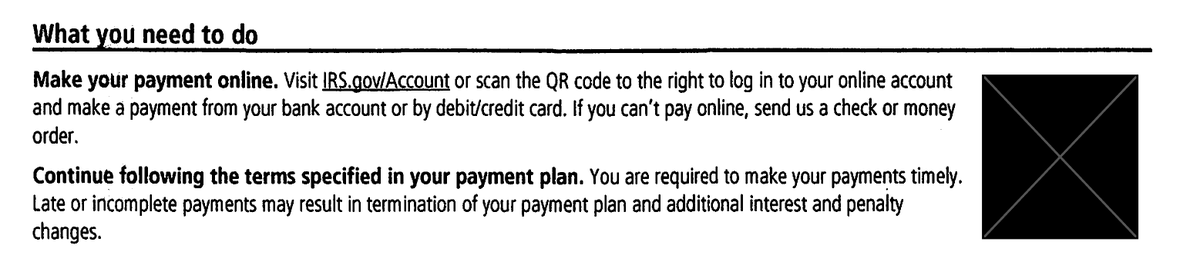
In the “What you need to do” section, the IRS tells you how it wants you to pay: online.
You can visit IRS.gov/Account — or scan the QR code printed on the notice — to log in to your online account and pay directly from your bank account or by debit or credit card.
If you can’t pay online, the IRS says, you can send a check or money order instead.
This section also contains an important warning that’s easy to skim past: you are required to make your payments timely, and “late or incomplete payments may result in termination of your payment plan” along with additional interest and penalty charges.
Part 4: “Consider Paying More Than the Minimum”

Next, in a boxed callout, the IRS offers a piece of advice we regularly give our own clients: consider paying more than the minimum amount due each month.
As the notice puts it, “You’ll finish paying sooner and pay less overall.”
Why?
Because penalties and interest don’t stop just because you’re on a payment plan — they continue to be added to your bill until you pay the full balance.
Every extra dollar you pay now is a dollar that stops generating interest against you.
Part 5: Managing Your Plan

The “Managing your plan” section points you to two useful IRS tools.
First, to view your payment plan details or check the status of your plan, you can sign in to your account at IRS.gov/Account, where you can view your amount owed, review your payment history, schedule future payments, and view pending and scheduled payments.
Second — and this is the part many taxpayers don’t realize — if you need to make a change to your plan, you can change your payment date, your installment payment amount, your bank account information, and even your plan type using the IRS’s Online Payment Agreement (OPA) tool at IRS.gov/OPA.
If your monthly payment amount no longer fits your financial situation, this is the place to fix it — before you miss a payment.
Part 6: Go Paperless

The IRS now offers to send this monthly reminder electronically instead of by mail.
If you’d rather go paperless, you can sign in to your Online Account, manage your communication preferences, and opt in to receive digital reminders when your payment is due.
Part 7: Where To Find More Information

On page 2, the IRS points you to irs.gov/cp521d for more information about the notice, and lists a phone number to call if you have questions you can’t resolve online — 833-678-7020 on this client’s notice.
If you call, the IRS asks that you have your account information ready.
Part 8: Payment Stub
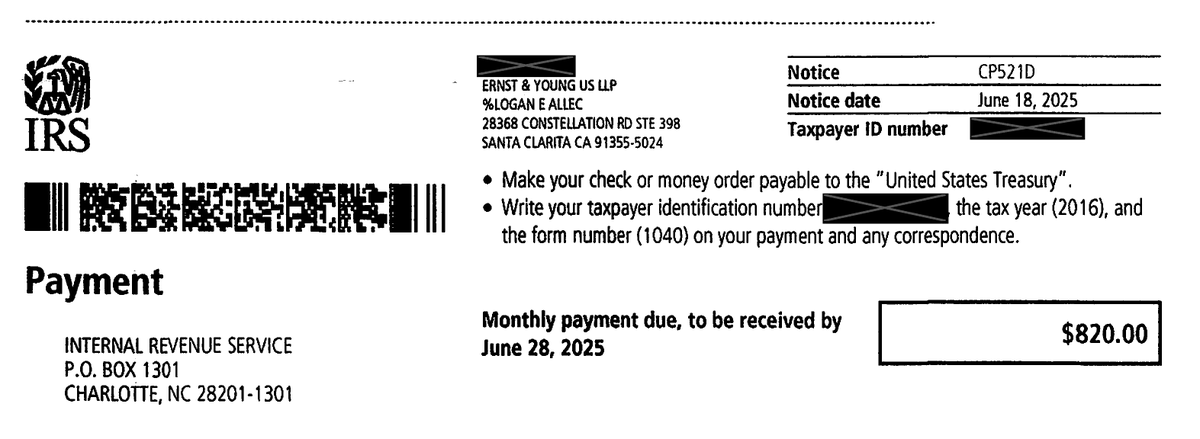
Finally, the last page of IRS Notice CP521D contains a payment stub to include if you pay by check or money order.
The IRS instructs you to make your check or money order payable to the “United States Treasury” and to write your taxpayer identification number, the tax year, and the form number (1040 on this client’s notice) on your payment and any correspondence.
The stub also restates your monthly payment amount and the date by which it must be received.
When Does the IRS Send Notice CP521D?
The IRS sends IRS Notice CP521D on a monthly cycle to taxpayers who are making payments under an installment agreement.
It’s part of the IRS’s CP521 family of installment agreement reminder notices.
On this client’s notice, the notice date is June 18 and the payment due date is June 28 — so you can expect each month’s reminder to arrive roughly 10 days before that month’s payment is due.
You can expect to keep receiving a reminder every month until your balance is paid in full, until you opt in to paperless digital reminders through your Online Account, or until your agreement ends for another reason — such as switching to direct debit payments or, on the unpleasant end of the spectrum, defaulting on the agreement.
Owe the IRS? Talk to a tax expert — free.
What Should You Do After Receiving Notice CP521D?
Here’s exactly what I’d recommend doing when your CP521D Notice arrives each month.
Step 1: Make Your Payment by the Due Date
This one’s obvious, but it’s the whole ballgame: pay the amount due so that the IRS receives it by the date on the notice.
The fastest and safest way is online — through your IRS Online Account directly from your bank account, or by debit or credit card (card payments go through an IRS-approved payment processor, which charges a processing fee).
If you pay by mail, send your check or money order — payable to the “United States Treasury,” with the payment stub included — well before the due date.
Step 2: Pay More Than the Minimum If You Can
Take the IRS up on its own suggestion.
Because penalties and interest keep accruing on your unpaid balance for the life of your payment plan, paying more than your required monthly payment — even occasionally — shortens your payoff timeline and reduces the total amount you’ll hand the IRS.
There’s no prepayment penalty on an IRS installment agreement.
Step 3: If You Can’t Make This Month’s Payment, Act Before the Due Date
Life happens — a slow month in your business, an unexpected expense, a job change.
If you know you can’t make this month’s payment, don’t just skip it and hope the IRS doesn’t notice.
It will.
Instead, get ahead of the problem.
You may be able to change your payment date or lower your monthly payment amount using the Online Payment Agreement tool, or you can call the number on your notice to discuss your options.
A modified agreement beats a defaulted one every time.
Step 4: Ask Whether Your Payment Plan Is Still the Right Resolution
Here’s something the notice won’t tell you: an installment agreement is not always the best deal available to you — it’s simply the easiest one to set up.
If your financial situation has deteriorated since you set up your plan, you may now qualify for a better resolution, such as an offer in compromise — settling your tax debt for less than you owe — or currently not collectible status, which pauses IRS collections entirely.
And if penalties make up a meaningful chunk of your balance, penalty abatement may be able to shrink it.
We’d be happy to review your situation and tell you honestly whether you’re in the right resolution — call us at 866-8000-TAX for a free consultation.
What Happens If You Miss an Installment Payment?
If the IRS doesn’t receive your payment by the due date, you’re at risk of defaulting on your installment agreement.
In practice, missing a single payment doesn’t always torpedo your agreement — but a missed payment puts you on the path to the CP523 Notice, in which the IRS announces its intent to terminate your installment agreement.
If your agreement is terminated, your full remaining balance becomes collectible, and the IRS can resume enforced collection actions — including levying your wages or bank account — that your installment agreement had been protecting you from.
In other words: IRS Notice CP521D is a friendly monthly nudge precisely because the alternative is not friendly at all.
Keep the agreement current, and the IRS stays off your back.
IRS Notice CP521D: Frequently Asked Questions
What is IRS Notice CP521D?
IRS Notice CP521D is a monthly reminder that your next installment agreement payment is due. It states your monthly payment amount and the date by which the IRS must receive it to avoid defaulting on your agreement.
Is the CP521D Notice bad news?
No. The CP521D is a routine bill for taxpayers on an IRS payment plan — it doesn’t mean anything is wrong with your account. It only becomes a problem if you miss the payment, which can put your installment agreement at risk of termination.
What happens if I miss the payment on my CP521D Notice?
Late or incomplete payments can cause the IRS to move toward terminating your installment agreement, typically via the CP523 Notice of intent to terminate. If your agreement is terminated, the IRS can resume enforced collection actions such as levies.
Why am I still being charged penalties and interest if I’m on a payment plan?
An installment agreement stops enforced collection, but it does not stop penalties and interest from accruing on your unpaid balance. That’s why the IRS itself suggests paying more than the minimum each month if you can — you’ll finish paying sooner and pay less overall.
Can I change my monthly payment amount or due date?
Yes. You can change your payment date, payment amount, bank account information, and plan type using the IRS’s Online Payment Agreement tool at irs.gov/opa — ideally before you miss a payment. If your finances have changed significantly, you may also qualify for a different resolution entirely, such as an offer in compromise or currently not collectible status.
What if I already made my payment?
If you already made your monthly payment, the notice and your payment may have crossed in the mail. You can verify the IRS received your payment by logging into your IRS Online Account at irs.gov/account.

“Lulu was my case manager and she did an amazing job setting up a tax payment plan with great terms. She was kind, professional and very thorough. I could not have asked for a better case manager.”
Get Help Now
Got a CP521D notice? Don’t wait for the IRS’s next move.
Talk to a tax expert — free, no obligation. We’ve resolved over $20 million in IRS debt for our clients.


Author:

Logan Allec, CPA, Founder and Owner
Logan Allec has been serving taxpayers as a CPA for over 14 years. After leaving his role at a "Big 4" firm, he started Choice Tax Relief to help everyday Americans who have found themselves behind on their taxes. He also educates thousands of people daily about tax relief on his YouTube channel. In addition to his CPA license, Logan also has a Master's Degree in Taxation from the University of Southern California (USC). He lives with his wife and children in the Los Angeles area. Learn more about Logan here.