

IRS Notice CP14IA: What It Means and What To Do

If you just received IRS Notice CP14IA, take a breath — despite the balance printed on it, this notice actually carries a piece of good news buried in the header: “You’ve successfully set up your payment plan.” The CP14IA is the version of the IRS’s standard balance-due notice (the CP14) that the IRS sends when you owe tax and you already have an installment agreement in place.
In plain English: the IRS is confirming your monthly payment plan is active, and reminding you how much you still owe while that plan runs.
The “IA” on the end stands for Installment Agreement.
That single detail is what separates a CP14IA from a plain CP14.
A CP14 is a first bill that assumes you’ll pay in full; a CP14IA assumes you’ve chosen to pay over time and confirms the arrangement.
Below, we walk through a real (redacted) CP14IA line by line so you know exactly what every number means and what — if anything — you need to do next.
Want to follow along with the actual document?
You can view a redacted IRS Notice CP14IA that one of our clients received here.
- A CP14IA confirms your IRS payment plan is set up. The headline — “You’ve successfully set up your payment plan” — is the IRS acknowledging your installment agreement is active for the tax year shown.
- It is not a sign anything went wrong. Unlike a CP523 (which threatens to terminate your plan), a CP14IA simply states your balance while the agreement is in good standing.
- You still owe the balance shown, and it keeps growing. Penalties and interest continue to accrue on the unpaid amount even while you’re making monthly payments — the notice says so explicitly.
- You usually don’t need to do anything new. If you keep making your agreed monthly payments on time, the plan stays active. The notice is informational.
- Paying extra shrinks the total cost. Because interest compounds daily, paying more than the minimum — or paying the balance off early — reduces what you ultimately hand the IRS.
Table of Contents
Where the CP14IA Fits in the CP14 Series
The CP14IA is the installment-agreement version of the CP14, confirming your payment plan is in place, and it is one of several closely related CP14 notices that each carry a different letter after “CP14.”
The table below shows how the CP14IA compares to the other notices in the series so you can see how yours differs from a standard first bill.
| Notice | What It Is | When the IRS Sends It |
|---|---|---|
| CP14 | The IRS's standard first bill for unpaid taxes — the most common balance-due notice it sends. | After you file a return showing a balance due and don't pay it in full by the return's due date. |
| CP14C | A CP14 issued with a disaster-relief cover page that postpones your payment deadline. | When your address of record is in a federally declared disaster area; penalties and interest are paused until the relief period ends. |
| CP14D | The same first bill in the IRS's redesigned “scan-and-pay” layout, with a QR code and resolve-your-balance boxes. | After you file with a balance due and don't pay by the due date — same meaning as a CP14, newer format. |
| CP14E | A version of the first balance-due notice, issued under IRC § 6303 just like the CP14. | After you file with a balance due and don't pay in full — in our experience, often after filing Form 1040-SR (the return for seniors). |
| CP14F | A version of the IRS's first bill in its redesigned “Notice of Balance Due” format. | After the IRS processes your return, finds the tax you reported exceeds your payments and credits, and you haven't paid the balance. |
| CP14G | Another version of the redesigned first bill for unpaid taxes. | After the IRS processes your return, sees an amount due, and doesn't receive full payment by the return's due date. |
| CP14IA | The installment-agreement version — confirms your payment plan is set up while the balance keeps accruing penalties and interest. | After you successfully set up an installment agreement (payment plan) on a balance you owe. |
| CP14J | The failure-to-pay-penalty version — your balance is unpaid tax plus a failure-to-pay penalty and interest. | After you file on time but don't pay in full, so a failure-to-pay penalty (but no failure-to-file penalty) applies. |
| CP14K | A version of the IRS's first bill, nearly identical in meaning to the CP14. | After you file a return with an amount owed and some balance remains unpaid once your payments and credits are applied. |
Free Consultation
Got a CP14IA notice? Don’t wait for the IRS’s next move.
Talk to a tax expert — free, no obligation. We’ve resolved over $20 million in IRS debt for our clients.
IRS Notice CP14IA at a Glance
| What it is | Confirmation that you’ve set up an IRS installment agreement (payment plan) on a balance you owe |
|---|---|
| Why you got it | You owe tax for the year shown and a monthly payment plan is now active on your account |
| Is it urgent? | No — it’s informational. There is no new deadline as long as you keep making payments |
| Do you owe money? | Yes — the notice shows your current balance, penalties, and interest |
| What to do | Keep making your monthly payments; consider paying extra to reduce interest |
| Where to get help | IRS.gov/CP14IA or the phone number on your notice; a licensed tax pro for plan changes or relief options |
CP14 vs. CP14IA: What’s the Difference?
These two notices look almost identical, which causes a lot of confusion.
The difference is entirely about whether a payment plan already exists on your account.
| IRS Notice CP14 | IRS Notice CP14IA | |
|---|---|---|
| Core message | “You owe money on unpaid taxes.” | “You’ve successfully set up your payment plan.” |
| Payment plan? | None yet — the IRS expects payment in full | Already active — a monthly installment agreement is in place |
| Pay-by deadline | Usually about 21 days to pay or arrange a plan | No new lump-sum deadline — you follow your monthly schedule |
| Action needed | Pay in full or set up a payment plan | Usually none — just keep paying on time |
| Penalties & interest | Accruing on the unpaid balance | Still accruing, even while on the plan |
IRS Notice CP14IA, Explained Line by Line
Let’s walk through the actual notice section by section using a redacted example.
Yours will show your own figures, but the layout and language will match.
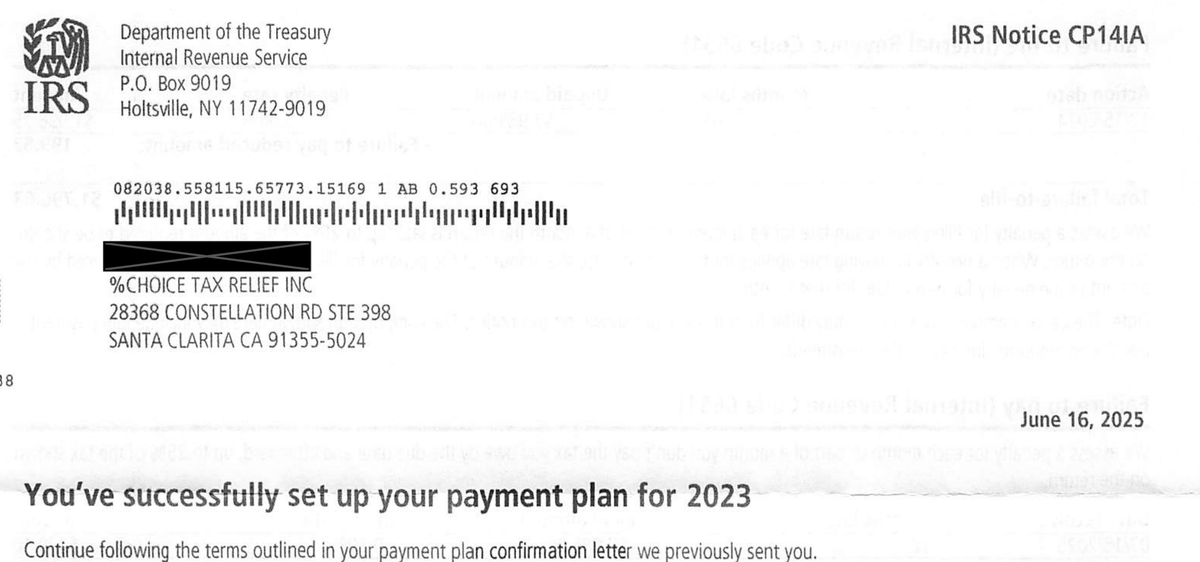
1. Notice Header & “You’ve Successfully Set Up Your Payment Plan”
The top-right corner identifies the notice as CP14IA, and the header block shows the notice date and the tax year at issue.
The headline is the reassuring part: it confirms the IRS has recorded your installment agreement.
Right below it, the IRS tells you to keep following the terms outlined in the payment plan confirmation letter it sent you separately — that letter is where your monthly payment amount and due date live.
2. Where to Find Your Payment Plan Information
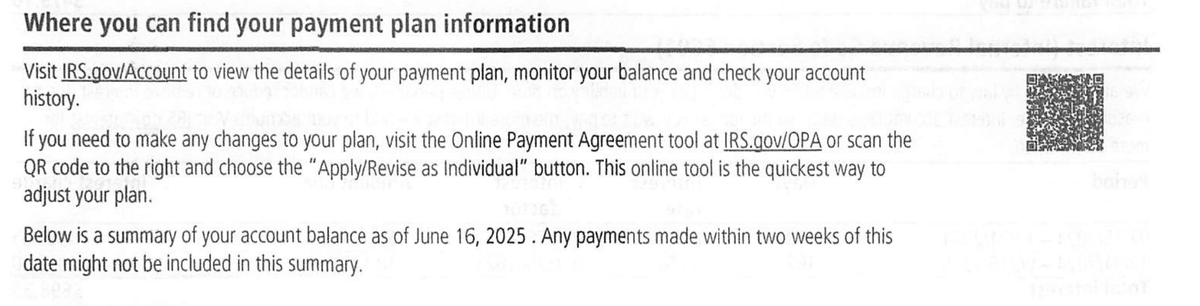
Next, the notice points you to your online account.
At IRS.gov/Account you can view your plan details, monitor your balance, and check your payment history.
If you ever need to change the plan — adjust the monthly amount or the payment date — you can do it through the Online Payment Agreement tool at IRS.gov/OPA and choose “Apply/Revise as Individual.” This section also reminds you that the balance shown is a snapshot as of the notice date and that recent payments may not yet be reflected.
3. Account Summary — What You Actually Owe
This is the heart of the notice.
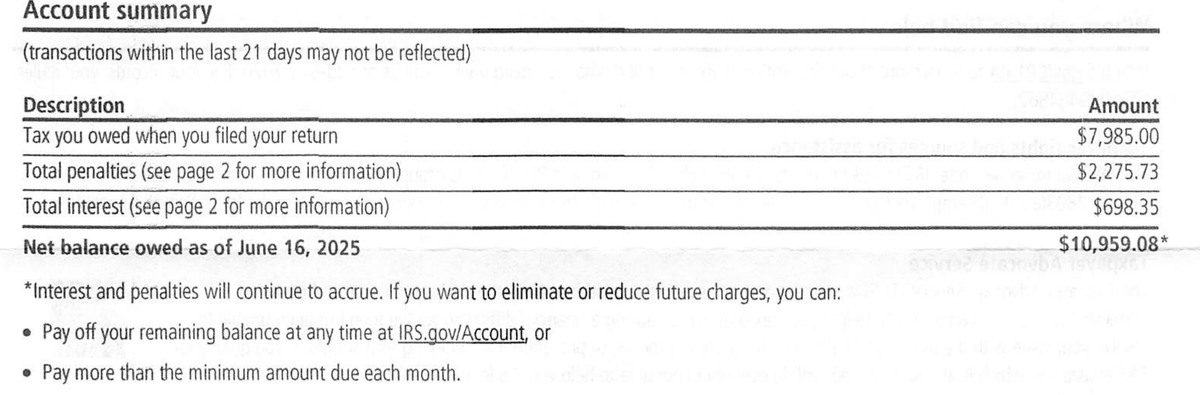
The account summary breaks your balance into three parts: the tax you owed when you filed your return, the total penalties, and the total interest, which add up to your net balance owed as of the notice date.
In our example, $7,985.00 of tax, $2,275.73 of penalties, and $698.35 of interest combine into a net balance of $10,959.08.
Just as important is the fine print beneath the table: interest and penalties will continue to accrue. The IRS spells out that to eliminate or reduce future charges you can pay off the remaining balance at any time or pay more than the minimum each month.
This is the single most valuable line on the notice — a payment plan stops collection pressure, but it does not stop the meter from running.
4. Penalties: Failure to File
Page 2 itemizes your penalties.
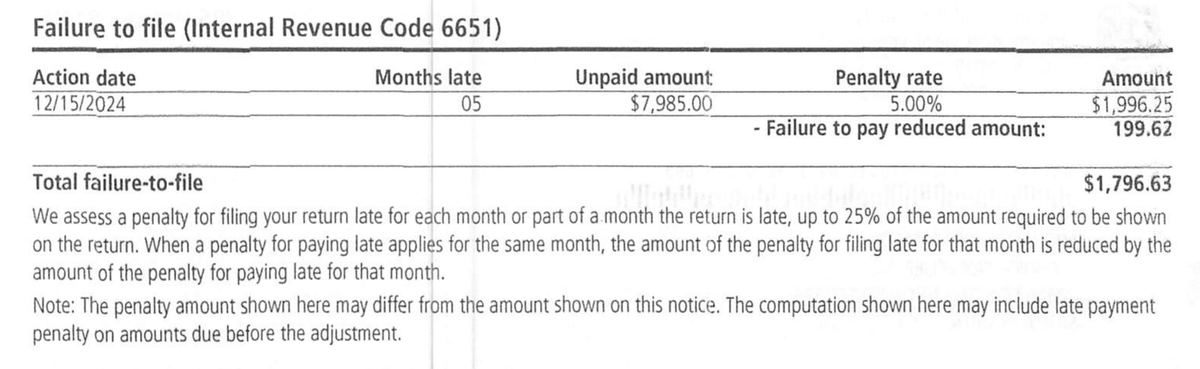
The failure-to-file penalty (Internal Revenue Code § 6651) applies when a return is filed late — it’s charged at 5% of the unpaid tax per month (or part of a month), capped at 25%.
In the example, five months of lateness produced a $1,996.25 charge, reduced slightly because the failure-to-pay penalty overlapped for the same months, landing at a total failure-to-file penalty of $1,796.63.
5. Penalties: Failure to Pay
The failure-to-pay penalty (also under § 6651) is charged for each month you don’t pay the tax you owe by the due date, at 0.5% of the unpaid balance per month, up to 25%.
Here it worked out to $479.10.
Note that once you’re on an approved installment agreement, the failure-to-pay rate is typically cut in half (to 0.25% per month) for months the agreement is in effect — another reason getting the plan in place matters.

6. Interest Charges
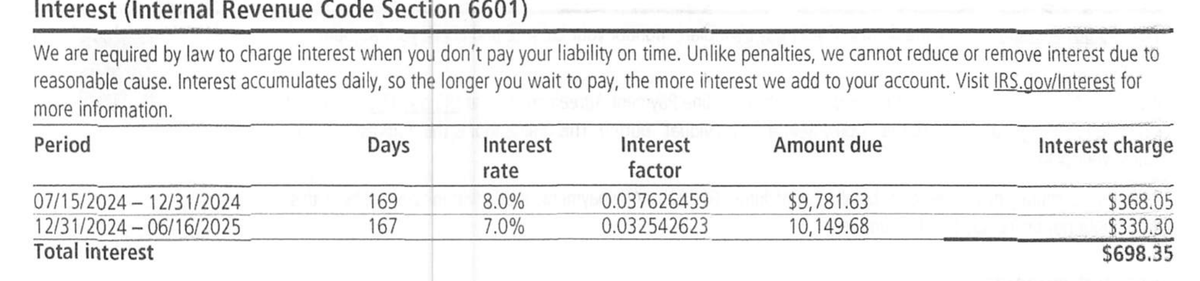
The interest section (§ 6601) shows how interest was calculated over each period, including the daily interest rate and factor the IRS used.
Unlike penalties, interest cannot be removed for reasonable cause — the IRS is required by law to charge it, and it compounds daily.
In the example, two rate periods (8.0% then 7.0%) produced $698.35 of interest.
Because it compounds, the faster you pay down principal, the less interest you’ll owe over the life of the plan.
7. Where You Can Find Help
The final section lists the IRS resources for this notice: IRS.gov/CP14IA, the toll-free number printed on your notice, and your caller ID for reference.
It also describes the Taxpayer Advocate Service (an independent organization within the IRS that helps when a tax problem is causing financial hardship) and Low Income Taxpayer Clinics.
Some CP14IA notices also arrive with a Notice 1462 insert, which grants extra time to file and pay if you’re in a federally declared disaster area.

When Does the IRS Send a CP14IA?
You’ll typically see a CP14IA shortly after an installment agreement is established on your account — for example, after you set up a payment plan online through the Online Payment Agreement tool, after a plan is arranged by phone, or after a tax professional negotiates one on your behalf.
It confirms the balance the plan covers.
If you owe for multiple years, you may receive related notices such as the CP89 Annual Installment Agreement Statement (a yearly recap of your plan) or a CP521D monthly reminder.
Owe the IRS? Talk to a tax expert — free.
What To Do When You Receive a CP14IA
For most taxpayers, a CP14IA requires no immediate action.
Still, it’s worth running through this checklist:
- Verify the numbers. Compare the tax year and balance to your own records and to your plan confirmation letter. If something looks off, log in at IRS.gov/Account to review your transaction history.
- Confirm your monthly payment is set up. Make sure your first (and ongoing) payments are scheduled — ideally via direct debit, which lowers the risk of a missed payment defaulting your plan.
- Keep paying on time. As long as you make every monthly payment by its due date and stay current on future tax filings, your agreement remains in good standing.
- Consider paying extra. Since interest compounds daily, any amount above your minimum shortens the plan and cuts your total cost. There’s no prepayment penalty.
- Explore whether a better option exists. If the balance is large or the monthly payment is a strain, you may qualify for a partial-payment installment agreement, an offer in compromise, or currently-not-collectible status. A licensed tax professional can tell you quickly which doors are open.
Tip: Set your installment agreement up on direct debit if you haven’t already. Direct-debit plans are less likely to default from a forgotten payment, and for many taxpayers they come with a lower setup fee than mailing checks.
What Happens If You Miss Payments?
The good standing a CP14IA confirms can be lost.
If you miss a monthly payment, incur a new tax balance, or fail to file a future return, the IRS can move to terminate your agreement.
When that happens, you won’t get another CP14IA — you’ll get a warning notice instead, such as a CP523 (or CP523H), which states the IRS’s intent to terminate your installment agreement and can lead to enforced collection like a CP504 notice and, ultimately, a levy.
If you ever receive one of those, act quickly — reinstating a defaulted agreement is possible but easier the sooner you respond.
Important: A payment plan keeps the IRS from actively pursuing collection, but penalties and interest keep accruing until the balance hits zero. If you can realistically pay the balance faster — or settle it for less through an offer in compromise — you’ll usually come out ahead of riding a long installment agreement to the end.
How Choice Tax Relief Can Help
Getting a CP14IA usually means you’ve already taken the right first step — you have a plan.
The question worth asking is whether it’s the best plan for your situation.
Our team of licensed tax professionals can review your balance, check whether you qualify to reduce it, and, if appropriate, renegotiate your installment agreement or pursue an offer in compromise.
If you’d like a second set of eyes on your notice, reach out for a free consultation.
IRS Notice CP14IA FAQs
“I had a great experience working with Lulu at Choice Tax Relief. From the very beginning, she was professional, knowledgeable, and took the time to clearly explain my options. Dealing with tax issues can be stressful, but Lulu made the process much easier by walking me through everything step by step.”
Get Help Now
Got a CP14IA notice? Don’t wait for the IRS’s next move.
Talk to a tax expert — free, no obligation. We’ve resolved over $20 million in IRS debt for our clients.


Author:

Logan Allec, CPA, Founder and Owner
Logan Allec has been serving taxpayers as a CPA for over 14 years. After leaving his role at a "Big 4" firm, he started Choice Tax Relief to help everyday Americans who have found themselves behind on their taxes. He also educates thousands of people daily about tax relief on his YouTube channel. In addition to his CPA license, Logan also has a Master's Degree in Taxation from the University of Southern California (USC). He lives with his wife and children in the Los Angeles area. Learn more about Logan here.