

IRS Notice CP3219N: Why Do I Have A Notice of Deficiency?

IRS Notice CP3219N is a Notice of Deficiency: the IRS has no tax return from you for a year, has figured the tax itself from income that employers, banks and other payers reported, and is giving you 90 days to challenge that figure in the U.S. Tax Court before it assesses the tax.
That deadline is set by statute, and the IRS cannot extend it.
You can answer the notice by filing the missing return, petitioning the Tax Court, doing both, or signing the response form to accept the IRS’s number.
In this article I go through the notice part by part and show you how to check the IRS’s math before you decide.
The walkthrough below uses a real CP3219N one of our clients received, with the client’s name and Social Security number blacked out.
Key Takeaways
- A CP3219N is a statutory Notice of Deficiency for a year the IRS says you did not file.
- You have 90 days from the mailing date, or 150 days if the notice is addressed to you outside the United States, to petition the U.S. Tax Court, and the last day is printed on page one.
- Filing your return, calling the IRS or contacting the Taxpayer Advocate Service does not extend that deadline.
- The IRS computes the tax as single or married filing separate with the standard deduction, so your own return may show a different number.
- Our client’s 2018 notice shows $37,215.00 of tax, $36,011.00 of withholding, $511.00 of penalties and $509.96 of interest, for an amount due of $2,224.96.
Table of Contents
What Is IRS Notice CP3219N?
The IRS explains the notice on its CP3219N page, starting with the reason: “We didn’t receive your tax return.”
The next sentence says where the number came from: “We calculated your tax, penalty and interest based on wages and other income reported to us by employers, financial institutions and others.”
The same page gives the notice its legal name: “The CP3219N is a Notice of Deficiency (90-day letter).”
A notice of deficiency is the notice the tax code generally requires before the IRS can assess income tax you did not report on a return, and it comes with 90 days to petition the Tax Court.
The CP3219N is the version for a year with no return on file, so the IRS is working from a substitute for return prepared under section 6020(b) of the tax code.
It is not a bill yet: the IRS describes it as “proposing a tax assessment,” and the bill comes after the IRS assesses.
It is not a tax return either, and the calculation page on our client’s notice says so: “Keep in mind we can’t accept this page as a return.”
We also have a separate article on IRS Letter 3219N, the letter the IRS uses for the same purpose.
Free Consultation
Got a CP3219N notice? Let’s get your tax returns caught up.
Talk to a tax expert — free, no obligation. We prepare years of unfiled tax returns and have resolved over $20 million in IRS debt for our clients.
IRS Notice CP3219N at a Glance
| Detail | What It Means |
|---|---|
| Notice type | Statutory Notice of Deficiency, also called a 90-day letter |
| Who gets it | Someone the IRS says did not file a return for the year |
| Amount due on our client’s 2018 notice | $2,224.96, made up of $1,204.00 of net tax, $511.00 of penalties and $509.96 of interest |
| Tax Court deadline | 90 days from mailing, or 150 days if addressed to a person outside the United States (January 13, 2025 on our client’s notice) |
| Where the petition goes | The U.S. Tax Court, never the IRS |
| Where the return goes | The IRS, with the response form, never the Tax Court |
| Tax Court filing fee | $60 as of October 2026 |
| If you do nothing | The IRS assesses the tax, penalties and interest and sends a bill |
| IRS phone number on our client’s notice | 866-681-4271 |
Why Did the IRS Send You a CP3219N?
The trigger is mechanical: payers reported income for you for the year, and the IRS’s records show no return.
Section 6020(b) of the tax code says that when a person fails to make a required return, the Secretary “shall make such return from his own knowledge and from such information as he can obtain through testimony or otherwise.”
The Internal Revenue Manual assigns that job to the Automated Substitute for Return (ASFR) program, which it calls “a Nonfiler or Return Delinquency (RD) program.”
The IRS has earlier notices for a missing return, such as the CP59, and inside ASFR the manual describes a 30-day letter, Letter 2566, that comes before the 90-day letter.
The manual has the 90-day letter follow when there is no response or an insufficient response to the 30-day letter, and it says “The letter is sent by certified mail.”
On our client’s notice the trigger is one Form W-2 reporting $185,519.00 of wages for 2018 and the sentence “Our records show you haven’t filed your 2018 tax return.”
A Part-by-Part Walkthrough of IRS Notice CP3219N
Here is our client’s CP3219N, one part at a time, with what I check on each.
Part 1: Notice of Deficiency Header and Summary
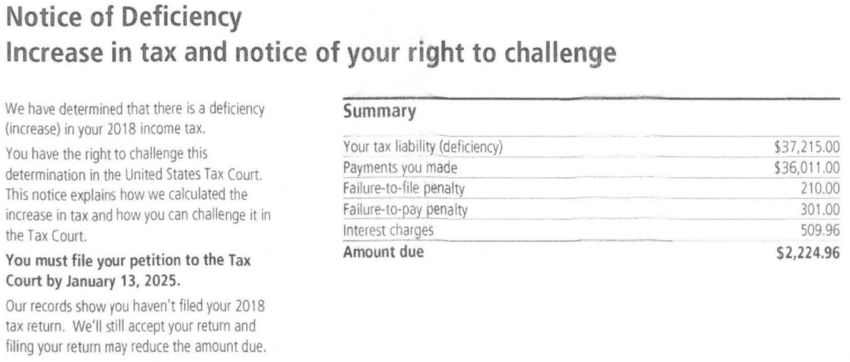
The headline reads “Notice of Deficiency,” and the first sentence is the determination: “We have determined that there is a deficiency (increase) in your 2018 income tax.”
Below it, in bold, is the sentence that controls everything else: “You must file your petition to the Tax Court by January 13, 2025.”
The summary box lists the numbers:
- Your tax liability (deficiency): $37,215.00
- Payments you made: $36,011.00
- Failure-to-file penalty: $210.00
- Failure-to-pay penalty: $301.00
- Interest charges: $509.96
- Amount due: $2,224.96
Run the arithmetic and it reconciles: $37,215.00 minus $36,011.00 leaves $1,204.00 of unpaid tax, and $1,204.00 plus $210.00, $301.00 and $509.96 equals $2,224.96.
The IRS calls the full $37,215.00 the “deficiency” because no return was filed and section 6211 of the tax code measures a deficiency without regard to wage withholding.
The line I point clients to first is “We’ll still accept your return and filing your return may reduce the amount due.”
Part 2: You Have the Right to Petition the Tax Court
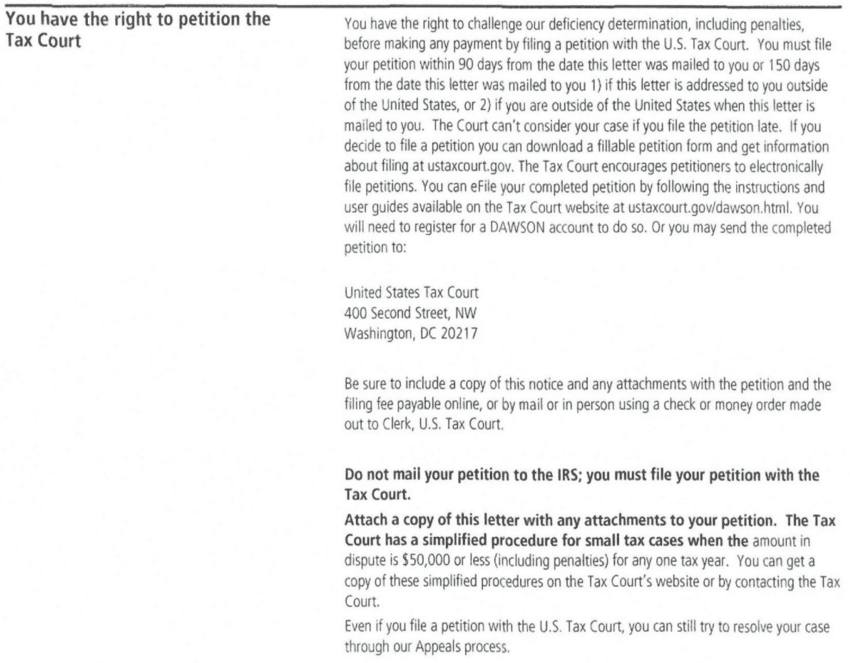
This part states the right: “You have the right to challenge our deficiency determination, including penalties, before making any payment by filing a petition with the U.S. Tax Court.”
It gives you 90 days from the date the notice was mailed, or 150 days if it is addressed to you outside the United States or you are outside the United States when it is mailed, and it adds, “The Court can’t consider your case if you file the petition late.”
You can file electronically through the court’s DAWSON system or mail the petition to United States Tax Court, 400 Second Street, NW, Washington, DC 20217, and the notice warns in bold, “Do not mail your petition to the IRS; you must file your petition with the Tax Court.”
It mentions a simplified procedure for small tax cases “when the amount in dispute is $50,000 or less (including penalties) for any one tax year,” and our client’s $37,215.00 deficiency plus $511.00 of penalties is under that limit.
The trade-off, according to the Tax Court, is that decisions in small tax cases are not appealable.
Part 3: You Can Still File Your Return
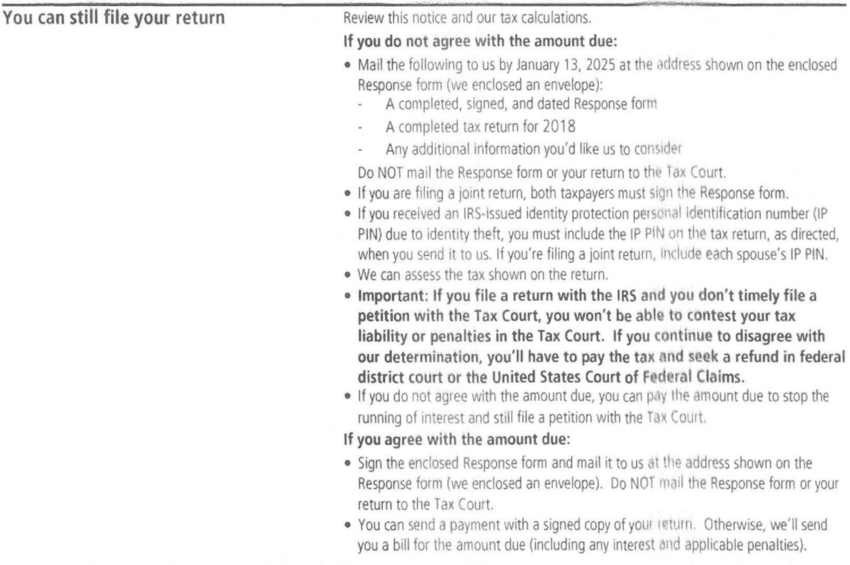
This part deals with the IRS rather than the court: if you do not agree with the amount due, you mail the signed response form, a completed 2018 return and any additional information to the address on the response form by January 13, 2025.
The notice warns, “Do NOT mail the Response form or your return to the Tax Court.”
Then comes a short sentence with real consequences: “We can assess the tax shown on the return.”
The bold paragraph after it is the warning I want every reader to see: “Important: If you file a return with the IRS and you don’t timely file a petition with the Tax Court, you won’t be able to contest your tax liability or penalties in the Tax Court.”
If you still disagree at that point, the notice says, “you’ll have to pay the tax and seek a refund in federal district court or the United States Court of Federal Claims.”
The notice also says you can pay the amount due “to stop the running of interest and still file a petition with the Tax Court.”
Part 4: If the IRS Doesn’t Hear From You and You Don’t Petition

This part is two sentences long: “If we don’t hear from you and you don’t file a Tax Court petition, we’ll assess your tax liability, plus any penalties and interest. We’ll send you a bill for this amount.”
Section 6213(c) of the tax code says the same thing: with no timely petition, the deficiency “shall be assessed, and shall be paid upon notice and demand.”
From that point the amount is a balance due, and the collection process I describe below can begin.
Part 5: Tax Calculations
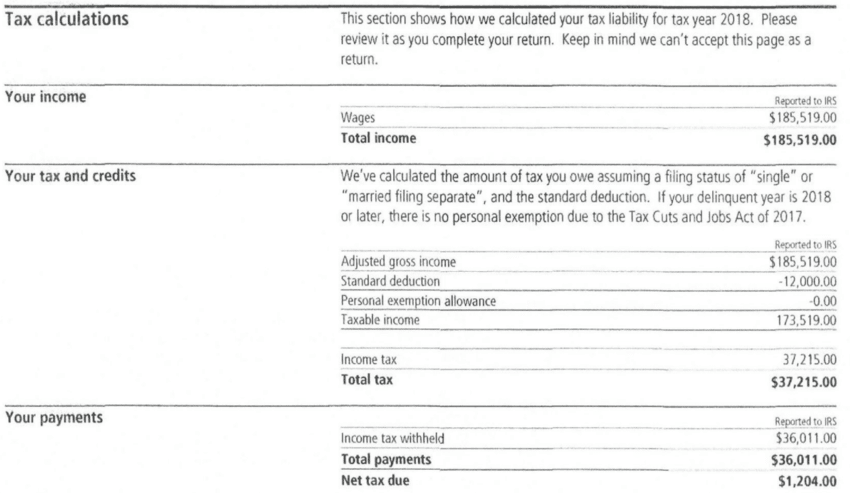
This section shows how the IRS built the $37,215.00, starting from wages and total income of $185,519.00.
The notice states its assumptions: “We’ve calculated the amount of tax you owe assuming a filing status of ‘single’ or ‘married filing separate’, and the standard deduction.”
The computation on our client’s notice runs like this:
- Adjusted gross income: $185,519.00
- Standard deduction: -$12,000.00
- Personal exemption allowance: -$0.00
- Taxable income: $173,519.00
- Income tax: $37,215.00
- Total tax: $37,215.00
- Income tax withheld: $36,011.00
- Net tax due: $1,204.00
The math checks out: $185,519.00 minus $12,000.00 is $173,519.00, and the 2018 rate schedule for a single filer ($32,089.50 plus 32% of the amount over $157,500) gives $37,215.58, which the notice shows as $37,215.00.
Income tax and total tax are the same figure, which tells you no credits were applied.
Part 6: Income Reported by Others
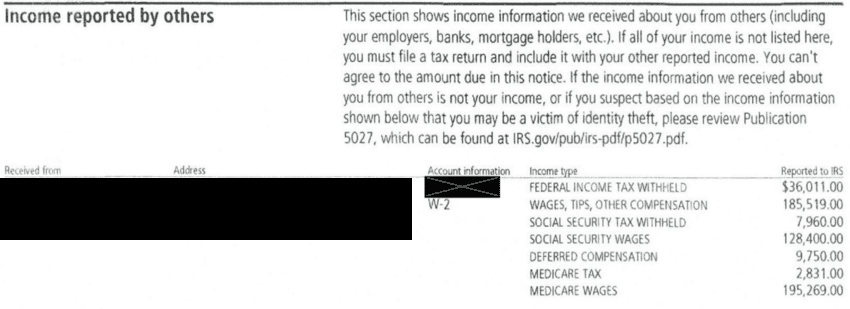
This section lists what payers reported, which the notice calls “income information we received about you from others (including your employers, banks, mortgage holders, etc.).”
Our client’s notice lists one Form W-2, with the employer’s name and address blacked out:
- Federal income tax withheld: $36,011.00
- Wages, tips, other compensation: $185,519.00
- Social security tax withheld: $7,960.00
- Social security wages: $128,400.00
- Deferred compensation: $9,750.00
- Medicare tax: $2,831.00
- Medicare wages: $195,269.00
These lines tie back to Part 5: the wages are the $185,519.00 the IRS taxed, and the withholding is the $36,011.00 it credited.
They also tie to each other, since the Medicare wages exceed the taxable wages by exactly the $9,750.00 of deferred compensation.
What I check here is whether every payer and every dollar belongs to the client, using the IRS wage and income transcript.
If income is missing from the list, the notice says you must file a return that includes it, and it adds, “You can’t agree to the amount due in this notice.”
If income is listed that is not yours, the notice points you to Publication 5027 on identity theft.
Part 7: Penalties
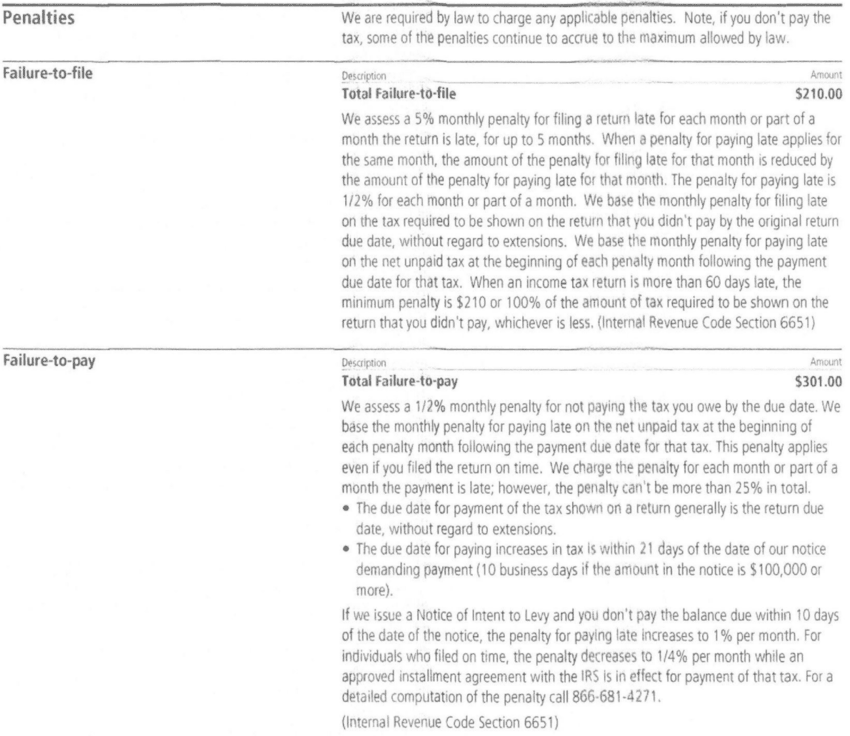
Our client’s notice shows a failure-to-file penalty of $210.00 and a failure-to-pay penalty of $301.00.
The notice describes the failure-to-file penalty as 5% a month for up to 5 months, reduced by the failure-to-pay penalty for the same month.
It also describes a floor: “When an income tax return is more than 60 days late, the minimum penalty is $210 or 100% of the amount of tax required to be shown on the return that you didn’t pay, whichever is less.”
The $210.00 on our client’s notice matches that minimum, and the notice does not show the monthly math, so I cannot tell you from the page alone how the IRS arrived at it.
The $210 is the figure on this notice, for a return due in 2019, and the IRS’s failure to file penalty page lists $525 for returns due after December 31, 2025.
The failure-to-pay penalty is easier to verify: the notice says it “can’t be more than 25% in total,” and $301.00 is exactly 25% of the $1,204.00 net tax.
That penalty applies even though no return was filed because section 6651(g) of the tax code treats the return the IRS prepares as the taxpayer’s return for this purpose.
Both penalties can be contested in a Tax Court petition or raised with the IRS in a penalty abatement request.
Part 8: Interest Charges
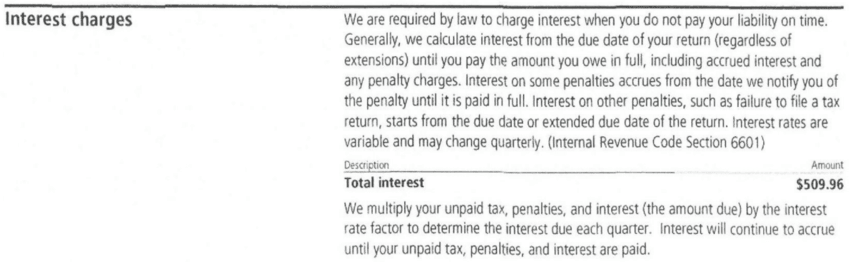
The interest section shows $509.96 and cites Internal Revenue Code section 6601.
The notice says interest generally runs “from the due date of your return (regardless of extensions) until you pay the amount you owe in full,” which for most 2018 returns means from April 15, 2019.
The rate can change every quarter, and the IRS’s interest rate page lists 7% for individual underpayments for the quarter beginning October 1, 2026, compounded daily.
The response form says the penalties and interest are “calculated to January 13, 2025,” so the $509.96 is a snapshot, and IRS interest keeps accruing until the balance is paid.
Part 9: Additional Information
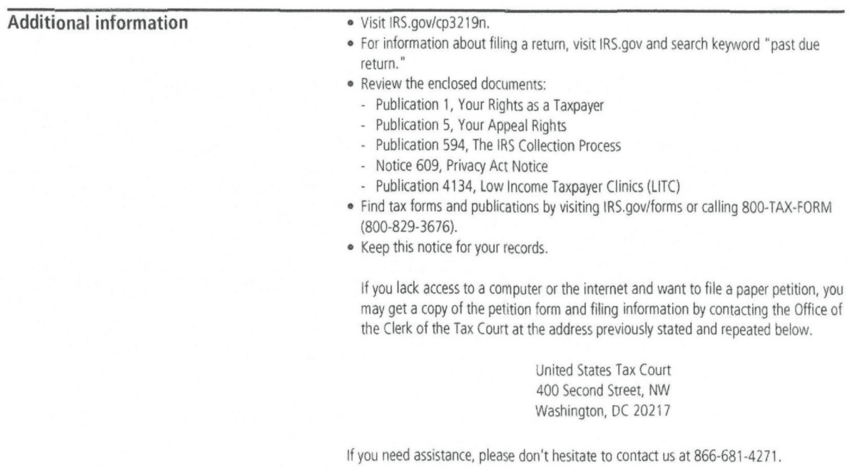
This part lists the publications enclosed with the notice, including Publication 5 on appeal rights and Publication 594 on the collection process, and gives 866-681-4271 as the IRS number to call for help.
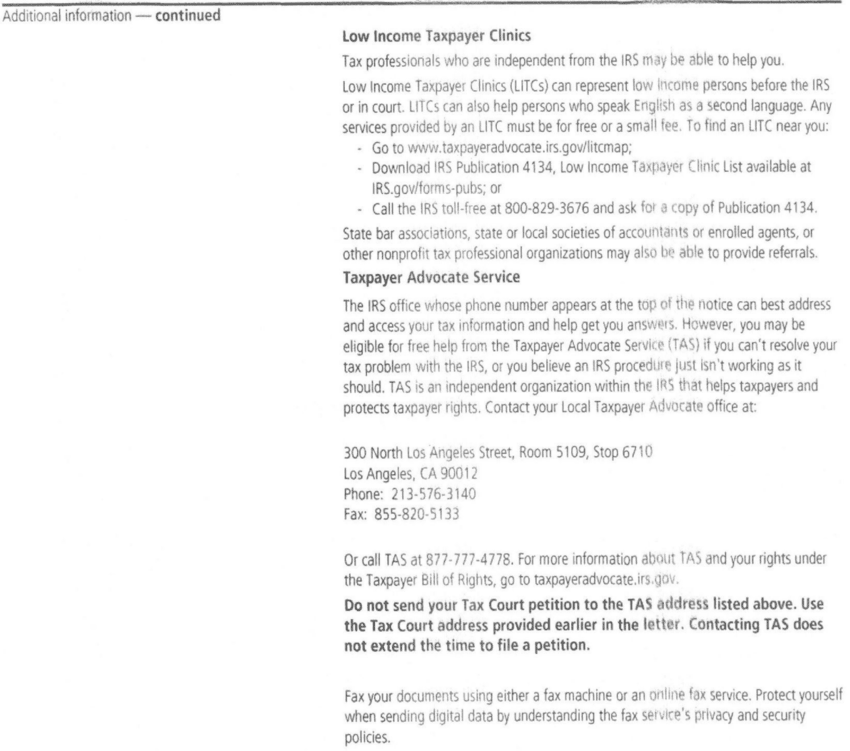
The second page describes Low Income Taxpayer Clinics, which the Taxpayer Advocate Service says are independent from the IRS and represent eligible taxpayers for free or a small fee.
The bold text at the bottom ends with a sentence I would put on a sticky note: “Contacting TAS does not extend the time to file a petition.”
Part 10: Response Form
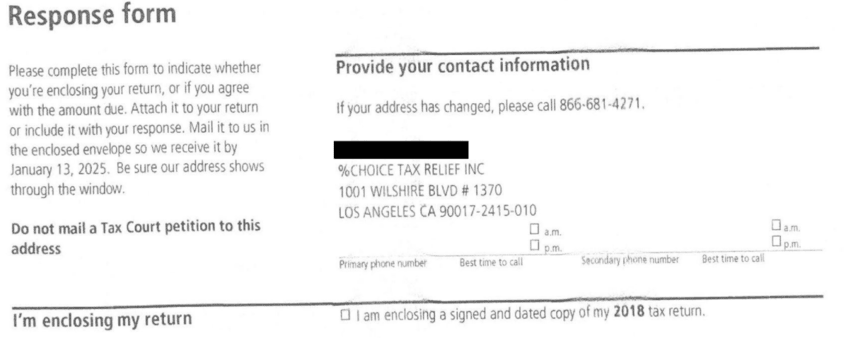
The response form is the page you send back to the IRS, either with your return or to agree with the amount due, and it asks for a reply by January 13, 2025.
It carries its own bold warning: “Do not mail a Tax Court petition to this address.”
The mailing block on our client’s form shows the client’s blacked-out name over “%CHOICE TAX RELIEF INC” and our Los Angeles office address at the time, because we hold a power of attorney for this client and the notice was mailed to our office.
The first checkbox is for people who disagree with the IRS’s number: “I am enclosing a signed and dated copy of my 2018 tax return.”
Part 11: I Agree With the Amount Due
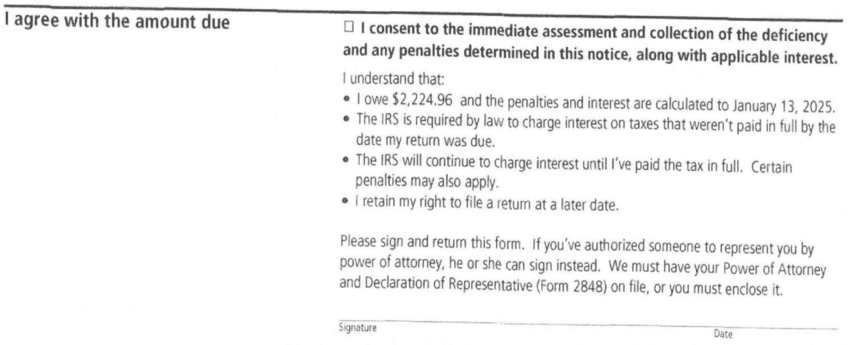
The second checkbox is in bold: “I consent to the immediate assessment and collection of the deficiency and any penalties determined in this notice, along with applicable interest.”
Signing it is a waiver under section 6213(d) of the tax code, which lets you give up the rule that keeps the IRS from assessing during the 90 days.
The form states the amount, “I owe $2,224.96 and the penalties and interest are calculated to January 13, 2025,” and it preserves one right: “I retain my right to file a return at a later date.”
A representative can sign for you if the IRS has your Form 2848 power of attorney on file or you enclose it.
I tell clients not to sign this box until the real return has been prepared and compared with the IRS’s number.
Part 12: Indicate Your Payment Option
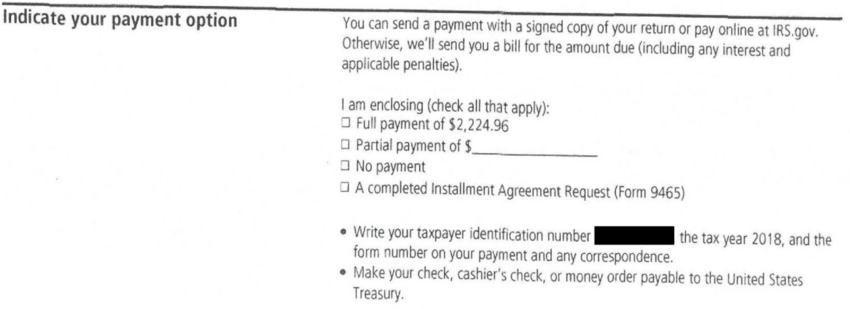
The last part offers four checkboxes: full payment of $2,224.96, a partial payment, no payment, or a completed Installment Agreement Request on Form 9465.
If you send no payment, the notice says, “we’ll send you a bill for the amount due (including any interest and applicable penalties).”
An installment agreement is the IRS’s monthly payment plan, and the IRS’s payment plan page ties its online long-term plan to having filed all required returns.
The 90-Day Deadline Is the One That Matters
Our client’s notice uses January 13, 2025 for two different things, the date to get a return to the IRS and the last day to petition the Tax Court, and the two are not equally firm.
The IRS says it “will accept your past due return” after the 90 days, although “you may experience significant delays.”
The Tax Court date is different: section 6213(a) of the tax code gives you 90 days after the notice is mailed, and the Tax Court’s guidance on starting a case says, “By law, the Tax Court cannot extend the time for filing a petition.”
The count runs from the date the IRS mailed the notice, not the date you opened it, and the statute treats a petition filed on or before the date printed on the notice as timely.
Important: Filing your return, calling the IRS and contacting the Taxpayer Advocate Service do not add a single day to the Tax Court deadline.
You may read that courts have softened this deadline, so here is where the law stands as I write this in October 2026.
The Tax Court’s own position, in Hallmark Research Collective v. Commissioner in 2022 and again in Sanders v. Commissioner in 2023, is that the deadline is jurisdictional, meaning the court has no power to hear a late petition.
Federal appeals courts are split, starting with the Third Circuit’s 2023 decision in Culp v. Commissioner that a late petition can be excused for equitable reasons.
The Second, Sixth and Eighth Circuits have since agreed, the First Circuit held in August 2026 that the deadline cannot be extended, and the Seventh and Ninth Circuits have treated it as jurisdictional.
Even the favorable decisions only sent the taxpayers back to the Tax Court to show they deserved extra time, and the Supreme Court declined to review the Third Circuit’s decision in 2024.
My advice does not change with any of it: treat the date printed on your notice as absolute.
Why the IRS’s Number Can Be Too High
The tax on a CP3219N rests on two assumptions the notice states: a filing status of “single” or “married filing separate” and the standard deduction.
On those assumptions, with no credits and no deductions beyond the $12,000.00 standard deduction, the wage earner on our client’s notice has $185,519.00 of wages and $36,011.00 of withholding and ends up owing $1,204.00 of tax before penalties and interest.
A real return can change that: for 2018 the standard deduction was $24,000 on a joint return and $18,000 for a head of household, and a return can claim itemized deductions and credits that appear on no information return.
The Taxpayer Advocate Service says that because the IRS may not have complete information, a substitute return “may overstate your tax liability.”
The number can also be too low if you had income that no payer reported, which is why the notice tells you to file a return that includes it.
File the Return, Petition the Tax Court, or Both?
The notice gives you two tracks, one with the IRS and one with the Tax Court, and nothing on it makes you choose only one.
Filing the return is the IRS track, and the IRS’s CP3219N page says, “The IRS will assess the amounts shown on your return.”
The risk in filing the return alone is the bold warning in Part 3, and the IRS repeats on its website that “your time for filing a petition with the Tax Court is not extended by filing a return.”
Petitioning is the court track, and while the case is pending section 6213(a) keeps the IRS from assessing the deficiency.
The Tax Court says “Most cases are settled by mutual agreement without trial,” and our client’s notice says you can still try to resolve your case through IRS Appeals after you petition.
A petition does not replace the return, because the Tax Court’s instructions say not to attach tax returns to the petition.
That is why I think of the two as working together: the petition protects the deadline, and the return supplies the correct numbers.
Important: The petition goes to the Tax Court and the return and response form go to the IRS, and our client’s notice repeats that instruction in at least four places.
If the 90 days have passed and the IRS has assessed, the Tax Court is closed for that notice, but the IRS’s page on filing past due returns says that when you file your own return, “The IRS will generally adjust your account to reflect the correct figures.”
The IRS calls that process audit reconsideration, and Publication 3598 says that once you have paid the amount due in full you must file a formal claim instead.
Refunds have their own limit, which the IRS’s CP3219N page states plainly: “To receive a refund, you must file the return within three years of the due date for the specific tax year.”
Under sections 6511 and 6513 of the tax code, a refund is generally limited to tax paid in the three years before the claim, and wage withholding counts as paid on the April due date of the return.
So a 2018 return filed in response to a notice with a January 2025 deadline can reduce or eliminate the balance but generally cannot produce a refund of that withholding.
CP3219N vs. CP3219A
The CP3219A is the sibling notice, and I put the two side by side below because the numbers are easy to mix up.
The IRS sends a CP3219A when a filed return does not match what payers reported, and it says that if it does not hear from you by the response date on a CP2000 it will send a statutory notice of deficiency.
| Detail | CP3219N | CP3219A |
|---|---|---|
| Return on file | The IRS says it has no return for the year | A return was filed |
| How the tax is figured | From payer-reported income, as single or married filing separate with the standard deduction | From the filed return, adjusted for the differences the IRS found |
| Earlier step | A 30-day letter, Letter 2566 | A CP2000 proposing the changes |
| How you agree | Sign the response form at the end of the notice | Sign and return Form 5564 |
| How you disagree with the IRS | File the missing return with the response form | Reply with a signed statement and supporting documents |
The Tax Court deadline is 90 days on both, and working with the IRS during that time does not extend it.
Want help getting caught up on your returns? Talk to a tax expert — free.
How to Respond to IRS Notice CP3219N
Here is the order I work in when a client brings me a CP3219N.
Step 1: Find the Petition Deadline
The date is in bold on the first page, and I tell clients to write it down the day the notice arrives.
Every other step has to fit inside it.
Step 2: Check the Income on the Notice
Compare the “Income reported by others” section with your own W-2s and 1099s.
The first thing we do is pull the IRS wage and income transcript, which the IRS says is available for the current and nine prior tax years.
Step 3: Prepare the Return for the Year
Prepare the return you should have filed, with your actual filing status, deductions and credits.
Our guide to filing back taxes covers the mechanics, and the IRS says you may be able to e-file a past due return from the past 2 years, while an older return is mailed with the response form.
Step 4: Decide on a Tax Court Petition
If the return cannot be filed and processed well before the printed date, or I expect the IRS to dispute it, I want a petition on file.
The Tax Court’s site says to submit the petition with a Statement of Taxpayer Identification Number (Form 4), a Request for Place of Trial (Form 5), a copy of the notice and the $60 fee, which the court may waive if you cannot pay.
It says a mailed petition is generally timely if the envelope bears a legible U.S. Postal Service postmark within the filing period, and that an electronic petition generally must be received by 11:59 pm Eastern Time on the last day.
Step 5: Send the Return and Response Form to the IRS
Check the box that says you are enclosing a signed and dated copy of your return, attach the return, and mail both to the address on the response form.
Tip: Keep a copy of everything in the envelope and mail it in a way that gives you proof of the mailing date and of delivery.
I tell clients not to treat the matter as closed until their IRS account transcript shows the tax from their own return.
Step 6: Deal With Any Balance That Remains
If the real return still shows a balance, the response form lets you pay in full, pay part, or attach a Form 9465 installment agreement request.
This is also the time to look at the penalties, because the IRS can remove failure-to-file and failure-to-pay penalties for reasonable cause or, for taxpayers with a clean three-year record, under its First Time Abate policy.
What Happens If You Ignore IRS Notice CP3219N
The notice answers this in Part 4: the IRS will assess the tax, penalties and interest and send a bill.
Your right to take that notice to the Tax Court ends with the deadline, and the notice says the remaining court route is to “pay the tax and seek a refund in federal district court or the United States Court of Federal Claims.”
Interest keeps running, and Publication 594 describes what can follow an unpaid bill: a federal tax lien, and a levy after a final notice of intent to levy sent at least 30 days in advance.
Publication 594 also says the IRS can attempt to collect for up to 10 years from the date of assessment.
I would rather a client file late than not at all, because you can still file the original return after the assessment, though without the Tax Court available for that notice.
Get Help With IRS Notice CP3219N
If you are holding a CP3219N, the first thing I look at is the date on page one, because it tells me how much time there is to work with.
At Choice Tax Relief we file a power of attorney on Form 2848, pull your wage and income and account transcripts, prepare the unfiled return for the year on the notice and any other missing years, and tell you plainly whether we think a Tax Court petition should be on file before the deadline.
If a balance remains after the real return is filed, we request penalty abatement where the facts support it and work out the rest through an installment agreement, an offer in compromise or currently not collectible status.
Call us at 866-8000-TAX or book a free consultation and we will tell you where your account stands.

“A special thank-you to Nathan and Luke for their help and professionalism throughout the entire process. They assisted me in getting four tax years filed, working directly with the necessary entities on my behalf.”
Frequently Asked Questions About IRS Notice CP3219N
Is IRS Notice CP3219N a bill?
No. It is a Notice of Deficiency, which proposes tax the IRS has not yet assessed. The bill comes after the 90 days pass without a petition or after you sign the response form.
How long do I have to respond to a CP3219N?
You have 90 days from the date the notice was mailed to petition the U.S. Tax Court, or 150 days if it was addressed to you outside the United States. The last day is printed on the first page.
Can the CP3219N deadline be extended?
The IRS cannot extend it, and the Tax Court’s guidance says that by law it cannot extend the time for filing a petition. Federal appeals courts disagree on whether a late petition can ever be excused, so treat the printed date as final.
Do I have to petition the Tax Court if I file my return?
No. The IRS can assess the tax shown on the return you file. The notice warns that if you file a return and do not petition on time, you cannot contest the tax or penalties in the Tax Court afterward.
Can I still file my return after the CP3219N deadline passes?
Yes. The IRS says it will accept a past due return after the 90 days, although you may experience significant delays. The right to take that notice to the Tax Court is gone.
What is the difference between a CP3219N and a CP3219A?
Both are notices of deficiency with a 90-day Tax Court deadline. The CP3219N is for a year the IRS says you did not file, and the CP3219A is for a filed return that does not match what payers reported.
Get Help Now
Got a CP3219N notice? Let’s get your tax returns caught up.
Talk to a tax expert — free, no obligation. We prepare years of unfiled tax returns and have resolved over $20 million in IRS debt for our clients.


Author:

Logan Allec, CPA, Founder and Owner
Logan Allec has been serving taxpayers as a CPA for over 14 years. After leaving his role at a "Big 4" firm, he started Choice Tax Relief to help everyday Americans who have found themselves behind on their taxes. He also educates thousands of people daily about tax relief on his YouTube channel. In addition to his CPA license, Logan also has a Master's Degree in Taxation from the University of Southern California (USC). He lives with his wife and children in the Los Angeles area. Learn more about Logan here.