

IRS Notice CP14C: Do I Need to Pay My Taxes During a Disaster?

IRS Notice CP14C is the balance-due notice the IRS sends when you owe money on a recently filed return and your address of record is in a federally declared disaster area. What makes the CP14C different from a standard CP14 is the cover page: it tells you the IRS has automatically postponed your payment due date until the disaster relief period for your area ends.
Because of that postponement, interest and the failure-to-pay penalty do not begin adding up on this balance until after the postponed date. In other words, you get real breathing room while you deal with the disaster — but the balance does not go away, and it still has to be paid.
Here is a redacted Notice CP14C that the IRS sent to one of our clients so you can follow along.
Key Takeaways
- A CP14C is a first balance-due notice (a CP14) wrapped in a disaster-relief cover sheet that postpones your payment due date to when the disaster declaration for your area expires.
- The postponement is automatic — you do not have to call the IRS or apply for it.
- Interest and the failure-to-pay penalty will not accrue on the balance until after the postponed due date, so paying by then avoids both.
- You can disregard the earlier due date printed on the enclosed CP14; the later, postponed date on the CP14C cover page is the one that controls.
- If you cannot pay in full by the postponed date, you still have options: a payment plan, an offer in compromise, currently not collectible status, or penalty abatement.
Table of Contents
Where the CP14C Fits in the CP14 Series
The CP14C is the disaster-relief version of the IRS’s first “Notice of Balance Due,” one of several closely related CP14 notices that each carry a different letter after “CP14.”
The table below shows how the CP14C compares to the rest of the series, so you can see what sets your notice apart and what the others mean.
| Notice | What It Is | When the IRS Sends It |
|---|---|---|
| CP14 | The IRS's standard first bill for unpaid taxes — the most common balance-due notice it sends. | After you file a return showing a balance due and don't pay it in full by the return's due date. |
| CP14C | A CP14 issued with a disaster-relief cover page that postpones your payment deadline. | When your address of record is in a federally declared disaster area; penalties and interest are paused until the relief period ends. |
| CP14D | The same first bill in the IRS's redesigned “scan-and-pay” layout, with a QR code and resolve-your-balance boxes. | After you file with a balance due and don't pay by the due date — same meaning as a CP14, newer format. |
| CP14E | A version of the first balance-due notice, issued under IRC § 6303 just like the CP14. | After you file with a balance due and don't pay in full — in our experience, often after filing Form 1040-SR (the return for seniors). |
| CP14F | A version of the IRS's first bill in its redesigned “Notice of Balance Due” format. | After the IRS processes your return, finds the tax you reported exceeds your payments and credits, and you haven't paid the balance. |
| CP14G | Another version of the redesigned first bill for unpaid taxes. | After the IRS processes your return, sees an amount due, and doesn't receive full payment by the return's due date. |
| CP14IA | The installment-agreement version — confirms your payment plan is set up while the balance keeps accruing penalties and interest. | After you successfully set up an installment agreement (payment plan) on a balance you owe. |
| CP14J | The failure-to-pay-penalty version — your balance is unpaid tax plus a failure-to-pay penalty and interest. | After you file on time but don't pay in full, so a failure-to-pay penalty (but no failure-to-file penalty) applies. |
| CP14K | A version of the IRS's first bill, nearly identical in meaning to the CP14. | After you file a return with an amount owed and some balance remains unpaid once your payments and credits are applied. |
Free Consultation
Got a CP14C notice? Don’t wait for the IRS’s next move.
Talk to a tax expert — free, no obligation. We’ve resolved over $20 million in IRS debt for our clients.
IRS Notice CP14C At a Glance
| Detail | What it means (with our client’s notice) |
|---|---|
| What it is | A first balance-due notice (CP14) issued with a disaster-relief postponement cover sheet (CP14C) |
| Why you got it | You filed a return showing tax due, and your address of record is in a FEMA-declared disaster area |
| Tax year & form | 2024 — Form 1040 |
| Balance due | $23,699.95 |
| Original CP14 due date | June 23, 2025 (disregard this one) |
| Postponed due date | October 15, 2025 |
| Interest & penalties | Do not accrue on the balance until after the postponed date |
| Who sent it | IRS, Fresno, CA service center |
| Phone numbers | IRS: 833-678-7020 · IRS Disaster Hotline: 866-562-5227 |
How a CP14C Differs From a Regular CP14
A standard CP14 and a CP14C say the same core thing — you owe a balance — but the CP14C adds disaster relief on top. Here is the difference at a glance:
| Regular CP14 | Notice CP14C | |
|---|---|---|
| What it tells you | You owe a balance on a filed return | You owe a balance and your due date has been postponed for a disaster |
| Due date | Roughly 21 days from the notice date | Postponed until the disaster declaration for your area expires |
| Interest & failure-to-pay penalty | Begin accruing right away if unpaid | Do not begin until after the postponed date |
| Do you have to apply? | N/A | No — the relief is automatic based on your address |
IRS Notice CP14C Explained, Part by Part
Here is a full, part-by-part walkthrough of the CP14C, using our client’s redacted notice as an example.
Part 1: The Disaster Relief Cover Page
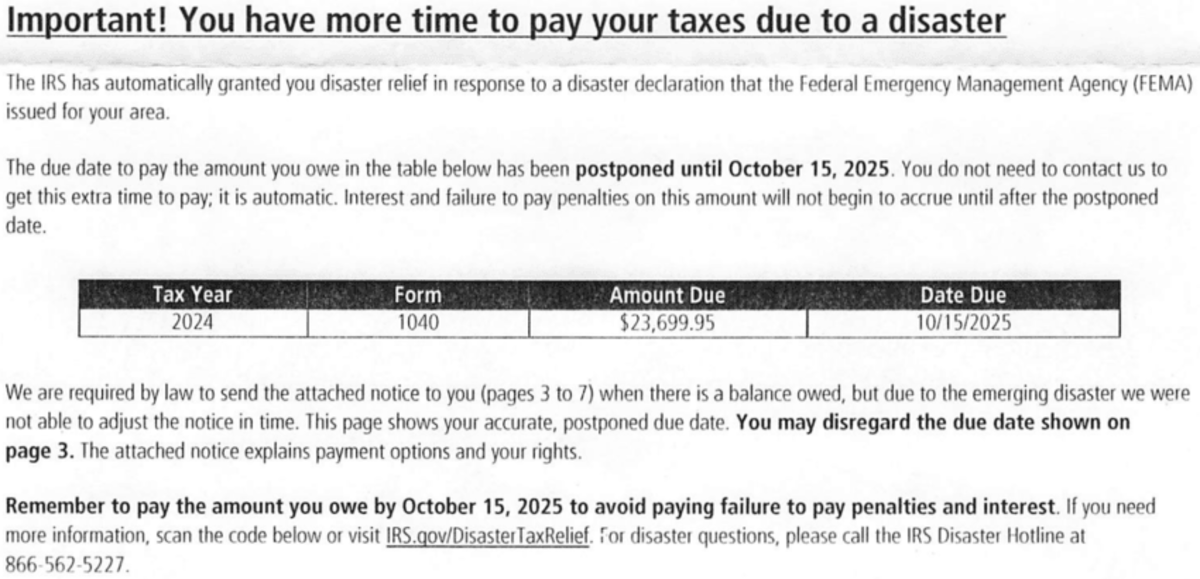
The notice opens with a cover page titled something like “Important! You have more time to pay your taxes due to a disaster.” It explains that the IRS has automatically granted you disaster relief in response to a Federal Emergency Management Agency (FEMA) declaration for your area, and that your due date to pay the balance below has been postponed — in this client’s notice, until October 15, 2025.
Interest and the failure-to-pay penalty will not accrue on this amount until after the postponed date. This is an automatic extension, so you do not need to call or apply to get it.
Tip: You do not have to do anything to activate the disaster postponement — it is applied automatically based on your address of record. If you have disaster-specific questions, the notice lists the IRS Disaster Hotline at 866-562-5227, and you can read more at IRS.gov/DisasterTaxRelief.
Part 2: Your Amount Due and Billing Summary
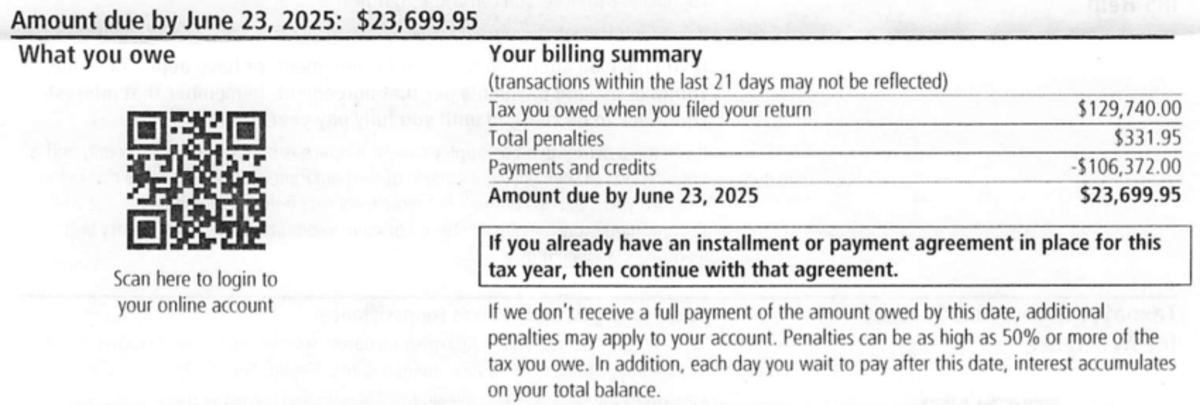
Enclosed behind the cover page is the actual CP14, which shows your amount due and a billing summary. In this client’s notice, the billing summary breaks down like this: tax owed when the return was filed of $129,740.00, total penalties of $331.95, payments and credits of -$106,372.00, for an amount due of $23,699.95.
Important: The enclosed CP14 shows its own due date (June 23, 2025 in this client’s notice). Disregard that date — the postponed date on the CP14C cover page is the one that applies to you. And if you already have an installment agreement in place for this tax year, keep making those payments as agreed.
Part 3: What the IRS Needs You to Do Right Now
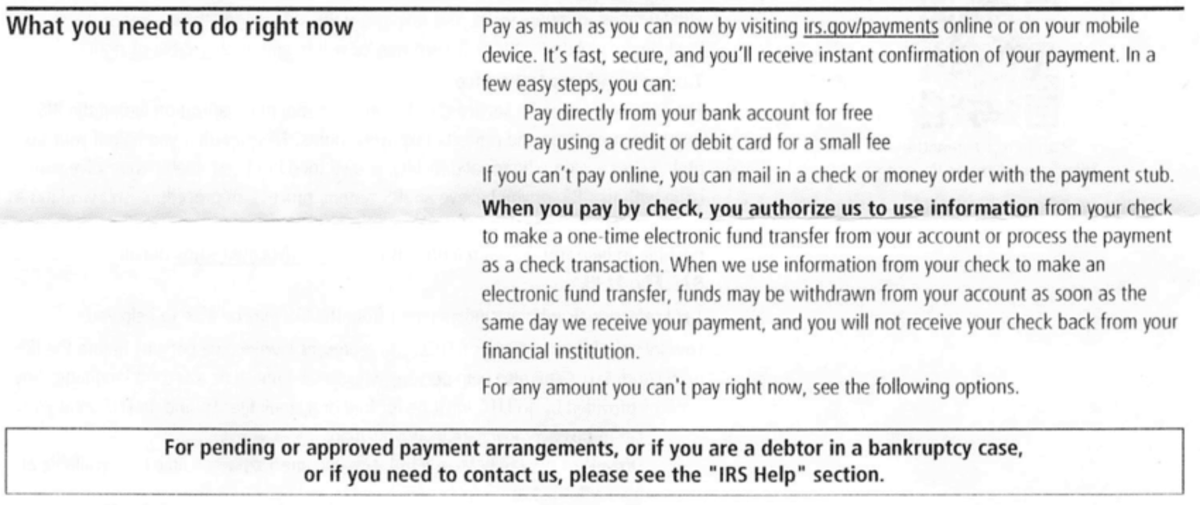
Next, the notice tells you what to do right now: pay as much of the balance as you can. You can pay online at irs.gov/payments directly from your bank account with no fee, or by credit or debit card for a small processing fee. If you cannot pay online, you can mail a check or money order with the payment coupon (more on that in Part 8).
Even though your due date is postponed, paying sooner means less that could eventually be subject to penalties and interest once the disaster relief period ends.
Part 4: Options If You Cannot Pay in Full
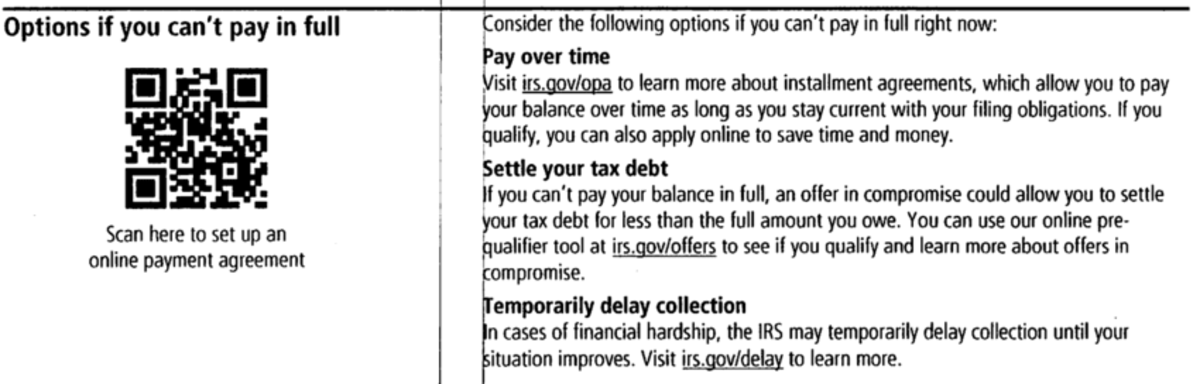
The notice then lays out your options if you cannot pay the full balance. There are three the IRS highlights:
- A payment plan (installment agreement), which lets you pay the balance off over time. You can set one up at irs.gov/opa.
- An offer in compromise, which can let you settle your tax debt for less than the full amount you owe. Learn more at irs.gov/offers.
- A temporary delay in collection (currently not collectible status), where the IRS pauses collection activity while you get back on your feet. See irs.gov/delay.
We break each of these down further below.
Part 5: IRS Help
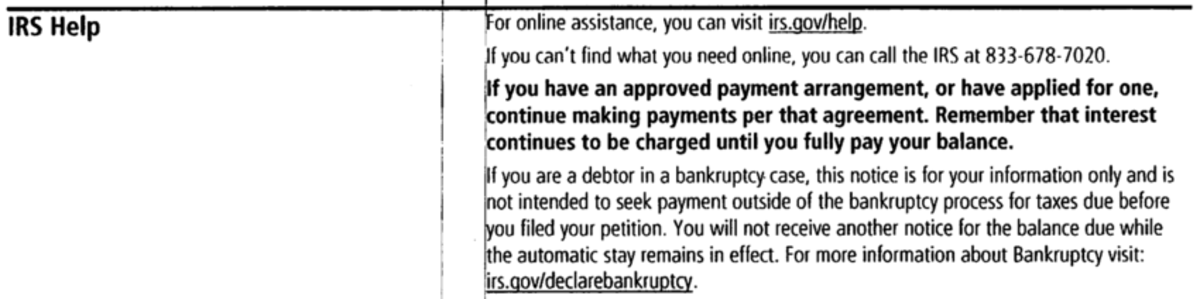
The “IRS Help” section points you to online assistance at irs.gov/help and gives a phone number to call — 833-678-7020 in this client’s notice. It also reminds you that if you already have an approved payment arrangement, you should keep paying it, and that interest continues until the balance is fully paid. If you are a debtor in a bankruptcy case, treat the notice as informational only and keep working through the bankruptcy process.
Part 6: Taxpayer Rights and Sources for Assistance
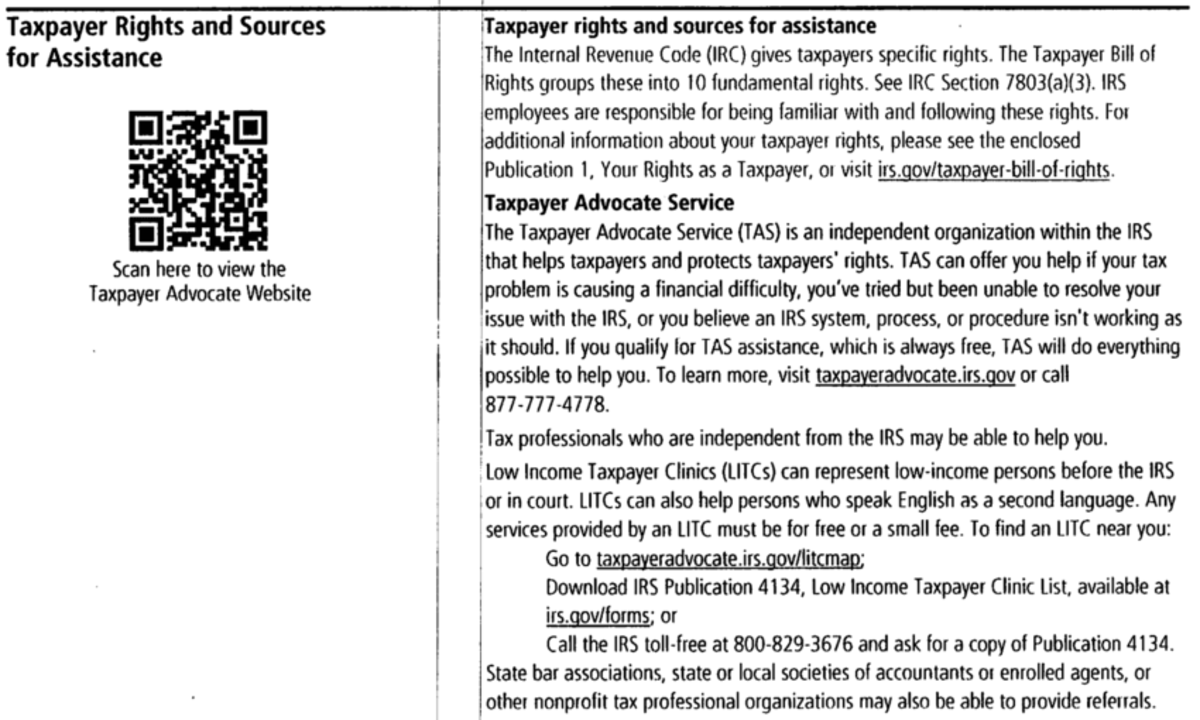
The IRS then summarizes your taxpayer rights and where to get help. The Taxpayer Bill of Rights groups your protections into 10 fundamental rights, and it is worth reviewing them so you know where you stand.
The notice also describes the Taxpayer Advocate Service (TAS) — an independent organization within the IRS that helps taxpayers resolve problems — reachable at 877-777-4778. For those who qualify, Low Income Taxpayer Clinics (LITCs) can represent you before the IRS, sometimes for free or a small fee.
Part 7: Penalties
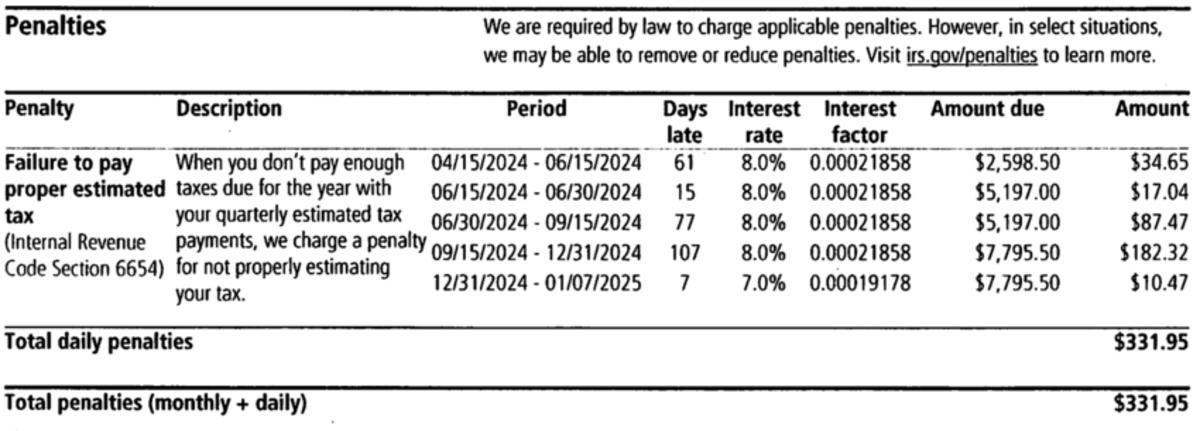
The penalties section breaks down any penalty charges on your account, showing the unpaid balance, the number of days late, the interest rate, and the amount for each period. In this client’s notice, the only penalty is a failure-to-pay-proper-estimated-tax penalty (Internal Revenue Code § 6654) totaling $331.95 — notably, there is no failure-to-pay penalty or interest yet, because the disaster relief postpones those until after the postponed date.
Tip: The IRS is required to charge applicable penalties, but many penalties can be reduced or removed through penalty abatement. It is almost always worth asking.
Part 8: Payment Coupon
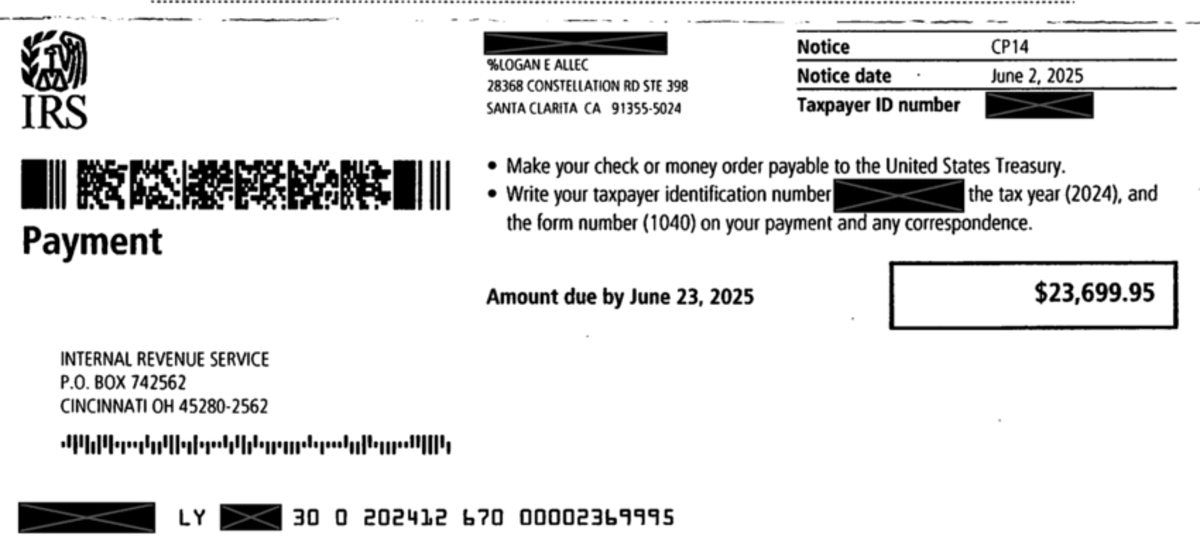
Finally, the notice includes a payment coupon for mailing in a check or money order. Make your payment out to the United States Treasury, and write your taxpayer identification number (TIN), the tax year, and the form number on it. Tear off the coupon, include it with your payment, and mail it to the address provided.
When Is a CP14C Sent?
The IRS sends a CP14C after you file a return showing a balance due, when your address of record falls within a federally declared disaster area that has active IRS relief. Rather than sending a normal CP14 with a due date you could not reasonably meet during a disaster, the IRS attaches the CP14C cover page to postpone your deadline automatically. The exact postponed date is tied to the disaster declaration for your area.
Owe the IRS? Talk to a tax expert — free.
What You Should Do If You Receive a CP14C
Here are the steps to take after a CP14C lands in your mailbox.
Step 1: Confirm You Actually Owe the IRS
Start by making sure the IRS is right. Look at the notice closely: is the math correct, and do you actually have an outstanding balance? Compare it against your filed return and your records. If everything checks out, you can move forward. If something looks off, it is your right to speak up — your account is yours to protect.
Step 1a: Dispute the Charges if the IRS Is Wrong
If there is a clear error, contact the IRS as soon as you can, usually through the phone number printed on the notice. The disaster relief gives you extra time, but you should not wait too long to raise a dispute. Be prepared to be patient and persistent — these issues are rarely resolved on the first call. Because the process can be frustrating, we call the IRS on our clients’ behalf to take that burden off their plate.
Step 2: If You Can Pay in Full, Do So
You have until the postponed date to pay without new interest or failure-to-pay penalties. If you can pay the balance in full by then and you see no errors, that is the fastest way to close the matter and keep penalties from ever starting.
Step 3: Seek Penalty Abatement From the IRS
If you cannot pay in full, consider penalty abatement, which asks the IRS to reduce or remove penalties on your account. It is worth pursuing, and it is something we always look at for our clients.
Step 4: Explore Your Tax Relief Options
If a balance remains after you have looked at the above, tax relief is on the table. That includes installment agreements, currently not collectible status (a temporary hardship pause), and the offer in compromise. Each works on a case-by-case basis, but any of them can meaningfully reduce the stress of an outstanding balance.
What Happens If You Ignore a CP14C?
The disaster postponement buys you time, but it does not last forever. Once the postponed date passes and the balance is still unpaid, interest and the failure-to-pay penalty begin to accrue, and the IRS restarts its normal collection cycle. That typically means a series of follow-up notices — first a CP501 reminder, then a CP503, and eventually a CP504 notice of intent to levy. The best move is to act on the CP14C before the postponed date, while you still have the most options and the fewest added costs.
IRS Notice CP14C Frequently Asked Questions
Is a CP14C good news or bad news?
A bit of both. It confirms you owe a balance, which is not fun — but it also tells you the IRS has automatically postponed your payment deadline because you are in a disaster area, so you have more time than a regular CP14 would give you.
Do I have to pay by the date printed on the enclosed CP14?
No. The enclosed CP14 shows an earlier due date, but you should disregard it. The postponed date on the CP14C cover page is the one that applies to you.
Will I be charged interest and penalties?
Not while the disaster postponement is in effect. Interest and the failure-to-pay penalty do not accrue on the balance until after the postponed due date, so paying by then avoids both. Any penalties already shown (such as an estimated-tax penalty) are separate and may be eligible for penalty abatement.
Do I need to call the IRS to get the disaster extension?
No. The relief is automatic, based on your address of record being in a federally declared disaster area. You do not have to call or apply for it.
What if I cannot pay by the postponed date?
You have options: an installment agreement to pay over time, an offer in compromise to settle for less than you owe, currently not collectible status to pause collection, and penalty abatement to reduce penalties. A tax relief professional can help you choose the best path.
How do I know if I am in a federally declared disaster area?
The CP14C itself confirms it, since the IRS applies the relief based on your address of record. You can also check the current list of disaster relief situations at IRS.gov/DisasterTaxRelief.

“I was quite skeptical at first, but wow, did Choice Tax Relief deliver in reducing my taxes. I owed very close to $50,000, and after their great work, I now owe the IRS less than $5,800. Folks, trust me — they really deliver beyond what I ever expected.”
Get Help Now
Got a CP14C notice? Don’t wait for the IRS’s next move.
Talk to a tax expert — free, no obligation. We’ve resolved over $20 million in IRS debt for our clients.


Author:

Logan Allec, CPA, Founder and Owner
Logan Allec has been serving taxpayers as a CPA for over 14 years. After leaving his role at a "Big 4" firm, he started Choice Tax Relief to help everyday Americans who have found themselves behind on their taxes. He also educates thousands of people daily about tax relief on his YouTube channel. In addition to his CPA license, Logan also has a Master's Degree in Taxation from the University of Southern California (USC). He lives with his wife and children in the Los Angeles area. Learn more about Logan here.