

IRS Notice CP14D: What It Means and What To Do

If you filed your tax return showing a balance owed and did not pay it in full by the deadline, the IRS mails you Notice CP14D.
It is the IRS’s first bill for the tax you reported but did not pay.
This guide walks through a real, redacted CP14D so you can see exactly what each line means.
You can view the full redacted notice here: redacted CP14D notice that one of our clients received (PDF).
By the end you will know why the penalties and interest were added and what options you have to resolve the balance.
Important: The dollar figures in this article come from one real, redacted CP14D and are shown only as an illustration.
Your own notice will list your tax year, your balance, and your due date, so always follow the numbers printed on your copy.
Key Takeaways
- What it is: the IRS’s first notice of a balance due on a Form 1040 you already filed.
- Why you got it: the tax on your return was more than the payments and credits applied to your account, and the difference was not paid by the filing deadline.
- What is in the balance: the unpaid tax, a failure-to-pay penalty under IRC §6651, an estimated-tax penalty under IRC §6654, and interest under IRC §6601.
- The deadline: pay by the date on the notice to stop additional penalties and interest from adding up.
- If you cannot pay: you can request a payment plan, an offer in compromise, or currently-not-collectible status.
- If you ignore it: the balance grows and the IRS escalates to CP501, CP503, and CP504, opening the door to liens and levies.
Table of Contents
Where the CP14D Fits in the CP14 Series
The CP14D is the redesigned “scan-and-pay” version of the IRS’s first “Notice of Balance Due,” one of several closely related CP14 notices that each carry a different letter after “CP14.”
Use the table below to see how the CP14D lines up with the other notices in the series and confirm what yours means and when the IRS sends it.
| Notice | What It Is | When the IRS Sends It |
|---|---|---|
| CP14 | The IRS's standard first bill for unpaid taxes — the most common balance-due notice it sends. | After you file a return showing a balance due and don't pay it in full by the return's due date. |
| CP14C | A CP14 issued with a disaster-relief cover page that postpones your payment deadline. | When your address of record is in a federally declared disaster area; penalties and interest are paused until the relief period ends. |
| CP14D | The same first bill in the IRS's redesigned “scan-and-pay” layout, with a QR code and resolve-your-balance boxes. | After you file with a balance due and don't pay by the due date — same meaning as a CP14, newer format. |
| CP14E | A version of the first balance-due notice, issued under IRC § 6303 just like the CP14. | After you file with a balance due and don't pay in full — in our experience, often after filing Form 1040-SR (the return for seniors). |
| CP14F | A version of the IRS's first bill in its redesigned “Notice of Balance Due” format. | After the IRS processes your return, finds the tax you reported exceeds your payments and credits, and you haven't paid the balance. |
| CP14G | Another version of the redesigned first bill for unpaid taxes. | After the IRS processes your return, sees an amount due, and doesn't receive full payment by the return's due date. |
| CP14IA | The installment-agreement version — confirms your payment plan is set up while the balance keeps accruing penalties and interest. | After you successfully set up an installment agreement (payment plan) on a balance you owe. |
| CP14J | The failure-to-pay-penalty version — your balance is unpaid tax plus a failure-to-pay penalty and interest. | After you file on time but don't pay in full, so a failure-to-pay penalty (but no failure-to-file penalty) applies. |
| CP14K | A version of the IRS's first bill, nearly identical in meaning to the CP14. | After you file a return with an amount owed and some balance remains unpaid once your payments and credits are applied. |
Free Consultation
Got a CP14D notice? Don’t wait for the IRS’s next move.
Talk to a tax expert — free, no obligation. We’ve resolved over $20 million in IRS debt for our clients.
What Is IRS Notice CP14D?
Notice CP14D is a balance-due notice in the IRS’s CP14 family.
The IRS sends it when you file a return with a balance due and do not pay that balance by the return due date.
In plain terms, you told the IRS how much you owed when you filed, the money never arrived, and this notice is the IRS asking for it.
Because it is the first notice in the balance-due sequence, a CP14D is generated automatically once your return posts to your account with an unpaid liability.
The balance-due notice program is governed by Internal Revenue Manual 5.19.1, which controls how the IRS issues and works these first-stage collection notices.
A CP14D tells you three things:
- The total the IRS says you owe.
- How that total breaks down into tax, penalties, and interest.
- The date by which the IRS wants it paid.
In substance a CP14D means the same thing as a standard CP14.
The main difference you will see is the modernized scan-and-pay layout, with a QR code and a set of resolve-your-balance boxes printed right at the top.
IRS Notice CP14D at a Glance
| Notice type | First notice of balance due (a version of the CP14) |
| What it means | You filed a Form 1040 showing tax due and did not pay it in full by the deadline |
| Amount on the notice | $34,234.90 (tax, plus §6654 and §6651 penalties and §6601 interest) |
| Typical deadline | About 21 days from the notice date |
| Main options | Pay in full, set up a payment plan, or pursue relief |
| If ignored | Escalates to CP501, CP503, then CP504 |
CP14 vs. CP14D: What’s the Difference?
The two notices carry the same core message, so it helps to see them side by side.
| IRS Notice CP14 | IRS Notice CP14D | |
|---|---|---|
| What it is | The IRS’s first notice of a balance due on a filed return. | A version of the CP14 balance-due notice with the redesigned scan-and-pay layout. |
| Why it is issued | An unpaid balance on a filed return, which may include failure-to-file, failure-to-pay, and estimated-tax penalties. | You filed a Form 1040 reporting tax due and did not pay it in full, so the balance is unpaid tax plus penalties and interest. |
| Penalties shown | Any combination that applies to your account. | Failure-to-pay under §6651 and failure-to-pay-proper-estimated-tax under §6654, with interest under §6601. |
| What comes next | CP501, then CP503, then CP504 if unpaid. | The same escalation path if left unpaid. |
| Your options | Pay, payment plan, or relief options. | Identical: pay, payment plan, or relief options. |
Why Did I Get a CP14D?
You received a CP14D because your filed return showed tax that the IRS has not been paid for.
A few common situations lead to this notice:
- You owed tax on your return and did not send a payment with it.
- Your withholding and estimated payments did not cover your total tax for the year.
- A payment you made was smaller than the balance due.
- An earlier IRS adjustment left tax unpaid on the account.
Whatever the cause, the notice reflects tax you reported, so the balance itself is rarely a surprise once you compare it to your return.
IRS Notice CP14D Explained, Part by Part
Let’s walk through this client’s notice section by section so you know exactly what you are looking at.
Part 1: The notice header
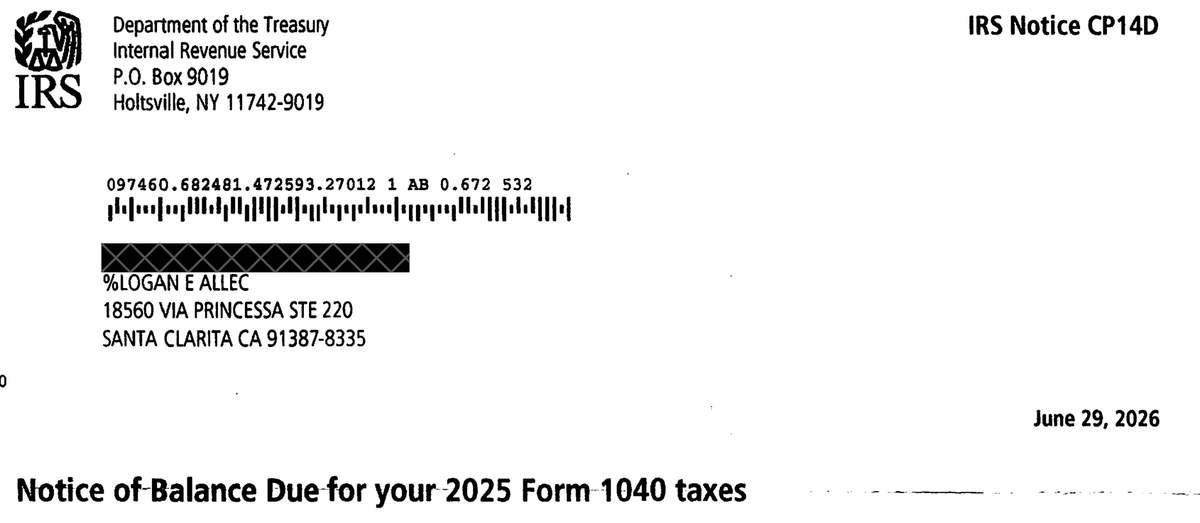
The top-left corner shows the IRS return address in Holtsville, New York.
The top-right corner names the notice as IRS Notice CP14D.
On the notice the notice is dated June 29, 2026 and covers Tax Year 2025 and Form 1040.
The notice date matters because the penalty and interest figures below are calculated up to that date.
Part 2: Total amount due and Scan & Pay

This box states the total the IRS wants and the date it wants it by.
On the notice the total amount due is $34,234.90, due by July 20, 2026.
The notice warns that additional penalties and interest will be added if the balance is not paid in full by the due date.
The QR code simply opens the IRS payment page, so there is no code to type by hand.
Part 3: How to resolve your balance
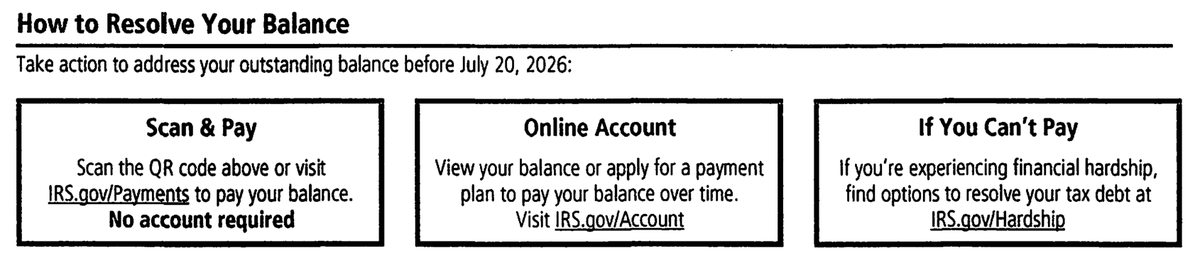
The redesigned CP14D prints your main options in three boxes.
- Scan & Pay — scan the QR code or visit IRS.gov/Payments to pay with no account required.
- Online Account — view your balance or apply for a payment plan at IRS.gov/Account.
- If You Can’t Pay — find hardship options at IRS.gov/Hardship.
These are the same options covered in more detail below.
Part 4: Your balance summary
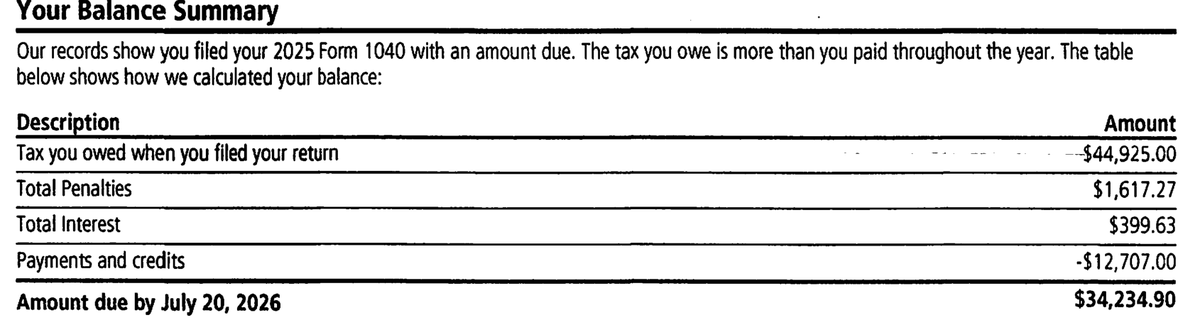
This table breaks the balance into its parts so you can see how the IRS reached the total.
On the notice it lists:
- Tax owed when the return was filed — $44,925.00
- Total penalties — $1,617.27
- Total interest — $399.63
- Payments and credits — −$12,707.00
Those figures net to the amount due of $34,234.90 by July 20, 2026.
The tax figure is the amount reported on the return, not something the IRS added.
Tip: The notice may not reflect payments made within the last 21 days, so check your IRS online account before paying again if you think you already sent money.
Part 5: Failure to pay proper estimated tax (IRC §6654)
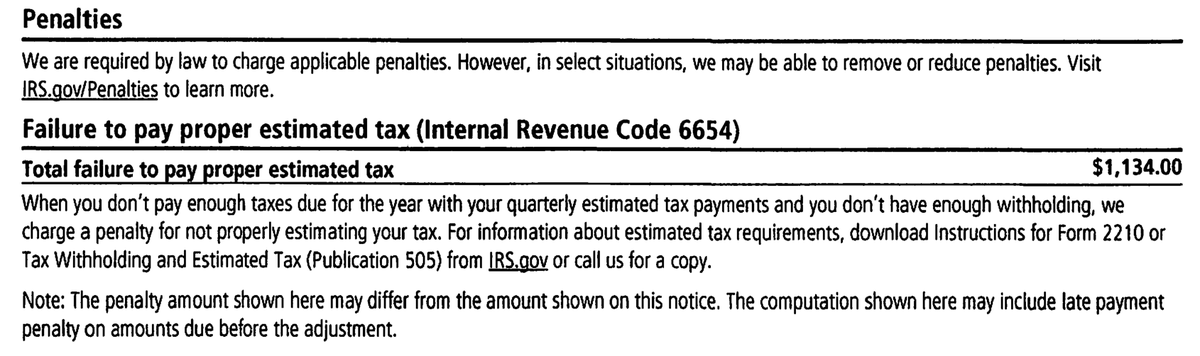
This penalty is charged under Internal Revenue Code §6654 when too little tax is paid during the year through withholding and quarterly estimates.
On the notice it totals $1,134.00.
It most often affects self-employed people and others who do not have enough tax withheld from a paycheck.
The Instructions for Form 2210 and Publication 505 explain how it is figured.
Part 6: Failure to pay (IRC §6651)

The failure-to-pay penalty is charged under Internal Revenue Code §6651 for each month or part of a month the tax goes unpaid, up to 25% of the tax shown on the return.
On the notice the notice reports:
- Unpaid amount — $32,218.00
- Months late — 3
- Penalty rate — 0.50% per month
- Penalty charged — $483.27
Because it accrues every month, the longer the balance sits, the larger this penalty grows.
Part 7: Interest (IRC §6601)
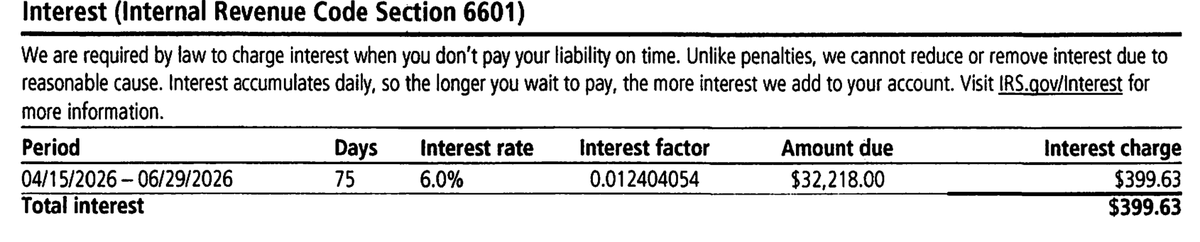
Interest is charged under Internal Revenue Code §6601 and, unlike penalties, generally cannot be removed for reasonable cause.
On the notice the interest section shows:
- Period — April 15, 2026 through June 29, 2026
- Days — 75
- Interest rate — 6.0%
- Amount interest was figured on — $32,218.00
- Interest charged — $399.63
Because interest compounds daily, it keeps growing until the balance reaches zero.
Part 8: IRS help and how to pay
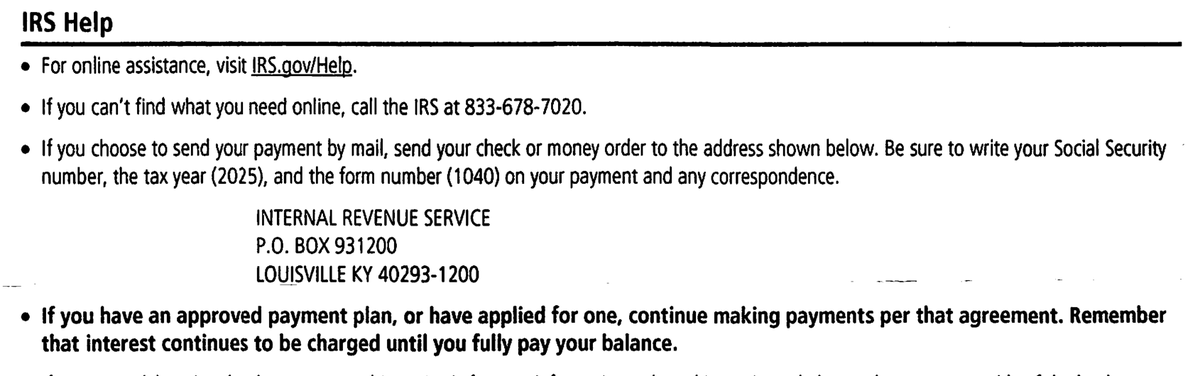
This section lists how to reach the IRS and where to send a paper payment.
For help online you can visit IRS.gov/Help.
The phone number on the notice is 833-678-7020.
If you mail a check or money order, the notice directs it to Internal Revenue Service, P.O. Box 931200, Louisville, KY 40293-1200.
Important: Write your Social Security number, the tax year (2025), and the form number (1040) on any mailed payment so the IRS credits it to the right account.
When Does the IRS Send Notice CP14D?
The IRS sends a CP14D shortly after a return posts with a balance that was not paid by the filing deadline.
For a calendar-year Form 1040, that deadline is generally April 15.
- Interest on the notice starts accruing April 15, 2026.
- The notice is dated June 29, 2026, about ten weeks later.
You will usually see a CP14D within a few weeks to a couple of months after you file with an unpaid balance.
Owe the IRS? Talk to a tax expert — free.
What to Do If You Got a CP14D
You have a clear set of options, and the right one depends on whether you can pay.
- Confirm the balance. Compare the tax figure on the notice to the total tax line on your filed return, and call the number on the notice before the due date if anything looks off.
- Pay in full if you can. Paying the balance stops the failure-to-pay penalty and interest from growing, and you can pay online at IRS.gov/Payments.
- Set up a payment plan. If you cannot pay all at once, apply for an installment agreement at IRS.gov/OPA or let us handle it through our installment agreement service.
- Explore relief if paying is a hardship. You may qualify for currently-not-collectible status or an offer in compromise to settle for less than you owe.
If you would like a licensed tax professional to review your CP14D and deal with the IRS for you, you can schedule a free consultation.
Can You Get the CP14D Penalty Removed?
In many cases, yes.
The failure-to-pay and estimated-tax penalties can sometimes be reduced or removed through penalty abatement.
You may qualify under first-time abatement if you have a clean compliance history for the prior three years.
You may also qualify for reasonable-cause relief if circumstances outside your control kept you from paying on time.
Interest is harder to remove and generally stands unless it was charged because of an IRS error or delay.
What Happens If You Ignore a CP14D
Ignoring a CP14D does not make the balance go away, and it starts the collection clock.
The IRS follows up with a predictable stream of increasingly serious notices:
- CP501 — a reminder that you still have a balance due.
- CP503 — a second, more urgent reminder.
- CP504 — a notice of intent to levy your state refund and other assets.
If the balance stays unpaid after CP504, the IRS can levy wages and bank accounts and file a federal tax lien.
Acting while the balance is still small is far easier than waiting for enforced collection.

“Very highly recommend their service! Caleb was extremely helpful and cleared up my tax issues with ease! Very friendly and knowledgeable!”
Frequently Asked Questions About IRS Notice CP14D
Is CP14D a bill?
Yes. CP14D is the IRS’s first bill for tax you reported on a filed return but did not pay by the due date. It shows the tax you owe plus any penalties and interest added so far.
Is CP14D different from a regular CP14?
Not in substance. Both are first balance-due notices for a filed return with unpaid tax. The CP14D uses the IRS’s redesigned scan-and-pay layout with a QR code and resolve-your-balance boxes, but it means the same thing as a CP14.
What happens if I cannot pay the full amount?
You have options. You can set up an installment agreement to pay over time, request currently-not-collectible status if you are facing hardship, or pursue an offer in compromise to settle for less than you owe. Interest continues to accrue on any unpaid balance.
Can the penalties on my CP14D be removed?
Sometimes. The failure-to-pay and estimated-tax penalties may be reduced or removed through penalty abatement if you have reasonable cause or a clean prior compliance history. Interest generally cannot be removed unless it was charged because of an IRS error or delay.
How long do I have to respond to a CP14D?
Pay or respond by the due date printed on the notice, which is usually about three weeks from the notice date. On the notice the notice was dated June 29, 2026 with a pay-by date of July 20, 2026.
I already paid, so why did I get a CP14D?
The notice may not reflect payments made within the last 21 days. Check your IRS online account first, and if a payment is genuinely missing, call the number on the notice before the due date with your proof of payment.
Get Help Now
Got a CP14D notice? Don’t wait for the IRS’s next move.
Talk to a tax expert — free, no obligation. We’ve resolved over $20 million in IRS debt for our clients.


Author:

Logan Allec, CPA, Founder and Owner
Logan Allec has been serving taxpayers as a CPA for over 14 years. After leaving his role at a "Big 4" firm, he started Choice Tax Relief to help everyday Americans who have found themselves behind on their taxes. He also educates thousands of people daily about tax relief on his YouTube channel. In addition to his CPA license, Logan also has a Master's Degree in Taxation from the University of Southern California (USC). He lives with his wife and children in the Los Angeles area. Learn more about Logan here.