

IRS Notice CP14K: What It Is and How to Respond

You open your mailbox, and there it is: an envelope from the Department of the Treasury.
Inside is IRS Notice CP14K, and near the top of the first page is a line you can’t miss: an amount due — with a deadline attached.
Here’s what that means: IRS Notice CP14K is the IRS’s first bill.
According to the IRS’s records, you filed a tax return with an amount owed, and — after applying all the payments and credits on your account — some of that balance is still unpaid.
The CP14K is the IRS formally telling you how much it thinks you owe, tacking on any penalties and interest that have accrued so far, and asking you to pay it by a specific date.
Here is a redacted CP14K Notice that one of our clients received.
If you’re familiar with the IRS Notice CP14 — the most common notice the IRS sends — the CP14K will look almost identical, because it’s a member of the same family.
The IRS attaches different version letters (CP14, CP14E, CP14K, and others) to this balance-due notice depending on the circumstances of the account, but the underlying message — and the response the IRS expects from you — is the same: you owe, and the clock is ticking.
In this article, I’ll walk you through a real CP14K Notice part by part, explain how the penalties and interest on it are calculated, and lay out exactly what you should do — whether you can pay the balance in full, need a payment plan, or can’t afford to pay it at all.
Key Takeaways
- IRS Notice CP14K is a Notice of Tax Due and Demand for Payment — the IRS’s first bill after you file a return with a balance that isn’t fully paid. It’s part of the same family as the standard CP14 Notice.
- The notice gives you a pay-by date — generally 21 days from the notice date — and the balance already includes any failure-to-pay penalty and interest accrued so far.
- Check the billing summary against your own records before you pay. Payments made within the last 21 days may not be reflected, and misapplied payments are one of the most common reasons a CP14-series notice is wrong.
- If you already have an installment agreement in place for the tax year on the notice, the CP14K itself says to simply continue with that agreement — but a brand-new balance can put an existing payment plan in jeopardy, so don’t assume it’s automatically covered.
- Ignoring a CP14K is expensive. Penalties and interest keep accruing, and the IRS will follow up with increasingly serious collection notices — CP501, CP503, CP504, and ultimately a final notice of intent to levy.
Table of Contents
Where the CP14K Fits in the CP14 Series
The CP14K is a version of the IRS’s first “Notice of Balance Due,” nearly identical to the standard CP14 and part of a family of closely related notices that each carry a different letter after “CP14.”
The table below shows how the CP14K compares to the other notices in the series so you can find yours and see what it means.
| Notice | What It Is | When the IRS Sends It |
|---|---|---|
| CP14 | The IRS's standard first bill for unpaid taxes — the most common balance-due notice it sends. | After you file a return showing a balance due and don't pay it in full by the return's due date. |
| CP14C | A CP14 issued with a disaster-relief cover page that postpones your payment deadline. | When your address of record is in a federally declared disaster area; penalties and interest are paused until the relief period ends. |
| CP14D | The same first bill in the IRS's redesigned “scan-and-pay” layout, with a QR code and resolve-your-balance boxes. | After you file with a balance due and don't pay by the due date — same meaning as a CP14, newer format. |
| CP14E | A version of the first balance-due notice, issued under IRC § 6303 just like the CP14. | After you file with a balance due and don't pay in full — in our experience, often after filing Form 1040-SR (the return for seniors). |
| CP14F | A version of the IRS's first bill in its redesigned “Notice of Balance Due” format. | After the IRS processes your return, finds the tax you reported exceeds your payments and credits, and you haven't paid the balance. |
| CP14G | Another version of the redesigned first bill for unpaid taxes. | After the IRS processes your return, sees an amount due, and doesn't receive full payment by the return's due date. |
| CP14IA | The installment-agreement version — confirms your payment plan is set up while the balance keeps accruing penalties and interest. | After you successfully set up an installment agreement (payment plan) on a balance you owe. |
| CP14J | The failure-to-pay-penalty version — your balance is unpaid tax plus a failure-to-pay penalty and interest. | After you file on time but don't pay in full, so a failure-to-pay penalty (but no failure-to-file penalty) applies. |
| CP14K | A version of the IRS's first bill, nearly identical in meaning to the CP14. | After you file a return with an amount owed and some balance remains unpaid once your payments and credits are applied. |
Free Consultation
Got a CP14K notice? Don’t wait for the IRS’s next move.
Talk to a tax expert — free, no obligation. We’ve resolved over $20 million in IRS debt for our clients.
IRS Notice CP14K At a Glance
| Question | Answer |
|---|---|
| What is it? | The IRS’s first bill for unpaid tax on a return you filed — a Notice of Tax Due and Demand for Payment |
| Is it a bill? | Yes. It states an amount due and a deadline — on this client’s notice, $4,299.82 due within 21 days of the notice date |
| Why did I get it? | The tax shown on your return exceeded the payments and credits on your account, leaving an unpaid balance |
| Do I need to respond? | Yes — pay by the due date, set up a payment plan, or pursue another resolution option before collection notices follow |
| What if I ignore it? | Penalties and interest keep growing, and the IRS escalates through its collection notice stream toward liens and levies |
CP14 vs. CP14K vs. CP501: What’s the Difference?
The IRS uses several closely related notices at the front end of its collection process, and it helps to know where the CP14K fits.
The standard CP14 is the IRS’s workhorse balance-due notice — the first bill sent under Internal Revenue Code § 6303, which requires the IRS to give you notice and demand for payment within 60 days of assessing a tax.
The IRS also prints variant codes on some of these first bills — CP14E, CP14H, CP14I, CP14K, and so on — reflecting internal processing differences.
The IRS’s own guidance for the CP14K mirrors its guidance for the CP14: review the notice, pay by the due date, and set up a payment arrangement if you can’t pay in full.
One feature you’ll notice on the CP14K is a prominent boxed reminder for taxpayers who already have a payment arrangement — more on that below.
If the balance goes unpaid, the CP14K won’t be the last letter you receive.
Here’s the usual sequence:
| Notice | What It Means | Your Move |
|---|---|---|
| CP14K | First bill: you filed a return with an amount owed, and a balance remains after payments and credits | Verify the numbers, then pay by the due date or get a payment plan in place |
| CP501 | First reminder that you still have a balance due | Same options — but penalties and interest have kept growing |
| CP503 | Second reminder: the IRS hasn’t heard from you | Act now, before the IRS moves to enforcement |
| CP504 | Notice of intent to levy — the IRS can seize your state tax refund and is preparing stronger action | Resolve the balance or assert your rights immediately |
After the CP504, the IRS can issue a final notice — such as an LT11 — giving it the legal green light to levy your wages and bank accounts after 30 days.
The whole point of responding to the CP14K early is to never let things get that far.
IRS Notice CP14K Explained, Part by Part
Now let’s go through an actual CP14K Notice — issued June 8, 2026, for tax year 2025 — one section at a time.
Part 1: Notice Header and Amount Due
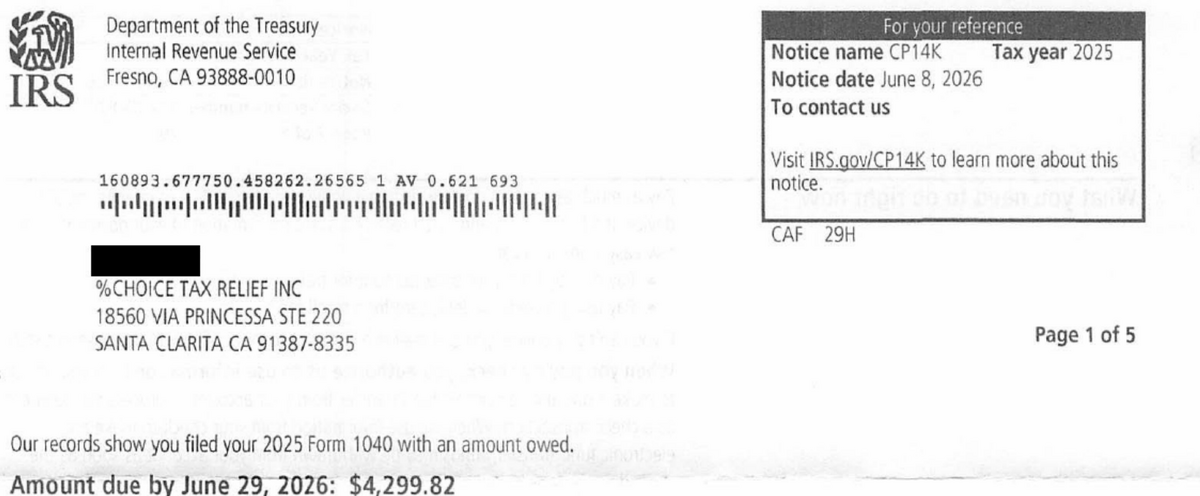
The first page opens with the basics in the “For your reference” box: the notice name (CP14K), the tax year (2025), and the notice date (June 8, 2026).
Below that is the headline that matters: “Amount due by June 29, 2026: $4,299.82.”
Notice the spacing of those dates — the due date is 21 days after the notice date.
That’s the standard window on a CP14-series notice for balances under $100,000.
(If you owe $100,000 or more, the IRS shortens the window considerably.)
The first page also states the trigger for the notice in one plain sentence: “Our records show you filed your 2025 Form 1040 with an amount owed.”
Part 2: Billing Summary
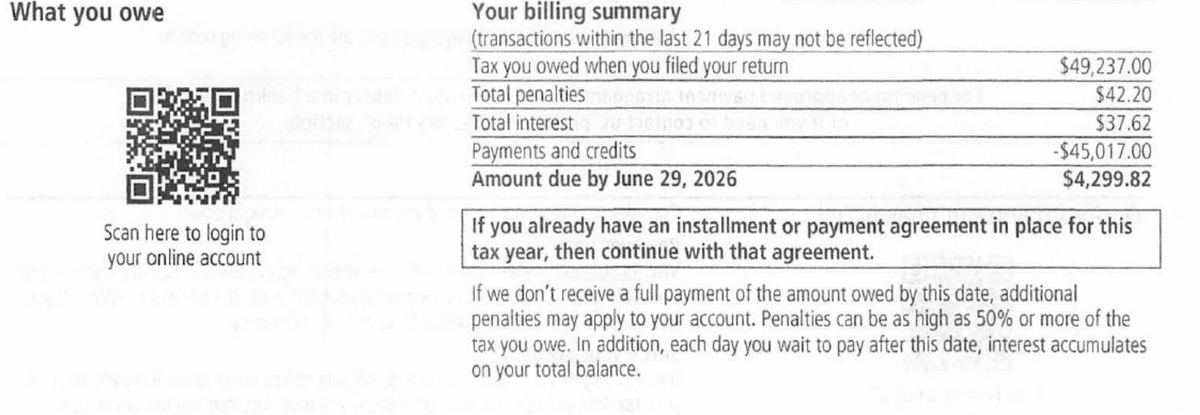
The billing summary shows how the IRS arrived at the amount due.
On this client’s notice:
| Billing Summary Line | Amount |
|---|---|
| Tax you owed when you filed your return | $49,237.00 |
| Total penalties | $42.20 |
| Total interest | $37.62 |
| Payments and credits | −$45,017.00 |
| Amount due by June 29, 2026 | $4,299.82 |
In other words, this taxpayer reported $49,237.00 of tax on their 2025 return, had $45,017.00 of withholding, estimated tax payments, and credits applied — and came up $4,220.00 short.
The remaining $79.82 of the bill is the failure-to-pay penalty and interest that accrued between the April filing deadline and the notice date (I’ll break both of those down in Parts 7 and 8).
Directly below the summary, the CP14K displays a boxed message: “If you already have an installment or payment agreement in place for this tax year, then continue with that agreement.”
So if you’ve already gotten ahead of this balance and set up a payment plan that covers it, the CP14K isn’t asking you to do anything new — just keep making your payments.
The page closes with a warning worth taking seriously: if the IRS doesn’t receive full payment by the due date, additional penalties may apply — and, in the IRS’s own words, penalties “can be as high as 50% or more of the tax you owe” — while interest accumulates each day you wait.
Part 3: What You Need to Do Right Now
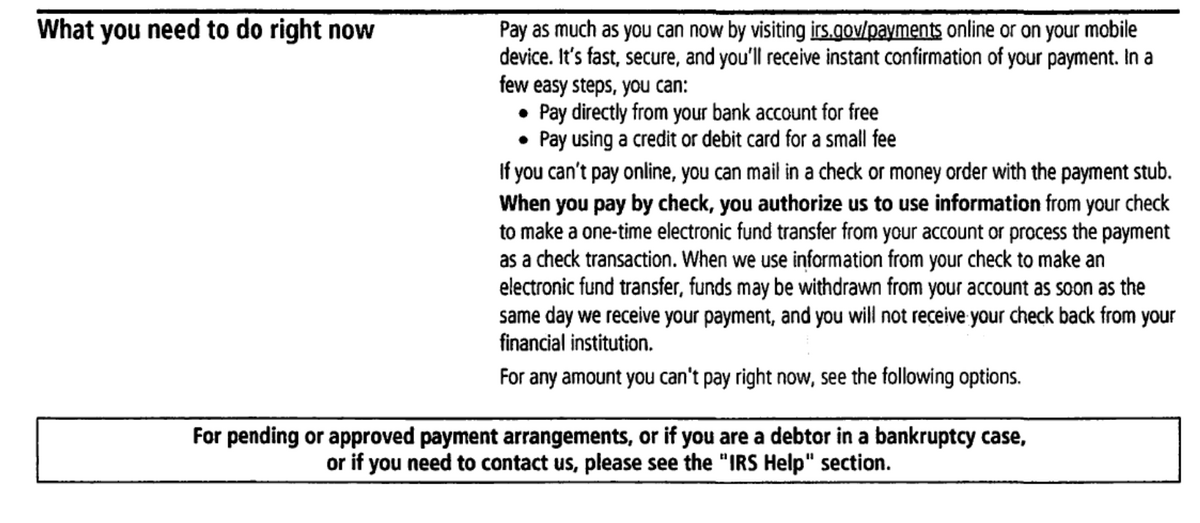
Page 2 gets to the point: pay as much as you can now at irs.gov/payments, either directly from your bank account (free) or with a credit or debit card (for a processing fee).
If you can’t pay online, you can mail a check or money order with the payment stub from the last page of the notice.
This section also includes the IRS’s standard check-processing disclosure: when you pay by check, you authorize the IRS to process it as a one-time electronic fund transfer, which means the money may leave your account the same day the IRS receives your payment.
Part 4: Options If You Can’t Pay in Full
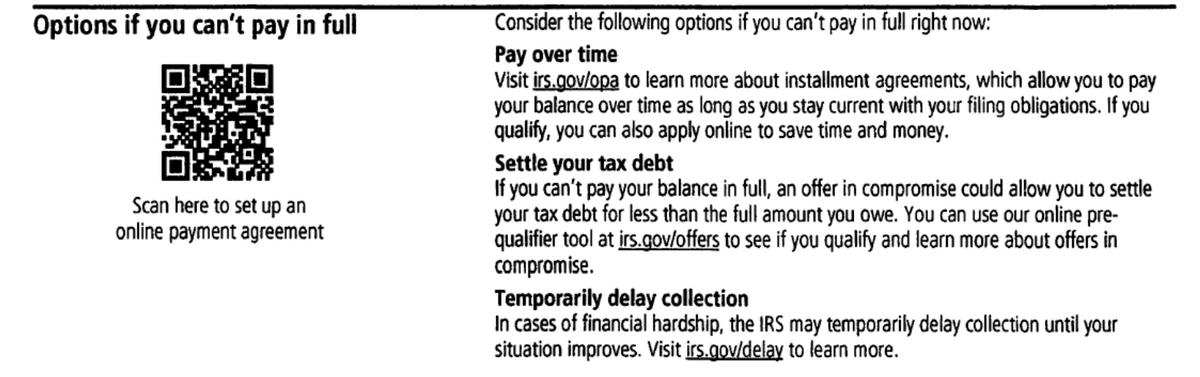
This is the most important section of the notice for anyone who opened their CP14K and felt their stomach drop.
The IRS lays out three paths:
- Pay over time. An installment agreement lets you pay your balance monthly, as long as you stay current with your filing obligations. Most taxpayers can apply online in minutes at irs.gov/opa.
- Settle your tax debt. An offer in compromise allows qualifying taxpayers to settle their tax debt for less than the full amount owed. The IRS’s pre-qualifier tool at irs.gov/offers gives you a first read on whether you might be a candidate.
- Temporarily delay collection. In cases of financial hardship, the IRS may mark your account currently not collectible and pause collection until your situation improves.
Part 5: IRS Help
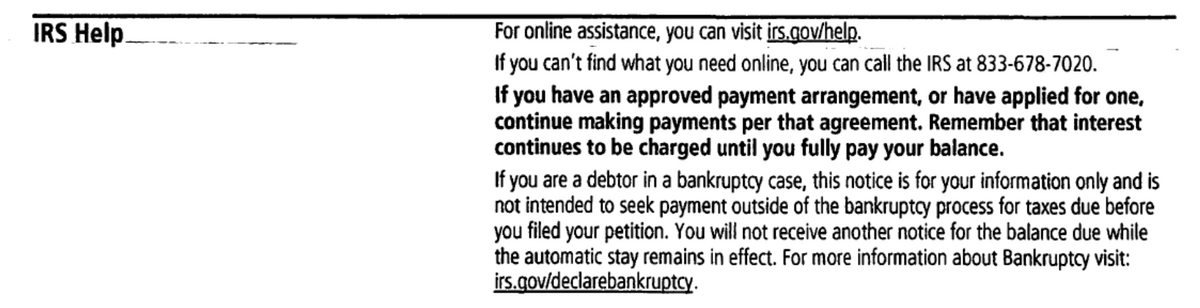
The IRS Help section lists the contact channels — online help at irs.gov/help, or the phone number printed on the notice (833-678-7020 on this client’s notice).
Two situations get special mention here:
- Approved or pending payment arrangements: keep making payments per your agreement, and remember that interest continues to accrue until the balance is fully paid.
- Bankruptcy: if you’re a debtor in a bankruptcy case, the notice is informational only — it isn’t an attempt to collect outside the bankruptcy process for pre-petition taxes, and the automatic stay pauses further balance-due notices.
Part 6: Taxpayer Rights and Sources for Assistance
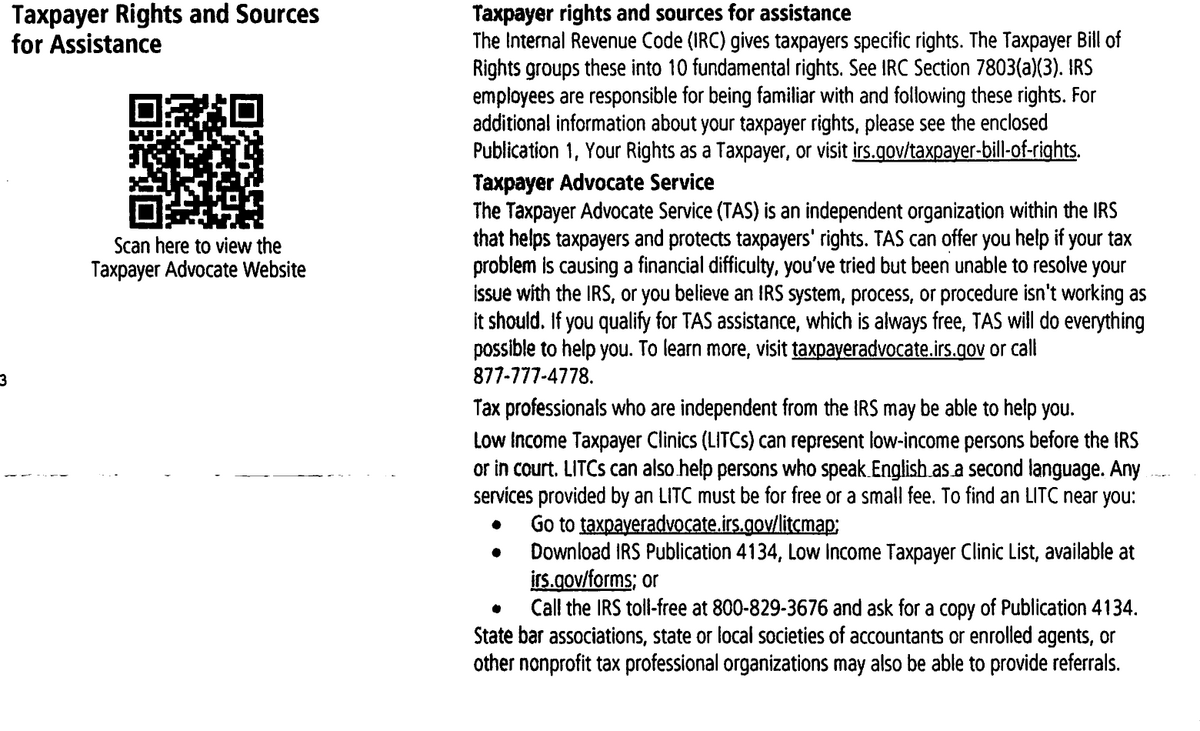
Page 3 reminds you that you have rights in this process.
The Taxpayer Bill of Rights groups them into 10 fundamental rights, and the Taxpayer Advocate Service (TAS) — an independent organization within the IRS — can step in for free if your tax problem is causing financial difficulty or the normal IRS channels aren’t working.
The notice also points lower-income taxpayers to Low Income Taxpayer Clinics (LITCs), which can represent you before the IRS for free or a small fee.
Part 7: Failure-to-Pay Penalty
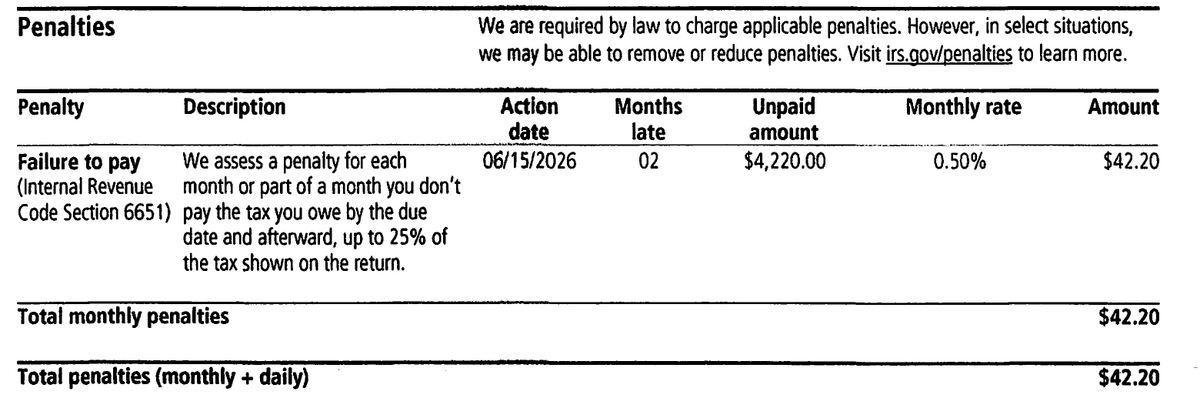
Here’s where the IRS shows its penalty math.
Under Internal Revenue Code § 6651, the failure-to-pay penalty runs at 0.5% of the unpaid tax for each month (or part of a month) the balance goes unpaid after the due date, up to a maximum of 25%.
On this client’s notice: $4,220.00 of unpaid tax × 0.5% × 2 months = $42.20.
The “months late” count is 2 because the payment deadline was April 15, 2026, and by the June notice the balance was into its second month of delinquency — and remember, a partial month counts as a whole month for this penalty.
The notice also notes that in select situations the IRS may remove or reduce penalties.
That’s not an empty promise: if you have a clean compliance history, first-time penalty abatement is often available for the failure-to-pay penalty, and reasonable-cause relief may be available in hardship situations.
Part 8: Interest
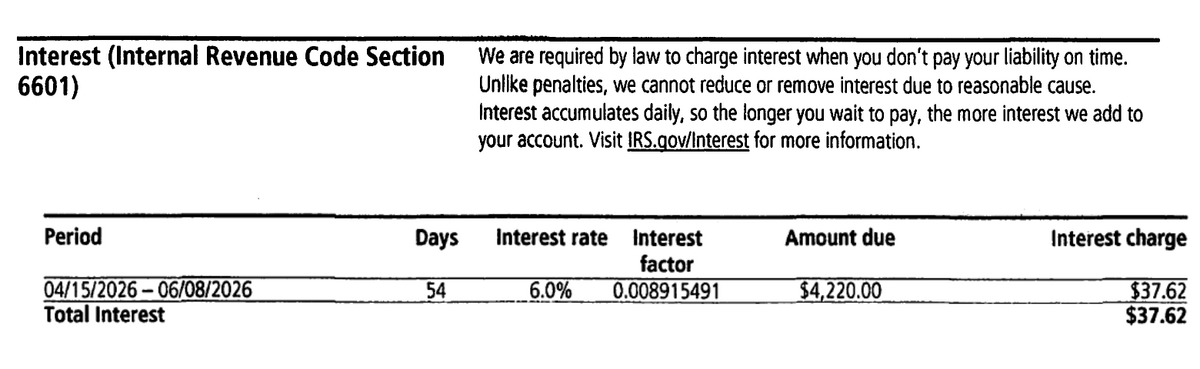
Under Internal Revenue Code § 6601, interest runs on any unpaid tax from the return’s original due date until the day the balance is paid — and unlike penalties, the IRS generally cannot waive interest for reasonable cause.
Interest also compounds daily.
This client’s notice charges interest at a 6% annual rate on the $4,220.00 unpaid balance for the 54 days from April 15, 2026 (the payment deadline for a 2025 return) through June 8, 2026 (the notice date), producing an interest charge of $37.62.
Note that the meter didn’t start at the notice date — it started at the April deadline, which is why a bill that arrived in June already has interest on it.
Part 9: Payment Coupon
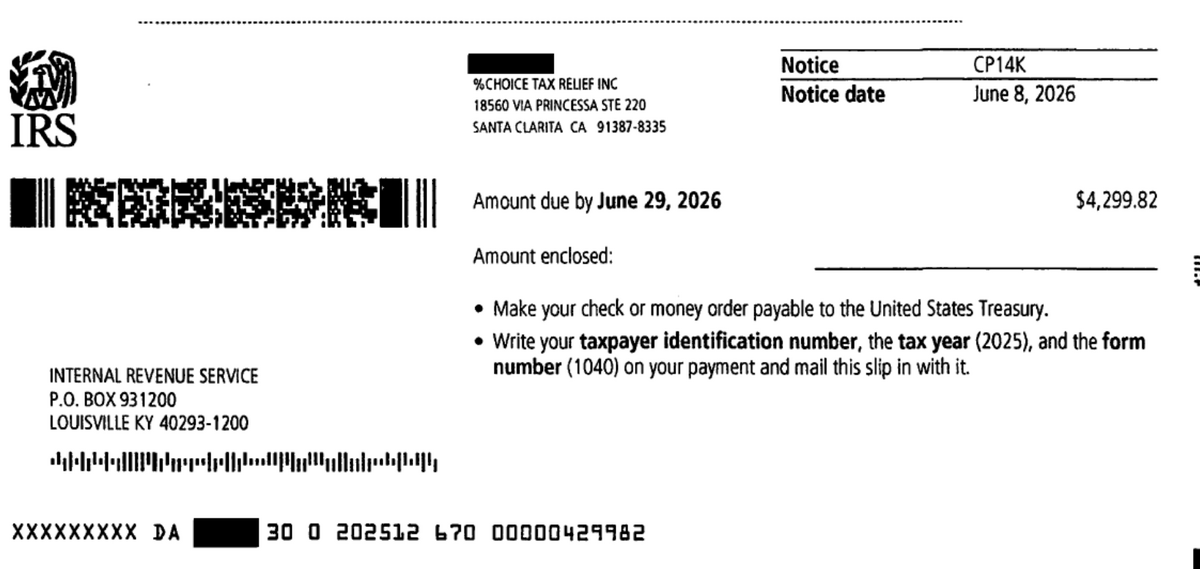
The last page is a detachable payment coupon for anyone paying by mail.
Make your check or money order payable to the United States Treasury, write your taxpayer identification number, the tax year (2025), and the form number (1040) on the payment, and mail it with the coupon to the address shown — on this client’s notice, an IRS payment processing center in Louisville, Kentucky.
When Does the IRS Send Notice CP14K?
The CP14K goes out shortly after the IRS processes a return showing an amount owed that wasn’t fully paid.
Under Internal Revenue Code § 6303, the IRS must issue notice and demand for payment within 60 days of assessing the tax — and for most individual filers, assessment happens when the return is processed during filing season.
That’s why CP14-series notices arrive in waves in late spring and early summer: file in April with a balance you didn’t fully pay, and the first bill typically lands in your mailbox in May or June.
This client’s notice CP14K, covering a 2025 Form 1040, is dated June 8, 2026 — right on schedule.
Owe the IRS? Talk to a tax expert — free.
What Should You Do After Receiving Notice CP14K?
Here’s the game plan I recommend to clients who receive a CP14-series notice.
Step 1: Verify That the Balance Is Right
Before you pay anything, pull out your copy of the return and compare it to the billing summary.
Does the “tax you owed when you filed” line match your return?
Are all of your payments — withholding, estimated payments, extension payments, and anything you sent with the return — reflected in the payments-and-credits line?
Log in to your account at irs.gov/account to see your current balance and payment history.
If a payment you made is missing or was applied to the wrong tax year — a surprisingly common problem — call the number on the notice with proof of payment before the due date.
Step 2: Pay What You Can by the Due Date
If the balance is correct and you can pay it, pay it by the due date at irs.gov/payments and be done — full payment within the window stops the penalty and interest meters entirely.
Can’t pay all of it?
Pay as much as you can anyway.
Both the failure-to-pay penalty and interest are calculated on the unpaid balance, so every dollar you pay now shrinks what the meters run on going forward.
Step 3: Already Have an Installment Agreement? Read the Fine Print
The CP14K’s boxed message says that if you already have an installment or payment agreement in place for this tax year, you should continue with that agreement.
That’s straightforward as far as it goes.
But here’s the trap I see taxpayers fall into: they have an existing installment agreement covering prior years, a new balance shows up on this year’s return, and they assume the new year just rides along.
It doesn’t.
A new unpaid balance can put your existing agreement into default.
If that’s your situation, contact the IRS (or have your tax professional do it) to amend your agreement to include the new year before the IRS treats the new balance as a broken promise.
Step 4: Can’t Pay? Get a Payment Plan in Place
If you need time, set up an installment agreement — ideally before the due date on the notice.
Most individual taxpayers who owe $50,000 or less (combined tax, penalties, and interest) can use the online payment agreement tool at irs.gov/opa and get an answer immediately, without financial disclosures.
An added bonus: while an installment agreement is in effect, the failure-to-pay penalty rate is cut in half, from 0.5% to 0.25% per month.
Step 5: Can’t Afford Payments at All? Look at Relief Options
If your financial situation is such that even monthly payments would leave you unable to cover basic living expenses, you have options beyond a standard payment plan:
- Offer in compromise: settle the debt for less than the full amount if your income and assets genuinely can’t cover it. Learn how we approach these in our offer in compromise practice.
- Currently not collectible status: the IRS pauses collection during genuine hardship (the balance remains, and interest continues, but the IRS stops demanding payment).
- Penalty abatement: first-time abatement or reasonable-cause relief can strip penalties off the balance even if the tax itself must be paid.
IRS Notice CP14K: Frequently Asked Questions
What is IRS Notice CP14K?
IRS Notice CP14K is a balance-due notice — the IRS’s first bill after you file a tax return with an amount owed that isn’t fully covered by your payments and credits. It shows the tax you reported, the payments applied to your account, any penalties and interest accrued so far, and the total amount due by a stated deadline.
Is a CP14K different from a regular CP14 Notice?
Not in any way that changes what you should do. The IRS prints different version letters (CP14, CP14E, CP14K, and others) on its first-bill notices to reflect internal processing differences, but the IRS’s guidance is the same for each: verify the balance, pay by the due date, or set up a payment arrangement if you can’t pay in full.
Why did I get a CP14K if I already made payments?
Two common reasons: your payments didn’t cover the full tax shown on your return, or a payment is missing from your account — perhaps applied to the wrong tax year. Also note that payments made within 21 days before the notice may not be reflected. Check your payment history at irs.gov/account and call the number on the notice if something is missing.
I already have an installment agreement. Do I need to do anything?
If your existing agreement covers the tax year on the notice, the CP14K itself says to continue with that agreement. But if the notice is for a new year not included in your agreement, contact the IRS to amend your agreement — a new unpaid balance can default an existing payment plan.
What happens if I don’t pay my CP14K by the due date?
The failure-to-pay penalty (0.5% per month, up to 25%) and daily-compounding interest keep accruing, and the IRS follows up with escalating collection notices — CP501, CP503, and CP504 — leading to a final notice of intent to levy, after which the IRS can garnish wages and levy bank accounts.
Can I settle the balance on my CP14K for less than I owe?
Possibly. If your income and assets can’t realistically cover the debt, an offer in compromise may allow you to settle for less than the full amount. The IRS’s pre-qualifier tool at irs.gov/offers gives a first read, and in hardship cases the IRS can also pause collection entirely under currently-not-collectible status.

“I did a lot of research and spoke to multiple companies that help with tax resolution. I’m glad I chose Choice Tax Relief. They are very knowledgeable and professional.”
Get Help Now
Got a CP14K notice? Don’t wait for the IRS’s next move.
Talk to a tax expert — free, no obligation. We’ve resolved over $20 million in IRS debt for our clients.


Author:

Logan Allec, CPA, Founder and Owner
Logan Allec has been serving taxpayers as a CPA for over 14 years. After leaving his role at a "Big 4" firm, he started Choice Tax Relief to help everyday Americans who have found themselves behind on their taxes. He also educates thousands of people daily about tax relief on his YouTube channel. In addition to his CPA license, Logan also has a Master's Degree in Taxation from the University of Southern California (USC). He lives with his wife and children in the Los Angeles area. Learn more about Logan here.